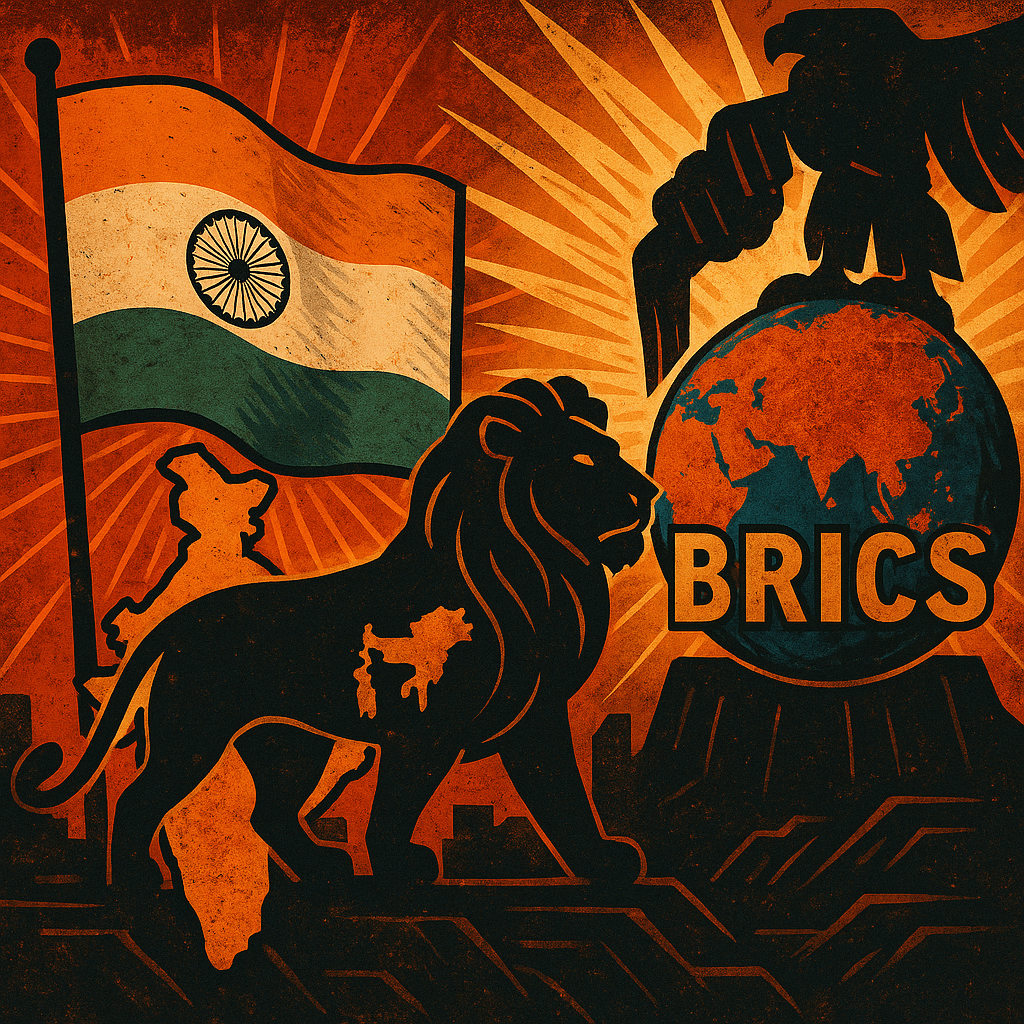
From BRICS+ summitry to strategic subservience, India’s fractured path reveals a deeper class conflict—between imperial integration and revolutionary sovereignty.
By Prince Kapone | Weaponized Information | July 31, 2025
Between Summits and Shackles: India’s Place in a Multipolar World
In the age of multipolarity, some seats at the table come padded with illusions. India, with its booming population, fast-growing GDP, and a flag planted firmly in the BRICS+ bloc, often presents itself as a sovereign actor rising to claim its rightful place in a reordered world. The headlines echo with ambition: the world’s largest democracy, a regional powerhouse, a strategic bridge between East and West. But peel back the curtain of official proclamations and diplomatic theater, and another India appears—less sovereign titan, more subordinate contractor in the imperial firmament. What stands exposed is not an emerging great power, but a deeply contradictory formation: a neocolonial state managing a comprador economy, presiding over mass impoverishment with the polished accent of global managerialism.
It is no accident that as Brazil declares open defiance to U.S. tariff coercion and Russia deepens its anti-dollar agenda, India remains locked in cautious silence—hedging, calculating, maneuvering. This is not the silence of strategic ambiguity; it is the silence of structural dependence. India’s position in BRICS+ is not the same as that of China, nor even Brazil. It is not anchored by revolution, nor rooted in sovereign economic capacity. It is, instead, the result of a political class and bourgeoisie that never severed the umbilical cord of colonial capital but learned to drink from its poisoned breast while waving the national flag. This is the central contradiction of India in 2025: a postcolonial power that walks like a giant but lives on the leash of global finance, techno-authoritarian surveillance, and military pacts engineered in Washington.
The condition of this contradiction is historical. British colonialism did not merely extract wealth—it reordered the social anatomy of India itself. It privatized land, empowered landlords, and fused caste hierarchy with capitalist accumulation. It left behind a political economy built on exclusion, control, and comprador collaboration. After independence, the Congress-led ruling bloc—rather than upend this foundation—cemented it. They built a developmentalist state, yes, but it was one that outsourced transformation to technocrats, subsidized monopolies, and suppressed the revolutionary energies of peasants and workers. Agrarian reform became Green Revolution; redistribution was postponed for growth; the slogans of self-reliance masked the realities of dependency. Sovereignty was spoken, but not enacted.
In the mirror of the global system, India presents a spectacle of contradictions. It leads G20 summits while millions of its citizens live in medieval conditions. It signs nuclear deals with the United States while evicting Adivasis from ancestral forests for mining contracts. It celebrates the rise of billionaires even as informal laborers starve beneath collapsing flyovers. This is not simply a developmental failure—it is the product of a class alliance structured to reproduce exploitation. The Indian bourgeoisie is not a nationalist class in the historical sense. It is a comprador class: middleman capitalists, data butlers to the empire, service contractors to Silicon Valley, pharmaceutical exporters to the imperial core. They do not seek rupture. They seek higher margins within the system that feeds them.
So when Trump threatens tariffs against Indian exports, or when BRICS+ talks of de-dollarization, the Indian state stammers. It wants to sit at both tables: that of the imperial master and the multipolar resistance. It dreams of mediating between Washington and Beijing, reaping rewards from both. But such dreams are fast dissolving in the acid of reality. The United States does not tolerate true neutrality, and BRICS is moving beyond symbolic opposition toward structural detachment. India, trapped by its own contradictions, may soon be forced to choose. And unless its people force the issue from below—through peasant insurgency, working-class mobilization, and Dalit assertion—the choice will be made by those whose wealth and power depend on continued subservience to the empire.
The Colonial Skeleton Beneath the Tricolor
To understand India’s ambiguity on the world stage today, one must begin with what was never dismantled. British colonialism did not simply exploit India—it reshaped it, encoded a new social software into its institutions, and left behind a deeply entangled architecture of extraction, caste supremacy, compradorism, and bureaucratic control. Unlike revolutions that upended their old orders, India’s 1947 moment was not a rupture but a negotiated inheritance. Power was transferred, but the social foundations of colonial capitalism were preserved. Zamindars became lawmakers, ICS officers became civil servants, and the new bourgeoisie emerged not from the crucible of national revolution but from the boardrooms of Tata, Birla, and Godrej—men who shook hands with Empire even as they wrote patriotic speeches for its funeral.
Samir Amin called it out with surgical clarity: India’s postcolonial state never confronted its colonial skeleton. It grafted a “national bourgeois plan” onto the body of imperial accumulation and declared it sovereign. But a body stitched together from feudal landlords, caste hierarchs, and foreign-aid–fed technocrats cannot walk toward liberation—it limps in circles. The land question, the foundational battleground of real decolonization, was buried under the fantasy of trickle-down Green Revolution. The peasant was told to farm better, not to own what he tilled. The Dalit was given a seat in Parliament but denied access to land, capital, and dignity. Instead of leveling the caste-class pyramid, the state built stairs between its floors—and called that democracy.
The consequences of this refusal to break are all around us. India’s economy remains structurally informal, agrarian labor remains dispossessed, and the cities swell with a precarious proletariat choking on smog and stagnant wages. The IT sector may shine for the Western press, but it floats on the backs of millions who live without social security, union rights, or even clean water. And behind it all, caste continues to function as the subterranean logic of accumulation—determining who is born to serve and who is born to profit. The Indian capitalist class, fattened on state subsidies, private monopolies, and export contracts, sees no reason to risk the wrath of empire or the rebellion of its own underclass. Its freedom was never meant for the people—it was meant for business.
This is why India’s inclusion in BRICS is not the same as its integration into multipolarity. Multipolarity requires the assertion of sovereignty—of breaking with the terms of imperialist globalization. But the Indian state has shown no appetite for such risk. When Russia pushes for de-dollarized trade and China advances alternatives to the IMF, India clings to its U.S. defense pacts and foreign capital inflows. It celebrates “strategic autonomy” even as it hosts military exercises with the Pentagon. Its leaders give speeches on civilizational pride while importing surveillance tech from Israel and borrowing hedge fund capital from Wall Street. This is not non-alignment—it is neocolonial balancing, where the leash may change hands, but the collar stays fastened.
And yet, beneath this cynical theater of national power, the contradictions are fermenting. The farmers’ uprising, the resurgence of Dalit assertion, the radical persistence of Maoist struggles in the tribal belts—these are not fringe movements. They are the suppressed voice of a nation whose majority has been written out of its own future. The real question facing India in 2025 is not whether it will rise as a great power, but whether its people will tear down the scaffolding of this fraudulent rise and build something worthy of the name freedom. Until then, every summit attended by Indian elites is haunted by the specter of unfinished revolution—and every handshake they offer to imperial capital is signed in the blood of the masses they still refuse to liberate.
The Contractor Class and the Mirage of Sovereignty
India’s ruling class does not dream of sovereignty—it dreams of scalability. Its ambition is not liberation from imperialism, but a better seat at its table, preferably near the tech titans and hedge fund managers. What poses as nationalism in Delhi is often just a culturally repackaged form of compradorism—wrapped in saffron, sold as civilization, but paid for in foreign capital and enforced by a caste-policed hierarchy. And what passes for global leadership is, more often than not, the refined labor of an elite contractor class: managing code for Silicon Valley, producing cheap generics for Big Pharma, policing the streets of occupied Kashmir with Israeli weapons, and signing joint naval exercises with the very empire it once claimed to resist.
This is the class that rose in 1991, when the Indian state opened its doors to global capital and buried what remained of the Nehruvian compromise. The bureaucrat gave way to the consultant; the trade unionist was replaced by the start-up founder; public health crumbled while private hospitals blossomed. In the eyes of the world, this was liberalization. In the eyes of the masses, it was enclosure. India did not build sovereignty; it built a mall on the ruins of its welfare state and handed the keys to McKinsey, Ambani, and Bezos. The national bourgeoisie, if such a thing ever existed, was now a service-sector appendage of imperialism—globalized in capital, Anglicized in taste, but provincial in its hunger for power over its own working class.
This class now speaks the language of multipolarity—but only so far as it expands its market share. It attends BRICS summits, yes, but never without checking whether the dollar is still stable. It rails against Western hypocrisy in speeches, then takes its family to London for medical checkups and Ivy League admissions. It flirts with China for trade, Russia for oil, and the U.S. for security guarantees. What it seeks is not exit from the imperial order, but optimized inclusion within it. A better algorithm, not a better world.
Yet multipolarity is not a branding strategy—it is a battlefield. China’s push for de-dollarization, Russia’s defiance of NATO, Brazil’s assertion against Trump’s tariffs—these are not symbolic gestures. They are material ruptures with a global order in crisis. And in this unfolding drama, India’s posture is untenable. It cannot simultaneously uphold the U.S. Indo-Pacific strategy and build solidarity with the Global South. It cannot host Pentagon warships in the Indian Ocean while claiming to lead a decolonial future. The contradictions are not merely ideological—they are structural, economic, and geopolitical. And the longer they are ignored, the more violently they will erupt.
Already, the pressure is mounting. The working poor—deprived, dispossessed, and drowning in debt—are stirring. The Dalits and Adivasis, long relegated to the margins, are asserting their place in history with sharpened clarity. The farmers who once fed empires now blockade highways in defense of their right to survive. This is not discontent—it is the early murmur of rupture. And no amount of data dashboards, investment expos, or ceremonial diplomacy can suppress it for long. For the empire may offer contracts to the ruling class, but it offers only chains to the rest. And the Indian masses have never worn chains quietly.
Bandung or Bondage: The Forked Road Ahead
There comes a moment in every nation’s history when the mask of pragmatism can no longer hide the reality of subjugation. For India, that moment is now. The era of playing both sides—of speaking multipolarity while serving the unipolar master—is rapidly closing. Trump’s tariff threats, China’s geopolitical assertiveness, Russia’s strategic patience, and Brazil’s renewed sovereignty push have all exposed the hollowness of India’s balancing act. You cannot be both the servant and the sovereign. You cannot straddle the fence when the house is on fire.
India must now decide: will it walk the path of Bandung, or will it deepen its bondage? The Bandung Conference of 1955, forged by the firebrands of decolonization, was a call for real sovereignty—a political, economic, and cultural break with the architecture of colonialism. But that call was abandoned in India not long after Nehru made it. The comprador bourgeoisie, in alliance with imperial capital and caste authority, abandoned the revolutionary road for the comfort of managerial integration into the world system. Today, the slogans of “Atmanirbhar Bharat” (self-reliant India) ring hollow, not because the idea is wrong—but because the class speaking it is incapable of realizing it. You cannot build sovereignty with servants of Wall Street.
The only force capable of realizing the Bandung promise today is not the Indian state—it is the Indian people. The peasantry that has been criminalized and expropriated. The working class that toils without contracts or protections. The Dalits and Adivasis who have never been given a nation to believe in. The youth who are told to compete globally while eating rationed grain at home. This is the social base of real multipolarity—not summits of elites, but mass insurgency from below. Not soft power diplomacy, but hard-won transformation.
The contradictions will not resolve themselves. Either India will break with its neocolonial structure—its caste-bolstered comprador economy, its IMF-calibrated fiscal policy, its Zionist-imported surveillance apparatus, its militarized appeasement of the West—or it will collapse into a deeper crisis of legitimacy, repression, and internal fracture. This is not alarmism. It is the logic of history. Systems that straddle contradictions without resolving them are systems waiting to fall.
The battle lines are already drawn. One path leads toward deepened subservience—a digital colony ruled by corporate conglomerates and cultural fascists, where the flag is waved but the country is owned. The other path is littered with sacrifice, yes—but it leads to a truly sovereign India, aligned with the Global South, de-dollarized, de-casted, de-imperialized, and directed by the needs of its people. The question is not whether India will become a “great power.” The question is: whose power, and for whom?
The Earthquake Beneath the Elephant
Beneath the surface of India’s diplomatic choreography and its carefully marketed growth story, something far more seismic is taking shape. The cracks in the foundation are not cosmetic—they are structural. They trace their lineage through British colonialism, postcolonial compromise, neoliberal betrayal, and the ongoing alliance between caste supremacy and capital accumulation. The polite fiction of India as a rising superpower in a multipolar world is sustained only by suppressing this deeper reality: that the majority of Indians remain shackled to a system that enriches the few and disciplines the many, all under the surveillance of imperial finance, Silicon Valley, and domestic repression.
The Indian state can no longer pretend neutrality in a world that is itself choosing sides. It cannot align militarily with Washington while claiming solidarity with BRICS+. It cannot crush peasant uprisings while speaking the language of sustainable development. It cannot celebrate Ambedkar’s birthday while imprisoning Dalit activists. It cannot trade in rubles and renminbi while hoarding dollars and weapons from Lockheed Martin. The contradictions are piling up, and they are not theoretical—they are combustible.
If India’s ruling bloc continues its current trajectory—clinging to the status of imperial subcontractor while managing dissent through censorship and communal division—it will not lead the Global South; it will betray it. And it will not uplift its people; it will burn their futures to keep the illusions of greatness alive. But if the masses—peasants, workers, youth, Dalits, Adivasis—can converge in a revolutionary bloc from below, then another future becomes possible. One where India doesn’t just attend multipolar summits but helps build a multipolar world founded on justice, land, bread, dignity, and emancipation.
As the dollar system creaks and the old empire lashes out, the time for hedging is over. In 2025, India stands not at the center of a global realignment, but at the edge of a political reckoning. It can continue pretending that sovereignty can be subcontracted to the same imperial order that stole it—or it can ignite the long-deferred fire of revolutionary transformation. The earthquake is coming either way. The question is whether India will be its victim—or its author.
 Weaponized Information
Leave a comment