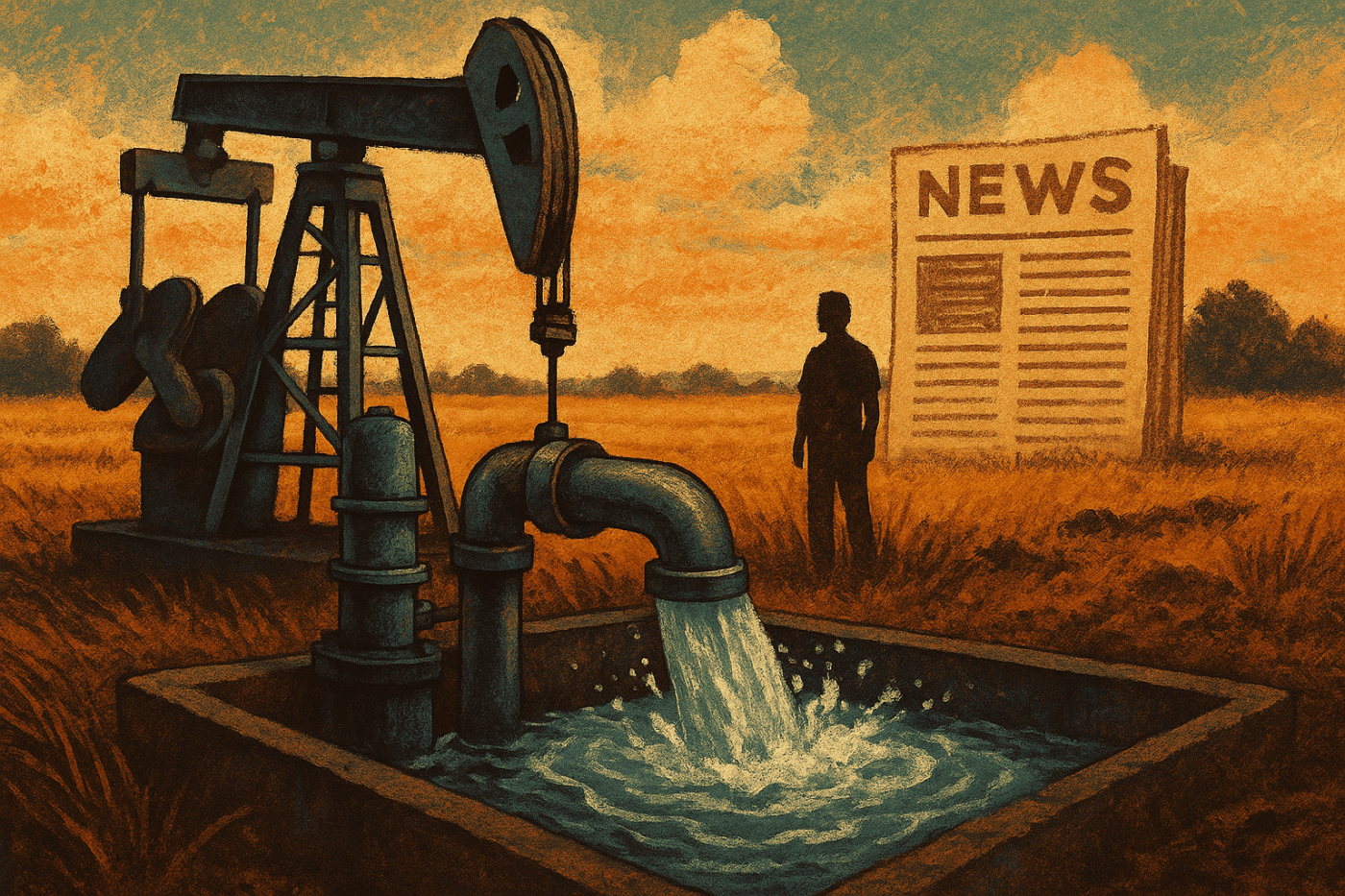
A Dallas financier eyes 16 billion gallons a year from the Carrizo-Wilcox Aquifer. Residents sound the alarm, but Texas law protects the pump, not the people. The media neutralizes outrage with polite technocracy. This is water war by paperwork—and the empire calls it development.
By Prince Kapone | Weaponized Information
July 30, 2025
The Law of the Pump: How the Empire Writes Property Over the People
By Weaponized Information | July 30, 2025
On July 29, 2025, the Texas Tribune put out a sterilized dispatch by Jess Huff under the headline: “East Texans condemn Dallas millionaire’s plan to pump 16 billion gallons of their groundwater to other parts of the state — every year.” The headline postures as concerned, but the body of the article plays the old game. It shuffles between local discontent and elite entitlement, then lands—right on cue—in obedient worship of property law. No shock. No fury. Just the ritual theater of American journalism doing its part in the great quiet war of enclosure.
Jess Huff, one of the regional scribes of nonprofit credibility, doesn’t write like someone trying to uncover power. She writes like someone cosigning it. There’s no class line drawn, no challenge issued—only the polite choreography of quoting people who don’t own the land while letting the people who do call the tune. Her writing dons the mask of neutrality but delivers the verdict of hierarchy: power speaks, and we transcribe.
The Texas Tribune, where Huff hangs her credentials, pretends to balance the scales. But the scales are rigged, and the balance is funded. Backed by donor-class foundations and technocratic gatekeepers, the Tribune isn’t in the business of defending the commons—it’s in the business of narrating their disappearance in the language of contracts and consultants. The article doesn’t expose—it inventories. What was filed, when, under what clause, with which permission slip. The question isn’t who controls the water. The question is whether they filed the right form.
This is how propaganda works in the empire: not with lies, but with narrative discipline. There are five tools in the journalist’s kit that do the job. First, legal sanitization. Readers are told—without blinking—that “Texas law largely allows landowners to do what they want with the groundwater beneath them.” No historical context, no moral interrogation. Just the gospel of settler law, treating the looting of aquifers like an innocent quirk of regional jurisprudence. Theft is made invisible by writing it into the rules.
Second, emotional minimization. Locals speak, yes—but their voices are flattened. We hear worry, not rage. Their testimony is framed as ambient anxiety, not organized resistance. What could be a political confrontation is rendered as mood lighting. The prose doesn’t shout. It doesn’t even whisper. It merely nods, as if noting the weather.
Third, technocratic mystification. The reader is introduced to aquifers as “sponges” and the pumping as a “verification process.” We are not supposed to see dispossession. We’re supposed to see science. Consultants speak with the authority of engineers, and so the crime disappears behind the language of measurements. Hydrology replaces hegemony. Colonization wears a lab coat.
Fourth comes preemptive deflection. The article reassures us that Bass is “only seeking permission to study the aquifer.” Ah yes, just a study. Just a tap on the glass. Nothing to worry about—yet. By isolating the present moment from the future plan, the article turns resistance into overreaction. Alarm is cast as irrational, because the disaster hasn’t happened—yet. But anyone who’s lived through capitalist development knows the script: first the study, then the seizure.
Fifth, and most fatal, is the use of juridical framing as moral closure. Terms like “property rights” and “rule of capture” are treated as laws of physics, not artifacts of conquest. There is no space for residents to question the ethics of the arrangement. The law is not just the terrain—it’s the endpoint. If it’s legal, it’s just. And if it’s just, you’re a fool for complaining. That’s how empire writes its crimes into the ledgers of legitimacy.
In the end, the article doesn’t defend Kyle Bass. It doesn’t have to. It defends the system that makes Kyle Bass possible. A billionaire’s theft of common water becomes an administrative curiosity. A community’s cry for justice is footnoted beneath the sacred text of private ownership. And the whole apparatus of extraction—the pipelines, the permits, the propaganda—is buried beneath a tone of polite detachment. The truth doesn’t matter. What matters is that the empire’s paperwork is in order.
Extraction Without Consent: The Silent Architecture of Resource Plunder
The Texas Tribune’s write-up reads like the literary equivalent of a pipeline—pressurized, directional, and tightly sealed. It delivers just enough data to appear informative while diverting attention from the larger truth: that Kyle Bass’s so-called “exploratory” venture is not some innocent study of the Earth’s rhythms—it’s a precision-calibrated land and water heist. According to the article, Bass—via his firm Conservation Equity Management—has quietly snatched up 11,000 acres in East Texas, laying plans to drill over 40 high-capacity wells across Anderson, Houston, and Henderson counties. The anticipated yield? 15.9 billion gallons of groundwater annually. In capitalist terms: liquidity.
Bass’s legal umbrella of choice is the “rule of capture”—an old settler-state doctrine from 1904 that grants landowners the right to pump as much water as they please from under their feet, neighbors be damned. The Texas Supreme Court blessed this arrangement again in Edwards Aquifer Authority v. Day (2012), declaring that groundwater is a private property interest. With that ruling, Wall Street got the green light to treat aquifers like oilfields. It’s not just water anymore—it’s capital waiting to be abstracted, speculated, and sold.
The article nods politely to the fact that Houston County—where Bass wants to drill 15 of his wells—has no groundwater conservation district. That’s not a footnote. That’s the play. In Texas, no district means no oversight. No permits, no production limits, no community say-so. The Texas Water Development Board confirms Houston County is one of the last free-fire zones in the Carrizo-Wilcox region—fertile ground for extraction without consent.
While the article floats the language of “study” and “exploration,” it fails to place this in the context of financialization. Since 2020, water itself has been commodified on the open market. The CME Group’s Nasdaq Veles California Water Index lets hedge funds bet on the future price of water like it’s corn or crude oil. As Bloomberg noted, this was the first time water entered the futures market—an obscene milestone. Now, financiers like Bass are syncing land acquisitions with this speculative frontier. It’s not about stewardship. It’s about stockpiles.
The article briefly gestures at fears of subsidence—land sinking triggered by groundwater depletion—but omits the full history of this ecological crisis. In the Houston–Galveston region, unregulated groundwater pumping during the mid‑20th century caused land to drop by as much as six to seven feet in areas like the Ship Channel. This crisis led the Texas Legislature to establish the Harris‑Galveston Subsidence District in 1975, charged with regulating water withdrawal and preventing further collapse. According to the U.S. Geological Survey, over 80 percent of documented land subsidence in the United States is due to the compaction of aquifer systems from groundwater extraction—making it the nation’s leading cause of sinking terrain. A recent satellite-based study published in Nature Cities and reported by the Houston Chronicle confirmed that Houston is the fastest-sinking major U.S. city, with over 40 percent of the city subsiding faster than 5 mm/year and about 12 percent sinking at rates exceeding 10 mm/year—driven largely by groundwater overuse (with oil and gas activity contributing). Yet the Tribune downplays this as a mild “concern,” treating land collapse like just another administrative variable rather than a systemic collapse under capital.
Most glaringly, there is no mention of the Carrizo‑Wilcox Aquifer’s recharge rate. This is not a minor detail—it’s the heart of the matter. According to the Texas Water Development Board’s recharge report, the Carrizo‑Wilcox is a semi-confined aquifer with highly variable recharge rates that depend heavily on rainfall, soil type, and vegetative cover. In many counties across East Texas, the annual natural recharge is estimated between 0.1 to 5.8 inches per year—a figure often insufficient to meet extraction volumes associated with industrial or speculative pumping operations. Add Bass’s projected withdrawals to this fragile system and you’re staring down the barrel of long-term aquifer depletion. But you’d never know that from reading the Tribune. No challenge to the assumption of endless supply. No hydrological critique. Just another quiet nod to the gospel of extraction.
The Tribune also ignores a deeper global pattern: the rise of private equity colonization of ecological infrastructure. The “Driving Dispossession” report from the Oakland Institute delivers a damning account of how private investors, financial institutions, and governments promote land, water, and mineral privatization under the guise of development—often dispossessing communities in the process. Complementing this, the Conservation Finance overview (synthesizing industry case studies) documents how conservation capital—often deployed by private equity—masks extractive outcomes as ecological restoration. While Bass’s firm brands itself with “ecological restoration,” this pattern shows that such rhetoric frequently cloaks transformation into resource extraction for profit. Capital in camouflage.
So let’s not get it twisted. This isn’t a quirky Texas water rights story. It’s not a legal footnote. It’s a case study in the 21st-century enclosure of life itself. What we’re seeing is the weaponization of property law, the financialization of basic survival, and the state’s complicity in treating aquifers as portfolio holdings. The land is being monetized. The water is being claimed. And what’s called “conservation” is really just extraction, sanitized and sold back to us as sustainable development. Kyle Bass isn’t conserving East Texas—he’s asset-stripping it in real time.
Enclosure Rebooted: Groundwater Seizure as Technofascist Counterinsurgency
To truly read the Texas Tribune’s coverage of Kyle Bass’s water grab is to rip off the polite mask of legality and stare directly into the face of empire. What the article delicately calls a “study,” and what Bass markets as an “opportunity,” is, in truth, a textbook example of Neocolonial Extractivism. Bass isn’t extracting water—he’s extracting power. Sovereignty. Life. He is reprogramming East Texas into a new kind of sacrifice zone, paved with court rulings and covered in consultant jargon. The strategy isn’t new. It’s the same one billionaires use when buying up farmland, hijacking seed supply chains, or snatching up global water rights under the camouflage of “data-driven sustainability.” The plantation logic hasn’t vanished. It’s just been digitized and buried deep beneath legal code.
The Tribune’s role here is no mystery. It doesn’t report the theft—it rehearses it. The theft becomes a process, the process becomes policy, and policy becomes truth. This is what Technofascism means at the level of media: domination not by brute force, but by neutral tone. The reader is led calmly through a forest of permits, modeling projections, and geology charts—but never through class struggle, never through ecological theft, never through the violent machinery of accumulation. The story performs a sleight of hand. Empire is laundered in lowercase. It’s not occupation, it’s “hydrological verification.” Not seizure, but “administrative review.” And through this linguistic fog, resistance is anesthetized. You are not asked to rise. You are asked to sit down and read.
The contradictions are grotesque. Bass claims environmental stewardship while draining a fragile, semi-confined aquifer. He clutches Texas’s settler-era “rule of capture” to justify extraction, all while branding his venture “Conservation Equity.” But this is no accident. It’s the blueprint of Lawfare—the strategic deployment of the legal system to privatize what was once held in common. The rule of capture is not a harmless legal oddity. It is a settler war tactic dressed up as jurisprudence. It transforms the theft of water into a “right,” and the community that depends on it into a legal afterthought. The Tribune reports it like a weather update: neutral, natural, inevitable.
But let’s not be fooled. That aquifer is not just geology. It is a political battleground. It is memory, inheritance, and necessity—being converted into speculative asset. Just as Bill Gates’s farmland empire locks in control over food systems and land prices—as exposed in Kyrie Is Right, Gates Owns the Plantation—Bass’s groundwater empire is designed to turn water into leverage. Not nourishment, but collateral. The people who rely on the aquifer are not participants—they’re obstacles. Unless they resist. Then they become targets.
The framing of residents as “concerned” but never furious, as testifying but never resisting, is not just a narrative choice—it is a mode of containment. The people of East Texas are allowed to appear in the story, but only as background noise. Their objections serve to dramatize the process, not to derail it. They are rendered legible only in their passivity. This is Technofascist Consolidation: a fusion of hedge fund capital, settler property law, and environmental data modeling into a unified class infrastructure of dispossession. As global capital exhausts external frontiers, it turns inward—enclosing water tables, forests, aquifers, and mineral basins. What the empire once seized through gunboats, it now reclaims through spreadsheets. The aquifer, like the plantation before it, is not being studied. It is being claimed.
Make no mistake: this is not about hydrology. It’s about domination. The goal is not just to drain the aquifer. It is to lock communities out of control over their own reproduction. As laid bare in Land Grabs and Red Scares, this is not some foreign conspiracy. It is a homegrown operation of capitalist consolidation. Wall Street doesn’t care about your party affiliation—it cares about extraction without resistance. And as white working-class rural communities—long lulled into settler privilege—begin to face the same plunder that’s ravaged Indigenous, Black, and migrant lands for centuries, the ruling class adjusts. They call the theft patriotism. They call the looting investment. And they expect you to thank them for the privilege of your own extinction.
What we need is not just water reclamation—but a revolutionary standpoint. The standpoint of the global peasantry, the dispossessed, the colonized within and beyond U.S. borders. The standpoint of those who can feel the drought in their mouths and see the corporate logos on the horizon. As we wrote in the Kyrie essay: “The plantation has Wi-Fi now.” So does the aquifer. Ownership is virtualized, mapped, bundled, collateralized. Extraction doesn’t arrive in uniforms—it arrives in PowerPoints.
So it falls to us to rupture the narrative. To say what the newspaper won’t. The “rule of capture” is not law—it is legalized looting. The environmental impact study is not science—it is a sales pitch to investors. The news article is not journalism—it is ideological sedation. And the “Dallas millionaire” is not some eccentric capitalist—he is a warlord with spreadsheets instead of soldiers. If we are to reclaim what has been taken, we must first reclaim our language. Because what’s at stake isn’t just groundwater. It’s the right to live on your feet, not die on your knees. Silently.
From East Texas to Everywhere: Reclaiming the Commons, One Well at a Time
This isn’t just a quarrel over a few wells in East Texas. It’s a trench line in a global war over the meaning of life itself. When Kyle Bass drills into the Carrizo-Wilcox Aquifer, he’s not just reaching for water—he’s probing the threshold of consent. He’s asking how far capital can go before we push back. Bass is no aberration. He’s the prototype. A venture capitalist with a spreadsheet for a sword. And the people of East Texas? They’re not just casualties. They’re on the front line of a counteroffensive against the monetization of being.
We raise our fists in full-throated solidarity with the East Texas Water Protectors, Indigenous climate warriors, and all frontline rural and colonized communities standing against the seizure of the land under their soles and the aquifers beneath their homes. From the protectors of Mauna Kea to the defenders of Thacker Pass, their resistance isn’t romantic—it’s revolutionary. It’s not symbolic—it’s material. It’s not optional—it’s necessary.
And while the empire tightens its grip, the multipolar world is beginning to rupture its narrative chokehold. In Chile, even though the Constitutional Convention’s attempt to constitutionally protect water failed, the demand itself cracked the silence. In Mexico, campesino collectives have reoccupied land under the banner of Recuperación, refusing to live as tenants on stolen ground. These are not isolated cases. They are coordinates on a global map of reawakening. From Cochabamba to Palestine, from Standing Rock to Santiago—people are saying no to commodified survival. And yes to life.
Here’s what we can do from inside the beast’s belly:
- 🎯 Campaign Target: Demand the disqualification of Conservation Equity Management and Kyle Bass from all state contracts and development projects. Launch petitions, direct pressure campaigns, and public confrontations targeting Texas county commissioners and state legislators. Challenge the rule of capture in the courts and in the streets.
- 💻 Proletarian Cyber Resistance: Build and distribute a public-facing Water Extraction Map tracking hedge fund water acquisitions across the country. Use open-source mapping tools to trace land ownership, permits, and shell firms. Turn spreadsheets into scandals.
- 🏴 Mutual Aid + Logistical Solidarity: Fundraise for East Texas households whose wells have already gone dry. Organize water delivery programs, distribute test kits, and commission independent hydrogeological studies to counteract corporate lies with people’s science.
- 🧠 Political Education: Launch a teach-in series titled “Whose Water? Whose Law?” bringing together land defenders, Indigenous organizers, hydrologists, and abolitionist lawyers. Publish toolkits on resisting water privatization and defending the commons under settler law. Host it everywhere—online, on the land, and inside occupied institutions.
The water is ours. The land is ours. The memory is ours. But none of it will be handed back. We will have to take it. Kyle Bass may think he’s drilling for liquid assets, but what he’s struck is something far more dangerous to his class: the revolutionary reservoir of human dignity. And that, comrade, runs deeper than any aquifer he could ever measure.
 Weaponized Information
Leave a comment