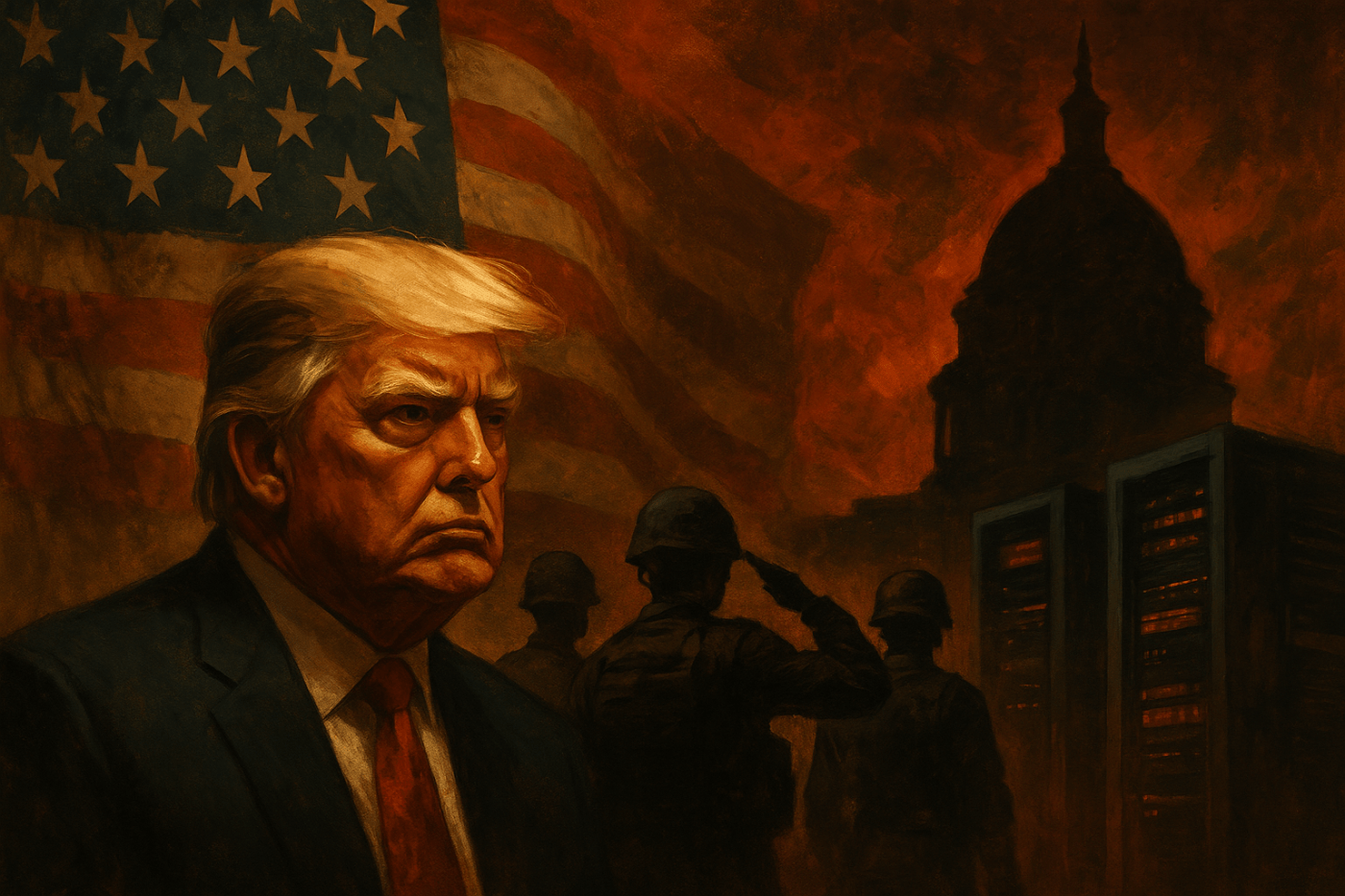
The Pentagon’s think tank withdrawal is not a pause—it’s a purge to enforce loyalty and silence dissent. Politico’s coverage masks this authoritarian turn with bureaucratic language and selective omission. What looks like retreat is actually a technofascist realignment of imperial control. To resist it, we must build revolutionary infrastructure, from propaganda to digital counter-power.
By Prince Kapone | Weaponized Information | July 28, 2025
The Silence of the Generals: When Empire Closes Its Mouth
On July 24, 2025, Politico ran a deceptively sterile article by Jack Detsch titled “Pentagon suspends participation in think tank events”, reporting that the Department of Defense—under the watch of Defense Secretary Pete Hegseth—had pulled out of all national security think tank engagements “until further notice.” It framed this as a bureaucratic adjustment, a simple pause in public appearances, rather than what it truly is: a purge.
Just one week earlier, the Pentagon abruptly cancelled its participation in the Aspen Security Forum, citing “the evil of globalism,” a line ripped straight from the Steve Bannon–Claremont Institute playbook. The article notes this, casually, as if the language of fascism hasn’t already been stitched into the Pentagon’s press releases.
The narrative it presents is cool, procedural, and apolitical—deliberately so.
Who is Jack Detsch, and what ideological labor is he performing here Detsch is not a reporter in the muckraking tradition. He is a career stenographer for the U.S. national security state—previously writing for Foreign Policy and Al-Monitor, outlets that serve as laundered mouthpieces for Pentagon insiders, defense contractors, and CIA-adjacent analysts. His beat is not “foreign policy,” but imperial perception management. He quotes uncritically, frames selectively, and retreats into ambiguity at key moments. In this article, he reproduces a regime shift in military doctrine as a minor scheduling update—because that is what the functionary class does when empire molts into a more brutal form.
And what of Politico itself? It is not neutral ground. Since its acquisition by German megacorp Axel Springer SE, Politico has codified its editorial loyalty to NATO, transatlantic capitalism, and what it euphemistically calls “Western democratic values.” Springer’s code of conduct requires staff to affirm support for Israel and the European Union, and to treat “free markets” as a sacrosanct principle. Its business model is to report on empire from inside the imperial boardroom. Politico does not question the legitimacy of the Pentagon, nor the Aspen Institute, nor the global architecture of U.S. war-making—it merely narrates the disagreements between factions within it.
The article itself is a masterclass in manufactured dullness. Detsch notes that the Pentagon’s public affairs office will now require all talking points to be preapproved, and that senior officials are banned from attending long-standing conferences like the Halifax International Security Forum. But nowhere does he examine the why. Nowhere does he interrogate the phrase “the evil of globalism,” nor connect it to the sweeping technofascist project consolidating under the Trump regime 2.0. He simply states that the Pentagon is reassessing which forums “align with administration values,” as if that phrase doesn’t carry the chill of a counterinsurgency doctrine.
This is propaganda by omission, and each omission serves a distinct function. By framing this decision as administrative rather than ideological, Detsch obscures the fascist content of the move. By leaving the phrase “globalism” unexamined, he legitimizes its conspiratorial deployment as a
nationalist dog whistle. His reliance on passive voice—“it was not immediately clear why Halifax had been singled out”—functions as deliberate disorientation, cognitive smog meant to dull the senses just as the regime launches its most decisive attacks.
Detsch also deploys the tactic of false equivalence, suggesting that the Pentagon and Aspen are in a disagreement of values, as if one is not a state military machine and the other a mouthpiece of it. The suggestion that both are “guests” at a table of ideas is farcical. Aspen does not exist to challenge the Pentagon—it exists to amplify it. But for the Trump regime, amplification is not enough. It demands absolute loyalty. In this new configuration, even ideologically adjacent institutions must be vetted, subordinated, or discarded.
Finally, the article lets fascist language sit unchallenged in the frame. “The evil of globalism” is repeated without quotation marks, context, or clarification. It is presented as a legitimate evaluative term—despite its lineage in white nationalist forums, anti-Semitic conspiracy theory, and MAGA campaign rallies. This is the quiet normalization of fascism via stenographic journalism.
In short, Detsch’s article does not report on a fascist policy—it collaborates in its rollout by laundering it in bureaucratic banality. He performs the role of every well-behaved imperial scribe before him: render the purge boring, make the repression procedural,
and above all, never name the regime for what it is. But we will.
Facts Behind the Firewall: What the Article Refused to Say
Let us begin with what the Politico article actually says. According to the report, the Department of Defense, under the direction of Trump appointees, has suspended all participation in think tank and research events as of July 23, 2025. The Pentagon’s Public Affairs Office is now vetting all future public appearances and requiring pre-approval of remarks and talking points. This directive applies to all active-duty military officers, senior enlisted leaders, and civilian officials across the Department of Defense.
The article further notes that the ban includes participation in the Aspen Security Forum, the Halifax International Security Forum, and possibly others like Sea Air Space and Modern Day Marine. This shift is said to reflect concerns about alignment with the Trump regime’s “values,” and follows language from Defense officials condemning the “evil of globalism.” Several officials, including the Navy Secretary and head of the Defense Innovation Unit, were originally scheduled to speak at Aspen before being pulled.
Now let’s excavate what the article left out—and what must be restored if we are to understand the true stakes of this policy shift. First, this is not a random administrative decision. It is an implementation of Project 2025, a comprehensive blueprint drafted by the Heritage Foundation to replace the liberal-managerial state with a Trumpist-dictatorial one. Within that plan, ideological control over the federal bureaucracy is paramount. The revival of Schedule F would give the President the power to purge tens of thousands of civil servants and replace them with political loyalists. This policy doesn’t just silence the Pentagon’s critics—it censors its own functionaries. The ban on think tank appearances is one more brick in the wall of political vetting, a quiet McCarthyism filtered through spreadsheet bureaucracy.
Second, the article omits the nature of the forums being banned. The Aspen Security Forum is not some independent policy salon. It is a NATO‑adjacent stage where military officials, defense contractors, media operatives, and U.S. allies harmonize the ideological instruments of war. Figures from the CIA, the State Department, and foreign governments routinely participate in panels (e.g. senior government officials and foreign defense leaders) as listed in the official speaker agenda. The event is underwritten by corporate sponsors like Lockheed Martin and Raytheon. The Halifax International Security Forum is equally enmeshed in transatlantic militarism, serving as a Five Eyes policy echo chamber hosted in Canada but shaped by U.S. funding. These are not “neutral” spaces—they are imperial communications nodes. The Trump regime’s decision to abandon them is not a rejection of empire, but of that specific form of imperial consensus. They are eliminating the multilateral mask to replace it with unilateral force.
Third, the article fails to locate this move within the deeper geopolitical terrain. Trump 2.0 is not coming to power in a vacuum. It is entering a world that is already fragmenting into multipolarity. The rise of BRICS+, the de-dollarisation of global trade, and the formation of sovereign financial institutions in the Sahel (like the Confederal Bank for Investment and Development) are signs of a world shedding the skin of U.S. domination. Trump’s response is not to retreat—but to recalibrate. By cutting off the Pentagon from transatlantic think tanks, he is realigning the machinery of empire under a different ruling-class faction—less Davos, more DeSantis. This is a purge of liberal imperialists by nationalist imperialists. The policy does not end empire. It centralizes it under new management.
Fourth, the economic drivers of this realignment are conspicuously absent from the article. The Trump regime is backed by a bloc of fossil-fuel billionaires, data monopolists, military contractors, and Christian nationalist oligarchs who view the liberal intelligentsia as both unreliable and unnecessary. Their vision of empire is not built on policy papers and panel discussions—it is built on surveillance platforms, paramilitary force, and AI-enhanced loyalty enforcement. That’s why the Pentagon is shifting from public diplomacy to internal vetting. The think tank circuit no longer serves the regime’s needs. In its place, a new apparatus of controlled speech, narrative synchronization, and digital censorship
is taking shape.
Finally, the omission of ideological continuity is telling. Think tanks like the Claremont Institute and institutions like the America First Policy Institute (AFPI) are not being sidelined. They are being elevated. These are the forums where policy is now written. They advocate openly for Christian theocracy, “wartime conservatism,” and the consolidation of power in an unaccountable executive. Their influence is not mentioned in the Politico article—but it is their fingerprints that are all over this Pentagon directive. The Aspen Institute may be out, but Claremont is in. The Halifax Forum is gone, but Project 2025 is doctrine.
The facts, in short, are these: the Pentagon’s disengagement is not neutrality—it is a power play. The Trump regime is centralizing narrative control within the military, cutting off the ideological pipelines of the old imperial consensus, and replacing them with a loyalist apparatus defined by militarism, censorship, and authoritarian nationalism. The article’s failure to connect these facts is not a lapse. It is an alibi. And we have revoked it.
From Aspen to Algorithm: The Empire Rebrands Itself
The facts are clear, and so are the stakes: the Trump regime’s withdrawal from Aspen, Halifax, and the think tank circuit is not a sign of imperial collapse—it is a sign of imperial mutation. What is being cast as a “pause” in public affairs is in truth a full-blown ideological realignment within the heart of the U.S. war machine. The Pentagon is not becoming more silent. It is becoming more loyal. And the silence is strategic. We are not witnessing a retreat from empire—we are witnessing its rebranding, scripted by new authors with old ambitions, performed on a stage without critics, for an audience that is being algorithmically engineered.
This is what we call Technofascism: the fusion of surveillance-state power, corporate governance, and military discipline into a digitally-managed authoritarianism. When the Pentagon begins to require pre-approved talking points and ideological vetting of public appearances, that is not just public relations—it is counterinsurgency on the terrain of discourse. The public sphere is being converted into a controlled space of message replication. What was once soft-power projection is now narrative lockdown. It is not about national security. It is about security from opposition. And in the logic of technofascism, the greatest threat is the idea that another world is possible.
What, then, are we to make of the sudden disappearance of Aspen and Halifax from the imperial calendar? This is not a conflict between peace and war, nor between isolation and engagement. It is a textbook case of Imperialist Recalibration. The Pentagon under Trump is not disengaging from global dominance—it is simply rejecting the multilateral ornamentation that accompanied it. The regime no longer sees value in the old consensus rituals. NATO-aligned think tanks, CFR-style diplomacy, liberal veneer—they are being swapped out for direct control, streamlined messaging, and brute enforcement. It is a recalibration from soft empire to hard empire, from decorum to decree.
The true danger of this recalibration lies in its informational infrastructure. This is not just a matter of who speaks on which stage—it is a transformation of the entire communicative logic of militarized rule. When the regime imposes ideological litmus tests on Pentagon speech, it signals a shift from pluralistic propaganda to algorithmic dogma. Forums like Aspen functioned as sites of managed debate, but they still left room for contradiction, deviation, even embarrassment. The new regime wants no such risk. What it wants is ideological sterilization—loyalty not just to policy, but to power itself. This is the logic of Cognitive Warfare: the preemptive elimination of dissent through the shaping of what can even be thought, let alone said.
And this is where the article’s silence on institutional function becomes lethal. Because Aspen and Halifax, as compromised as they are, still functioned as sites of cross-institutional visibility. They allowed foreign ministers to speak with generals, journalists with spies, technocrats with officers. They created a feedback loop—self-reinforcing, yes, but still multi-nodal. What Trumpism is constructing instead is a sealed loop of information flow: Pentagon to Heritage, Heritage to Claremont, Claremont to Project 2025, Project 2025 to the Commander-in-Chief, and back again. No deviation. No contradiction. No memory. This is how the Imperialist Media Apparatus consolidates under fascist command: by amputating its liberal limbs and fusing what remains to the executive nervous system.
And so the contradiction sharpens. What the liberal imperialists built over decades—transatlantic forums, think tank echo chambers, policy consensus rituals—is now being discarded by the very empire it once served. But not because that empire has died. Because it has changed shape. The contradiction is not between empire and anti-empire, but between different ways of managing domination. Trilateral imperialism—of the CFR, the Trilateral Commission, the Aspen Institute—is being dismantled to make way for a different ruling-class configuration. A configuration that no longer needs compromise. That no longer fears collapse. That sees in crisis only the opportunity for conquest.
The proletariat of the world must understand this moment not as one of imperial retreat, but of imperial evolution. The U.S. war machine is not stepping back from the world. It is stepping into a new skin. One that no longer flatters the lie of democratic values. One that no longer bothers with the consensus of elites. One that speaks only in loyalty, commands only through fear, and believes only in its own permanence. What has been banished is not globalism—but the illusion of debate. And what rises in its place is the empire unmasked.
Building Firewalls of Our Own: From Propaganda Silence to Revolutionary Sound
Let there be no confusion—when the Pentagon silences itself, it is not signaling peace, but preparing for war of another kind.
A war not just against rival states, but against ideas. Against contradiction. Against memory. What was once a public affairs operation is now a loyalty test,
and what was once a think tank is now an ideological liability. But the silence they seek to impose is not invincible. It can be broken—by building sound from the ground up, from the silenced classes and colonized nations who were never invited to Aspen or Halifax in the first place. Their resistance has never needed a podium. It only needed a platform.
That resistance is already underway. In West Africa, the Alliance of Sahel States—Burkina Faso, Mali, and Niger—have launched a $10 billion sovereign investment bank, defying the Bretton Woods regime and its imperial managers. In Latin America, CELAC and ALBA movements are coordinating regional self-defense against sanctions, coups, and U.S. military encirclement. These are not symbolic acts—they are the infrastructure of Anti-Imperialist Sovereignty, built from below and enforced by the people’s will. Their message is clear: the empire may shift its shape, but our struggle will not surrender its clarity.
In the Global North, solidarity must move beyond moral support and into concrete rupture. First, we must target the institutional nerve centers of technofascism. Groups like the America First Policy Institute and the Heritage Foundation’s Project 2025 are not policy mills—they are factories of fascism. Their funding sources, board members, and university pipelines must be exposed, disrupted, and de-platformed. Launch targeted campaigns that make them visible to the very communities they intend to erase.
Second, we must build our own propaganda infrastructure—counter-think tanks, revolutionary media hubs, and underground education networks. Fund and distribute material from the Black Alliance for Peace, the Tricontinental Institute, and indigenous media like Teia dos Povos. These are not support organizations—they are organs of revolutionary clarity in a collapsing information ecosystem.
Third, sharpen our weapons on the digital front. Engage in Proletarian Cyber Resistance—counter-mapping the regime’s digital censorship, disrupting fascist narratives on AI-managed platforms, and defending the few remaining open networks. From peer-to-peer educational exchanges to cyber syndicalist collectives, the terrain of struggle now runs through the fiber-optic core of empire.
Finally, raise the level of political education. Make the contradictions legible to those whom the Pentagon now seeks to discipline into silence. Expose the difference between “anti-globalism” and anti-imperialism. Show how technofascism is not a deviation, but a fulfillment of capitalist empire’s long arc. Teach that what is being replaced is not power—but the costume it used to wear.
They have their firewalls. So must we. Not the kind that silence dissent, but the kind that shield revolutionary struggle from co-optation, confusion, and erasure. If they will no longer speak in public, we will speak louder. If they will no longer debate, we will organize. If they will no longer mask the empire, then let us strip it bare—and bury it.
 Weaponized Information
Leave a comment