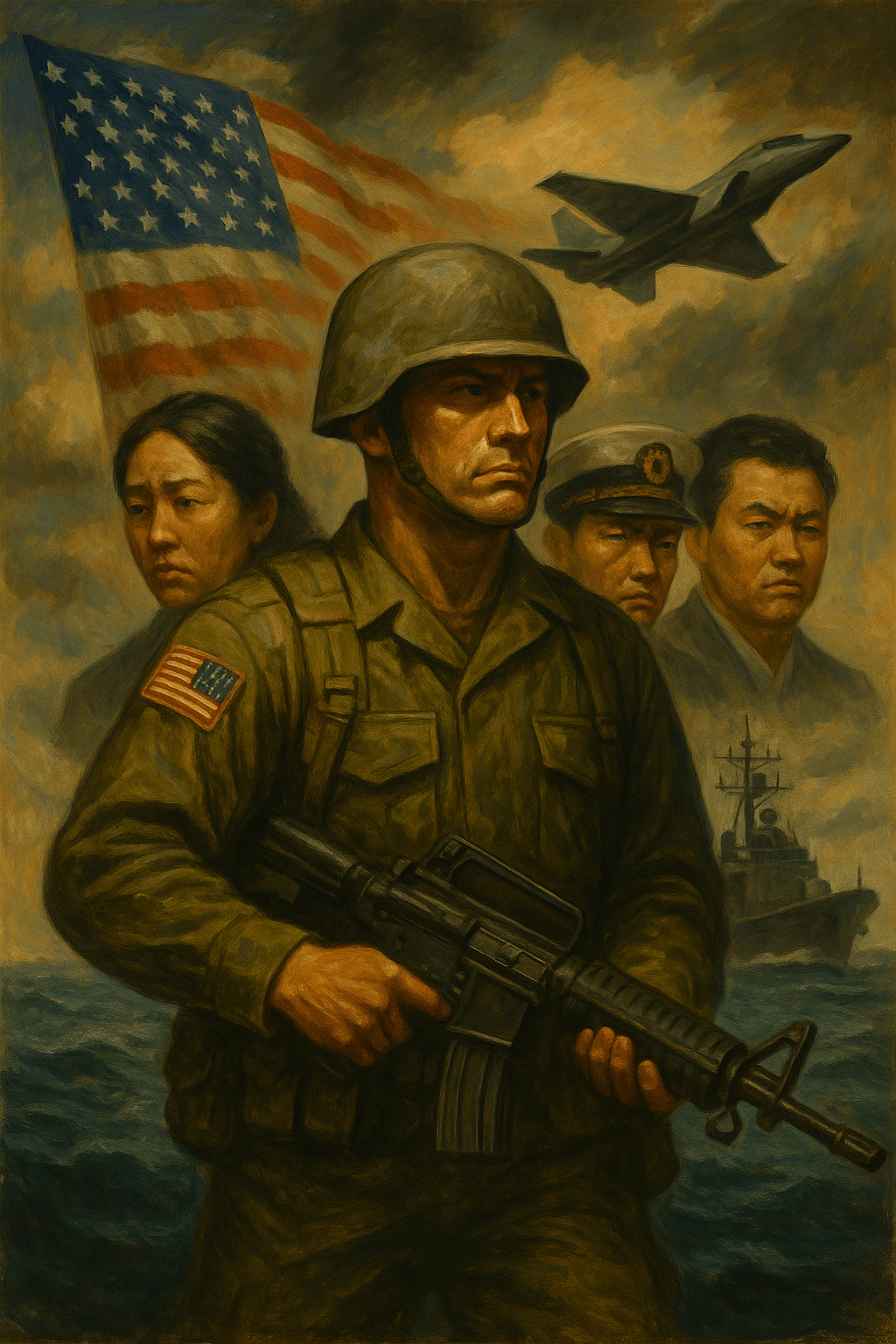
The Atlantic Council, Asia Times, and U.S.-funded scholars like Hanjin Lew are scripting a future where peace is only possible under American military occupation. This essay dismantles the psychological operation that frames Asian sovereignty as instability and imperial presence as protection. It excavates the buried histories of U.S. war crimes, suppressed diplomacy, and regional movements for decolonization and multipolar peace. At its core, it names the real threat to empire: an Asia that speaks, governs, and defends itself without asking Washington’s permission.
By Prince Kapone | Weaponized Information
July 24, 2025
The Benevolent Occupier and the Fear of an Unsupervised Asia
Hanjin Lew’s July 22, 2025 Asia Times article offers up a familiar imperial fantasy: the United States as the reluctant but necessary chaperone of East Asia, keeping the regional “wild horses” from tearing each other apart. Cloaked in the language of realism and historical caution, the piece is less an analysis of geopolitics than a weaponized nostalgia for Cold War occupation, a strategic lament for the passing of unipolarity. It’s the kind of narrative that teaches the colonized to be afraid of their own independence.
Lew spins his tale with a clear message: without U.S. military dominance, Asia will fall into chaos. China, unrestrained, will bully the region. Japan, unmonitored, will reawaken its militarist demons. Korea, caught in the middle, will descend into ancient blood feuds. And so the savior must stay. The framing is as old as empire itself: when the colonizer leaves, the “natives” slaughter each other. The more things change, the more the justification for occupation remains exactly the same.
But let’s not pretend this is some neutral analysis from a dispassionate scholar. Lew is no impartial observer. His résumé reads like a directory of comprador loyalty. A darling of Korean think tanks financed by U.S. defense contracts, he serves as a mouthpiece for Washington’s military strategy wrapped in academic prose. And his publisher, Asia Times, touts itself as Pan-Asian alternative to Western propaganda, yet frequently publishes pieces that regurgitate imperialist talking points.
The article is laced with quotes from the high priests of empire—Henry Kissinger, John Mearsheimer, and the ghost of Mao misquoted. Kissinger, the original bureaucrat of bloodshed, is summoned to remind us why Japan can’t be trusted without American chains. Mearsheimer, ever the realist, appears to say the quiet part out loud: America’s presence isn’t about peace, it’s about control. The irony is delicious—hawks on all sides admit U.S. domination is unpopular, yet they double down on its necessity.
Lew weaponizes history as a cautionary tale, evoking the Mongol invasions, the collapse of dynasties, and Korea’s blood-soaked resilience as proof that Asia has always been a battleground in need of supervision. But what he omits is louder than what he includes. There’s no mention of Hiroshima and Nagasaki, of the Korean War’s mass civilian slaughter, of Vietnam’s napalmed children. U.S. wars are conveniently erased while Chinese invasions from the 13th century are dredged up like prophecy. It’s not history—it’s imperial horror fiction, penned to spook the peasants into compliance.
Lew’s most insidious maneuver is the psychological operation at the heart of his thesis: the claim that U.S. military presence is a pacifier. It’s a masterstroke of cognitive warfare—recasting the garrison state as a guardian angel. Under this logic, Okinawa is not a U.S. colony but a necessary concession. The Philippine archipelago is not occupied but protected. Sovereignty becomes a dangerous luxury. Independence, a prelude to genocide. The only way to keep the peace, we’re told, is to surrender it.
In the final twist, Lew quotes Pompeo quoting Kim Jong Un, claiming that even North Korea sees the U.S. as a “bulwark” against China. This is the classic imperial ventriloquism act—putting your own words in the mouths of your enemies to justify staying put. If even the “madman” of Pyongyang supposedly begs the empire to remain, who are we to say no? It’s less journalism than a psy-op in quotation marks.
The deeper objective of the article is clear: to foreclose the very possibility of an Asia that is both peaceful and free. The suggestion that Korea, Japan, and China could resolve their differences without Washington’s boot on their necks is ridiculed as naïve, dangerous, even suicidal. But what Lew and his backers fear is not Asian war—it’s Asian unity. A continent that speaks to itself without consulting its occupier is a threat to empire. That’s the nightmare they’re trying to sell us as prophecy. And like all empires on the brink, they whisper it with trembling conviction: without us, you will destroy yourselves. Without us, you are nothing. The only disaster they fear… is decolonization.
The Myths We’re Sold and the Histories We’re Denied
What Hanjin Lew calls realism is a carefully staged performance—a fog of historical fragments, false threats, and imperial talking points masquerading as expertise. Let’s excavate what the article actually offers, and more importantly, what it omits. It does report some basic facts: yes, China attempted two failed invasions of Japan in 1274 and 1281. Yes, the ancient Korean kingdom of Goguryeo fought multiple Chinese dynasties. Yes, the U.S. has intensified its Indo-Pacific military posture. And yes, the U.S. still claims to act as a “restraining” force on Japanese militarism. These details are technically accurate. But they are buried under omission, distortion, and historical erasure that serve a singular purpose: to legitimize U.S. military occupation as a force for peace.
What’s missing is everything that would indict the empire Lew defends. There is no mention of the indiscriminate U.S. bombing of North Korea, which leveled 80% of its cities and towns and killed millions between 1950–53, including the targeting of dams and civilians. There is no reference to the decades-long Okinawan movement against U.S. military occupation, demanding an end to the desecration of their land and the violence U.S. troops bring with them. There is no note of how the 2025 trilateral summit between China, Japan, and South Korea—held without U.S. involvement—demonstrated that East Asia is fully capable of dialogue without imperial supervision.
Lew invokes “Asian volatility” but says nothing of the Yoshida Doctrine, through which the U.S. rearmed Japan after WWII, turning it into a Cold War partner while preserving elements of its wartime elite. He ignores how Japan’s so-called pacifism was always conditional—a creation of U.S. occupation, not Japanese nationalism. Today, Washington is not “restraining” Tokyo—it is accelerating its militarization through arms sales and security pacts.
While the article warns of Chinese expansion, it never mentions the ASEAN Political-Security Community Strategic Plan or the Treaty of Amity and Cooperation in Southeast Asia (TAC) created by Asian nations themselves. It never mentions how the rise of regional multipolarity is challenging U.S.-backed frameworks like AUKUS and the Quad. It never cites movements that reject U.S. military presence, from the Philippine Senate’s 1991 expulsion of U.S. troops to the mass protests against THAAD in South Korea.
Economically, Lew says nothing of the material incentives behind U.S. occupation. But U.S. bases are not just strategic—they are lucrative. As William Hartung documents, U.S. presence in Asia ensures weapons contracts, surveillance networks, and shipping routes for American multinationals. The Talisman Sabre exercises serve not peace, but imperial performance: 40,000 troops simulating war in a region that is supposedly stable under U.S. leadership.
As for the claim that Kim Jong Un sees the U.S. as a bulwark against China, this rests on the thinnest of hearsay: Mike Pompeo’s own memoir. There is no corroboration, no public confirmation, and no analysis of how U.S. war games on the peninsula heighten risk for all Koreans. It’s imperial ventriloquism dressed up as revelation.
In the world Lew refuses to acknowledge, sovereignty is the antidote to violence—not its cause. His entire argument depends on readers forgetting that the U.S. has been the primary driver of war in the region for 70 years. It is the only power to drop nuclear bombs. It has over 50,000 troops in Japan, and 22,844 in South Korea. Itdominates East Asian airspace, sea lanes, and cyberspace. It has actively undermined every form of Asian-led peace and cooperation that doesn’t run through its State Department or war machine.
Once these buried histories and suppressed facts are brought to the surface, the scaffolding of Lew’s argument collapses. His vision of “order” is built on occupation. His warnings of “chaos” are projections of what the empire fears most: an Asia that speaks with its own voice, guards its own borders, and writes its own future.
Occupation as Stability, Empire as Peace: The Logic of Permanent War
Once the fog of misinformation clears, what remains is not an argument for peace, but a blueprint for permanent occupation. The contradictions exposed in Lew’s narrative are not incidental—they are structural. He speaks of chaos without America, but the chaos is already here, precisely because of America. He invokes history to warn against regional self-governance, but history shows it is U.S. militarism—not Asian independence—that has left mass graves from Seoul to Saigon. The real story isn’t about preventing war. It’s about preventing sovereignty. This is Imperialist Recalibration: the strategic redesign of empire in the face of declining legitimacy, using psychological warfare, “realist” jargon, and oriental panic to justify what can no longer be defended in plain terms.
Lew’s framing hinges on the idea that Asia is incapable of balance without U.S. supervision. This is the colonial contradiction rendered contemporary. The empire tells us that freedom is dangerous, and that only through occupation can peace be achieved. But what Lew frames as “regional instability” is better understood as counterinsurgency—a preemptive strategy of domination aimed not at defending peace, but at suppressing movements for multipolar sovereignty. When the Philippine people expelled U.S. bases in 1991, it wasn’t chaos that followed—it was imperial retaliation: aid cuts, destabilization campaigns, and the eventual re-entry of U.S. troops via the 1998vVisiting Forces Agreement (VFA>.
Consider how Lew justifies U.S. control over Japan: not because Japan is aggressive, but because it might become aggressive. This is the logic of algorithmic governance—preemptive control based on modeled threats and speculative futures. In other words, Japan must remain under occupation not because of what it does, but because of what it might do. This is the same rationale that legitimizes mass surveillance, predictive policing, and pre-crime doctrine. The U.S. empire no longer reacts to threats—it manufactures them through simulations, and then uses those simulations to justify real violence.
This is where the ideology fuses with the infrastructure. Lew’s article is not just an opinion—it is part of a broader system of consent manufacturing. It complements RAND’s regional containment strategy, aligns with CSIS’s Indo-Pacific forecasts, and reinforces the narratives needed to sell AUKUS arms packages, justify EDCA expansions, and normalize permanent exercises like Talisman Sabre. Together, they form what we must name as the Sanctions Architecture in its military form: not economic punishment, but strategic siege. Bases, drills, and treaties become the invisible prison bars of an occupied Asia.
And what of the people Lew never mentions? The Okinawan farmers fighting base construction? The South Korean workers protesting U.S. deployments near their homes? The Filipino youth organizing against EDCA? They are the living refutation of his thesis. For them, the U.S. is not a neutral presence—it is an occupying force that denies land, autonomy, and memory. Their resistance is not nostalgic—it is anti-colonial. They reject the idea that war is inevitable without the white man’s boot on their soil.
The most insidious part of Lew’s article is its attempt to close off imagination. It treats multipolarism as delusion and U.S. retreat as apocalypse. But in doing so, it reveals the empire’s deepest fear: that Asia is already building new structures of cooperation and solidarity, outside the reach of Washington. The Tricontinental Institute calls this the rise of hyper-imperialism’s contradictions—as resistance grows globally, the old centers of power respond not with humility, but with panic. They double down on control, on presence, on dominance. Lew is simply the scribe for that desperation.
To reframe the contradiction is to name the real crisis: not China, not Japan, not the ghosts of past wars, but the crumbling legitimacy of U.S. hegemony in East Asia. The future of the region does not depend on the continuity of Pax Americana. It depends on anti-imperialist sovereignty: the ability of nations and peoples to resolve conflict, build cooperation, and defend autonomy without asking permission from their occupiers. This is not naïve. It is necessary. And more importantly—it is already underway.
Peace as Performance, Occupation as Architecture
Strip away the rhetorical varnish from Hanjin Lew’s thesis and what you’re left with is a meticulously crafted defense of U.S. military primacy in East Asia. But this isn’t simply nostalgia for Cold War equilibrium—it’s a sophisticated justification for what Weaponized Information names the Forward Containment Architecture. From Okinawa to Guam, from the Philippines to Korea, the U.S. isn’t “maintaining peace”—it’s hardwiring the region with drone launchpads, missile hubs, and surveillance corridors. These are not defensive alliances; they are pre-positioned chokeholds disguised as diplomacy, allowing U.S. command to pivot from proxy deterrence to direct force within minutes.
To make this arrangement palatable to the masses, Lew leans on the tired myth of Asian instability—a notion older than the empire itself. In his telling, Japan must be restrained, Korea protected, and China contained. But the real story is that these nations are ensnared in a system of Neocolonial Militarism. Their defense budgets are tethered to U.S. arms contracts. Their command structures are interoperable with U.S. warfighting doctrine. Their national security strategies are co-authored by Pentagon advisors. It is not cooperation—it is controlled dependency, enforced through logistical integration, elite training programs, and joint exercises that simulate war with China under the banner of “stability.”
But even more insidious than the military hardware is the ideological software—the illusion that these are sovereign decisions made by sovereign states. This is what WI defines as Sovereignty Theater: a staged performance where Asian client regimes repeat the lines of “regional balance,” “shared values,” and “mutual defense,” while Washington directs every movement from behind the curtain. The Philippines signs the Enhanced Defense Cooperation Agreement and calls it “partnership.” Japan doubles its defense budget and calls it “autonomy.” South Korea hosts U.S. THAAD batteries and calls it “deterrence.” What we’re watching is not strategy—it’s scripted submission, broadcast globally to manufacture consent.
And this consent doesn’t build itself. It must be engineered, circulated, and rehearsed through what WI calls Cognitive Warfare. Lew’s article is itself an operation in this domain—a soft-power missile launched at the collective imagination. It paints any U.S. withdrawal as suicidal, any call for multipolar dialogue as naïve, and any move toward decolonization as a guaranteed slide into civil war. It weaponizes historical fragments—like Mongol invasions and Goguryeo defiance—without context or causality. It revives Kissingerian racial determinism under the guise of sober analysis. And it closes its case with the absurd claim that even North Korea quietly supports U.S. troops. This isn’t journalism. It’s strategic hallucination.
What Lew fears most is not war. It’s independence. Because if East Asia were to sever itself from the Pentagon’s architecture and reject its scripted roles, it might discover that its own people are capable of writing a new script—one rooted in diplomacy, not deterrence. One aligned with solidarity, not subordination. The truth is: the U.S. didn’t stop World War II to protect Asia—it fought it to replace the old imperialists with a new one. And that empire, now decaying and desperate, is clinging to its role as director of the regional theater. But the audience is restless. The actors are breaking character. And the curtain is starting to fall.
 Weaponized Information
Leave a comment