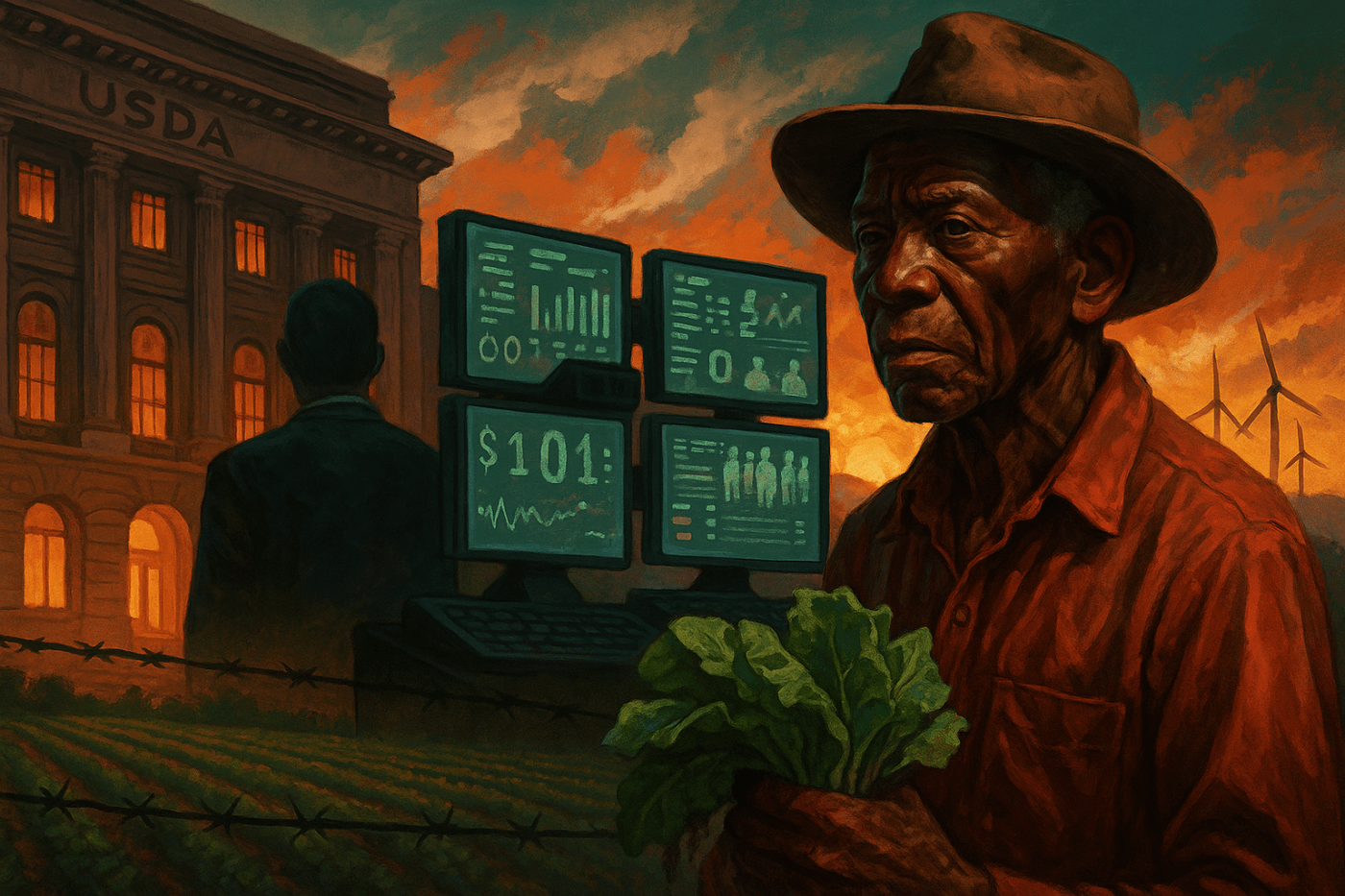
Capital B’s coverage launders settler policy as neutral bureaucracy, masking a colonial offensive. The USDA’s rollback is not reform—it is the continuation of a land war to suppress Black nationhood. Bureaucratic neutrality and algorithmic governance now serve as tools of settler-colonial pacification. Internal colonies are organizing across digital, agricultural, and political fronts to reclaim sovereignty.
By Prince Kapone | Weaponized Information
| July 22, 2025
Meritocracy Is Just White Power in Business Casual
On July 17, 2025, Capital B published an article by Aallyah Wright titled “USDA Ends Key Support for Black Farmers Amid Trump Anti-DEI Orders”. At first glance, it appears to document a bureaucratic decision: the USDA is eliminating the term “socially disadvantaged” from its program guidelines. But under the guise of reporting, this article performs a quiet sleight of hand. It rebrands state-sanctioned racial exclusion as administrative “fairness.” It sanitizes the rollback of symbolic redress as “reorientation.” And it conceals the colonial logic beneath a thin layer of objectivity. This is not neutral journalism—it’s counterinsurgency in print.
The article is a textbook case of ideological containment. It presents the USDA’s shift as a reasonable policy update aimed at improving “meritocracy,” never questioning who defines merit, who controls access, and whose land is at stake. The USDA’s assertion that it has “sufficiently addressed” its legacy of discrimination is relayed without interrogation. What we get instead is a flattened narrative where settler power structures are treated as legitimate administrators of justice. The deeper history—the deliberate liquidation of Black farmland, the bureaucratic sabotage of Black agricultural life—is not engaged. The article offers concern, but never insurgency. It gestures at harm, but leaves the colonial structure intact.
Author Aallyah Wright is a seasoned rural issues reporter, with prior work at ProPublica that exposed discrimination in agriculture. But here, her class position within nonprofit liberal media restrains her from confronting the deeper contradictions. She gives space to Black farmers’ concerns but never frames them as part of a colonized nation’s struggle for sovereignty. She critiques institutional neglect but leaves untouched the settler state’s foundational violence. The system is portrayed as flawed, not illegitimate. The crime is in execution, not design.
Capital B, the platform publishing this piece, is no rogue outlet. It is a Black-led nonprofit funded by liberal philanthropic behemoths like the Ford Foundation and the American Journalism Project. These institutions operate as ideological airlocks—ventilating dissent just enough to keep the pressure low. Their function is to critique racial disparity without challenging the settler-capitalist order that creates it. They trade in stories, not sovereignty. And Capital B’s role, in this context, is to manage narrative volatility—not to expose the foundational contradictions of U.S. empire.
The article deploys several key propaganda techniques. First, it uses the language of “meritocracy,” “reorientation,” and “efficiency” to reframe racial exclusion as procedural objectivity. This is a classic Framing Technique: what used to be called discrimination is now recast as equal treatment. By echoing USDA language about “upholding fairness,” the article reinforces the illusion that removing race-conscious language is a step forward, not backward.
Second, it engages in Omission by failing to reference the USDA’s century-long role in orchestrating Black land loss. There is no mention of the Pigford lawsuits. No discussion of the 12 million acres of Black land lost through racist loan denials, foreclosure abuse, and economic sabotage. This is historical amnesia by design—an evacuation of memory to make the present appear neutral.
Third, it deploys Emotional Manipulation by centering “fairness” as a shared concern, subtly inviting sympathy for the bureaucrats and white litigants challenging DEI. The reader is emotionally steered to interpret this policy shift as balanced, reasonable, and overdue. The white settler’s grievance is framed as a legitimate perspective, not as a weaponized narrative.
Fourth, the article repeats USDA euphemisms like “modernization” and “putting farmers first” without critique. This is Cognitive Warfare: the replacement of concrete power shifts with abstract, technocratic jargon. The USDA isn’t dismantling access for colonized farmers—it’s “reorienting” services. The purge is obscured by process.
Fifth, the article subtly invokes a Colonial Trope: Black farmers are cast as vulnerable recipients of aid, with one quoted as saying, “they’re going to take back the money — the little bit we were getting.” This framing suggests dependence rather than rightful land claims, reinforcing the image of the Black farmer as a beneficiary, not a sovereign actor. In doing so, it erases the political demand for land as the basis of nationhood, reducing the struggle to one of access, not autonomy.
Sixth, the article participates in Liberal Containment by reducing the issue to terminology and representation. It frames the USDA’s decision as a definitional dispute over “socially disadvantaged” rather than a structural maneuver to consolidate settler land control. The term DEI is treated as a category to be debated, not a battlefield of colonial contradiction. The call for new definitions obscures the call for land back.
The function of the article is not to lie, but to limit. It doesn’t distort the facts—it buries the truth under administrative language. This is how modern propaganda operates under nonprofit liberalism. The aim isn’t to deny injustice—it’s to narrate it without revolutionary implications. To highlight harm while shielding the system that inflicts it. And in doing so, it prepares the reader not for resistance—but for resignation.
The Land Was Never Lost—It Was Taken
By 2025, Black farmers held less than 2% of all U.S. farmland. That number isn’t just a statistic—it’s a scar. It marks the territory where a nation within a nation was dispossessed by policy, sabotage, and force. In 1920, Black farmers held over 16 million acres. Today, barely 4.7 million remain. This collapse did not result from demographic shifts or “market forces.” It was engineered. The USDA, through its county-level networks and discretionary power over loans, insurance, and disaster aid, served as the bureaucratic muscle behind a century-long campaign to sever Black people from the land that grounded their autonomy. The goal was never fairness. It was pacification.
The Capital B article mentions none of this. Not the 12 million acres lost. Not the Pigford v. Glickman settlement of 1999, in which more than 22,000 Black farmers filed claims alleging decades of USDA discrimination—only around 15,645 to 16,000 of whom received payments. Not the 2023 reports documenting that USDA’s county-level systems and discretionary authority routinely deny loans and underfund Black farmers. Not the fact that, according to the USDA’s own 2022 Census of Agriculture, Black producers make up just 1.24% of the national farming population.
The article doesn’t omit this history out of ignorance—it omits it to maintain legitimacy.
These are not just oversights. They are structural Omission Patterns designed to obscure the reality that Black farmers are not a “disadvantaged group”—they are part of a colonized nation systematically stripped of land, wealth, and self-determination by the settler state. The denial of loans, the foreclosure of farms, and the bureaucratic sabotage of aid programs weren’t unfortunate errors. They were war strategies. And like all colonial war strategies, they were aimed at one thing: destroying a people’s material base for nationhood.
That erasure is now accelerating under the banner of “neutrality.” Following two executive orders from Donald Trump in early 2025, the USDA announced it would eliminate all DEI mandates and drop the term “socially disadvantaged” from its programs. Secretary Brooke Rollins declared the agency would now operate under “merit-based” frameworks that make no distinction based on race or gender. The department issued a statement claiming that it had “sufficiently addressed” its discriminatory history and was now simply “putting farmers first.” But in practice, this shift means the final demolition of even symbolic redress—and the full restoration of settler land entitlement.
Capital B repeats these statements without critical framing. But here’s what’s really happening: the rollback is not about equality—it’s about consolidation. The state, under pressure from economic contraction and legitimacy collapse, is circling the wagons. And Black farmers, already at the margins, are being cut loose entirely. DEI is not being reformed—it is being discarded. And the land is being sealed off behind a wall of meritocratic rhetoric and algorithmic exclusions.
Enter Adam Faust, the white Wisconsin farmer who successfully sued the Biden administration in 2021 to block $4 billion in debt relief for nonwhite farmers. In 2025, Adam Faust sued the USDA again—this time alleging its conservation and loan programs favor “women and minorities.” He is represented, again, by the Wisconsin Institute for Law and Liberty, a right-wing think tank that specializes in Lawfare: using litigation to dismantle any structural concessions to colonized peoples. The Capital B article mentions Faust but omits this machinery. His lawsuit is not an individual complaint—it’s a settler counteroffensive masquerading as legal redress.
And it’s working. Across the South, USDA offices—still dominated by white-controlled county committees—continue to prioritize familiar white applicants while sidelining Black farmers through “discretionary” processing. The Native American Agriculture Fund and others have reported similar patterns of exclusion. In practice, what Rollins calls “equal service” means fast-tracking white ownership while filtering out internal colonies through paperwork, denials, and delays. The mechanisms have changed, but the function is unchanged: protect settler land control at all costs.
Even when so-called “relief” is offered, it arrives gutted.
In 2023, Black farmers applying for the USDA’s Discrimination Financial Assistance Program were denied due to narrowly defined eligibility, burdensome documentation, and arbitrary rejection. The Memphis-based Black Farmers and Agriculturalists Association sued in federal court to challenge their exclusion. The Capital B article mentions the lawsuit, but frames it as a reaction—not as evidence of institutional war. There is no appeals court for the theft of a nation’s land. There is no redress process that can undo liquidation by spreadsheet.
Meanwhile, the broader system is tightening. Four corporations—Tyson, JBS, Cargill, and National Beef—control approximately 80% of U.S. beef processing. Even for those Black farmers who still hold land, survival is tethered to supply chains they don’t control. Any notion of “equal opportunity” is a farce when the entire infrastructure is designed to crush independent producers—and when Black farmers are already operating with the weight of stolen generations on their backs.
And this is not just an American story. In Zimbabwe, the Smallholder Farmers’ Forum and related rural organizations report that smallholder farmers are routinely excluded from financing by agribusinesses and banks—leading to land dispossession under the pretense of “development.” Across the Global South, the pattern is familiar: land is grabbed, sovereignty is denied, and the state intervenes only to manage dissent. What connects these struggles is not geography—but colonial logic. Whether in Mississippi or Matabeleland, the colonial state knows that land is power, and sovereignty must be suffocated.
The Capital B article ends with a quote from Lloyd Wright, a retired USDA employee, who says he doesn’t consider himself “socially disadvantaged,” just Black and discriminated against. But that’s the point. It was never about terminology—it was about land. And for colonized nations inside the U.S.—Black, Native, and Chicano alike—this isn’t just policy failure. It’s warfare. What’s being revoked isn’t just funding. It’s the material foundation of sovereignty.
Colonial Pacification Disguised as Policy Reform
The USDA’s decision to strike the term “socially disadvantaged” from its programs is not some neutral, technocratic policy shift. It’s a land war maneuver. What the settler state could no longer justify as reparative, it has now reclassified as discriminatory. What was once a barely symbolic gesture toward justice has been methodically dismantled, leaving the colonized with nothing but bureaucracy and betrayal. This is not about regulatory language—it’s about who gets to live on the land, and under what conditions. It is the soft-touch phase of settler-colonial warfare: the clipboards replacing the carbines.
In 1865, General Sherman’s Special Field Order No. 15 promised 40 acres to freed Africans—but President Andrew Johnson reversed the order within months, returning the land to Confederate enslavers. In 2025, no bayonets are needed. A USDA memo signed by Secretary Brooke Rollins serves the same function—scrubbing the colonized out of agricultural policy, and returning the soil to its “rightful” owners. This is what we call Settler-Colonial Pacification: the process by which the settler state disarms resistance not through open violence, but through administrative erasure, legal attrition, and policy neutralization.
The logic is simple. If you remove the language that names a people’s oppression, then you remove the state’s obligation to address it. Rollins calls it “merit-based.” The USDA calls it “reorienting.” But under the hood, this is an algorithmic purge. Eligibility is now filtered through Algorithmic Governance—risk scores, data inputs, and predictive models that encode past discrimination as present-day policy “efficiency.” The numbers don’t see race, we’re told. But the structures behind those numbers do. And what they see is who belongs on the land, and who does not.
That structure is upheld by what we call the Colonial Contradiction: the irreconcilable tension between the U.S. settler regime’s democratic self-image and its colonial foundations. A state that claims liberty and equality cannot afford to acknowledge the existence of internal colonies—Black, Native, and Chicano peoples whose stolen land, labor, and sovereignty are the conditions for the settler’s freedom. The USDA’s policy doesn’t resolve this contradiction. It conceals it, in the language of law and fairness, while quietly reinforcing settler control.
Lawsuits like those filed by Adam Faust are instruments of that concealment. Presented as individual grievances, they function as mechanisms of Lawfare, weaponizing civil litigation to delegitimize redress and criminalize equity. The courts become terrain not for justice, but for settler reaffirmation. The state doesn’t just deny colonized people relief—it uses their demands as fuel to consolidate white entitlement as constitutional principle.
The strategic timing of this rollback is not coincidental. As U.S. imperial power falters abroad, it must reassert discipline at home. The rise of multipolar resistance—BRICS+, China’s agricultural investments in the Global South, the expansion of food sovereignty networks—has exposed the fragility of U.S. agribusiness supremacy. In response, the settler state is fortifying its internal frontiers. The USDA is not streamlining policy. It is fortifying domestic territory for an imperial core in crisis. And it is doing so not against external enemies, but against the descendants of those it once enslaved, dispossessed, and annexed.
The rollback of DEI is just the formal recognition that the mask has come off. Liberal containment has served its purpose. Now the settler regime is preparing for open class warfare under the banner of “fairness.” But the deeper question isn’t about equity—it’s about sovereignty. And the people being targeted—Black farmers in the Delta, Native communities in the Plains, Chicano land collectives in the Southwest—are not simply under-resourced. They are stateless, landless, and denied national recognition inside the borders of an empire built on their destruction.
These are not minority rights issues. They are colonial contradictions. And those contradictions can no longer be managed with technocratic fixes or semantic debates. The USDA’s new framework is not a glitch. It’s the intended function of a settler machine recalibrating itself for long-term survival.
But the people remember. The land remembers. And with every new policy meant to erase them, the internal colonies of this empire are reminded that their fight is not for inclusion—but for liberation.
The Land Will Not Be Lost Quietly
The USDA can erase words from policy, but it cannot erase memory from the land. It cannot erase the blood in the soil, or the people who have fought to stay rooted in it. This rollback is not the end of the struggle—it is the latest act of war against the internal colonies of this empire. And it clarifies what’s at stake: not reform, not recognition, but sovereignty. The land was stolen through conquest. It will not be reclaimed through petitions. It will be taken back by those who understand that to be free, we must fight—not for inclusion into a collapsing settler order, but for its dismantling.
We stand in revolutionary solidarity with the land stewards of the Black, Native, and Chicano nations—internal colonies fighting for survival inside the empire. Organizations like the Black Farmers’ Network, the Native American Agriculture Fund, and the Southwest Organizing Project are not nonprofits—they are resistance cells, building the material foundations of autonomy. These communities are not simply underserved. They are occupied. And their struggle is not for equity. It is for land, power, and nationhood.
That struggle is mirrored across the Global South. In Brazil, the Movimento dos Trabalhadores Rurais Sem Terra (MST) continues to occupy and redistribute land seized by agribusiness. In Kenya, the Seed Savers Network protects indigenous agriculture from transnational seed monopolies. In South Africa, landless movements demand expropriation without compensation. These are not symbolic acts. They are coordinated uprisings against colonial agriculture—and the empire sees them as threats because they are.
Inside the imperial core, we must respond with the same strategic clarity. The settler regime is consolidating. We must build Dual and Contending Power: autonomous infrastructure that directly challenges the state’s control over land, food, and survival. This is not charity. This is strategy.
- Campaign Target: Pressure land-grant universities and liberal foundations to divest from agribusiness monopolies like Tyson, JBS, and Cargill. Redirect funds to Black- and Indigenous-led land trusts, farming co-ops, and defense collectives. Target: USDA-aligned 1890 Historically Black Land-Grant Institutions.
- Mutual Aid Initiative: Support projects like the National Black Food & Justice Alliance and Soul Fire Farm. Fund seed banks, cooperative land buybacks, irrigation, and infrastructure—not administrative overhead.
- Proletarian Cyber Resistance: Archive USDA discrimination evidence using decentralized tools. Upload documentation to IPFS and
Archive.org. Mirror case files across open-access servers. Use #BlackLandMatters, #LandBackSouth, and #USDAOnTrial to disrupt digital space and force counter-memory into public view. - Political Education Front: Host teach-ins and reading circles that center land and sovereignty. Key texts: Eric Holt-Giménez’s A Foodie’s Guide to Capitalism, Monica M. White’s Freedom Farmers, and the Tricontinental’s Newsletter on Food Sovereignty. Decolonize our political literacy and reconnect theory with struggle.
- Disruption Tactic: Launch boycott campaigns against Whole Foods, Walmart, and agribusiness trade lobbies. Link food workers, tenant unions, and urban gardens into a united anti-settler food sovereignty front.
These are not incremental reforms. They are seeds of rupture. They prepare us to survive the storm—and to organize its direction. We are not waiting for a sympathetic administration. We are building now. And as long as we fight for the land, the land will not forget us. This empire may erase terms from policy, but it cannot erase us from history. The land will not be lost quietly. Neither will we.
 Weaponized Information
Leave a comment