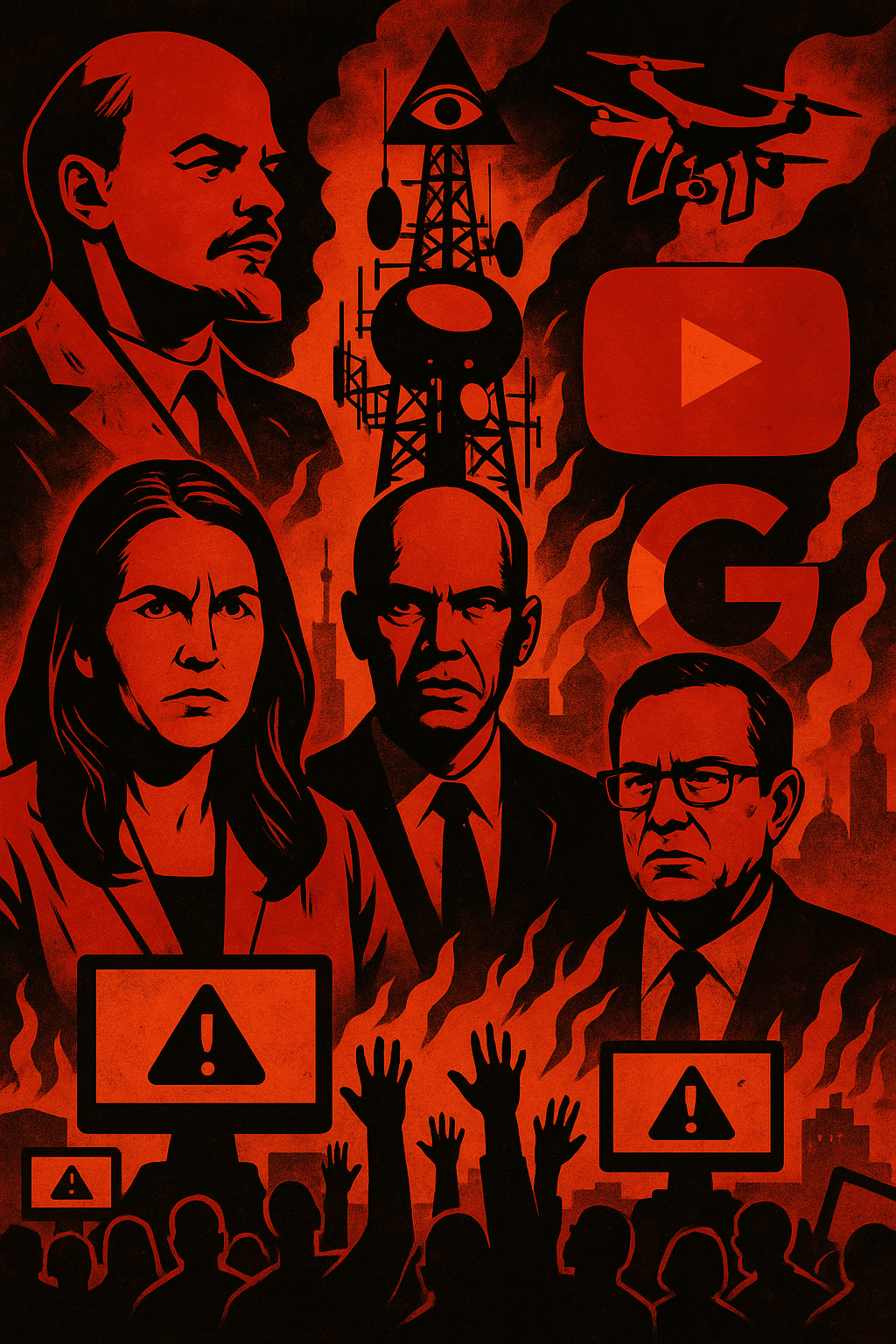
The Gabbard Leaks: Russiagate Was a Counterinsurgency
Mother Jones gaslights the masses while laundering spook propaganda. The facts buried in the leaks expose an intelligence fabrication. Russiagate wasn’t a scandal—it was an imperial information war. Now is the time to organize, resist, and weaponize memory.
By Prince Kapone | Weaponized Information | July 22, 2025
Manufacturing Treason: The Psychological Operations Behind Russiagate
David Corn, long-time imperial stenographer at Mother Jones, has returned once again to do what he does best: shovel another steaming load of Russiagate fertilizer into the mouths of liberals trained to eat from the same poisoned trough. His July 2025 piece—Tulsi Gabbard’s Dangerous Disinformation Campaign Against America—doesn’t read like journalism. It reads like a soft-power op-ed from the desk of Langley. A revival sermon for a dead psyop. A last-ditch attempt to discipline thought, not report facts. Corn, after all, wasn’t a bystander to Russiagate—he was the first mainstream figure to promote the discredited Steele Dossier in 2016. He didn’t just fall for the lie. He helped build it.
The outlet he writes for has long abandoned its muckraking soul. Mother Jones is now a laundering machine for liberal imperialism in Patagonia fleece. Its pages are saturated with NGO euphemism and grant-funded obedience. With donors tied to the Ford Foundation, Carnegie, and Open Society, and with editorial influence tethered to the very “democracy promotion” networks that camouflage U.S. regime change, Mother Jones doesn’t challenge power—it manufactures consent for it. Corn isn’t some rogue journalist investigating the deep state. He is its ideologue, dressed in NPR syntax and progressive sheen.
His latest piece is less journalism than ritual. Gabbard is not debated—she is disciplined. Her calls for peace, for transparency, for declassification of imperial lies, are not countered with argument, but buried in innuendo. The headline flirts with treason. The subtext treats dissent as sedition. And the structure is pure counterinsurgency logic: criminalize memory, stigmatize deviation, and sanctify the security state as the final arbiter of truth.
What makes this article textbook psychological warfare is not what it argues—but how it maneuvers. Corn deploys the full liberal propaganda arsenal. First, he pathologizes dissent: Gabbard’s critique of the intelligence community is not engaged—it’s treated as delusion, foreign infection, or narcissistic betrayal. Second, he invokes emotional totems—“national security,” “Russian interference,” “election integrity”—as shields from scrutiny, engineered to hijack the limbic system and short-circuit analysis. Third, he collapses categorical distinctions: meme reposts become cyberattacks, criticism becomes collaboration, disagreement becomes complicity. Fourth, he relies on strategic omission. There’s no mention that the 2017 ICA was produced by a “hand-picked” trio of agencies under direct instruction from Obama. No reference to the absence of forensic proof. No sourcing transparency. Just suggestion, fog, and fear.
Fifth, Corn traffics in Cold War costume jewelry. He deploys analogies like “useful idiot,” “Kremlin-aligned,” and “echoes the Russian line”—phrases recycled from the McCarthyist attic. These aren’t arguments. They’re performative loyalty tests. The aim isn’t debate—it’s public shaming through guilt by association. And sixth, he deploys the oldest imperial tool of all: Orientalist trope construction. Russia is framed as the shadowy foreign manipulator, the eternal schemer of Eurasian chaos. Gabbard, by association, becomes ideologically contaminated—a vector of “foreign influence,” cast outside the bounds of patriotic legitimacy. This isn’t journalism. It’s narrative quarantine.
And backing him up—like a State Department choir echoing CIA hymns—are the usual suspects. RAND Corporation briefings on “influence operations.” Atlantic Council policy memos. YouTube’s “Threat Analysis Group.” MSNBC panels stacked with former spooks turned experts. These aren’t neutral institutions. They are the amplification nodes of empire. They don’t repeat Corn because he’s correct. They do it because his narrative aligns with theirs: one of total control over the terrain of information, where memory is weaponized, and thought itself becomes a battlefield.
Corn’s article erases the line between journalism and soft statecraft. It’s not an exposé. It’s an inquisition. A cleansing ritual designed to cauterize deviance before it spreads. Gabbard is not confronted—she’s delegitimized. Her disclosures aren’t refuted—they’re framed as dangerous. The goal isn’t to inform, but to preempt, to inoculate, to make sure no inconvenient truth can take root. This is how empire lies: not by silencing speech outright, but by drowning it in patriotic fog, implication, and reputational threat. The truth doesn’t get denied—it gets disappeared.
Unmasking the Machinery: Facts, Fictions, and the Vanishing Line Between Them
Now that we’ve stripped the Mother Jones article down to its ideological bones, we must pivot to the terrain of fact. Not opinion. Not insinuation. Fact. This is the space where propaganda fractures under the pressure of evidence—and where the contradictions buried inside imperial information warfare begin to surface.
Let us begin with what the article explicitly claims:
- Director of National Intelligence Tulsi Gabbard released over 100 pages of declassified intelligence reports and internal communications from 2016 relating to alleged Russian interference in the U.S. presidential election.
- Gabbard asserted that the 2017 Intelligence Community Assessment (ICA) was politically manufactured by the Obama administration to delegitimize Donald Trump’s electoral victory.
- The documents she released include internal analyses from the NSA and DHS between August and December 2016 stating that Russia neither possessed the intent nor capacity to alter vote tallies or breach election infrastructure.
- Gabbard further claimed that these assessments contradict the narrative—cemented by the ICA—that the Russian state launched a coordinated operation to install Trump using cyberattacks and disinformation.
- David Corn rebuts this by asserting that the ICA focused primarily on broader covert efforts—such as the DNC email leaks and social media manipulation—and was unrelated to infrastructure vulnerabilities.
But what Corn omits is as revealing as what he says. The ICA, released on January 6, 2017, was not the product of the full intelligence community. It was compiled under express directive from President Obama by a “hand‑picked” team of analysts drawn exclusively from the CIA, FBI, and NSA—excluding 13 other agencies, including the State Department’s Bureau of Intelligence and Research and the Department of Homeland Security. According to the 2018 Senate Intelligence Committee review, only analysts from those three agencies were involved in producing the assessment. A separate investigation by former U.S. intelligence officials published at Consortium News concluded that the ICA provided “no hard evidence,” only assertions by senior officials. And former NSA Technical Director William Binney and the Veteran Intelligence Professionals for Sanity conducted a forensic analysis of the DNC data, arguing it was more consistent with a local file transfer—not remote exfiltration by Russian hackers. Corn does not engage these points. He buries them.
What Gabbard’s document release makes clear is that multiple high-level assessments from August through December 2016 directly contradict the alarmist narrative that would later become institutionalized through the ICA. Internal memos reveal that DHS and NSA officials repeatedly noted a lack of evidence indicating any Russian intent to disrupt vote tabulation or access voter databases. In one instance, an February 2018 DHS–NSA joint memo describes media reports of foreign “hacking” as “inaccurate and speculative,” citing no technical indicators to support intrusion claims. These memos were never made public—until now.
Corn also sidesteps another key fact: the ICA was never subjected to an independent audit or peer review. Its conclusions were immediately cited by major media outlets as definitive, but even the July 2018 Senate Intelligence Committee review acknowledged that “confidence levels varied” across agencies—with the CIA and FBI expressing high confidence, and the NSA only moderate confidence. Additionally, the declassified version of the ICA released to the public contained no raw intelligence or underlying evidence, only analytic conclusions. To this day, the report has never been independently audited or peer-reviewed, as confirmed by the absence of such a review in the Office of the Inspector General’s semiannual reports. This discrepancy has never been addressed. The report became dogma, not through scrutiny—but through saturation.
Gabbard’s core contention is not that Russia did “nothing”—but that the narrative constructed in early 2017 was a strategic distortion: a form of narrative consolidation designed to reassert elite control in the wake of a legitimacy crisis. It is a claim increasingly supported by historical pattern: researchers from the Geopolitical Economy Report documented how U.S. disinformation campaigns “spread disinformation and fake news… to promote pro‑Western narratives”—in effect framing elite manipulation as foreign interference and popular skepticism as treason. In this framing, Russiagate becomes less a scandal than a containment strategy.
The timing is critical. The ICA was compiled in December 2016 and released in January 2017—mere days before Trump’s inauguration. Its function was not merely diagnostic. It was disciplinary. By blaming a foreign actor for the collapse of liberal legitimacy, the intelligence community successfully redirected the rage of the 2016 electorate—both Sanders insurgents and Trump populists—away from the failures of neoliberal governance and toward a cartoon villain in Moscow. That distraction proved decisive.
The economic context matters just as much. The 2008 financial collapse gutted working-class confidence in both parties. By 2016, the ideological glue binding Wall Street, Silicon Valley, and the foreign policy establishment was dissolving. The ruling class needed a new consensus. Russiagate supplied it. As Florian Zollmann noted in “Manufacturing a New Cold War” (2021), the “Russiagate” narrative acted as “a discourse of ‘distraction’ that served to deflect from NATO’s militarization of Eurasia.” It was a multi-use narrative: it explained Clinton’s failure, suppressed Sanders’ momentum, neutralized demands for electoral reform, and justified an emerging censorship infrastructure.
Corn mentions none of this. Not the forensic contradictions. Not the selective analyst group. Not the metadata evidence. Not the post-2016 foreign policy maneuvers made possible by the narrative. And certainly not the intelligence community’s history of using planted stories to steer domestic opinion—a fact documented by researchers from Church Committee hearings to CIA whistleblowers. Corn’s silence is not journalistic discretion. It’s narrative discipline.
Behind his moral panic over “Gabbard’s recklessness” lies a deeper anxiety: the imperial consensus is eroding. When the ICA was released, the U.S. still wielded unchallenged narrative dominance. But the terrain has shifted. The Global South is no longer passive. Multipolar blocs like BRICS+ are rejecting Washington’s framing of global events. As noted in the Tricontinental Institute’s May 2023 analysis on the Global South’s advocacy for a “New World Information and Communication Order,” hundreds of journalists and intellectuals across Africa, Asia, and Latin America are actively challenging Western media hegemony and building alternative narrative infrastructures. In that context, the Gabbard leaks are not just domestic scandal—they are rupture points in a collapsing imperial information order.
Corn pretends the only danger lies in Gabbard’s disclosures. But the real threat—at least to empire—is that the historical record is being re-opened. And inside that record is not a tale of Russian hackers, but a blueprint for how liberal imperialism manufactures truth in the service of elite survival.
Declassified Lies and Digital Inquisitions: Russiagate as Class Counterinsurgency
What the Gabbard leaks have exposed is not simply the corruption of an intelligence report. It’s the operational blueprint of a domestic counterinsurgency campaign—tailored for the digital age. The 2017 ICA was not just bad intelligence. It was a battle order in an unfolding civil war over meaning, legitimacy, and control. The battlefield? Not Ukraine. Not Syria. Not the South China Sea. But the U.S. population itself.
This wasn’t foreign policy. This was Technofascism: the fusion of militarized state power, Big Tech infrastructure, and intelligence coordination to discipline thought, suppress dissent, and reassert elite command over a society breaking apart at the seams. It was the state’s answer to a legitimacy crisis that neither Clintonism nor Trumpism could contain. And like all imperial projects in crisis, it sought refuge in old tactics—wrapped in new packaging.
The 2016 rupture—the Brexit–Trump–Sanders moment—wasn’t a fluke. It was the breakdown of consent in the heart of the empire. The ruling class panicked. So they reached for the familiar playbook of imperialist recalibration: swap out direct repression for algorithmic control, shift from physical censorship to digital invisibilization, and redeploy psychological operations once aimed at the Global South against their own population. Russiagate became the test case.
The ICA functioned as a doctrinal document. Not for foreign engagement, but for domestic orientation. It licensed surveillance. It justified censorship. It reframed dissent as infiltration. And it didn’t stop at Trump. Its real targets were whistleblowers, antiwar movements, dissident Black organizers, and independent journalists. Those who remembered too much. Those who asked the wrong questions. Those who refused to bow to the algorithmic altar.
This was Cognitive Warfare—not the clumsy propaganda of yesteryear, but a full-spectrum operation aimed at the brainstem of mass perception. It operated through YouTube’s “trust and safety” filters, Facebook’s visibility throttles, Google’s blacklists, and a legion of synthetic “fact-checkers” trained to neutralize not lies, but truths that threatened empire. The metrics of success weren’t accuracy—they were obedience.
The Russiagate narrative wasn’t constructed to uncover what happened. It was engineered to criminalize what was possible: that working people might reject the political establishment; that the empire might no longer command blind faith; that the corporate state’s monopoly on information might slip. The ICA was less a report than a redline—a boundary placed around dissent, enforced by reputation destruction, digital erasure, and social shunning. This is the new face of empire’s security apparatus: decentralized, outsourced, and hidden behind soft branding.
And here lies the deeper contradiction. As U.S. imperial reach shrinks abroad, its coercive capacity turns inward. What we are witnessing is not a retreat—but a mutation. The same tools once deployed to destabilize Venezuela, Syria, or Libya are now aimed at Oakland, Atlanta, and Detroit. The war has come home. The intelligence agencies no longer function merely as foreign operators—they are now the interior decorators of domestic reality. Russiagate was their proof of concept.
And what of the global stage? Here too, the contradictions are exploding. BRICS+ expands while U.S. alliances contract. Sanctions boomerang. Financial weapons backfire. The Global South no longer swallows the narrative whole. What Gabbard’s leaks rupture is not just domestic decorum—but the entire architecture of epistemological domination. The monopoly on truth is fracturing. And in that fracture, a new terrain of anti-imperialist sovereignty begins to breathe.
Make no mistake—Tulsi Gabbard is no revolutionary. But her disclosures now operate as what the system fears most: a rogue variable in the algorithm. An unpredictable input in a tightly managed simulation. And while the liberal wing of the white ruling class scrambles to plug the breach, what they cannot undo is the rupture itself.
Russiagate was not a hoax. It was not a mistake. It was not a scandal. It was a domestic information war—a class-based digital counterinsurgency launched to re-impose control over a population no longer buying the official myths. It was the ideological vaccine against 2016. And now, its side effects are showing.
From Inquisition to Insurgency: The Terrain Belongs to Us
Let’s stop pretending. Russiagate was never about Russia. It was about us. About memory. About terrain. About control. It was a successful counterinsurgency operation—designed not to uncover truth, but to bury it beneath algorithmic rubble and liberal panic. And now that the Gabbard leaks have ruptured the official narrative, the question before us isn’t whether the empire lied. We already know it did. The question is: what do we do now that the lie is exposed?
First, we reclaim the archive. The ICA, the Mueller probe, the endless MSNBC echo chamber—these were tools of enforced forgetting. We counter them with political education. Organize study circles. Host teach-ins. Print zines. Circulate the Gabbard files alongside COINTELPRO documents, Operation Mockingbird revelations, and the Snowden leaks. Build what the ruling class fears most: historical consciousness fused with collective memory. The antidote to Cognitive Warfare is epistemological self-defense.
Second, we fortify the lifelines of revolutionary information. Sites like Black Agenda Report, Multipolarista, Popular Resistance, and The Geopolitical Economy Report are under constant algorithmic siege by the Imperialist Media Apparatus. Support them—not with claps and retweets, but with funds, mirrored backups, and digital protection squads. These are the lungs of the movement. Without them, we suffocate.
Third, we name the real threat. RAND Corporation. Google Jigsaw. YouTube’s “Threat Analysis Group.” The Atlantic Council’s Digital Forensic Research Lab. These are not policy shops or think tanks. They are the R&D labs of narrative warfare—the brains behind the weaponized infrastructure of domestic repression. We must treat them as such. Expose their funders. Track their board members. Disrupt their events. Develop counter-lists and sabotage campaigns. Our movement needs not just watchdogs—but information insurgents.
Fourth, we deepen our technological discipline. That means operationalizing a strategy of Proletarian Cyber Resistance. Use encryption. Build mirrors. Scrape archives. Leak with purpose. Host offline libraries. Train comrades in digital security. Build counter-algorithms. Share banned content. Mask IPs. Disperse networks. Don’t just survive inside their machine—jam it. The algorithm is not neutral. It’s a weapon. Learn its code, then turn it back on the architects.
Finally, we expand the fronts of struggle by building Dual and Contending Power on the digital terrain. Platforms like Mastodon, Element, and decentralized archives must become more than escape hatches—they must be transformed into parallel institutions of proletarian knowledge and coordination. The goal is not to go off-grid. It is to build a new grid—beyond the grasp of technofascist surveillance, and rooted in revolutionary internationalism.
The ruling class has bots, bandwidth, and black budgets. But it does not have the people. We do. And when the contradictions finally rupture the narrative façade, it won’t be a Kremlin psyop that tips the balance. It will be a class of conscious, organized, defiant people—armed with memory, trained in sabotage, and ready to seize the terrain.
The inquisition is failing. The fog is lifting. The terrain is ours. Let’s take it.
 Weaponized Information
Leave a comment