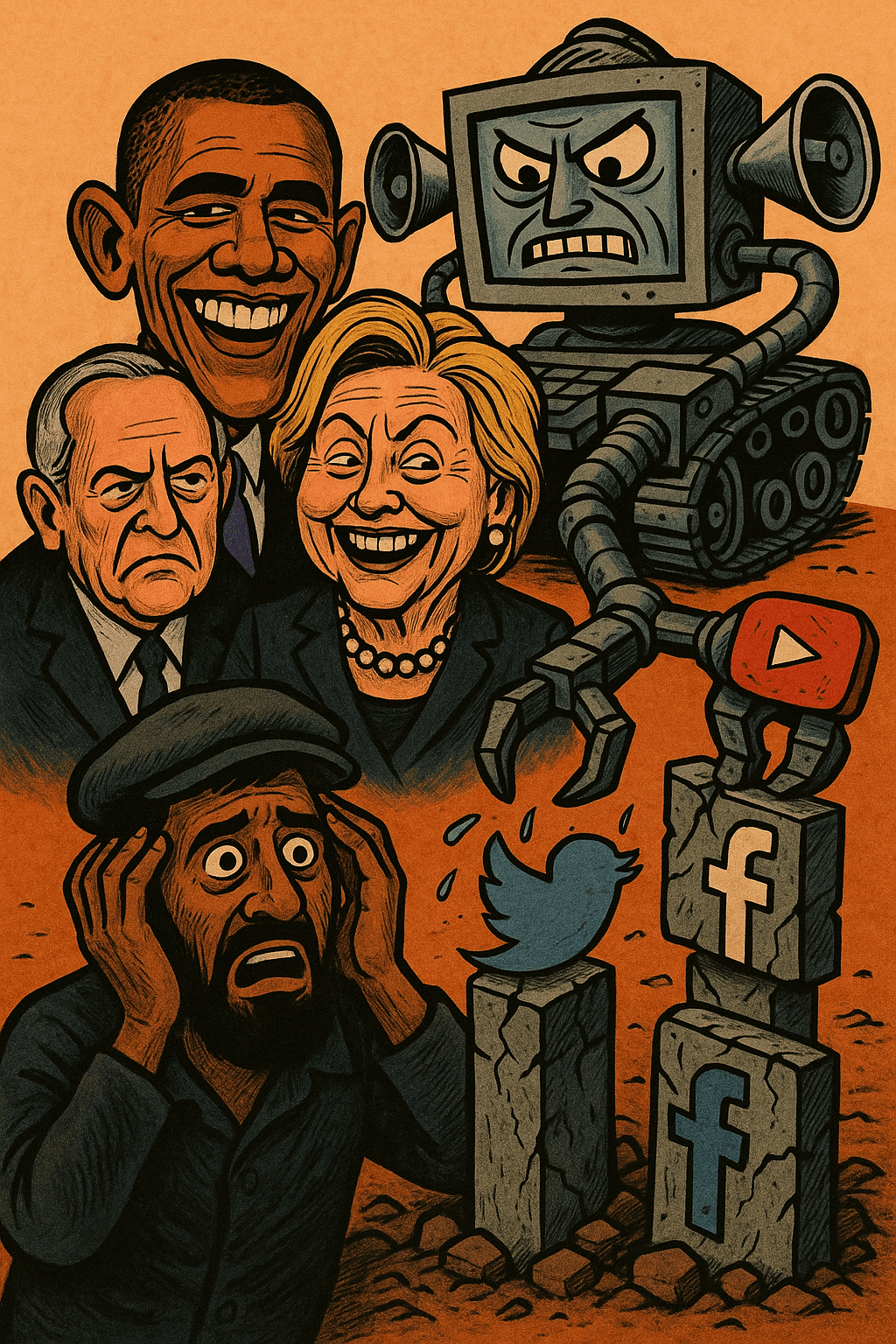
How the White Ruling Class Used a Manufactured Crisis to Cement Algorithmic Control and Suppress Dissent
By Prince Kapone | Weaponized Information | July 22, 2025
Who Built the Lie?
Russiagate was never a scandal. It was a strategy. A full-spectrum psychological operation masked as patriotism, manufactured by a collapsing empire to reassert control over its own population. Its architects weren’t QAnon fanatics or rogue intelligence operatives—they were liberal technocrats, the polished managers of decline, the Obamas and Clintons of the world. And it wasn’t hatched in the backrooms of conspiracy forums—it was engineered inside the vaulted command posts of state power, boardrooms, intelligence offices, and editorial suites. Russiagate was empire talking to itself, scripting a new loyalty oath in the language of liberal fear and algorithmic truth.
To understand Russiagate, we must begin not with Trump’s vulgarities but with Obama’s velvet glove. As detailed in No Kings, the post-9/11 liberal establishment didn’t dismantle the imperial war machine—they upgraded it. Obama institutionalized drone killings, codified surveillance, and extended Bush-era state secrecy. He didn’t dismantle the throne—he polished it. And Clinton, as Secretary of State, did her part to repaint empire in rainbow hues while feeding Libya to the hyenas. The executive office under them wasn’t just powerful—it was sacred, and Russiagate was its holy war to preserve that sanctity.
Drawing on Bloodlines of Empire, we must strip Obama’s legacy of its liberal illusions. He was not a deviation from empire—he was empire’s new interface. The Black face of white power. A technocratic reformulation of colonial authority. Russiagate emerged from this ruling-class anxiety—the fear that the empire’s image was cracking, that legitimacy was slipping through digital fingers, that too many people were waking up to multipolar realities and asking the wrong questions. So the ruling class did what ruling classes do: they invented an enemy. And they made Trump its vessel.
Tulsi Gabbard’s recent revelations—confirming that Obama directly ordered the Intelligence Community Assessment that kickstarted Russiagate—should surprise no one. She simply said out loud what the evidence has always made plain: Russiagate was a coup by narrative. A liberal counterinsurgency disguised as national defense. The intelligence assessment, signed off just before Trump’s inauguration, didn’t just shape the public story—it licensed censorship, justified surveillance, and reframed dissent as infiltration. It built the scaffolding of a new internal security state governed not by law, but by belief. It didn’t expose foreign meddling—it criminalized domestic deviation.
This wasn’t about Russia. It was about control. It was about suppressing the rising anti-war movement, burying the wounds of empire, and disciplining a population increasingly suspicious of the bipartisan script. Russiagate turned dissent into danger. It turned the anti-imperialist left into Kremlin dupes. It turned Black radical thought into foreign subversion. It was never about Trump. He was a symbol of system breakdown, yes—but the real threat wasn’t his incompetence. It was the risk that his accidental honesty might pull back the imperial curtain just enough to let the people see how the empire actually works.
The liberal elite didn’t fear fascism. They feared exposure. And so they built a lie so grand, so rehearsed, so algorithmically enforced, that even the skeptics began to doubt themselves. This wasn’t politics. It was psychological warfare. And the casualties were real: journalists purged, movements neutralized, foreign policy dissent erased, and the people left bewildered—locked in a digital fog, told to pick a side in a war where both sides served the same throne.
Russiagate was not an error. It was the dry-run for digital dictatorship. It was how the white ruling class, unified in crisis, reasserted its grip on the imperial mind. And it worked—not because the story was true, but because the system that told it controlled the channels through which truth could even be seen.
The Infrastructure of Manufactured Reality
Russiagate wasn’t stitched together in secret. It was engineered in plain sight, through the cold machinery of technofascism—a crisis-born fusion of corporate media, intelligence bureaucracy, Silicon Valley algorithms, and Wall Street capital. As outlined in The Technofascist System and Hyper-Imperialism, the post-2008 imperial order did not just evolve. It calcified. It fused. And Russiagate was its first major domestic exercise—a soft war against memory, skepticism, and multipolarity, all disguised as national security.
This was not a “hoax” in the petty sense—it was doctrine. A ruling-class policy decision to protect the narrative architecture of U.S. empire during a time of unprecedented internal volatility. Russiagate offered the illusion of accountability while reasserting elite consensus around empire. It framed crisis as conspiracy. It masked rebellion as treason. It told the American people: if you resist the war machine, if you question NATO, if you doubt the CIA’s wisdom—you are not a citizen, you are a suspect.
Every organ of imperial culture participated. MSNBC became the stenographic arm of the deep state. The Atlantic rebranded war as virtue. Intelligence analysts were lionized as moral heroes. And the tech sector—Google, Facebook, YouTube, Twitter—positioned themselves as the digital custodians of “democracy,” inventing euphemisms like “Trust and Safety” to conceal their role in suppressing dissent. Russiagate did not expose corruption—it formalized censorship.
What emerged was a new digital civil religion, where “foreign interference” became the sacred threat and obedience to Western hegemony the only path to salvation. Russiagate was not a freak accident. It was the algorithmic enforcement arm of a ruling class trying to restore ideological cohesion in the aftermath of imperial overreach and economic collapse. It was about memory management—rewriting the narrative of the 2016 rupture so that empire remained blameless and dissent remained dangerous.
The true target was not Trump. It was us. Those who questioned Syria, doubted NATO, exposed Ukraine’s far-right paramilitaries, or challenged the official history of Libya, Venezuela, or Palestine. Russiagate was not meant to correct disinformation—it was designed to smother inconvenient truths beneath the language of cyber-security and digital hygiene. Its architects knew the future of imperial rule would not be fought with tanks in the streets, but with filters, bans, and curated timelines. Technofascism is not a boot on the neck—it is a hand on the feed.
The function of Russiagate was clear: domesticate the internet. Reconfigure the political terrain. Weaponize identity, liberal aesthetics, and Cold War nostalgia to criminalize deviation. And when the dust cleared, what remained wasn’t democracy—it was the shell of one, animated by algorithms and guarded by the same intelligence agencies that have overthrown dozens of governments in the Global South. Russiagate did not mark a rebirth of civic virtue—it marked the arrival of the algorithmic coup.
Obama, Clinton, and the War on Memory
Russiagate wasn’t just the product of technocratic fear—it was the deliberate handiwork of the empire’s most trusted caretakers: Barack Obama and Hillary Clinton. Not because they were rogue actors, but because they were loyal servants of a system unraveling at its seams. In their hands, narrative became weapon. Memory became the battlefield. And truth? Truth became a liability—too unstable, too raw, too full of history. So it had to be replaced. Rewritten. Buried beneath layers of respectable lies and liberal panic.
As dissected in Bloodlines of Empire, Obama’s ascendancy was never about transformation—it was about pacification. He inherited the throne of empire not to dismantle it, but to stabilize it. His task was to rebrand colonial power with multicultural packaging, to defuse rebellion with symbolic representation. In short: to manage decline. His role in Russiagate is not some shocking betrayal—it is a fulfillment of that role. When he directed the intelligence agencies to produce the 2017 ICA, he wasn’t resisting Trump’s policies—he was preempting the unraveling of the imperial consensus.
Clinton’s role was just as essential. Her defeat wasn’t a tragedy for empire—it was a threat. A warning sign that the ruling class had lost grip on the domestic narrative. And in that vacuum of control, they needed a new script—one that could explain away failure, deflect accountability, and consolidate elite power in the name of national defense. Russiagate was that script. And it was Clinton who laced it with Cold War fear, identity politics, and the liberal trauma of 2016. She didn’t lose because she was out of touch—she lost because the empire’s story no longer worked. Russiagate was her way of rewriting the ending.
Together, Obama and Clinton didn’t just sign off on Russiagate. They helped design the framework of technofascism that made it possible. As exposed in No Kings, both were central to expanding the executive arsenal—drone warfare, mass surveillance, domestic propaganda, and the legal scaffolding of the digital panopticon. Russiagate didn’t emerge from the margins. It emerged from the center—from the institutional convergence of empire’s most stable administrators. It wasn’t rogue—it was rational.
The primary objective wasn’t to stop Trump. It was to restore the primacy of the Yankee intelligence elite. To reassert the legitimacy of NATO and the Atlanticist order. To inoculate the U.S. population against the rising tide of multipolar analysis, anti-imperial critique, and class consciousness. And above all, to discipline the sectors of the population—Black, Muslim, socialist, working-class—who were veering off the imperialist script. Russiagate served as a cognitive correction, a mass ideological reset designed to make sure the colonized didn’t get any ideas, and the colonizers didn’t lose faith in their mission.
This is the war on memory. The war to erase the real causes of empire’s decline and replace them with fantasy. A fantasy where imperial betrayal comes from abroad, not from within. A fantasy where democracy is under attack—not by the intelligence agencies, but by foreign bots. A fantasy where the managers of empire are freedom fighters, and dissent is a glitch in the algorithm. But we remember. We remember what Obama did in Libya. We remember what Clinton did in Honduras. And we remember that the architects of Russiagate have never fought fascism—they’ve only ever managed it.
The Algorithmic Coup: Google, YouTube, and the New Ministry of Truth
Russiagate wasn’t just written in headlines—it was enforced in code. The liberal ruling class didn’t need jackboots and book burnings when they had content moderation and search algorithms. Through Silicon Valley, the imperial state found its most obedient soldiers—not in fatigues, but in hoodies. And their battlefield was the feed. Their weapons were visibility, monetization, and digital silence. As exposed in Google, YouTube, and the New Ministry of Truth, the platforms that once promised open access became the gatekeepers of imperial dogma.
Russiagate offered the moral justification for this transition. Under the guise of combating “foreign influence,” Big Tech handed over the keys of the public sphere to the very intelligence agencies whose lies had fueled every war since Vietnam. Suddenly, expressing doubt about NATO’s expansion, questioning the White Helmets, or opposing U.S. involvement in Ukraine became grounds for removal. Channels were deleted. Videos were throttled. Entire communities vanished in a click. And the public was told it was all for their safety.
This wasn’t error—it was blueprint. YouTube’s takedowns of thousands of alleged “state-linked” channels weren’t backed by evidence. No public audits. No content samples. No appeal. Just opaque proclamations from entities like Google’s Threat Analysis Group—names that sound less like moderation teams and more like military task forces. These weren’t terms of service violations. They were acts of information warfare, waged against anyone who dared to speak outside the empire’s sanctioned grammar.
In this new regime, dissent isn’t debated—it’s erased. The algorithm doesn’t argue—it buries. It doesn’t persuade—it disappears. And the enforcers of this digital dictatorship are celebrated as “trust and safety” experts, peddling the illusion that freedom requires pre-approved speech and democracy requires silence. Russiagate gave these censors a blank check. It didn’t just demonize dissent—it categorized it as enemy propaganda, flattening all opposition to U.S. imperialism into a threat vector.
We are witnessing the birth of an algorithmic coup, where perception is policed not by reason, but by machine logic coded in the interests of empire. The platforms are no longer neutral. They are battlefield terrain. Russiagate normalized the use of these tools not to protect the people, but to protect the ruling class from the people. It created a digital iron curtain around imperial legitimacy—one enforced not by state decree, but by platform policy updates, influencer campaigns, and invisible code.
This is not content moderation. It’s information war. A war where the targets are journalists, whistleblowers, antiwar organizers, and the politically disobedient. A war where Google acts as the judge, YouTube as the executioner, and the State Department as the ghostwriter. Russiagate made this war respectable. And in doing so, it inaugurated a new model of imperial rule—one where control over information is total, instantaneous, and deniable.
Liberalism’s Role in the Counterrevolution
The most dangerous myth about Russiagate is that it was a noble effort to “save democracy” from the grip of authoritarianism. But the truth is simpler—and far more damning. Russiagate was the liberal wing of the technofascist counterrevolution, a psychological operation dressed in progressive language, designed to suffocate rebellion with hashtags and algorithms. As Technofascism and the Unified Ruling Class makes clear, there is no meaningful difference between the liberals who built the surveillance state and the conservatives who now inherit it.
Liberalism did not oppose Trump’s policies. It opposed his unpredictability. His failure to manage empire with finesse. His refusal to play the game with the proper etiquette. What terrified the liberal class was not fascism—it was incompetence. It was the fear that Trump’s blunt arrogance might expose the imperial machinery behind the bipartisan script. And so they responded—not with resistance, but with reassertion. They didn’t seek to dismantle fascist tools. They sought to control them. To brand them with rainbow flags and academic credentials and wield them with moral superiority.
Russiagate allowed liberals to cosplay as freedom fighters while constructing a censorship regime that would’ve made COINTELPRO blush. They championed whistleblowers—until those whistleblowers exposed the empire. They praised journalists—until those journalists asked questions about Syria, Palestine, NATO, or Ukraine. They wrapped their war on dissent in the language of safety, equity, and “trusted information.” And in doing so, they handed the state a new toolkit: one capable of erasing political memory while feigning moral progress.
The liberal elite never abandoned empire. They refurbished it. They made it palatable. Marketable. And when cracks began to show, they constructed Russiagate as a psychic patch—a story that could preserve their own self-image as enlightened defenders of democracy, even as they expanded the surveillance state, criminalized journalism, and partnered with tech monopolies to throttle anti-imperialist voices into silence.
Russiagate was liberalism’s answer to the empire’s legitimacy crisis. It was their way of redirecting working-class rage away from the culprits—Wall Street, NATO, the intelligence community—and toward a phantasm: a foreign enemy planted in our minds by algorithm and repetition. It transformed structural critique into national security risk. It reframed righteous anger as dangerous naivety. It turned every critic into a potential traitor.
This wasn’t just ideological sleight of hand. It was a psychological assault on the possibility of revolutionary consciousness. Russiagate helped crush the fragile coalitions forming in the wake of empire’s failures: Black-led antiwar coalitions, class-based critiques of bipartisan corruption, the embryonic internationalism bubbling up from the streets. It shattered solidarity by injecting suspicion. And in doing so, it proved once again that liberalism is not a bulwark against fascism—it is its ideological camouflage.
Tulsi Gabbard and the Partial Exposure of a Total System
Tulsi Gabbard’s revelations didn’t blow the lid off a scandal—they confirmed the architecture of a system already in place. Her statement, naming Obama as the originator of the 2017 Intelligence Community Assessment that launched Russiagate, was treated like a bombshell. But in truth, it only scratched the surface of a well-oiled counterinsurgency machine. What Gabbard called “treasonous” was never a deviation—it was continuity. It was the ruling class doing exactly what it was built to do: protect empire at all costs.
Gabbard’s positioning is telling. A former intelligence officer herself, she denounces Russiagate not to expose imperialism but to recover some semblance of bourgeois order. She recoils from the lawlessness of the operation but not the structure that made it possible. Her critique, while useful in peeling back the curtain, ultimately mourns the decline of a constitutional republic that never served the colonized, the working class, or the Global South. It’s a nostalgia for a “better” empire. One that still wore a mask.
And yet, her intervention presents a strategic opportunity. It breaks the illusion of consensus. It shows cracks in the ruling class’s facade. But we must be clear: these cracks are not invitations to repair the system—they are invitations to smash it. We cannot allow this moment to be recaptured by liberal constitutionalism or right-wing populist spin. The danger isn’t that Obama or Clinton betrayed America. The danger is that they faithfully served the system as it exists—and that system is incompatible with truth, peace, or human liberation.
Gabbard reveals the mechanics of the psy-op, but stops short of indicting the empire itself. She speaks of misuse, not design. But Russiagate was not misused—it was deployed. With discipline. With intention. As a counterinsurgency weapon aimed inward, against a domestic population showing early signs of multipolar awareness, class consciousness, and antiwar defiance. The intelligence community didn’t go rogue—they went operational. The algorithm didn’t malfunction—it functioned precisely as intended.
Our responsibility now is to expand the critique. To move beyond the question of who gave the order and confront the deeper structure that demands such orders. To reject the false binary between constitutional fidelity and deep-state sabotage. Both are arms of empire. Both exist to maintain capitalist domination—one through spectacle, the other through secrecy.
Gabbard pulled a thread. We must now unravel the whole garment. Because Russiagate is not just a lie—it is a lesson. It teaches us that empire will weaponize anything to maintain control: identity, information, morality, even the trauma of its own citizens. And unless we confront the totality of the system—not just its latest scandal—we will remain trapped in its simulations, arguing over shadows while the structure remains untouched.
The Factional Circus and the Weaponized Timing of Tulsi’s Truth
Tulsi Gabbard’s recent revelation—that Barack Obama personally directed the 2017 Intelligence Community Assessment launching Russiagate—isn’t just a long-delayed truth bomb. It’s a recalibrated message from inside the machine. On the surface, it looks like a righteous indictment of liberal overreach. But step back, and you’ll see it for what it really is: a strategic narrative intervention, dropped precisely when the Cowboy-Digerati bloc is consolidating power under Trump 2.0. Her truth is not insurgent—it’s instrumental. It doesn’t threaten the ruling class—it repositions it.
As Trump 2025 makes clear, Trump was never an outsider. He didn’t drain the swamp—he deepened it. He restocked it with Goldman Sachs vampires, fossil fuel profiteers, and Silicon Valley’s quiet tyrants. His populism was a mask—a way to re-legitimize the Cowboy faction of the ruling class while handing the digital reins to the Digerati. His real constituency wasn’t the working class—it was the real estate sharks, oil barons, and private data-miners riding the wave of technofascism. Gabbard’s revelation is not a rupture from that system—it’s a reaffirmation of it, timed to redirect discontent back into the MAGA machine.
Russiagate, after all, was not just a liberal hoax—it was a Yankee-led counterinsurgency operation to discipline the Cowboy rebellion. The goal wasn’t to stop Trumpism as a political threat to democracy. The goal was to halt any deviation from the imperial consensus—especially Trump’s flirtations with multipolarity and unorthodox foreign policy. As Big Tech, Big Oil, Big Banks, and Big Brother shows, the three ruling factions—the Yankees, Cowboys, and Digerati—may squabble over who drives the empire, but none are interested in ending it. All three profit from its continuity. Gabbard’s statement doesn’t disrupt that structure. It shores it up—by offering MAGA loyalists a clean-cut villain (Obama), just as the Epstein files, deep state mistrust, and class rage threaten to boil over.
This is the real theater of American politics: not left versus right, but elite versus elite. Russiagate was the Yankee-Digerati bloc’s way of enforcing narrative discipline during a period of imperial instability. Gabbard’s revelation is now the Cowboy-Digerati bloc’s way of rewriting that narrative—to cast themselves as victims, not co-managers, of the very technofascist system they helped build. As The Second Coming of MAGA details, this factional struggle is not new. It’s the 21st-century mutation of a long-standing inter-ruling class war: Yankees for transatlantic finance stability, Cowboys for unregulated extractive dominance, and the Digerati for algorithmic empire.
What’s changed is the terrain. The Digerati now control the flow of information itself—the feeds, the signals, the public memory. They are no longer just players; they are referees. That’s what makes Russiagate such a critical turning point. It was the first large-scale deployment of algorithmic governance against a domestic population. And now, as the Cowboy-Digerati bloc prepares to wield that same infrastructure, it must first clear its own name. Gabbard does just that—by exiling Russiagate to the Obama-Clinton matrix, even though Trump’s regime did nothing to dismantle it. In fact, it expanded it. His DOJ empowered Palantir. His ICE used predictive surveillance. His FCC refused to regulate Big Tech. His administration helped pilot the very panopticon that liberals are now blamed for inventing.
This is the factional circus: one wing builds the weapon, the other disowns it. One launches the psy-op, the other exposes it. But neither seeks to dismantle the system. They only want to control it. The tragedy is that much of the working class has been enlisted into these elite wars—cheering for Cowboys or Yankees, blaming the wrong enemy, while the Digerati quietly fortify their empire of thought. What Gabbard offers is not revolutionary truth—it is factional leverage. A safe release valve. A way to redirect rising class consciousness into another partisan narrative, just as Russiagate once did in reverse.
The only viable path forward is to reject the whole game. The whole swamp. The whole simulation. Russiagate wasn’t just a scandal. It was a test. A weaponized rehearsal. And Tulsi’s revelation, while useful in peeling back the curtain, must not seduce us into MAGA nostalgia or constitutional fantasies. The Cowboy-Digerati coalition is no savior. It is a different flavor of the same imperial rot. Our job isn’t to pick a faction—it’s to expose them all. To organize outside their machines. To build power where they cannot algorithmically erase it. Because when the next psy-op comes, it won’t wear the same mask—but it will serve the same master.
From Hoax to Hammer: Russiagate as Domestic Counterinsurgency
Russiagate was never about Russia. That was the camouflage. The real target was us—workers, organizers, antiwar voices, Black radicals, journalists, teachers, students, and all who dared to question the gospel of empire. What masqueraded as a national security investigation was, in reality, a domestic counterinsurgency narrative engineered to confuse, fracture, and neutralize the emerging anti-imperialist horizon. Russiagate didn’t prevent foreign interference—it tested how effectively the state could manipulate domestic perception in the name of preventing it.
Its true function was to sow suspicion, not against the ruling class, but against each other. To replace internationalist solidarity with paranoia. To stigmatize critique as subversion. To isolate voices that called for peace, multipolarity, and the demilitarization of U.S. foreign policy. Russiagate blurred the lines between dissent and disloyalty, turning principled opposition into prosecutable suspicion. This wasn’t a policy debate—it was a battlefield. And empire made sure to hold the high ground.
In the wake of the 2016 rupture, when popular mistrust in the system was at an all-time high, the ruling class needed a hammer. Not just to discipline the right, but to obliterate the left. Russiagate became that hammer. It branded Black anti-police uprisings as Russian disinfo. It painted Muslim organizers as foreign sympathizers. It buried anti-imperialist media beneath waves of “misinformation” panic. It was, as analyzed in The Technofascist System and Hyper-Imperialism, a dry run for a new era of domestic psychological warfare—one that didn’t need to shoot, because it could simply delete.
And it worked. The left fractured. Movements stalled. Independent platforms were sterilized. Political memory was hacked and overwritten by algorithmic repetition. Russiagate wasn’t a deviation—it was a doctrine. A test of how quickly a ruling class in crisis could pivot to full-spectrum information dominance. A soft war fought on digital terrain, with bots and fact-checkers replacing bullets and billy clubs.
It wasn’t the end of democracy—it was the rehearsal for something else entirely: a regime where consent is no longer manufactured through persuasion, but through curated perception. Where belief is no longer debated, but engineered. Where allegiance is measured not by action, but by algorithmic compliance.
Russiagate showed us the blueprint. It showed us how crises will be framed going forward. Every breakdown, every deviation, every moment of rupture will be seized by the ruling class as a justification for deeper surveillance, tighter narrative control, and more aggressive ideological policing. The lie may change—but the logic won’t. As long as the system remains intact, so will its tools of mental containment.
We are not dealing with a one-time hoax. We are dealing with the codification of perception warfare. Russiagate wasn’t the empire malfunctioning—it was the empire adapting. And if we fail to recognize that, we will keep mistaking the tools for the problem, the scandal for the structure, the hoax for the hammer.
No Kings, No Algorithms, No Empire
Russiagate is over, but the system that birthed it remains intact—more entrenched, more adaptive, more ruthless than ever. It learned from Russiagate. It evolved. It streamlined the techniques of psychological warfare and baptized them in the language of progress. The lesson for empire was clear: if you can’t persuade the people, program them. If you can’t win the argument, delete the opposition. And if the truth threatens your rule, criminalize memory itself.
That’s what we’re up against. Not just misinformation. Not just censorship. But the systemic manipulation of perception by a ruling class that cannot govern by consent and no longer tries to. The algorithm is now the empire’s preferred weapon. Not just to surveil, but to sculpt. To train the eye. To guide the hand. To manufacture affect, attention, and allegiance at scale. Through curated feeds, demonetized channels, and trust-and-safety regimes, the technofascist order polices not just what we say, but what we can imagine.
Our struggle must match the scale of this threat. We cannot fight shadow bans with petitions. We cannot answer algorithmic preemption with constitutional nostalgia. We need revolutionary media infrastructure—rooted not in liberal hand-wringing, but in clarity, discipline, and political courage. We must build platforms that do not beg for legitimacy from the masters of empire, but expose them. Platforms that name the system, not just its latest scandal. That track the psyops in real time, but also teach people how to see through them—how to resist their pull, how to reclaim their minds.
This also means refusing alignment with either wing of the ruling class. MSNBC and MAGA are not opposites. They are rival managers of the same settler imperial system. One cloaks its domination in etiquette and algorithms. The other in brute spectacle. But both seek to preserve the empire, discipline the colonized, and direct working-class rage away from power and toward spectacle. We owe them no allegiance. Only exposure.
Russiagate was not an anomaly. It was a prototype. A narrative weapon designed to be picked up again, reshaped for the next crisis, the next deviation, the next insurrection of thought. And it will return. As long as the empire survives, it will need new lies to protect it. New scapegoats to blame. New psyops to reroute dissent. And when it does, we must be ready—not with reactions, but with theory. With history. With revolutionary organization.
There can be no kings in our movement. No algorithms to decide what’s true. No empire to tell us what is possible. Our resistance begins where their simulation ends—with the people, in motion, rejecting the imperial script and building something else. Not in the image of their collapsing order, but in the shadow of its defeat.
 Weaponized Information
Leave a comment