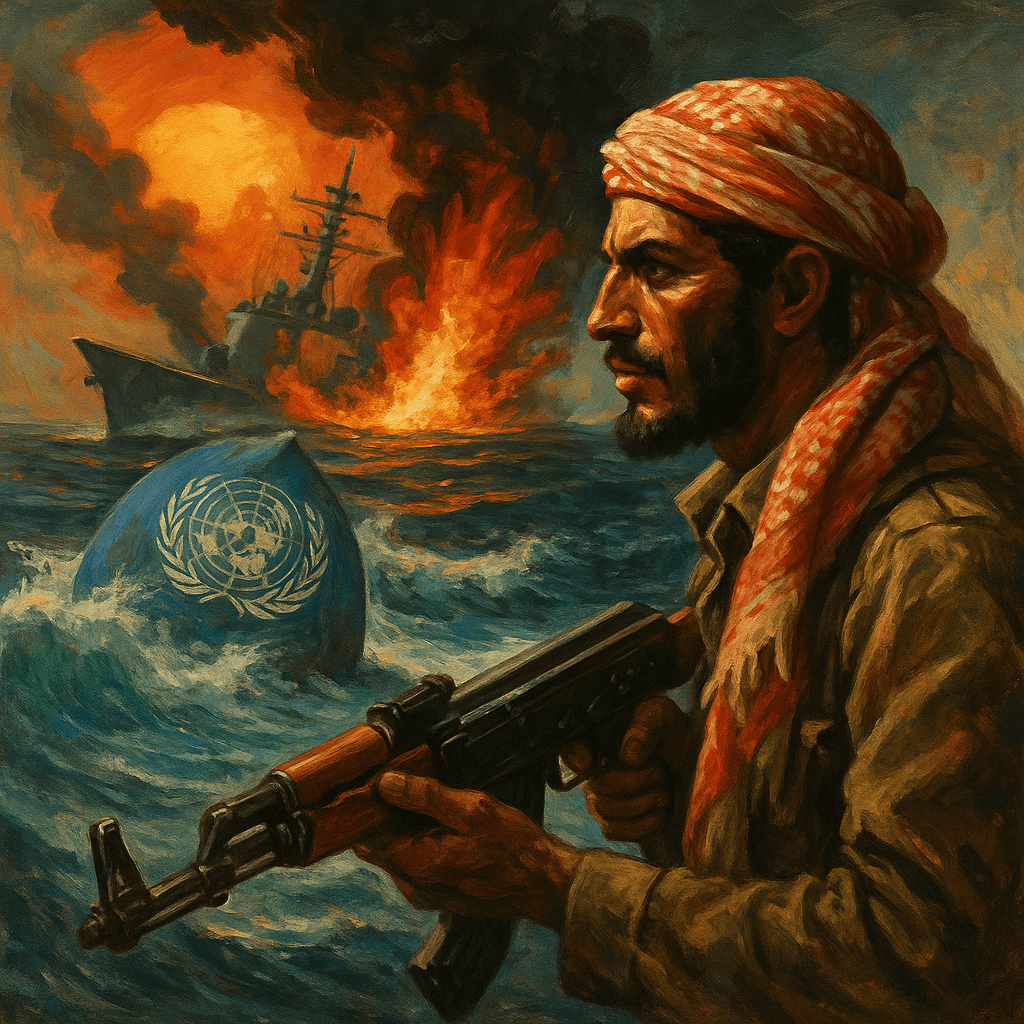
By Prince Kapone | Weaponized Information
July 20, 2025
Scripts of Subjugation: CNN and the Art of Imperial Storytelling
On July 19, 2025, CNN published an article titled “Nothing has changed: Iran tries to rearm proxy groups as US talks stall” by Mostafa Salem and Nic Robertson. The headline alone betrays the conceit—an exhausted empire, apparently baffled that Iran won’t submit, gestures again toward the same tired script. The article portrays Iran as a destabilizing force arming shadowy proxies across the Middle East, thwarting peace and dragging the region into chaos. Meanwhile, the United States, having recently “bombed the hell out of their various places,” is presented as reluctantly noble, open to negotiations but understandably frustrated. It’s not news—it’s a screenplay, one in which empire remains the protagonist, no matter how many bodies pile up offstage.
Let’s start with the cast. Mostafa Salem reports from CNN’s Middle East bureau in Cairo, often relying on U.S.-aligned governments and military sources. His work frequently recycles Pentagon and CENTCOM statements with minimal scrutiny, including past reports on Iranian activity in Iraq and Syria based heavily on anonymous defense officials. Nic Robertson, meanwhile, is CNN’s International Diplomatic Editor and a longtime fixture in the Western war-media circuit. In 2011, Robertson was embedded with British forces in Libya, producing coverage that downplayed NATO’s civilian casualties while parroting the official narrative of humanitarian intervention. He’s not a journalist—he’s an interpreter of imperial violence, translating bombs into policy.
Their employer, CNN, is owned by Warner Bros. Discovery, a conglomerate whose financial portfolio overlaps with weapons manufacturers, tech monopolies, and energy giants. During the 2003 Iraq invasion, CNN aired hours of Pentagon briefings uncritically, embedded reporters with U.S. troops, and gave airtime to military contractors posing as neutral analysts. In 1991, during the Gulf War, it famously turned war into television spectacle—live-streaming missile strikes and sanitizing carnage. This is not incidental. CNN is not just a broadcaster—it is a node in the U.S. war apparatus, a delivery system for legitimizing force under the veneer of journalism.
The article amplifies the usual suspects. Michael Knights of the Washington Institute—an AIPAC-linked think tank formed to launder U.S.-Israeli war policy into respectable analysis—offers the line that Iran is trying to show it “still exists” by rearming its allies. No context, no history—just psychologized paranoia. The piece also quotes the EU’s Aspides naval mission and private maritime risk firm Vanguard Tech, both of which exist to justify the securitization of international waters for Western shipping interests. It’s a full orchestra of imperial logistics: think tank, military op, private firm, media mouthpiece—each playing its part.
Beneath the surface, six propaganda instruments hold the piece together. First, framing: Iran is painted as a rogue saboteur, while U.S. and Israeli assassinations, bombings, and blockades are treated as routine maintenance of world order. The question of whether the U.S. or Israel has any legitimacy to strike sovereign territory is never raised. Second, selective absence: the article makes no mention of the years-long U.S.-backed Saudi war on Yemen, the Israeli bombings of Syria, or the open-air siege of Gaza. History is not background here—it’s liability, so it’s erased.
Third, there’s emotional priming. Words like “chaos,” “misery,” “strangulation,” and “existential crisis” are scattered throughout, evoking fear and helplessness. But the cause of that misery—the siege, the sanctions, the assassinations—is never attributed to the empire. Fourth, the article deploys a cognitive inversion: Iranian support for regional actors is cast as aggression, while U.S. occupation and economic control are depicted as natural conditions being disrupted. The logic is clear: empire is stability; resistance is instability.
Fifth comes civilizational contempt. A regional source is quoted asking rhetorically what Hezbollah’s weapons have “given them”—suggesting, with a colonial sneer, that resistance has no strategic value. This isn’t analysis. It’s mockery wrapped in expert language. Sixth, the legitimacy trick: Trump brags about bombing Iranian facilities and delaying talks, yet the article centers Iran’s responsibility for returning to negotiations. Violence from the West is normalized; diplomacy from the colonized is treated as obligation.
The article never seeks to understand resistance—it only wants to surveil and punish it. There is no room here for the political will of Houthis, Hezbollah fighters, Iraqi militias, or ordinary Iranians. They are ghosts, shadows, abstractions with weapons. Only empire has language. Only empire has reason. What CNN delivers is not journalism—it is cartography for the colonial imagination, drawing lines of threat and control while erasing the very lives those lines cut across.
Siege Behind the Headlines: Extracting the Buried Truths of Imperial Warfare
Behind the spectacle of CNN’s headline lies a set of verifiable, selectively curated claims that serve as the article’s foundation. To excavate the propaganda, we must first strip the narrative down to its bare bones:
- Red Sea Operations: U.S. Central Command claims to have intercepted a vessel carrying 750 tons of Iranian weapons—including missiles and drone parts—en route to the Houthis, marking the “largest weapons seizure” in Yemeni National Resistance Forces history.
- Houthi Attacks: The Houthis allegedly sank two commercial vessels using drone boats and missiles, killing four and capturing six crew members. These were the first major strikes after a period of calm.
- Iraq Strikes: Drone attacks attributed to Iran-backed groups hit five oil fields in the Kurdish region, including sites operated by U.S. companies, reportedly destabilizing production.
- Hezbollah’s Decline: The article asserts Hezbollah has lost credibility following the death of its leader Hassan Nasrallah, increased Israeli airstrikes, and the collapse of its Syrian supply line after the fall of Bashar al-Assad.
- Syria’s Role: Syria’s new government has allegedly intercepted multiple Iranian arms shipments bound for Hezbollah and claims to be monitoring money transfers through Iraq.
- U.S.-Iran Negotiations: Donald Trump declares he’s in “no rush” to negotiate, boasting about bombing Iran’s facilities. Iranian officials downplay the possibility of talks, noting that any diplomacy depends on Supreme Leader approval.
What CNN omits from this skeletal framework is the flesh and blood of material history. Take Yemen: far from being a story of unprovoked Houthi aggression, the Red Sea confrontations are rooted in a brutal U.S.-backed war. Since 2015, a Saudi-led coalition armed and supplied by the West has bombed Yemen relentlessly, turning the country into the world’s worst humanitarian disaster. The United Nations Development Programme estimated that 377,000 Yemenis had died by the end of 2021—about 60 % from indirect causes like starvation and disease—most of which are directly tied to the Saudi blockade. Iranian support to the Houthis must be understood in this context: not as escalation, but as asymmetric deterrence under siege.
The Houthis’ naval blockade and precision strikes in the Red Sea must be understood not as acts of piracy, but as lawful and morally justified interventions under international law. According to the 1948 Convention on the Prevention and Punishment of the Crime of Genocide, all State Parties are legally bound to “prevent and punish” genocide, which includes taking measures to halt ongoing or imminent mass atrocities. The Saudi-led coalition’s U.S.-backed war on Yemen has killed hundreds of thousands, imposed famine as policy, and systematically destroyed civilian infrastructure—actions widely recognized as meeting the Convention’s threshold for genocidal aggression. In that context, the Houthis’ disruption of supply chains used to sustain that war effort may constitute a legitimate and necessary act of collective self-defense and a legal duty to interrupt ongoing atrocities. Their actions are not rogue—they are a response rooted in principle.
In Iraq, drone strikes on U.S.-operated oil fields in the Kurdish region are often framed as destabilizing sabotage. But this overlooks the legacy of imperial oil extraction that made those sites targets in the first place. Since the 2003 invasion, U.S. and European oil companies—including Chevron, ExxonMobil, and BP—have extracted billions of dollars from Iraqi soil under the protection of American military bases and private contractors. Recent reporting from the Associated Press and Reuters highlights how the Popular Mobilization Forces (PMF), a coalition of Iran-backed militias, have targeted oil infrastructure—not out of nihilism, but as a continuation of anti‑occupation resistance. The Kurdistan Regional Government described these as “acts of terrorism” aimed at destabilizing the regional economy, while acknowledging they’re part of a broader struggle against foreign control over Iraq’s resources.
Hezbollah’s decline is presented as a collapse in credibility, but the real story is one of strategic repositioning amid enormous external pressure. The group was forged in 1985 to resist the Israeli occupation of southern Lebanon—an occupation that lasted 18 years. According to Augustus Richard Norton, Hezbollah developed not just a military wing but a wide social base, building schools, hospitals, and resistance infrastructure. Its strikes on Israel since October 2023 were not desperate—they were calibrated responses in solidarity with Palestine. Its “decline” is not a failure but a transition into a new phase of long-term confrontation with a more aggressive settler state.
Syria’s new anti-Iranian posture is cited without identifying the nature of the regime that replaced Assad. But if we look closely at reports from the International Institute for Strategic Studies and Carnegie Middle East Center, we find a familiar story: Jihadist mercenary death squads, IMF-aligned figures, U.S. diplomatic “advisors,” and Gulf-friendly technocrats forming a caretaker regime under foreign guidance. The seizure of Iranian weapons and financial networks by this government is less a regional turn against Tehran and more a textbook case of post‑conflict reorientation into the Western orbit.
Trump’s boasts of bombing Iran are left uncommented, but they represent open violations of international law. Article 2(4) of the UN Charter prohibits the threat or use of force against another state’s sovereignty. The assassination of IRGC commander Hossein Salami mirrors the 2020 murder of Qassem Soleimani, which the UN Special Rapporteur on Extrajudicial Killings deemed unlawful. These are not tactical moves—they are acts of war.
What CNN also ignores is the multipolar counter-current reshaping the very terrain it pretends to survey. Iran is no longer isolated. It joined BRICS+ in 2024, signed long-term energy and military cooperation deals with Russia and China, and has deepened ties with Latin American and African partners. The Tricontinental Institute’s analysis of “hyper‑imperialism” lays bare how nations like Iran are forging new circuits of sovereignty outside the U.S.-controlled infrastructure of SWIFT, the IMF, and dollarized trade. To call Iran’s arming of allies “provocation” while ignoring this structural siege is to miss the plot entirely.
What CNN calls “rearming proxies” is not a glitch—it’s the only available strategy within a world order designed to block legal, diplomatic, and financial alternatives. The so-called “smuggling networks” are the arteries of survival in a system that has criminalized sovereign self-defense. It is not Tehran destabilizing the region. It is the empire that built an architecture of war, theft, and coercion—and now fears the collapse of its scaffolding.
A Different Map of the Middle East: Reframing Resistance in a World on Fire
Peel away the sanitized headlines and one thing becomes clear: what the empire calls “chaos” is simply the world refusing to stay conquered. CNN’s narrative spins Iran’s actions—arming allies, disrupting logistics, and holding lines under siege—as desperation. But in reality, this is the logic of survival under imperial siege, not madness. The drone strikes in Iraq, the arms flowing to Hezbollah, the Red Sea blockades—these are not spasms of rogue actors. They are strategic acts of resistance by sovereign forces refusing to be dismantled and reassembled as clients of the U.S. security architecture. What we are witnessing is not a crisis of the region, but a crisis of imperial control.
This crisis takes the form of Imperialist Recalibration. When brute force no longer produces submission, the empire shifts to assassination, sabotage, and diplomatic siege. The U.S. assassination of Hossein Salami, the dismemberment of Syria, and the constant Israeli drone war across Lebanon and Iraq are not isolated events. They are symptoms of an order that can no longer command consent. As direct occupations backfire and proxy regimes lose credibility, imperial power adapts by splintering resistance and fragmenting sovereignty. This is not peacekeeping—it is crisis management through controlled destabilization.
Behind the drones and sanctions is a deeper structure: the Sanctions Architecture. Iran’s so-called smuggling networks exist because legal pathways are systematically blocked. A sovereign nation under constant economic siege, unable to trade in dollars or access its own assets, is forced to build informal economies and asymmetric defense systems. The financial infrastructure of empire—SWIFT bans, secondary sanctions, banking blacklists—is not merely punitive. It’s strategic warfare through monetized starvation. The missiles in Yemen and the rockets in Lebanon are not just launched from silos—they are forged in the fire of financial isolation.
But the deadliest weapon is not financial—it is psychological. Cognitive Warfare shapes public perception so thoroughly that empire’s aggression is seen as order, and resistance becomes an aberration. When the U.S. bombs an Iranian general, it’s a “targeted strike.” When Iran funds a defense militia, it’s “regional destabilization.” When the Houthis strike a shipping lane, it’s piracy. When the Saudis bomb a school bus, it’s a footnote. This asymmetry of meaning is no accident. It’s designed to make war palatable, colonization respectable, and rebellion irrational. The goal is to so thoroughly delegitimize anti-imperial actors that their mere existence is framed as threat.
But even this imperial narrative is beginning to fracture. Because on the ground, what’s emerging is not chaos—it’s Proxy Sovereignty. These forces—Hezbollah, the Houthis, the PMF in Iraq—are not puppets of Tehran. They are revolutionary formations with roots in their own national struggles. They have their own command structures, territorial bases, and political strategies. Their alliance with Iran is forged through shared enemies, not obedience. To reduce them to “proxies” is to erase decades of liberation struggle and regional working-class militancy. It is to deny the material conditions that birthed them in the first place.
As Samir Amin once wrote, imperialism does not collapse under the weight of its contradictions—it is dismantled by the coordinated insurgency of the periphery. What we’re seeing in the Middle East is precisely that: a distributed, decolonial refusal to accept the world order imposed by Washington and Tel Aviv. This is not the failure of diplomacy—it is diplomacy’s exposure as a colonial instrument. And it is not the collapse of statehood—it is its reconfiguration by popular forces under siege.
The Global South is learning to fight on all fronts—military, financial, informational. While BRICS+ builds economic alternatives, resistance movements defend those alternatives with rifles and rockets. Iran’s role is not that of a rogue arms dealer—it is a logistical hub of refusal. Every Houthi drone that crosses the Red Sea, every Iraqi rocket that lands on a U.S. compound, every Hezbollah operation that disrupts the Israeli border, reminds us that empire’s power is no longer absolute. It is contested. And it bleeds.
From the standpoint of the global proletariat, these forces are not threats to peace. They are the preconditions of it. Peace cannot be brokered by the arsonists who set the region ablaze. It must be built by those who remain standing in the ashes. What CNN calls instability is in fact the stubborn presence of organized life refusing to disappear. Their fight is not some distant regional quagmire—it is the front line of a global class war. And their victory is ours.
Solidarity Is Not a Slogan: Building a Frontline from the Global North
If imperialism wages total war, then solidarity must be total resistance. The bombs dropped in Yemen echo in Baltimore. The sanctions on Iran are cousins to the evictions in Oakland and the medical bankruptcies in Detroit. The same system that strangles Beirut with debt strangles Black and Indigenous communities with austerity and cops. So when the Houthis block a shipping lane or Hezbollah repositions on a border, we do not clutch our pearls—we recognize the language of refusal. This is not about regional affairs. It’s about global fault lines, and we in the imperial core must choose where we stand: as passive beneficiaries of empire, or as active saboteurs of its machinery.
First, let us make our position clear. We stand in militant solidarity with the Yemeni resistance and its naval campaign in the Red Sea. We stand with the Popular Mobilization Forces of Iraq defending their soil from U.S. extractivism. We stand with Hezbollah, not because we romanticize them, but because they remain one of the few forces in the region capable of withstanding Israeli settler-colonialism and refusing disarmament on imperial terms. And we stand with the Iranian people under siege—not as blank slates or passive victims, but as agents in a multipolar counteroffensive whose contours are still unfolding.
Take the Red Sea campaign. The Houthis have struck strategic shipping lanes with drone boats and missiles, disrupting the logistical arteries of global trade and forcing multinational corporations and insurance giants into retreat. The West calls it terrorism. We call it counter-logistics—a working-class disruption of imperial flow. It’s not just about cargo—it’s about cracking the illusion of U.S. maritime invincibility. This is how you turn chokepoints into weapons and oceans into frontlines.
So what do we do here, at the imperial command core? First, we launch a concrete divestment campaign targeting U.S. and NATO-affiliated arms manufacturers—Raytheon, BAE Systems, Lockheed Martin, Elbit Systems—and the financial institutions invested in them. Focus on university endowments, public pension funds, and city contracts. Start with the University of California system, which as of 2024 held approximately $3.3 billion in companies tied to the military-industrial complex, including weapons manufacturers. Demand immediate divestment and reinvestment in cooperative, worker-led infrastructure.
Second, we initiate a mutual aid front for revolutionary media. Build or support funding campaigns for platforms like
Al Mayadeen English and
Press TV. Offer technical support, decentralized hosting, and digital defense against cyberattacks. Model this after the 2021 “Palestine Media Support Network,” which raised over $1 million to rebuild independent media infrastructure in Gaza. Media is a weapon—arm it.
Third, we organize a Proletarian Cyber Resistance project to map U.S. naval infrastructure in the Red Sea, Gulf of Oman, and eastern Mediterranean. Use open-source intelligence (OSINT), satellite tracking, and leaked maritime insurance data to chart supply chains, refueling stations, and arms routes. Publish these maps as public counter-surveillance tools and strategic guides for activists and researchers alike. Expose the architecture of empire in motion.
Fourth, we build political education infrastructure to carry these truths into our unions, campuses, and neighborhoods. Start local teach-ins on the weaponization of the Red Sea, the history of sanctions warfare, and the role of resistance economies. Tie these conversations directly to domestic conditions: rising energy prices, militarized police budgets, and the theft of public wealth for endless war. Create accessible materials that trace the imperial chain from our streets to their shorelines. Bring maps. Bring visuals. Bring rage.
This isn’t charity. It’s counterpower. Our job is not to speak for the resistance—it is to disrupt the comfort of imperial silence. The point is not to translate the struggle, but to escalate it. When we sabotage complicity at home, we extend the front line. When we fund media, we punch holes in the narrative. When we strike at supply chains, we force the empire to fight on too many fronts. That’s how empires collapse—not by debate, but by interruption. Their system is global. Ours must be too.
 Weaponized Information
Leave a comment