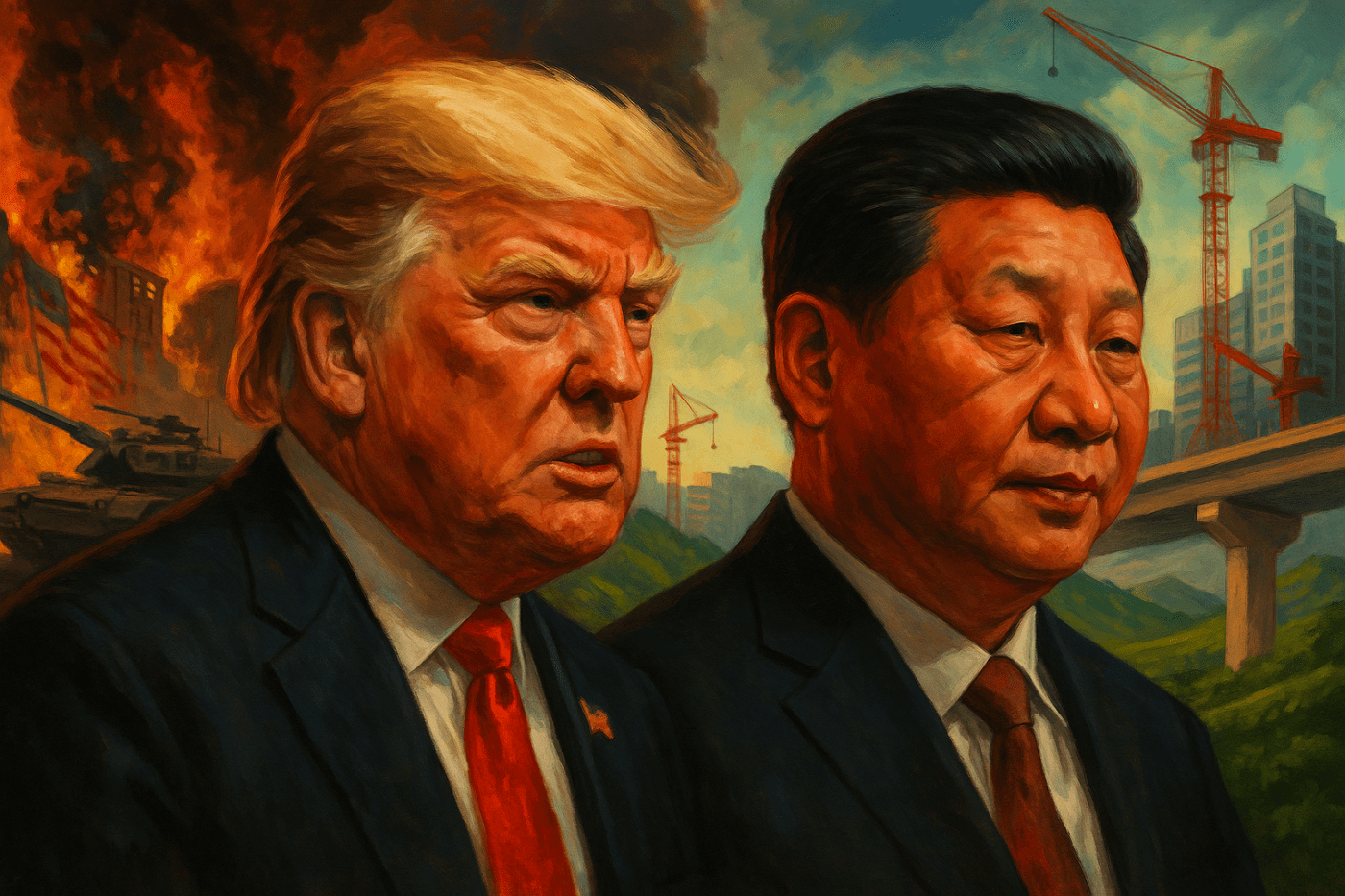
As U.S. global credibility collapses under the weight of its own violence, Pew polls and Associated Press narratives step in to soothe the liberal conscience and reframe revolt as a perception glitch. But the world has moved on—and it’s not looking back.
By Prince Kapone | Weaponized Information
July 18, 2025
Narrative Management in a Dying Empire: Pew, AP, and the Manufacturing of Relevance
“Global views of China and Xi improve, while they decline about the US and Trump, survey says” is a July 15, 2025 article published by the Associated Press and penned by Didi Tang, a long-time correspondent for Western outlets whose past reporting from Beijing reflects the typical Beltway-aligned lens of suspicion, distortion, and liberal angst toward China’s rise. The article summarizes the latest findings from the Pew Research Center, which show a modest uptick in global views of China and Xi Jinping, and a sharper decline in the image of the United States and Donald Trump. On its face, it appears neutral. But under the hood, it’s something else entirely: a well-calibrated tool of narrative stabilization, meant to keep the American liberal class ideologically tethered to a collapsing empire.
Let’s start with Didi Tang. Her function is not to deliver critical journalism—it’s to channel the concerns of the empire’s chattering class into manageable sentiments. She doesn’t interrogate imperial power; she laments its declining popularity. Like so many foreign correspondents trained in Cold War atmospherics, Tang avoids structural critique in favor of soft emotional calibration. Her reporting doesn’t examine why trust in the U.S. is falling—it simply registers that it is, and then quickly asks: what can be done to restore it? This is the ideological reflex of someone deeply embedded in the machinery of liberal empire maintenance. Not a saboteur of empire, but a sentimental technician.
As for the Associated Press, its claims to neutrality are betrayed by its actual function. AP isn’t just a news service—it’s one of the key arteries of imperial communication. Its content feeds the pipelines of CNN, MSNBC, NPR, the BBC, and hundreds of local U.S. outlets who no longer fund serious foreign coverage. What AP prints becomes gospel for the passive consumer. And what this article prints, quite plainly, is the idea that global opinion matters only in relation to U.S. credibility. Not hunger, not war, not dignity—just credibility. AP is not reporting global sentiment. It’s orchestrating American anxiety.
The principal amplifier here is the Pew Research Center, which masquerades as a dispassionate polling institution while operating as a core node of the U.S. perception management ecosystem. Pew is funded by The Pew Charitable Trusts, a philanthropic entity long embedded in elite consensus manufacturing. Its reports are routinely cited by imperial think tanks like Brookings and the Center for Strategic and International Studies (CSIS), which use Pew’s data to validate military budgets, tech censorship, and diplomatic hardball. These institutions don’t exist to tell us what the world thinks—they exist to decide which thoughts count.
This article performs its ideological labor through six distinct propaganda maneuvers. First, there is strategic neutrality: while it reports China’s modest improvement in global favorability, the entire frame centers U.S. “trust” and “credibility,” implicitly suggesting that any decline in U.S. image is a global crisis. Second, we see absence as containment: there is no mention of why confidence in the U.S. is eroding—no reference to drone warfare, coups, sanctions, or surveillance. Third, the article relies heavily on emotional pacification, using words like “trust” and “reliability” to shift the reader’s concern from material conditions to managerial aesthetics. Fourth, the piece deploys comparative confusion, flattening global contradictions into poll numbers that frame empire as just another brand with a bruised reputation. Fifth, there’s a textbook case of false equivalence: past criticisms of China’s pandemic policy or human rights record are invoked vaguely, as if China and the U.S. are equally culpable players in a shared geopolitical decline. And sixth, we find what can best be described as ideological suggestion: Xi Jinping’s rise in approval is presented without explanation, inviting the Western reader to infer some suspicious undercurrent—“He’s up, but we don’t know why”—as if the global South’s judgment is always suspect, always in need of correction.
This is not an article about world opinion. It’s a script for the managerial class of the imperial core, one that transforms structural collapse into an issue of public relations. It doesn’t challenge U.S. global dominance—it weeps for its dented image. It doesn’t reckon with the historical causes of anti-American sentiment—it offers therapeutic cues for how to cope with the loss of imperial prestige. When Trump’s base starts burning MAGA hats and calling the whole thing a hoax, it’s not because they’ve seen through the propaganda. It’s because their favorite brand of it is being edged out. Meanwhile, the Associated Press is still clinging to the fantasy that if the numbers can be framed just right, maybe the empire can still sell itself to the world. But the world is not buying. And beneath the quiet desperation of this article lies the one truth no imperial institution can admit: the decline is not a poll—it’s a process. And it’s not reversible.
The World Remembers: U.S. Decline Is a Verdict, Not a Mood
Pew’s numbers may be accurate, but its story is incomplete. It’s true that the U.S. has lost favor across much of the world, and it’s true that China’s image is rising, if modestly. But what Pew and the Associated Press refuse to say outright is that this isn’t just a matter of trust in leadership or diplomatic style—it’s a deeper indictment of an imperialist system in decline. Global opinion hasn’t turned sour because Trump tweets too much or Biden stutters too often. The world is fed up with the violence, theft, arrogance, and control the U.S. has exported for generations. What we are seeing in these polls is not a crisis of charisma. It is a hard-earned backlash against empire. And the people doing the polling know it.
According to the AP article, Pew surveyed more than 30,000 people across 25 countries between January 8 and April 26, 2025. In 10 high-income countries—among them Canada, France, Germany, and Italy—favorability toward the U.S. dropped from 51% last year to 35%. Meanwhile, China’s favorability rose from 23% to 32%. Trump’s global confidence rating sits at 24%, down from Biden’s 53% in the previous year. Xi Jinping, though still below majority approval, rose from 17% to 22%. Israel stood out as an exception: 83% viewed the U.S. favorably, with 69% expressing confidence in Trump and just 9% in Xi. That disparity, while presented as an outlier, actually confirms a deeper pattern—those most materially and ideologically aligned with U.S. imperialism cling hardest to its decaying legitimacy.
What’s missing from the AP report is a mountain of evidence that the world’s negative views of the United States are not new, and not vague. In fact, the U.S. has consistently been seen as the greatest threat to global peace. In a 2019 YouGov poll in Germany, respondents voted U.S. President Donald Trump the “greatest threat to world peace.” That trend continued in 2018 Ipsos Global Advisor polling, which found that across 30 countries, only 29% of global respondents believed Trump’s policies had made the world safer. Even the European Council on Foreign Relations reports that many EU citizens view the United States not just as a declining power, but as a threat to European democracy itself. This isn’t about a personality crisis. It’s about structural revulsion.
That revulsion is rooted in history—and in material conditions. The United States maintains over 750 military bases around the globe, 200 of which surround China. It enforces sanctions on more than 30 countries, many of them in the Global South, crippling their ability to import medicine, food, and essential goods. According to the truthout, these blockades led to tens of thousands of unnecessary deaths during the COVID-19 pandemic alone. The Sanctions Architecture functions as a system of economic warfare, targeting any nation that defies U.S. policy or asserts its sovereignty. Venezuela, Iran, Cuba, Zimbabwe, Nicaragua—these are not rogue regimes, they are test cases in collective punishment. And the world sees it.
By contrast, China’s rising favorability is grounded in material partnerships and political restraint, not marketing. In Africa, the Afrobarometer Annual Report 2023 shows that Chinese infrastructure investment and development aid are widely welcomed, especially compared to Western loans tied to privatization demands and debt servitude. In Southeast Asia, the State of Southeast Asia 2024 survey by the ASEAN Studies Centre found that China has overtaken the U.S. as Southeast Asia’s preferred strategic partner—chosen by over half of respondents—because these countries have “done the math,” weighed against coups, surveillance, and militarized U.S. encirclement. These are material choices, not illusions.
The pivot to China is not an endorsement of authoritarianism—it’s a rejection of permanent dependency. When China brokered the 2023 peace agreement between Iran and Saudi Arabia, or when it pushed forward infrastructure financing through BRICS+, it showed that a different kind of power arrangement is possible—one that doesn’t begin with bombs and end in austerity. This does not mean China is benevolent, or that its interests always align with those of working people. But it does mean that China is not offering vassalage. And that distinction matters deeply to those in the Global South who’ve lived through centuries of European and American plunder.
Even within the Global North, the contradiction is becoming harder to suppress. The Pew report’s numbers show cracks in the empire’s own image. The U.S. public may still be conditioned to think of its country as “the leader of the free world,” but the rest of the world increasingly sees it as the lead jailer of sovereignty. The fact that Pew and AP refuse to name the historical causes of this sentiment is not a mistake—it’s a tactic. By treating global distrust as a new phenomenon, they erase the long trail of burned villages, crushed unions, and IMF contracts that produced it.
And what of Israel? Its outlier status makes sense when placed in material context. Israel is not simply a U.S. ally—it is a regional enforcement outpost, bankrolled with billions in annual military aid. Its overwhelming favorability toward the U.S. is not the result of cultural admiration—it is a byproduct of shared settler colonial logic and a deep reliance on imperial sponsorship. That 83% approval rate isn’t a reflection of trust—it’s a confession of dependency.
Global views don’t shift in a vacuum. They reflect centuries of policy, generations of memory, and the real-life experiences of people at the wrong end of empire. The world hasn’t just changed its mind. It has finally found the words to say what it’s always known: U.S. leadership is not leadership at all. It is domination dressed in PR. And the people are done being polite about it.
What the World Already Knows: Decline Can’t Be Polled Away
Pew asks the world whether it “trusts” the United States, but the world has already delivered its answer—and it didn’t need a survey. What we’re witnessing isn’t a reputational dip or a branding problem. It’s the unraveling of an empire that no longer knows how to rule except through coercion. The Associated Press frames this moment as a leadership crisis. But Trump is not the disease—he’s a symptom. What’s decaying is not the office, but the entire edifice. The trust deficit isn’t between foreign publics and the U.S. president—it’s between the Global South and the imperial system itself. No number can hide that rot. And no poll can re-legitimize a global order built on theft, occupation, and conditionality.
This is the political essence of what we call Imperialist Recalibration: the strategic reorganization of coercive power in the face of declining legitimacy. The U.S. can no longer command with soft power alone. Its old weapons—NATO diplomacy, dollar supremacy, Harvard-branded liberalism—are losing their magic. What replaces them is a more desperate posture: sanctions layered on top of sanctions, think tanks churning out Cold War scripts, and media outlets like AP trying to convince Americans that “trust” is the problem—not the policies that shattered it. This recalibration is not reform. It’s reinforcement. It’s the empire wrapping itself in barbed wire as it sinks deeper into disrepute.
The Pew survey doesn’t just measure sentiment—it’s part of the infrastructure that helps manage it. This is where Perception Management Infrastructure enters the frame. Institutions like Pew, Brookings, and CSIS are not just observers of global opinion—they are architects of ideological containment. They take the collapse of U.S. credibility and repackage it as a minor issue of optics, a crisis of personality, or a hiccup in messaging. When the world says, “We reject your empire,” Pew asks, “But what if we sent a different CEO?” This sleight of hand turns imperial violence into a question of public relations. And the Associated Press plays its part by laundering that question through journalism.
This containment isn’t just psychological—it’s technological. The United States is responding to global distrust not by changing its behavior, but by expanding its control over speech, data, and access. This is the logic of Technofascism: the fusion of state power with digital infrastructure to preempt dissent and secure imperial narratives. Visa bans on international students, AI-powered censorship algorithms, and surveillance coordination across tech firms aren’t isolated measures—they’re architecture. In a world where the U.S. can no longer claim moral leadership, it builds firewalls instead. And every firewall erected against the Global South is eventually aimed inward, toward domestic populations deemed unruly, ungrateful, or ungovernable.
Within this matrix, the media doesn’t inform—it engineers belief. The rise in China’s favorability is not treated as a shift in material alliances, but as a mysterious development, as if the world simply “woke up” liking Beijing. That framing isn’t ignorance—it’s strategic. It allows institutions like Pew and AP to skip over the infrastructure projects, the debt relief, the peace mediation. Instead of asking why people prefer China in some cases, they imply it must be an illusion. This is the subtle work of Digital Colonialism: delegitimizing the political consciousness of the Global South by filtering its preferences through a Western rubric of “reliability” and “trust.” If a country prefers China, it must be misinformed, manipulated, or illiberal. Never rational. Never sovereign.
This epistemic hierarchy is how empire defends itself when it can no longer dominate by force alone. It erases the political agency of the colonized, the working class, and the multipolar South by implying that their choices are errors to be corrected. And yet, those choices are increasingly decisive. When Angola enters BRICS+ debt-clearing arrangements, or when Southeast Asian governments reject U.S. base expansion, they are exercising dual and contending power—constructing material alternatives to the empire’s monopoly on legitimacy. These shifts are not merely diplomatic. They are structural expressions of de-linking, of delinking not just from U.S. policy, but from U.S. reality.
The AP’s attempt to script global dissent as a mood swing, and Pew’s effort to quantify revolt into a digestible chart, are both acts of desperation. They reveal a class of imperial managers who still believe that hegemony can be restored by measuring its decay. But the rest of the world has moved on. The peoples of the Global South are not waiting for a better poll—they are building the conditions for sovereignty. And the working class in the Global North must recognize that its fate is bound to this rising tide. The question is not whether we trust the U.S. empire. The question is how long we will allow it to define trust at all.
Dig the Grave, Don’t Just Read the Polls: Turning Crisis into Counterpower
The world has moved on. It sees the United States not as a beacon, but as a threat. The Pew numbers confirm what the bombs, blockades, and sanctions already taught: empire is not a misunderstanding—it’s a machine. And that machine is breaking down. But here in the heart of it, in the belly of the beast, most of us are still taught to treat imperial decline like a public opinion problem. As if more transparency, better presidents, or a rebrand could restore faith in the global enforcer. That’s the illusion this AP piece tries to sustain. But the working class in the imperial core has another job: not to restore the empire’s legitimacy, but to dismantle its infrastructure. If the empire is bleeding trust, we don’t give it a bandage—we hand it a shovel. The only proper response to the collapse of U.S. credibility is to make sure it stays buried.
We begin by standing in clear solidarity with those already digging trenches against empire. BRICS+ is not just a diplomatic alliance—it’s a wedge in the wall of Western financial domination. In May 2025, Angola entered debt-clearing talks within BRICS+ to bypass the IMF and settle payments in non-dollar currencies. This isn’t a symbolic gesture—it’s an act of dual and contending power, a strategic rejection of the empire’s monopoly over money and punishment. From Latin America’s push for regional financial autonomy to China’s alternative infrastructure corridors, the resistance is not abstract. It’s material. And it’s growing. Our job is to support it—not with empty cheerleading, but with action from inside the core.
Here’s how we strike back against the perception management machine from within the Global North:
1. Target the Money Behind the Metrics
The Pew Research Center doesn’t operate in a vacuum. It is funded by the Pew Charitable Trusts, whose endowment includes corporate holdings tied to Wall Street and Big Tech. We launch a public campaign to expose and disrupt this financing network. Demand financial disclosures, map the trustees and donors, and pressure media institutions to label Pew as a U.S. soft power actor, not a neutral observer. Use counter-metrics to highlight their bias—track which regions get polled, whose voices are erased, and which results get press amplification. Turn transparency into sabotage.
2. Fund the Global South’s Data Sovereignty
Data is warfare. And the Global South has been forced to rely on Northern institutions for measuring its own population, economy, and sentiment. We redirect resources into autonomous initiatives like the Tricontinental Institute, regional polling cooperatives, and decolonial research networks. Provide funding for survey translation, infrastructure, digital security, and public dissemination. Support South-South knowledge production that doesn’t filter its findings through empire’s rubric. Let the world speak for itself—and let us amplify, not interpret.
3. Build the Tools to Track Their Lies
Develop and deploy an open-source browser extension or mobile app that flags propaganda mechanisms in real time across U.S. and Western media outlets. Use GitHub to host a plugin that detects framing cues, statistical manipulation, and source bias in publications like AP, Reuters, and Bloomberg. Integrate it with existing counter-disinfo platforms to build a living database of perception management. Make ideology visible—train the working class to read between the graphs.
4. Teach What Trust Really Means
Launch a popular political education series titled “Who Shapes the World?” built around live teach-ins, downloadable zines, and short-form video explainers. Use the Pew article as a case study in ideological warfare. Break down the mechanics of soft power, survey manipulation, and institutional framing. Host monthly Zoom sessions connecting educators in the imperial core with anti-imperialist scholars in the Global South. Make trust a political question, not a poll result. Train the class not just to read the news—but to destroy its architecture.
Imperial decline is not a spectator sport. It’s an opening. And every institution that seeks to soften or delay that collapse—Pew, AP, the think tanks and narrative managers—is an enemy infrastructure node. Don’t wait for collapse to be televised. It already is. The question is whether we treat it as news—or as a battlefield. A new world is clawing its way out of the wreckage. If we are to have a place in it, we must earn that place by helping bring the old one down. Start digging.
 Weaponized Information
Leave a comment