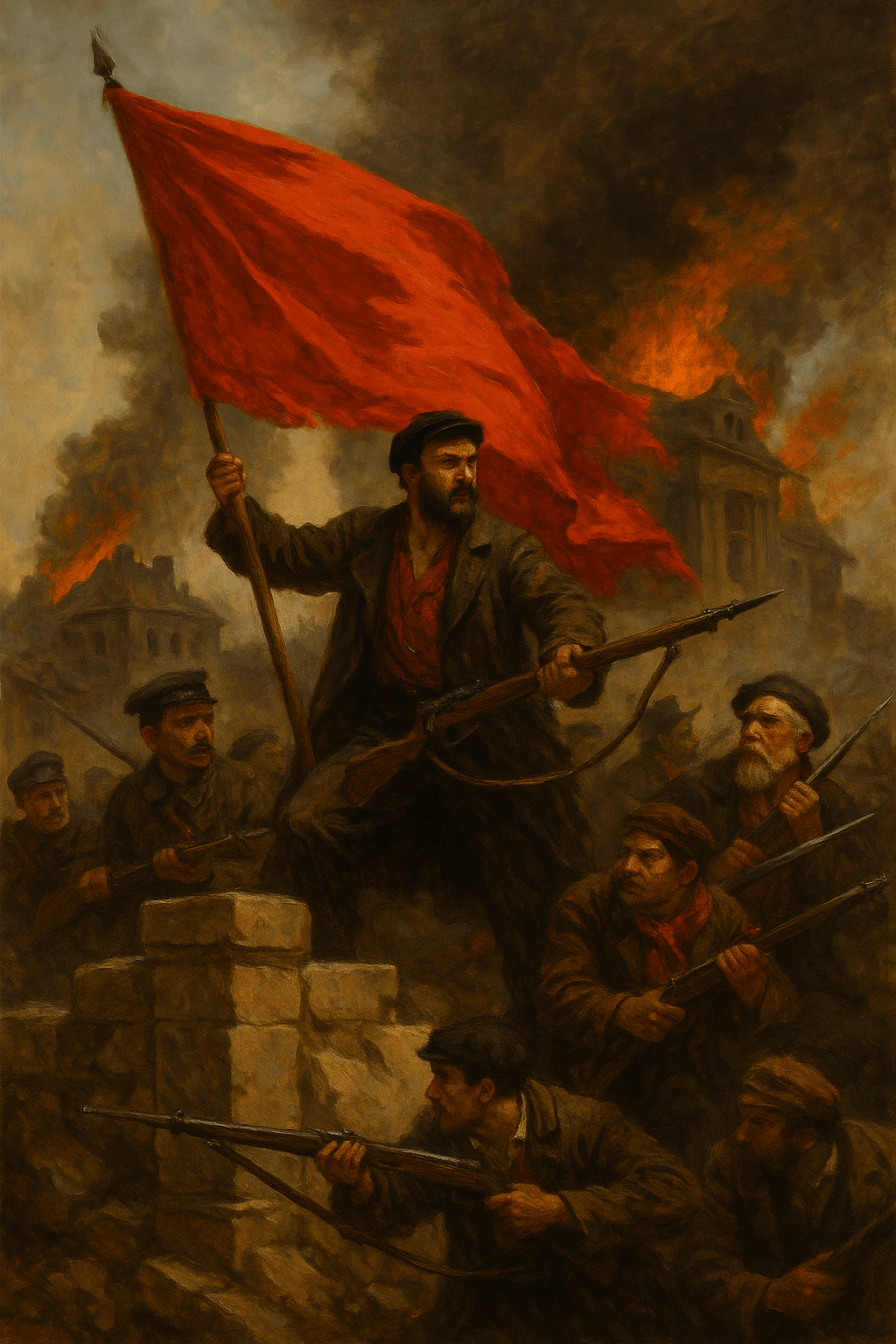
In The Civil War in France, Karl Marx did not romanticize revolution—he studied it, dissected it, and returned its lessons to the working class as weapons. From the smashing of the bourgeois state to the early contours of the dictatorship of the proletariat, the Paris Commune revealed the shape of worker power in embryo. This article excavates Marx’s intervention as a blueprint for revolutionary leadership, proletarian discipline, and the ruthless demolition of capitalist illusions.
By Prince Kapone | Weaponized Information | July 17, 2025
🟥 Storming Heaven: The Commune and the Machinery of Rupture
“The working class cannot simply lay hold of the ready-made state machinery, and wield it for its own purposes.” With that one sentence, Karl Marx lit a match under the entire scaffolding of liberal democracy. No ballot box alchemy. No bourgeois constitution converted into a tool of liberation. No savior riding in on horseback—or in our case, Twitter. The capitalist state, Marx insisted, is not a neutral instrument. It is a fortress. And the only way to liberate the working class is to breach the walls, dismantle the arsenal, and torch the blueprints.
In The Civil War in France, written while the blood of Communards still soaked the cobblestones, Marx did not marvel from afar at the Paris Commune. He studied it. Not as a fantasy of the future, but as a living laboratory of proletarian statecraft. It wasn’t perfect. It wasn’t finished. It wasn’t even victorious. But it was real. “Its true secret,” he wrote, “was this. It was essentially a working class government.” Not one that claimed to speak for the workers. Not one that promised to deliver someday. But one actually composed of workers, accountable to workers, and acting in the name of their own class power.
Marx saw in the Commune the first historical appearance of what he called “the political form at last discovered under which to work out the economic emancipation of labor.” It wasn’t a finished structure. It was a weapon in development, forged in the fire of mass struggle. The Commune abolished the standing army. It replaced professional politicians with delegates subject to immediate recall. It cut the salaries of public officials to those of ordinary workers. It tore down the Napoleonic pillar of national chauvinism. And it did so while under siege from the Prussian military and betrayed by the French bourgeoisie. “The Commune was formed of the municipal councillors,” Marx wrote, “chosen by universal suffrage…responsible and revocable at short terms.” This wasn’t democracy as brand identity—it was power as proletarian necessity.
But this wasn’t utopia. It was contradiction incarnate. It was the dawn of a new class rule, not the end of all rule. It was a dictatorship of the oppressed over the oppressors. The working class, for the first time in history, was attempting to govern not in the name of justice or nation or civilization, but in the name of its own collective interest. “The Commune,” Marx clarified, “was to be a working, not a parliamentary body, executive and legislative at the same time.” And that made it dangerous—not only to the ruling class in France, but to every ruling class on earth. Because if workers could govern themselves in Paris, they could do it in Petrograd, in Havana, in Johannesburg, in Chicago, in Gaza.
What Marx uncovered was not a model to be copy-pasted, but a strategic breakthrough to be studied, adapted, and advanced. The bourgeoisie understood it better than most of the Left does today. That’s why they responded with such savage violence. The slaughter of the Communards was not a response to a threat—it was a response to a precedent. Because the Commune proved that the state is not immortal. That it can be seized, disassembled, and replaced. And that lesson, once learned, cannot be unlearned.
🟥 The Wreckers of Empire: Class Dictatorship and the Negative Form of Power
Marx did not write in celebration of the Commune as a blueprint for what to build, but as a wrecking manual for what had to be destroyed. The genius of the Commune was not that it perfected proletarian governance, but that it initiated the systematic dismantling of the capitalist state. It began the negative work—the necessary demolition—that every revolution must undertake if it is to escape the gravitational pull of the old order. And it did so with clarity and courage. “The Commune made that catchword of bourgeois revolutions—cheap government—a reality,” Marx wrote, “by abolishing the two great sources of expenditure: the standing army and the State functionarism.”
The Commune moved quickly. It shattered the chain of command that linked the police, the military, and the bureaucracy to capitalist property. The standing army was dissolved and replaced with a people’s militia. The police were stripped of their political function and placed under communal authority. Judges lost their lifetime posts. Bureaucrats were no longer insulated mandarins; they became accountable servants. “All officials, high or low,” Marx noted with satisfaction, “were to be paid only the wages of a workman.” The capitalist class was being evicted from the institutions it had built to rule in its own image. The state was no longer theirs.
None of this was symbolic. These weren’t reforms. They were ruptures. Material blows against the very mechanisms that uphold class society. Marx saw in the Commune the embryo of a dictatorship of the proletariat—not as tyranny, but as transition. A dictatorship not over people, but over the conditions of exploitation. A dictatorship not of cruelty, but of necessity. The working class cannot govern through the old forms. The old forms are scaffolds for capital, constructed to protect private property, suppress mass politics, and neuter revolutionary energy. If the state is a weapon, then the first task of revolution is to disarm the class that wields it—and to take that weapon into proletarian hands.
Marx was blunt. The bourgeois republic, even stripped of monarchy, remained a “dictatorship of capital.” Elections every four years did not change that. What the Commune did—what terrified the ruling class—was to begin constructing a power that did not depend on professionals, managers, lawyers, or landlords. It called their bluff. It revealed that society could run without them. And worse—that it could run better without them. “It broke the instrument of class rule—the state machine—and replaced it with institutions truly responsive to working people.” That is not reform. That is rupture.
And in case anyone had doubts, the bourgeoisie responded as they always do when their rule is interrupted: with butchery. Not because they were frightened of failure, but because they were frightened of success. The danger of the Commune was not its instability—it was its example. It showed the world that another form of power was not only imaginable, but achievable. And so they killed it. In its infancy. In its sleep. But not before it taught us how to fight, how to build, and most importantly—how to destroy.
🟥 Leadership in the Furnace: Errors, Discipline, and Proletarian Pedagogy
Marx did not canonize the Commune. He weaponized it. He studied its errors as seriously as its triumphs, not to discredit the revolution, but to discipline future ones. This was not armchair hindsight. It was revolutionary pedagogy. “The great social measure of the Commune,” Marx wrote, “was its own working existence.” That’s not a slogan. It’s a diagnosis. The Commune did not live long enough to build socialism—but it lived just long enough to begin destroying the state machinery that made socialism impossible. Its first and greatest accomplishment was simply being. Governing. Acting. Surviving, however briefly, as a living body of proletarian power.
But Marx did not flinch from critique. He denounced the Commune’s fatal mistake in “standing respectfully outside the gates of the Bank of France.” That building—its gold, its credit instruments, its levers of financial sovereignty—remained untouched. “This was also a serious political mistake,” Engels later reflected, “the bank in the hands of the Commune would have been worth more than 10,000 hostages.” Here lies a lesson in revolutionary strategy: the seizure of power means nothing if the circuits of capital remain intact. The Commune overthrew the state but hesitated at the vault. And in that hesitation, the bourgeoisie found oxygen.
Marx also diagnosed the ideological shortcomings that weakened the Commune from within. The Blanquists, who had dominated the Central Committee, believed in seizing power through a disciplined minority. But when faced with the responsibilities of governance, they decentralized. Irony, Marx observed, was not just poetic—it was historical. “And what did the Commune, with its majority of these same Blanquists, actually do?” he asked. “They instituted the very decentralization they had always opposed.” In the heat of revolution, theory melted. And still, something clearer was forged.
The Proudhonists, too, were turned inside out. Suspicious of association, hostile to centralized coordination, they nonetheless participated in collectivizing closed factories into worker cooperatives and proposing their integration into a single industrial union. “The Commune,” Marx noted, “was the grave of the Proudhon school of socialism.” The lesson here is sharp: revolution radicalizes even its most cautious participants. There is no pure ideological alignment. Only struggle, rupture, and rectification.
What Marx models here is not detachment, but fidelity. He did not exalt the Commune as flawless. He embraced it as formative. Not because it succeeded, but because it fought. Because it dared. Because it illuminated, through both courage and failure, the terrain of revolutionary leadership. “They have no ready-made utopias to introduce,” Marx wrote of the Communards, “they knew that to work out their own emancipation…they would have to pass through long struggles.” That is the mass line. That is revolutionary humility. That is what separates a doctrine from a living process.
The Commune was not defeated because it lacked idealism. It was defeated because it lacked time, weapons, coordination, and allies. But what it built—however incompletely—was a new horizon. And what it left behind was a strategic archive for all who follow. The point is not to repeat the Commune. The point is to study it, absorb it, and surpass it. That is what Marx did. And that is what we must do now.
🟥 The Lesson Written in Blood: From Belleville to Gaza, the Class War Continues
There are moments in history when the future bleeds into the present—when a single act of defiance becomes a roadmap, and a single defeat becomes a prophecy. The Paris Commune was one of those moments. It was not just a rebellion. It was a declaration. A brief but blazing affirmation that the working class can govern, can build, can destroy and create in the same breath. And that affirmation was so dangerous, so intolerable to the ruling class, that they buried it in blood. “Paris,” Marx wrote, “the head and heart of the working class, has been made to bleed at every pore.” That sentence is not a metaphor. It is a record of slaughter. Twenty thousand dead in a week. Executed in cellars, on sidewalks, behind barricades. Their only crime was that they had dared to take power.
And yet, they live. “Working men’s Paris,” Marx wrote, “with its Commune, will be forever celebrated as the glorious harbinger of a new society.” That sentence, too, is not metaphor. It is obligation. Because the Commune was not just buried—it was inherited. It lives wherever workers build their own organs of power. Wherever landlords are evicted and police disarmed. Wherever bureaucrats are subject to recall and property is reclaimed as collective life. It lives in the soviets of 1917, the land seizures of Zimbabwe, the co-operatives of Chiapas, the communal councils of Venezuela, the popular committees of Jenin and Khan Younis. It lives wherever people organize not to be governed, but to govern.
Engels, writing twenty years later, made it plain: “That was the Dictatorship of the Proletariat.” Not the caricature painted by Cold War propagandists, but a living form of worker power. Not a fantasy of control, but a structure of defense. A state form not for perpetuating rule, but for transitioning beyond it. And if today’s revolutionaries hesitate to use that term, it is only because they fear what it demands: discipline, courage, rupture. The dictatorship of the proletariat is not a slogan. It is a condition. Without it, there is no path out of capitalist barbarism. Only spectacle, simulation, and surrender.
Marx never claimed the Commune was enough. He claimed it was necessary. He knew that its survival would have required coordination across cities, solidarity across borders, and the immediate expropriation of the ruling class. “The working class did not expect miracles from the Commune,” he reminded us. “They have no ready-made utopias to introduce.” That sentence should be carved into every revolutionary headquarters. No blueprints. No saviors. Only struggle, forged through contradiction, carried out by the masses themselves.
Today, as technofascism tightens its grip, as imperial wars escalate under the banner of freedom, as AI is weaponized to suppress dissent and enclose cognition itself, we return to the Commune not as symbol but as strategy. From Belleville to Baltimore, from Montmartre to Manila, the conditions that birthed the Commune are here again: mass immiseration, elite indifference, political theater, and militarized repression. The only thing missing is us.
So let us not mourn the Commune. Let us not romanticize it either. Let us study it, internalize its contradictions, and pick up the line where it was dropped. “It was the conquest of that political form which at last allows the economic emancipation of labor,” Marx wrote. The conquest—not the concession. And that form, however unfinished, is now our inheritance.
We owe the dead more than flowers. We owe them fidelity. Not to what they were—but to what they began.
 Weaponized Information
Leave a comment