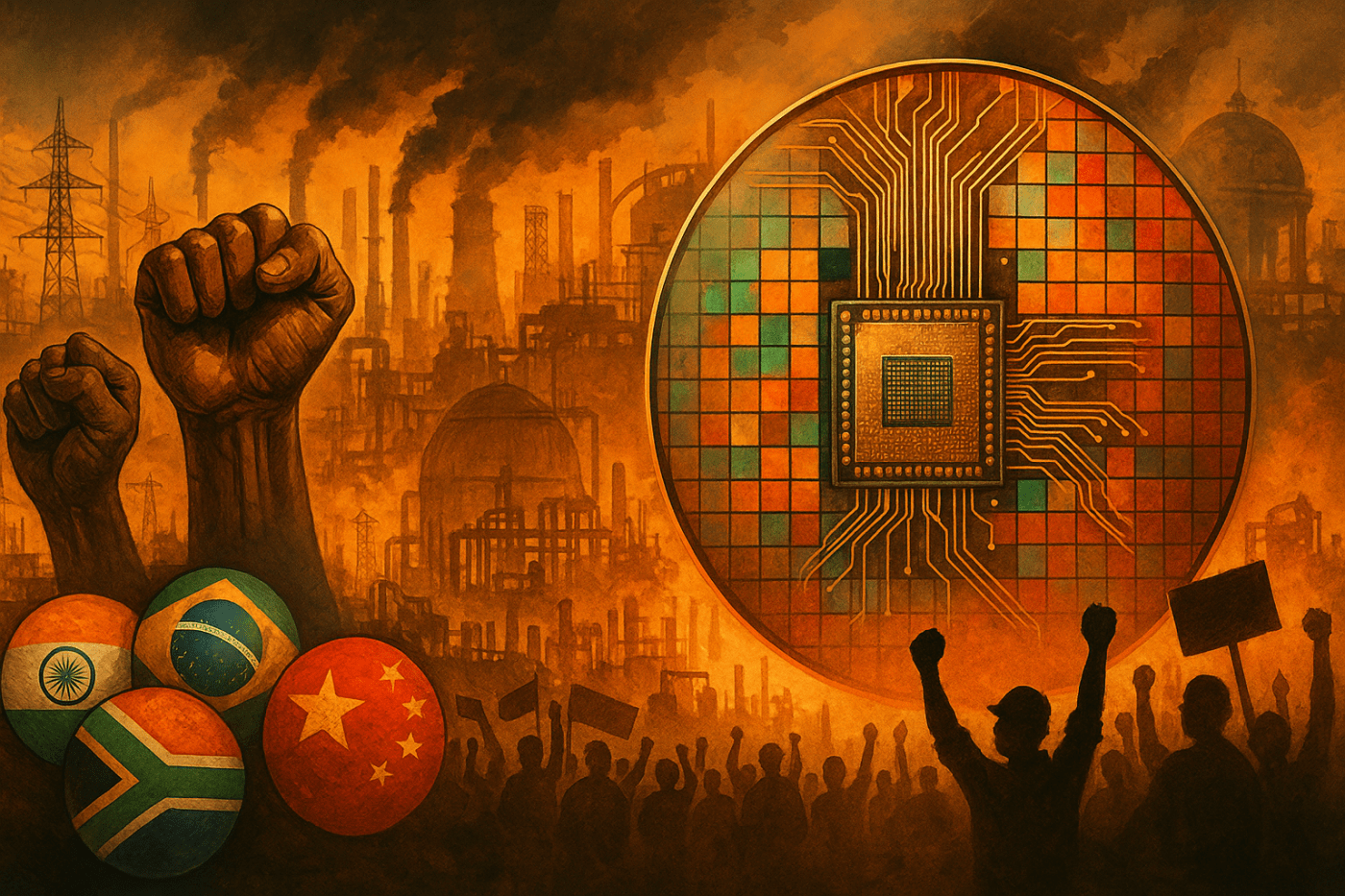
Behind CNN’s techno-optimist veneer lies a blueprint for digital counterinsurgency—where chip factories become fortresses, AI becomes empire’s algorithm, and reindustrialization masks a deeper imperial recalibration.
By Prince Kapone | Weaponized Information | July 15, 2025
Silicon Nostalgia and the Gospel of Industrial Renewal
On July 13, 2025, CNN Business published an article by Auzinea Bacon titled “Nvidia’s CEO says the US should ‘reduce’ dependency on other countries, onshore technology manufacturing.” The piece centers on a televised conversation between Fareed Zakaria and Nvidia’s Jensen Huang, where the billionaire AI magnate extols the virtues of re-industrializing America, reducing dependency on foreign countries (read: China), and advancing U.S. leadership in chip manufacturing. The narrative is a corporate-nationalist fairy tale wrapped in techno-utopian promises—reassuring a wounded empire that its supremacy can be restored by bringing back the factory floor, with robots and AI to help.
Auzinea Bacon, the article’s author, is a faithful scribe of capitalist futurism. Her prior work at Bloomberg Businessweek and other elite business press outlets aligns squarely with the ideology of capital accumulation, where billionaires are visionaries, supply chains are value streams, and empire is just “economic leadership.” She does not challenge Huang; she amplifies him. No counterpoint is offered. No material stakes are clarified. This is not journalism—it’s stenography.
CNN, of course, is the perfect platform for this genre of imperial rehabilitation. Owned by Warner Bros. Discovery, a conglomerate deeply entangled with the military-entertainment complex, CNN has long served as a megaphone for elite consensus—particularly where techno-capitalism intersects with state power. Whether the topic is sanctions, surveillance, or semiconductors, CNN ensures that U.S. primacy is always framed as necessary, inevitable, and benevolent. It’s a war drum in business-casual attire.
The propaganda chorus is conducted by several recognizable voices. Fareed Zakaria, empire’s favorite house intellectual, opens the stage with soft prompts designed to flatter Huang’s “visionary” leadership. The Trump White House, via press secretary Karoline Leavitt, is quoted as asserting America’s inability to “rely on China” for key technologies—an old Cold War slogan recycled for the semiconductor age. And Jensen Huang himself, cloaked in technocratic modesty, delivers the central thesis: that U.S. “dependency” must be reduced, and domestic manufacturing revived—for stability, security, and social well-being.
What follows is a masterclass in soft-focus propaganda. First, there’s the technonationalist framing: the return of industry is equated with the return of national dignity, as if silicon wafers and clean rooms can repair the empire’s legitimacy crisis. Then, the article deploys omission as persuasion, carefully avoiding any mention of why U.S. manufacturing was offshored in the first place (spoiler: it was capitalism, not China). Huang’s statements are presented without critique, giving the illusion of objectivity while smuggling in a full-throated endorsement of militarized techno-nationalism.
Emotionally, the article trades in manufacturing nostalgia—evoking a lost world where Americans made things with their hands, earned honest wages, and lived stable lives. Huang waxes poetic about “the craft of making things,” conveniently sidestepping Nvidia’s own reliance on Taiwanese production and global subcontracting. The article reassures readers that AI will create new jobs, even as it admits 41% of employers plan to downsize due to automation. This contradiction is not resolved—it is managed through emotive misdirection, where anxiety is channeled into faith.
Then comes the cognitive warfare tactic: redefine dependency. The U.S. is framed as vulnerable and over-reliant on others, particularly Taiwan and China. But the word “dependency” here conceals more than it reveals—it’s not just technological reliance being reduced, but imperial command being restored. By framing the global division of labor as a danger rather than a decision, the article erases the long arc of neoliberal outsourcing that built U.S. capital’s dominance in the first place.
Lastly, the article indulges in Orientalist flattening. While Taiwan is cast as fragile and exposed, the unspoken culprit is always China—implied to be dangerous, unpredictable, and undeserving of trust. The very notion of “onshoring” is treated as morally superior and democratically responsible, even as it flows from a doctrine of economic nationalism that mirrors colonial-era extraction zones in reverse. The geography of global capitalism is rewritten to render the Global South invisible except as a supply chain risk.
In the end, what this article offers is not a window into the future, but a mirror reflecting the deep insecurities of a declining empire. The dream of domestic revival is not rooted in justice, equality, or sustainability—but in a desperate hope that the empire can manufacture its way out of geopolitical decline, with chips instead of tanks, and CEOs instead of generals. But behind every AI chip lies a mine, a sweatshop, a surveillance camera—and the ghost of every laborer deemed disposable in the quest for U.S. “leadership.”
Supply Chains, Subsidies, and the Strategic Illusion of Self-Reliance
The CNN article presents a carefully curated selection of empirical claims, framed as neutral economic insight. Jensen Huang is quoted throughout affirming the United States’ need to “re-industrialize,” reduce “dependency” on foreign manufacturing, and cultivate domestic capabilities in artificial intelligence and semiconductor fabrication. He supports the Trump administration’s policy of onshoring production, asserting that domestic manufacturing would lessen the burden on Taiwan, home to the world’s largest chipmaker, TSMC. Trump, the article states, has enacted sweeping tariffs to accelerate this transformation, while TSMC has committed $100 billion in U.S. investment. Huang assures readers that AI’s disruption of the labor force will ultimately uplift society through productivity gains, even as the World Economic Forum reports that 41% of employers plan to downsize due to automation by 2030. Finally, Huang touches on AI ethics, offering vague reassurances about regulation and optimism about curing diseases through protein modeling and future robot-labor applications.
What the article omits is more revealing than what it states. First, the supposed “dependency” on Taiwan and China did not arise spontaneously—it was engineered by U.S. policy through decades of neoliberal globalization. Beginning in the 1980s, Washington facilitated the offshoring of manufacturing, driven by the demands of U.S. capital for cheap labor and tax arbitrage. The CHIPS and Science Act of 2022, continued under Trump 2.0, now offers more than $280 billion in subsidies to private chipmakers like Intel, Micron, and Nvidia—public money with little to no binding labor, environmental, or affordability requirements.
Second, Nvidia is no neutral innovator. The company is deeply embedded in the military‑industrial complex, with contracts supplying high‑performance GPUs for Pentagon AI systems, drone targeting software, and border surveillance technologies. These chips enable real‑time intelligence analysis, social media monitoring, and even autonomous weapons development— the Washington Post reports that MITRE is building a $20 million AI supercomputer with Nvidia for federal (including Pentagon) use.
Third, the article frames AI as both inevitable and benevolent, yet conveniently bypasses the enormous material infrastructure behind it. The AI “boom” depends on massive energy consumption, water use for chip fabrication, and rare earth mineral extraction—much of it occurring under violent, colonial conditions in the Global South.
Fourth, the promise of AI job creation must be placed alongside empirical job losses already underway. Amazon, Google, and Meta have laid off tens of thousands of workers in the past two years while rapidly expanding AI integration. Logistics workers, call center staff, graphic designers, and even software engineers are being replaced by algorithmic systems. A 2025 report by the World Economic Forum finds that the bulk of job growth will be in low-paid, precarious “human interaction” roles—care work, education, service—and tech-related jobs will require elite credentialing and access to capital. CEO Andy Jassy also confirmed that Amazon expects AI-driven efficiency to shrink its corporate workforce in the coming years.
Fifth, the claim that AI will aid in curing disease—while partially true in computational terms—glosses over the structural barriers to equitable access. Breakthroughs in drug discovery will not be shared as common goods; they will be patented, privatized, and sold at predatory prices. As past global health crises have shown—from HIV to COVID—corporate monopolies routinely block affordable access to life-saving technologies, particularly in the Global South.
Finally, the strategic narrative of U.S. “dependency” on Taiwan’s TSMC must be placed within the broader geoeconomic competition between China and the United States. Far from being a passive supplier, TSMC has become a battleground in the U.S.-China tech war. The U.S. has pressured the firm to restrict chip exports to Chinese firms, while simultaneously pushing it to relocate advanced facilities to Arizona and Texas. This isn’t about sovereignty—it’s about extending imperial control over the chokepoints of the global digital economy.
All of these dynamics unfold within a larger multipolar context. The BRICS+ bloc has begun investing in its own semiconductor development to break free from Western-dominated patent regimes and supply networks. In May 2025, BRICS announced a new multilateral Semiconductor Sovereignty Fund aimed at coordinating research and production capacity across member nations. The goal is not merely technical autonomy—it is a rejection of the empire’s rules-based technology order.
The CNN article erases these realities. It replaces economic history with parables of “re-industrialization,” and substitutes geopolitics with corporate PR. There is no mention of the actual class structure that benefits from onshoring, nor the global labor that continues to be exploited to fuel the AI supply chain. We are left with a pristine illusion: that America can revive its fortunes by building chips and robots at home, while the rest of the world simply falls into line. But history, class struggle, and the global majority have other plans.
Empire in a Lab Coat: Technofascism, Neo-Industrial Neocolonialism, and the Weaponization of AI
Strip away the marketing jargon, the hopeful tone, and the sentimental appeals to a “manufacturing revival,” and what you’re left with is a sharpened doctrine of imperial recalibration. This isn’t economic renewal—it’s the redeployment of imperial architecture through a digital chassis. The United States, facing the exhaustion of its offshore accumulation model, is trying to reboot its dominion by fusing military doctrine, AI development, and industrial planning into a singular project of control. What CNN frames as a technocratic “solution” is, in fact, the operational logic of technofascism: the integration of corporate artificial intelligence, state violence, and imperial planning to manage economic, social, and geopolitical crises from above.
Jensen Huang’s rhetoric about “dependency” and “stability” is not the language of cooperation—it’s the language of dominance. His vision for onshoring chip fabrication, reindustrializing American production, and integrating AI across sectors is a corporate-state hallucination of sovereignty, where power is centralized, labor is deskilled, and automation is weaponized. Nvidia’s central role in this configuration is not accidental. As a supplier to both commercial cloud infrastructures and the Pentagon’s warfighting AI, Nvidia embodies the political economy of neo-industrial neocolonialism: a model where manufacturing returns to the imperial core, but the extraction zones—the mines, the water sources, the exploited labor—remain in the periphery.
Consider the logic: America offshored its industrial base to discipline domestic labor and inflate corporate margins. Now, as global dependency backfires and China threatens to eclipse U.S. technological supremacy, the ruling class seeks to reterritorialize production—backed by subsidies, tariffs, and techno-nationalist ideology. But this isn’t a return to 20th-century Fordism. The new regime is designed around cognitive capitalism: an economy that mines not just minerals, but minds. In this schema, AI replaces human knowledge, creativity is captured through algorithmic prediction, and workers are reduced to data entry points in a system designed to anticipate and suppress dissent.
Huang’s flippant assurance that “every engineer uses AI” is less a forecast than a mandate. Under cognitive capitalism, even intellectual labor is surveilled, quantified, and disciplined. The creative worker becomes both a subject and an object of machine learning—a contributor to the system that will one day replace them. The same system that “helps” design cancer treatments will be used to flag your speech, monitor your movements, and calculate your credit score. AI’s productivity gains don’t flow evenly—they flow upward, into the portfolios of Nvidia shareholders and the arsenals of imperial police forces.
Meanwhile, for those pushed out of relevance by these shifts, a new category is being formed: surplus humanity. These are not simply unemployed workers—they are workers rendered structurally unnecessary to capital. AI enables this because it makes disemployment not a failure of policy, but a technological inevitability. CNN reassures us that “some jobs will be lost,” but fails to mention that those lost jobs are unlikely to be replaced with living wages, healthcare, or stable futures. They’ll be replaced with conditional gig work, algorithmic performance evaluations, and biometric surveillance on the job. The unemployed will be policed, not employed. The future of labor is discipline.
Even AI’s most “hopeful” applications—drug discovery, disease modeling, robotics—are layered with imperial function. Huang says AI will “cure all disease.” Perhaps. But in capitalism, cures are sold, not shared. And in empire, the deployment of cures is stratified by class, nation, and race. What’s framed as global humanitarian progress is actually a process of monopolization. Algorithms trained on public data become proprietary tools. Robots trained in open-source labs become intellectual property. Discovery becomes enclosure.
All of this must be understood as part of a broader dialectic: a crisis of empire producing a recalibrated ruling-class strategy. As Washington’s global command frays, it turns to silicon-based sovereignty: a strategic convergence of military deterrence, infrastructure control, and AI-driven governance. Taiwan becomes a chip hostage. BRICS becomes a tech threat. TSMC becomes a geopolitical bargaining chip. And the U.S. domestic population, already fragmented by class, race, and precarity, is offered a familiar myth: that salvation lies in industrial rebirth, led by benevolent billionaires.
But the path to sovereignty does not run through Arizona chip fabs or Silicon Valley R&D labs. It runs through the insurgent formations of the Global South—where alternative systems are being built, from BRICS+ semiconductor networks to socialist models of digital governance. The proletariat of the periphery has never relied on the imperial center to solve its problems. And neither should the workers of the core. Our task is not to revive U.S. power—it is to dismantle it.
Sabotaging the Circuitry of Empire: Class Struggle Against Silicon Supremacy
If the empire is trying to reboot itself through AI, semiconductors, and patriotic reindustrialization, then the responsibility of revolutionaries in the Global North is to seize the circuit board and smash the operating system. We must name this moment for what it is: a digital counterinsurgency masquerading as economic revival. The factories being built are not for workers—they’re for algorithmic obedience. The chips being printed are not for peace—they’re for war. The artificial intelligence being deployed is not neutral—it is the ideological machinery of a decaying capitalist state scrambling to survive. Our solidarity must align with the colonized, the outsourced, the unemployed, and the criminalized—not the techlords and their synthetic dreams.
That means standing with the growing networks of resistance across the world. In May 2025, the BRICS+ Semiconductor Sovereignty Fund was launched to help Brazil, South Africa, India, and others develop public, cooperative chip infrastructure free from U.S. IP regimes and sanctions. This isn’t just industrial policy—it’s counter-power. It represents a strategic move by the Global South to liberate itself from the silicon leash of imperial finance and regain control over the tools of the digital age. This kind of technological sovereignty is not a nationalist fantasy—it is a material necessity for liberation.
In the Global North, our task is to build pressure, expose complicity, and disrupt the machinery from within. First, we must launch a direct campaign targeting Nvidia, demanding full disclosure of all Pentagon, ICE, and police contracts. This can take the form of mass shareholder petitions, campus walkouts, and coalition-building between tech workers and anti-militarist groups. Nvidia must be identified not as a “job creator,” but as a profiteer of digital repression.
Second, we should build mutual aid infrastructure for open-source AI alternatives. These projects already exist—like AI for the People, Open Justice AI, and co-op funded tech labs—but they lack sustained funding. We can coordinate tech solidarity funds, offer skillshares, and redirect labor from Big Tech back toward public-serving, decolonized tools that resist commodification and privatization.
Third, we must advance a new form of proletarian cyber resistance. This includes counter-mapping Nvidia’s production facilities and supply chains, tracking public subsidies and lobbying efforts, and building open databases that reveal how AI tools are used against workers, migrants, and dissidents. When the tools of empire become digitized, so too must the archives of resistance.
Finally, we must scale up political education. We need study groups, reading circles, teach-ins, and zines on AI colonialism, the role of semiconductors in imperial warfare, and the long arc of neoliberal outsourcing. But this education must be rooted in struggle—not abstract theory. It should train people not just to understand the contradictions, but to intervene in them.
The war for the future is not one of nations or brands—it is a class war over who controls the tools that shape life. AI does not belong to Nvidia. Knowledge does not belong to Google. The digital terrain must be reclaimed—not through nostalgia for American industry, but through revolutionary coordination across class lines and colonial borders. It’s time to defragment the empire’s hard drive and upload a new operating system: one rooted in solidarity, sovereignty, and socialism.
 Weaponized Information
Leave a comment