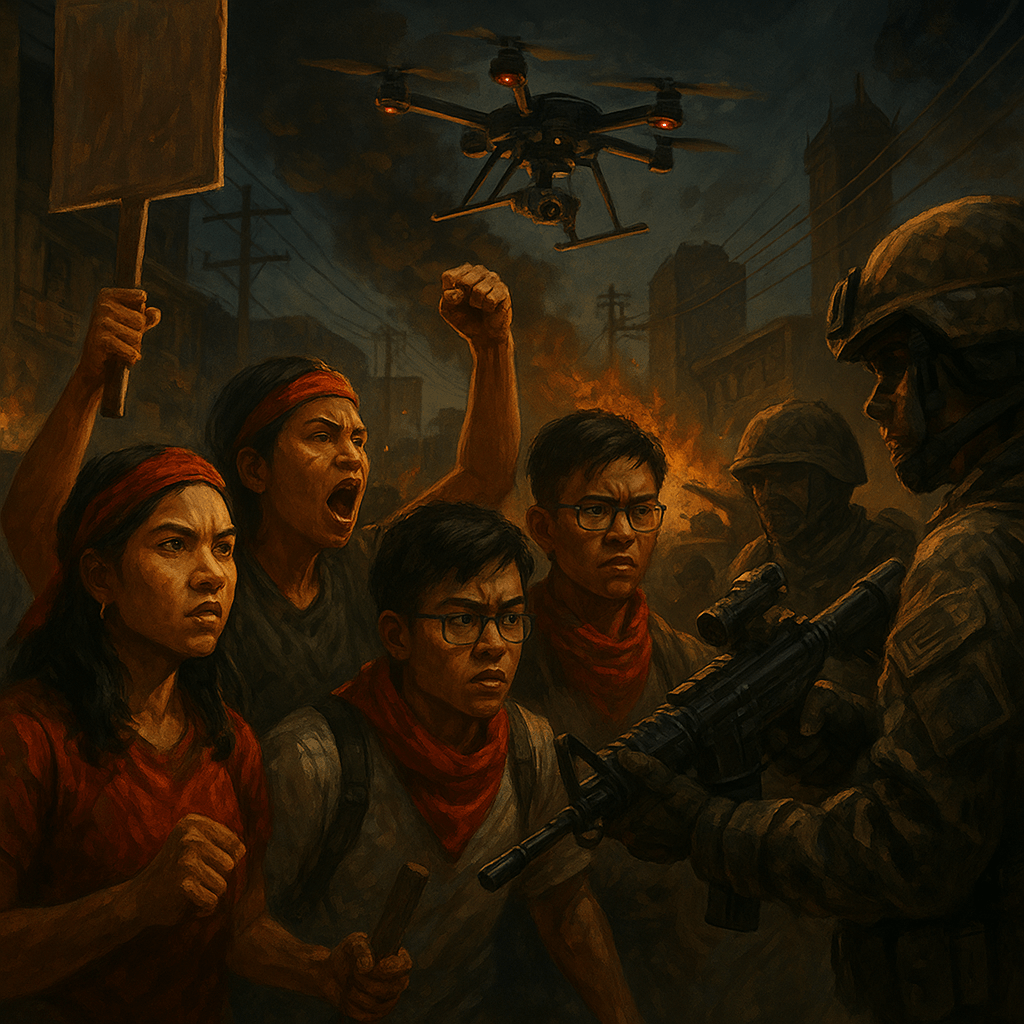
Behind 3D-printed drones and joint exercises lies a colonial architecture of war, where the Philippines is cast as both launchpad and buffer in Washington’s campaign to encircle China.
By Prince Kapone | Weaponized Information | July 12, 2025
Occupation as Assistance, War as Welcome: Unmasking the Narrative Machine
On July 9, 2025, USNI News published a defense puff piece by Aaron-Matthew Lariosa titled “U.S. Army Expanding Presence in the Philippines as China Threat Looms.” The article sells an imperial military buildup as if it were a summer internship program. It celebrates the deployment of 3D-printed drones, high-tech missile systems, and air assault drills across the Philippine archipelago, all under the familiar marketing slogans of “security,” “partnership,” and “readiness.” It’s propaganda in combat boots—and the author’s job is to make the war machine sound like a development agency with night vision.
Lariosa isn’t an outlier. He’s a product of the military-media revolving door, reporting for Task & Purpose, Military Times, and now USNI News—outlets that don’t report on empire, they help manage it. His job isn’t to question imperial power, but to normalize it. There’s no investigation into whose land these “joint exercises” are occupying, no inquiry into what it means for a foreign power to rehearse war on another nation’s soil. Just uncritical stenography for the Pentagon’s Indo-Pacific script. This is not journalism—it’s war PR in a flak jacket.
And USNI News? It’s the house organ of the U.S. Naval Institute—funded by the likes of Lockheed Martin, Northrop Grumman, and Raytheon. These are the same weapons dealers who profit every time a new Enhanced Defense Cooperation Agreement (EDCA) site opens in the Philippines. They don’t publish news; they publish justifications. Their editorial line is shaped by generals and boardrooms, not facts or truth. In their hands, militarism becomes modernization, and conquest gets rebranded as coordination.
Right from the headline—“China threat looms”—you know what time it is. That’s not a statement of fact; that’s a mood setter. “Looms” does all the work without showing a single receipt. It plants fear in the reader’s mind without taking on the burden of evidence. It’s psychological warfare, not journalism. No facts, no nuance—just vibes and veiled threats.
The body of the article keeps the act going with a steady stream of euphemisms. These aren’t war drills, we’re told—they’re “exercises.” Deploying heavy weaponry isn’t an act of escalation, it’s just “training.” It’s a semantic game where missiles become mentors and Apache helicopters are just friendly flying tutors. This is the linguistic gymnastics of occupation with a smile.
Not once does the piece stop to ask a question. Not about who gave permission. Not about what these drills mean for the people who live there. Not about whether any of this is even welcome. That silence is the loudest part of the article. Because when power speaks, the job of propaganda is to shut everybody else up.
Then comes the tech talk—just in case you weren’t sold on the soldiers, maybe the gadgets will get you. We’re told about 3D-printed drones, remote-controlled death toys, water filters, and fancy batteries. It’s not news—it’s a Silicon Valley startup pitch, just with more camouflage. The reader is nudged to cheer for military innovation, as if “improving lethality” is some sort of humanitarian breakthrough.
And let’s not forget the great equalizer: “joint” operations. The article leans on this word like it’s a moral shield. If both sides have boots on the ground, the thinking goes, then everything must be fair and friendly. But “joint” here just means two hands on the same gun—one pulling the trigger, the other holding the barrel. It’s choreography, not equality.
What Lariosa delivers is not a critique of power, but a performance for it. There are no uncomfortable truths, no contradictions worth exploring—just a smooth, orderly recitation of military talking points. This is what happens when journalism forgets how to ask “why” and remembers only how to say “yes, sir.” And that, comrades, is how empire hides its boots behind bylines.
Facts on the Ground: Drones, Drills, and the Recolonization of Luzon
Strip away the Pentagon press-kit language and what remains are the material facts of U.S. military escalation in the Philippines. According to the USNI article, the U.S. Army’s 25th Infantry Division has embedded itself deep into Luzon’s strategic geography under the banner of Exercises Salaknib and Balikatan 2025. The drills included long-range maneuver operations, deployment of Tomahawk-capable missile systems, and air assault simulations on islands near the Taiwan Strait. These are not routine “training operations”—they’re rehearsals for regional war, designed to fuse the Philippine military into the logistical chain of American hegemony.
- Over 50 FPV drones were assembled by U.S. troops using 3D printers deployed to field sites in Northern Luzon.
- A Mark 41 vertical launching system capable of firing Tomahawk and SM-6 missiles was installed on Philippine soil in 2024 and remains operational.
- HIMARS batteries, upgraded for anti-ship targeting, were included in this year’s joint exercises.
- 20+ aircraft (Chinooks, Apaches, Blackhawks) conducted daily flight operations and long-range airlifts from Luzon to Batanes and Calayan.
- U.S. and Philippine forces conducted land-sea-air logistical maneuvers across 250 miles of Philippine territory, rehearsing rapid redeployment scenarios.
- The EDCA agreement was expanded in 2023 to include three new forward-operating U.S. sites in Northern Luzon, near the Taiwan Strait.
- The entire operation was executed under “Operation Pathways,” a U.S. Indo-Pacific strategy explicitly aimed at regional deterrence and forward positioning.
What the article refuses to tell you is that this entire military infrastructure sits atop a history of blood and betrayal. The Philippines was annexed in 1898 and formally colonized by the United States for nearly five decades, during which time it served as a launchpad for Pacific expansion. The U.S. violently suppressed Filipino resistance in a war that killed over 200,000 people. That foundational violence laid the groundwork for the so-called “security partnership” we see today.
As the Asia Maritime Transparency Initiative has documented, EDCA sites are constructed with U.S. funds, operated under U.S. logistics, and accessed freely by U.S. forces under the pretense of rotation. They are bases in everything but name—an act of geopolitical ventriloquism.
Resistance to this recolonization is alive and organized. Groups like Bayan, Gabriela, and the League of Filipino Students have denounced the permanent war footing that EDCA and Balikatan represent. These mass-based organizations have led protests, filed legal challenges, and educated the public on the dangers of becoming a U.S. outpost in a war they never voted for. Their analysis is sharp: U.S. forces are not defending the Philippines—they are endangering it.
Since 2014, the Philippines has received over $500 million in U.S. military aid—covering hardware, training, and infrastructure bundled in a colonial contract. That aid does not come free. It binds the Philippine Armed Forces to U.S. strategic priorities, shifting its doctrine from internal security (counterinsurgency) to “territorial defense” that just so happens to align with Pentagon war games against China. This is Neocolonial Extraction at work: sovereignty is exchanged for weapon systems, and national defense becomes outsourced to a foreign empire with regional ambitions.
This is not a frictionless alliance. The Philippines’ largest trade partner is not the United States, but China. In 2023–2024, bilateral trade volume reached an estimated $38 billion with China, compared to about $20–23 billion with the U.S. The contradiction is glaring: Manila is anchoring its military strategy to a state it trades less with, trusts less, and historically suffered under. The result is strategic schizophrenia—military allegiance to Washington, economic dependency on Beijing. At the 2023 ASEAN Summit in Jakarta, regional leaders openly pushed back against U.S. base expansion, calling for non-alignment and ASEAN neutrality.
The encirclement logic driving U.S. deployments is not defensive—it’s strategic domination. The Bashi Channel and Luzon Strait are maritime chokepoints critical for U.S. naval access in the event of conflict with China. These passages connect the South China Sea with the Pacific, making them strategically vital for power projection and submarine operations. The new EDCA sites in Cagayan and Isabela position the Philippines as a forward garrison in a war plan it did not design. These deployments are not about protecting Filipino lives; they’re about leveraging Filipino geography. The country is being militarized without being developed, used without being empowered.
What Lariosa calls “training” is in fact the dry run for a regional war—one in which the Philippines will be the first to burn, but the last to decide. The facts on the ground tell a clear story: this is not cooperation, it is subordination. And beneath every drone’s flight path lies the broken promise of sovereignty.
Sovereignty Theater and the Architecture of Hyper-Imperialism
Strip away the flags, the handshakes, and the flashbulbs, and what remains is the bitter truth: the Philippines is not a partner—it’s a platform. The U.S. military isn’t training with Filipino forces; it’s embedding them into a war they didn’t ask for, against a neighbor they still trade with. The language of “mutual defense” is the stagecraft of empire. What we’re witnessing is Sovereignty Theater: a performance in which Filipino troops play the role of equal allies while U.S. commanders run the script, control the logistics, and determine the targets.
This entire deployment is a textbook case of Hyper-Imperialism—the global extension of U.S. military, technological, and logistical power into the peripheries of the world system to manage imperial crisis externally. Here, decline does not produce withdrawal. It produces a more flexible, decentralized, and digitally mediated form of domination. The 3D-printed drones in the jungles of Luzon are not about innovation—they’re about scalability. The empire no longer needs permanent bases or massive battalions. It needs modular outposts, proxy troops, and weaponized infrastructure embedded into the sovereignty of weaker states. In this arrangement, the Philippines becomes a node, not a nation.
These systems form what we now define as a Forward Containment Architecture: a grid of missile hubs, drone launch sites, airlift corridors, and naval chokepoints stretching from Luzon to the Bashi Channel. This architecture isn’t meant to protect the Philippines—it’s designed to corner China. Its logic is Cold War redux, but without the diplomacy. Each new EDCA site brings U.S. launch capabilities closer to Chinese territory. And in the event of war, it won’t be Pentagon cities that burn first—it’ll be Filipino soil, Filipino bodies, Filipino futures.
The contradiction is clearest in the material terrain itself. Provinces like Cagayan and Isabela are among the poorest in the archipelago—lacking in public infrastructure, battered by typhoons, and neglected by national development plans. Yet these same regions now host cutting-edge missile systems and expeditionary drone labs. This is Necro-Extractivism: not the extraction of minerals or timber, but the extraction of military utility from land made disposable. There is no development here, only deployment. No sovereignty, only staging.
At the center of this architecture lies Neocolonial Militarism—a structure of foreign command embedded inside a nominally independent military. The Philippine Army, increasingly trained in U.S. doctrine, armed with U.S. weapons, and linked to U.S. strategic objectives, is no longer sovereign. Its movements are calibrated to American deterrence logic, not Filipino defense. Its alliances are dictated by Pentagon threat assessments, not public mandate. The illusion of parity collapses the moment the logistics chain activates—and U.S. command systems override every local directive.
This is the role of the comprador class: to provide the signatures, uniforms, and press releases that disguise recolonization as partnership. From the Armed Forces of the Philippines brass to the subservient functionaries in Malacañang, the Philippine elite has again proven willing to trade sovereignty for subcontracted relevance. This time, however, the trade is encrypted in drone firmware and coordinated through joint cyber command. Colonial collaboration has gone digital.
And the Philippines is not alone. The 2009 closure of the U.S. airbase in Manta, Ecuador, and recent protests against American drone operations in Djibouti reveal a broader pattern. Wherever empire finds logistical value, it builds hyper-imperial nodes: flexible, deniable, and easily integrated into global warfighting systems. The Philippines just happens to be one of the most geostrategically vital—positioned between the South China Sea and the first island chain of the U.S. Indo-Pacific strategy.
For the international proletariat, the implications are clear. What’s unfolding in Luzon is not a bilateral agreement—it’s an imperial operating system update. Sovereignty is window dressing; the software is coded in Washington. And when the system boots up, it doesn’t matter what language the uniforms speak. The commands come from the same decaying empire, desperate to maintain relevance through militarized integration and outsourced escalation.
War is no longer declared. It is programmed. And the Philippines, like so many other semi-colonial states, is being refitted not for defense, but for deterrence by destruction. When Washington says “readiness,” it means Luzon is pre-cleared for sacrifice. That’s the true doctrine of hyper-imperialism. And unless it is dismantled from below, missile by missile, node by node, this war machine will continue to dress its domination in the borrowed robes of partnership.
Sabotage the Supply Chain: Breaking the Empire’s Peripheral Grip
The Philippines isn’t just being militarized—it’s being wired into a global architecture of war. What’s being built across Luzon is not “defense cooperation”; it’s colonial infrastructure disguised as diplomacy. And while resistance grows in the archipelago—from farmers resisting EDCA land grabs to youth shutting down drone tech summits—our role in the Global North is to sabotage the machine from our end. This is not a moment for symbolic solidarity. It’s a call for strategic, material disruption.
We stand in full, unwavering solidarity with BAYAN, GABRIELA, League of Filipino Students, and ICHRP—forces on the ground who have named the stakes: EDCA is not defense; it is death infrastructure. They are organizing in a context where “joint exercises” mean bombed-out rice fields, where “security assistance” means U.S. command dominance, and where “partnership” is a polite word for permanent occupation. Our duty is to weaponize every ounce of privilege we hold and strike at the heart of the imperial logistics chain.
The first target is capital. Launch divestment campaigns in every union pension fund, university endowment, and municipal portfolio tied to Lockheed Martin, Raytheon, General Dynamics, and Northrop Grumman. These are the companies building the weapons being deployed to Luzon—missiles that turn rural provinces into forward operating zones. Target their shareholders, blacklist their recruiters, sabotage their reputation on every campus and in every city council meeting. This isn’t about moral optics—it’s about disrupting the flow of capital that makes EDCA profitable.
Second, we resource the resistance. Mutual aid isn’t charity—it’s revolutionary infrastructure. Commit to raising $500 monthly stipends for at least 10 LFS organizers embedded in Northern Luzon. Use decentralized fundraising platforms (e.g., Open Collective, Mutual Aid Crew) to support local campaigns resisting base expansion and militarized displacement. Fund zines, radio networks, counter-propaganda squads. A war machine runs on logistics; so does a liberation movement.
Third, we fight with code. Launch the EDCA Base Map: an open-source, continuously updated digital archive of all U.S. military infrastructure on Philippine soil. Built on OpenStreetMap, hosted via GitHub, and coordinated by anti-imperialist researchers and tech collectives, this map should trace drone corridors, missile silos, port expansions, and supply routes. Pull FOI data, use satellite imagery, scrape military contract databases. Make the hidden visible. Crowdsource the cartography of recolonization—and let it fuel direct action.
Finally, we build a political education offensive worthy of the moment. Host teach-ins, reading circles, and film screenings on the true nature of U.S. militarism in the Pacific. Anchor these efforts in revolutionary Filipino texts like Amado Guerrero’s Philippine Society and Revolution and contemporary debriefs from the Tricontinental Institute. Design a curriculum that trains new cadres to connect hyper-imperialism abroad with class war at home. Every drone base in Isabela has a data center in Virginia. Make the link.
In the age of hyper-imperialism, logistics is domination. But we can become the rupture. The Pacific is not America’s highway. The Philippines is not a weapons depot. And those who claim to represent us—unions, NGOs, universities, tech collectives—must be made to choose: feed the machine or fight it. This isn’t a petition moment. It’s a sabotage moment. Get to work.
 Weaponized Information
Leave a comment