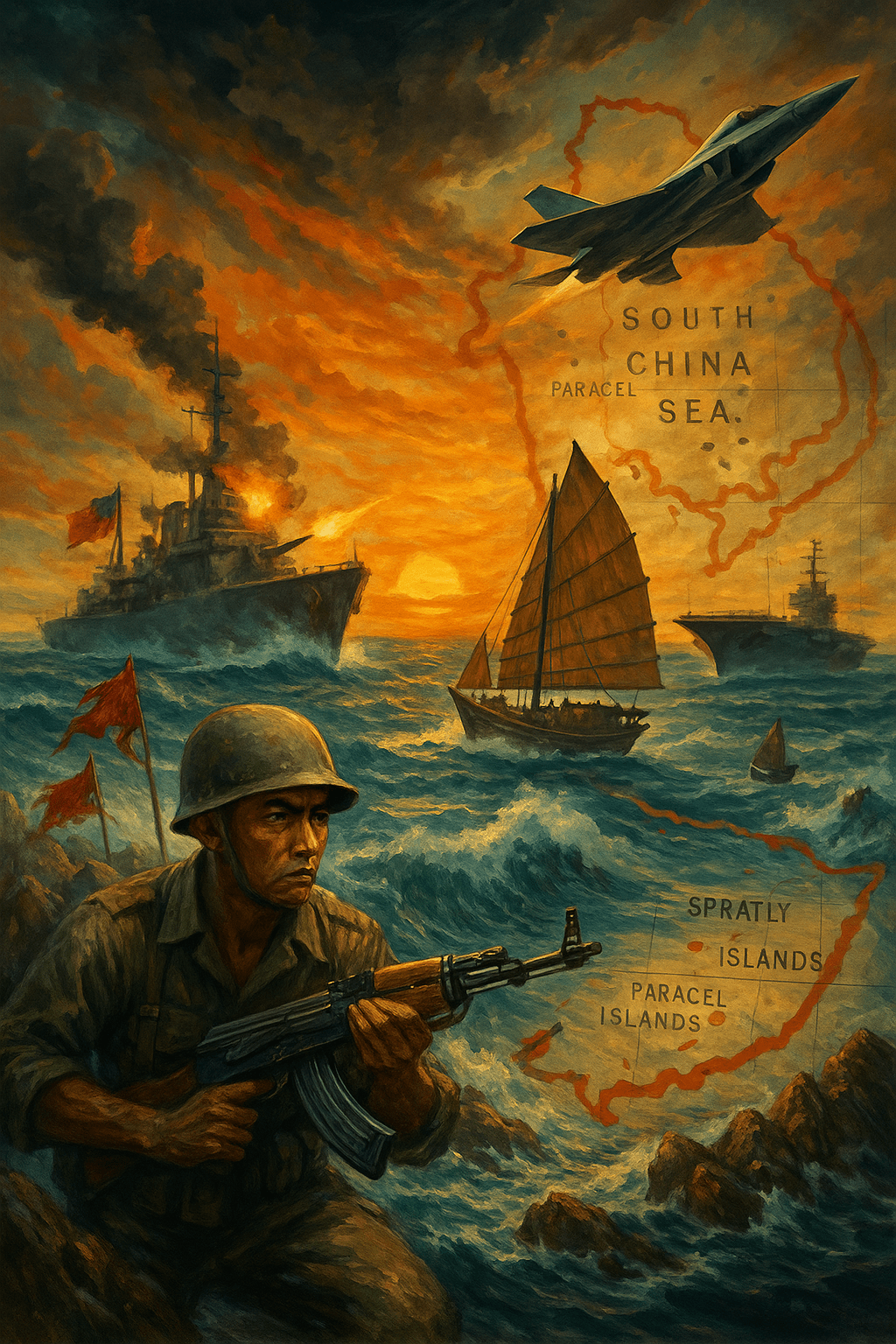
How Empire Wrote the Law of the Sea in Blood, Branded Resistance as Aggression, and Turned the South China Sea into a Battleground of Hegemony and Hope
By Prince Kapone | Weaponized Information | July 11, 2025
Where Empires Drew Their Maps in Blood
The South China Sea didn’t become a battlefield by nature—it was made one by empire. Its currents were once traversed by Malay, Vietnamese, Cham, and Chinese sailors, long before anyone called them international shipping lanes. But over centuries, these waters were transformed from shared maritime space into militarized territory—first by European colonial powers, and later by the United States. Gunboats wrote the first lines of division, and treaties signed under duress gave them legal form. The ghosts of those decisions still haunt the reefs and shoals today.
Western colonizers came not just for spices and slaves, but for control of the sea. The Portuguese, Spanish, Dutch, British, and French militarized the maritime world, carving naval empires into Asia’s archipelagos. The Portuguese built fortresses along the Strait of Malacca in the early 1500s. The British turned Singapore into a garrison port. The Dutch monopolized trade routes from Jakarta to Makassar. These powers weren’t interested in shared governance or local rights—they came to divide, extract, and rule.
When the United States seized the Philippines in 1898, it did so through the Treaty of Paris, which transferred the archipelago from Spain to the U.S. without any input from its people. That document became the legal basis for U.S. imperial claims in the South China Sea. From there, Washington established military strongholds—Subic Bay, Clark Air Base—that anchored its naval domination of the Pacific for the next century.
In 1932, France unilaterally annexed the Paracel Islands on behalf of colonial Indochina, ignoring Chinese protests. These seizures—based on European doctrines like terra nullius—erased centuries of Asian maritime presence and enshrined Western conquest into international cartography.
Today’s disputes cannot be understood outside this legacy. China was not a colonizer in Southeast Asia—it was colonized. It lost Hong Kong to Britain, Taiwan to Japan, and was carved up by foreign fleets and foreign laws. The Philippines, Vietnam, and Malaysia all inherited maritime claims defined by colonial treaties and occupation—frameworks imposed under empire and later upheld by Western-led legal regimes.
What we call “disputed territory” today often traces back to maps drawn by empires. These maps, backed by force and legalized through postwar institutions, continue to define who owns what—even as the people most affected were never consulted. The post-WWII “rules-based order” simply locked in those imperial lines under new management.
China’s critics like to pretend it is inventing history. But it was the West that invented this dispute—by militarizing the region, redrawing its borders, and building a legal order to freeze their colonial spoils in place. Now, when China contests this inheritance—not by launching wars, but by asserting historical presence—it is painted as an aggressor.
The South China Sea is not just a geopolitical flashpoint. It is a colonial wound. And if peace is truly the goal, we must first admit: the law of the sea was written not to liberate the region, but to discipline it. And it still serves those who wrote it in blood.
The Indo-Pacific Illusion: How Empire Rebranded Itself
After centuries of direct colonial rule, the imperialists changed tactics. They gave up the spectacle of conquest but kept the substance of control—repackaging dominance in the language of alliances, deterrence, and international law. “Indo-Pacific” is one of their latest inventions. It didn’t come from the region’s peoples, but from the bowels of the Pentagon, Japanese strategic circles, and Anglo-American think tanks who needed a new framework to contain China while pretending they weren’t doing exactly that.
The concept first reemerged in the 2000s, but it was under Obama’s 2011 “Pivot to Asia” that it became U.S. grand strategy. Trump hardened it into doctrine. Biden institutionalized it. In each case, the Indo-Pacific was presented as a “free and open” region. But behind the slogans stood a military blueprint. U.S. bases were expanded in Guam, Okinawa, Darwin, and the Philippines. New military partnerships—AUKUS, the Quad, EDCA—began fusing into a hardened encirclement structure. U.S. missile systems were stationed across Asia, aircraft carriers began constant patrols, and the region’s skies and seas were filled with surveillance drones, warships, and joint drills.
The U.S. called this security. But what it was building was siege infrastructure. The logic was old—stretching back to Cold War containment—but the targets had shifted. This wasn’t about stopping war. It was about stopping multipolarity. The Indo‑Pacific strategy seeks to halt China not because it has committed imperial crimes (it hasn’t invaded a single country in over 40 years), but because it offers an alternative development model—one centered on state sovereignty, infrastructure finance, and South–South cooperation.
U.S. officials, of course, talk about upholding the “rules-based international order.” But Washington itself refuses to ratify UNCLOS, bombs countries without Security Council approval, and maintains a global network of over 800 military bases. When the empire invokes “freedom of navigation,” it’s not defending international norms—it’s defending its right to dominate global trade routes with naval superiority. The same Cold War powers that once backed colonial regimes in Vietnam and Indonesia now claim to be defenders of Asian sovereignty.
China’s response has been cautious but firm. It has built dual‑use infrastructure in the South China Sea—not to launch invasions, but to prevent encirclement. It has pushed the Belt and Road Initiative to link Asia, Africa, and Latin America through rail, ports, and digital fiber—precisely because U.S.-dominated institutions like the IMF and World Bank have long denied the Global South the means to build on its own terms. And it has proposed frameworks like the Global Security Initiative (GSI) and Global Development Initiative (GDI) to resist the militarization of diplomacy.
This is not to romanticize China’s posture. Its strategy includes contradictions. Island reclamation has caused environmental damage, and some of its coast guard activity is confrontational. But these actions must be contextualized. A country surrounded by hostile fleets and missile systems, subjected to economic warfare and diplomatic demonization, will not respond with disarmament. It will respond with deterrence. That’s not expansionism—it’s survival.
The real threat posed by China isn’t that it seeks empire, but that it offers a vision of development outside empire. That’s what Washington can’t tolerate. If China can rise through sovereign planning, infrastructure, and cooperation with the Global South, then U.S. hegemony no longer looks inevitable. It looks obsolete. And so, the Indo-Pacific is not a geographic zone—it’s a political fiction designed to reassert imperial geography through another name.
The South China Sea, in this frame, becomes not a neutral waterway, but a symbolic frontier. Every reef is a red line. Every radar dome is a crisis. But this is a crisis manufactured by the very powers who militarized the region in the first place. The U.S. doesn’t fear a war in Asia—it fears peace without its permission. And that’s why it sails destroyers under the banner of order: not to stabilize the sea, but to dominate it.
The Law of the Sea or the Law of the Strong?
If you listen to Washington, the story is simple: there are rules, and China is breaking them. The rules are called international law—specifically the United Nations Convention on the Law of the Sea (UNCLOS)—and in 2016, an arbitral tribunal ruled that China’s “Nine-Dash Line” had no legal basis. Case closed, right? Not quite. Because beneath the legal jargon lies a deeper question: who wrote the rules, and who enforces them?
The 2016 tribunal ruling, widely celebrated in Western media, was not delivered by a neutral court but by an ad hoc panel under UNCLOS Annex VII. China refused to participate in the process—not because it rejects international law wholesale, but because the tribunal preemptively dismissed China’s historical rights claims as irrelevant under UNCLOS’s framework. In doing so, it reaffirmed a legal order in which centuries of pre-colonial and non-Western maritime history are rendered invisible.
The United States, as noted, has never ratified UNCLOS. Yet it positions itself as its loudest defender, conducting “freedom of navigation operations” with warships in contested waters while ignoring binding rulings from other international courts—such as when it rejected the 1986 International Court of Justice ruling against its covert war in Nicaragua. International law, it seems, only matters when it aligns with U.S. power.
China, on the other hand, has ratified UNCLOS and submitted diplomatic notes, white papers, and legal arguments defending its position based on both treaty law and historical practice. Its claims are rooted not only in Qing-era maps or dynastic naval expeditions, but in a long pattern of usage, administration, and patrol of disputed maritime features. These assertions may be controversial, but they are not inherently lawless.
Critics argue that China’s claims undermine the “rules-based order.” But what is rarely acknowledged is that the “rules” in question were forged by colonial powers and post-war hegemonies. UNCLOS itself was negotiated under immense pressure from Western maritime powers who shaped its definitions of Exclusive Economic Zones (EEZs), continental shelves, and archipelagic states to reflect their own priorities. China’s challenge, then, is not to law per se—but to a system of law that denies the legitimacy of its history and strategic insecurity.
That doesn’t mean China’s actions are above criticism. Island-building has caused environmental damage, and aggressive coast guard maneuvers have put Filipino and Vietnamese fishers at risk. But these behaviors unfold in a region saturated with U.S. military installations, nuclear-capable bombers, and ballistic missile systems. To present China’s actions in isolation—as if they are emerging in a legal vacuum—is to erase the structural asymmetry of global force.
What’s needed is not a dismissal of law, but its decolonization. International maritime order must be grounded in multilateralism, history, and the real interests of the people who depend on the sea—not the imperial prerogatives of naval hegemons. Legal norms must serve peace, not power projection. They must make room for historical rights as understood by formerly colonized civilizations—not just those codified in Eurocentric treaty frameworks.
Until that happens, the so-called rules will remain what they’ve always been: guidelines for the weak, and instruments for the strong. And China’s refusal to be disciplined by a system that once carved up its coastlines with gunboats should not be vilified. It should be understood—for it marks the beginning of a deeper conversation about what justice on the seas might finally look like.
Lines in the Water, Lies in the Air
Few images have stirred Western anxiety like China’s Nine‑Dash Line—a sweeping curve on the map that seemingly engulfs the entire South China Sea. To hear Washington or Tokyo tell it, this line is a blueprint for empire, a maritime Great Wall asserting total Chinese control over international waters. But the truth, like the sea itself, is more fluid than the headlines suggest. And the map they fear is not a product of Communist expansion, but a legacy of China’s fractured republican past.
The Nine‑Dash Line first appeared in 1947, drawn by the Republic of China (then under Chiang Kai‑shek) in a map published by the Kuomintang government. It was an attempt to represent long‑standing Chinese activity across the Spratly and Paracel Islands—fishing, exploration, naval patrols, and settlement dating back centuries. After 1949, the People’s Republic inherited this map and later modified it, transforming it into a legal and strategic boundary rooted not in conquest, but in historical continuity.
This is not to say China’s claims are above criticism. The ambiguity of the Nine-Dash Line—whether it denotes sovereignty, maritime jurisdiction, or historical presence—has rightly raised concerns. But to cast it as a Chinese invention untethered to history is disingenuous. China’s historical presence in the region is well-documented, and its interpretation of the line has evolved over time—from a rough marker of influence to a more legally nuanced claim incorporating sovereignty over land features and rights within adjacent waters.
China’s critics often ignore that its legal arguments have shifted toward a hybrid model—asserting sovereignty over specific islands (with accompanying maritime entitlements under UNCLOS), while also defending traditional fishing rights and long-term presence as historical usage under international custom. That position may be contentious, but it is no more abstract than the Philippines’ invocation of Spanish-era colonial documents or Vietnam’s reliance on French maps to bolster their respective claims.
Meanwhile, the U.S.—which has no claim in the region—continues to frame the Nine-Dash Line as the pretext for Chinese expansionism, while sailing warships through the same waters in the name of “freedom of navigation.” Every Chinese radar dome is labeled a “military threat,” every artificial reef an “illegal outpost”. But few in the Western press acknowledge the broader context: that China is encircled by hundreds of U.S. military bases, subject to constant surveillance, and increasingly excluded from regional economic blocs unless it submits to U.S. diktats.
Of course, China has acted forcefully. Its coast guard has used water cannons, lasers, and blockades against Filipino vessels. It has intimidated Vietnamese oil rigs and deployed paramilitary maritime militias in disputed zones. These are not just symbolic gestures—they impact livelihoods and escalate tensions. But to present these actions as proof of imperial ambition, while excusing decades of Western militarization and intervention in the region, is to judge in bad faith.
What China seeks is not dominion over the sea, but strategic depth. It is responding to a security environment shaped by U.S. encirclement, not plotting to become the next naval hegemon. The Nine-Dash Line is not an empire’s boundary—it is a nation’s survival instinct, drawn in the shadow of a century of colonial humiliation and contemporary containment.
To treat China’s maritime claims as illegitimate while defending an international legal order built atop Western conquest is to deny history itself. The real danger in the South China Sea is not that China may one day dominate it, but that the U.S. already does—and demands that everyone pretend otherwise.
Archipelago of Resistance: The View from Southeast Asia
The South China Sea is not China’s backyard—but neither is it America’s chessboard. It is a living sea bordered by nations with long histories, deep grievances, and legitimate claims. Vietnam, the Philippines, Malaysia, Brunei, and even Taiwan all assert rights to parts of the sea. But to understand these disputes only as a reaction to China is to flatten their complexity. These claims are rooted not just in law, but in the wreckage of colonialism and the struggle for postcolonial sovereignty.
Vietnam’s case is the most historically grounded. Hanoi claims continuous sovereignty over the Paracels (Hoàng Sa) and Spratlys (Trường Sa) dating back to the 17th century, and it has maintained a presence on dozens of Spratly features. But it also remembers being colonized—first by China for over a millennium, then by France, then bombed by the U.S. for refusing to bow. Vietnam does not trust Beijing blindly, but it also refuses to be a proxy in America’s new Cold War. Its strategy is non-alignment with sharp edges.
The Philippines has taken a more legalistic approach. Its 2016 tribunal victory at The Hague invalidated China’s sweeping maritime claims under UNCLOS. But the Philippines’ own claims rest on colonial-era maps inherited from Spain and the United States. And today, its government is caught in a contradiction: asserting sovereignty over the Kalayaan Island Group while inviting more U.S. troops and bases onto its soil. President Marcos Jr. has allowed expanded access to U.S. forces under EDCA, reanimating the very colonial footprint that once subjugated the archipelago.
Malaysia and Brunei have pursued quieter, more diplomatic paths. Malaysia claims maritime entitlements based on its continental shelf, but avoids military confrontation. Brunei’s claim is the narrowest—limited to a small part of the Spratlys—and is rarely emphasized in public forums. Both states seek to balance ties with China while defending sovereignty under UNCLOS provisions. Taiwan, for its part, mirrors Beijing’s territorial stance but is rarely taken seriously by the West—treated as an independent democracy only when convenient to U.S. strategy.
These countries are not pawns. They are calculating. They hedge, maneuver, and adapt. But what unites them is a shared memory: of being dictated to by foreign powers who claimed to bring “civilization” but brought only conquest. That’s why U.S. attempts to frame its military posture as “defending the region” ring hollow. The region remembers who built Subic Bay and bombed Hanoi. It remembers who drew the lines on colonial maps and signed away islands in European treaties.
ASEAN’s efforts to create a Code of Conduct with China reflect a desire for peaceful resolution, not bloc confrontation. These negotiations have been slow, fragmented, and at times undermined by China’s actions—but they represent the only path forward rooted in regional agency. Countries like Indonesia have proposed joint development zones. Vietnam and China have established hotlines and crisis protocols. The Philippines, even under U.S. pressure, has engaged in direct maritime talks with Beijing. These are not acts of weakness—they are attempts at sovereignty under fire.
The region’s resistance is not uniform, and neither are its alliances. But there is a common aspiration: to resolve disputes without becoming pawns in a U.S.–China confrontation. The real challenge is to defend national interests without surrendering them to imperial ones. In that sense, the South China Sea is not just a contested space—it is an archipelago of resistance, where postcolonial nations assert their right to navigate both the sea and the storm.
Currents of Capital and Cannons: The Geopolitical Economy of the Sea
Beneath the surface of the South China Sea lies more than coral reefs and sunken claims. It is the main artery of the global economy—a passage through which nearly one‑third of world maritime trade flows, valued at over $3.4 trillion annually. Oil from the Gulf, semiconductors from East Asia, grains from Australia, minerals from Africa—all pass through this maritime superhighway. Whoever governs these waters doesn’t just influence regional geopolitics—they help shape the global economic order.
That’s why the sea is crisscrossed by more than just fishing vessels and oil tankers. It’s watched by satellites, patrolled by warships, and mapped by the algorithms of military logistics. The United States portrays its naval presence as protective—defending “freedom of navigation.” But what it’s defending is the unipolar command of sea lanes that has allowed it to dominate the post‑WWII economic architecture. In the name of open seas, the U.S. sails nuclear‑powered destroyers, installs missile systems, and surveils China’s coastal heartlands from international waters—then accuses China of destabilization when it responds.
What China fears is not invasion, but isolation. It imports over 70 % of its crude oil—most of it by sea. Its eastern ports are the lifeline of its economy. The U.S. Indo-Pacific Command has quietly rehearsed blockades and “choke point” scenarios for years. That’s why Beijing is building outpost infrastructure—not to seize new colonies, but to prevent a future strangulation. The military installations on Fiery Cross, Subi, and Mischief Reefs may be controversial, but they are best understood as deterrents against encirclement, not symbols of conquest.
At the same time, the South China Sea is being ravaged—not just by conflict, but by capital. Its fish stocks, once among the richest in the world, have declined by more than 70% in some areas due to overfishing, climate stress, and maritime militarization. Coral reefs are being dredged to build airstrips, while deep‑sea drilling projects compete with geopolitical flashpoints. Every naval drill contaminates the waters with oil, waste, and sonar. The imperial powers talk of protecting order, but they’re gutting the ecosystem that millions depend on for survival.
China’s Belt and Road investments in port infrastructure are often framed as “debt traps” by the West. But what they more often reflect is a strategy to build a parallel system of maritime logistics—one less vulnerable to U.S. disruption. From Gwadar to Hambantota to Sihanoukville, China is weaving a maritime Silk Road designed not just for commerce, but for survival in a hostile financial and military environment. It is an attempt—not without contradictions—to shift Asia away from IMF‑imposed dependency and toward South–South integration.
This doesn’t mean China is building a socialist utopia at sea. Some of its investments displace communities. Some of its overfishing policies are aggressive. But compared to the U.S. model of aircraft carrier diplomacy and dollar-backed debt peonage, Beijing’s approach is less extractive and more negotiable. It reflects a different logic—one that privileges infrastructure and interdependence over gunboat diplomacy.
The South China Sea is where these two visions now collide: one of imperial permanence backed by firepower, and one of postcolonial assertion under siege. In that collision, the region faces not only military danger—but also a decision. Will it allow the sea to become a NATO lake, patrolled by a foreign empire desperate to hold onto global supremacy? Or will it forge a path toward regional sovereignty, ecological stewardship, and cooperative coexistence?
Peace Without the Gunboat: The Path to a Just Resolution
If peace is to come to the South China Sea, it will not ride in on a U.S. destroyer. It will not be negotiated from an aircraft carrier or imposed by the so-called “international community” headquartered in Washington, London, or Brussels. True peace will come from the region itself—led by the very nations that have suffered under centuries of colonization, containment, and coerced alignment. But for that to happen, the empire must step aside.
The United States is not a neutral party here. It is the most heavily armed actor in the region, maintaining over 60 military bases and facilities in the Indo‑Pacific. It is the only nation conducting weekly warship patrols through contested waters. It has openly rejected multilateral agreements it doesn’t control, including UNCLOS. And it continues to insert itself into bilateral disputes—not to mediate, but to militarize. This is not conflict resolution. This is conflict management in the service of imperial primacy.
By contrast, the region’s states—however divided—have consistently sought non-military frameworks. ASEAN has worked, however slowly, toward a binding Code of Conduct with China. Indonesia and Malaysia have proposed joint patrols and resource-sharing agreements. Vietnam has continued diplomatic engagement despite deep tensions. The Philippines, even under U.S.-aligned governments, has at times pursued direct maritime dialogue with Beijing. These efforts are uneven, but they reflect a desire to build a regional security architecture based on cooperation, not confrontation.
China, too, has called for bilateral solutions, joint development, and “shelving disputes in favor of common development”. Its proposals are not always accepted—but they represent an alternative to the armed exceptionalism of the U.S. model. This is not to excuse China’s behavior, especially where it has used economic leverage or coast guard coercion. But unlike the United States, it is not projecting force 7,000 miles from home. It is defending what it sees—rightly or wrongly—as its historical and strategic space. The path forward must include all voices—but cannot allow one to dominate from across an ocean.
The most viable peace framework begins with a clear premise: the U.S. must demilitarize its posture. Freedom of navigation must be decoupled from gunboat diplomacy. ASEAN must be strengthened and resourced to lead conflict resolution. China must be engaged, not excluded, and held to standards that all powers—including the U.S.—are willing to follow. Environmental cooperation, fisheries management, and joint energy development must take precedence over territorial maximalism.
And most importantly, the region must reject the narrative that peace is impossible without Western power. That lie has brought only war, from Iraq to Libya to Afghanistan. It has no place in Southeast Asia. What is needed is a multipolar peace—messy, imperfect, but rooted in sovereignty, mutual respect, and the recognition that the sea is not a prize to be won, but a commons to be defended.
In the end, the South China Sea will not be secured by missiles. It will be secured by memory—by remembering what the empire did, how it drew its maps in blood, and how it continues to provoke war in the name of order. The sea belongs to those who live by it, not those who fly in with flags and fleets. And when that truth anchors diplomacy, real peace becomes possible.
 Weaponized Information
Leave a comment