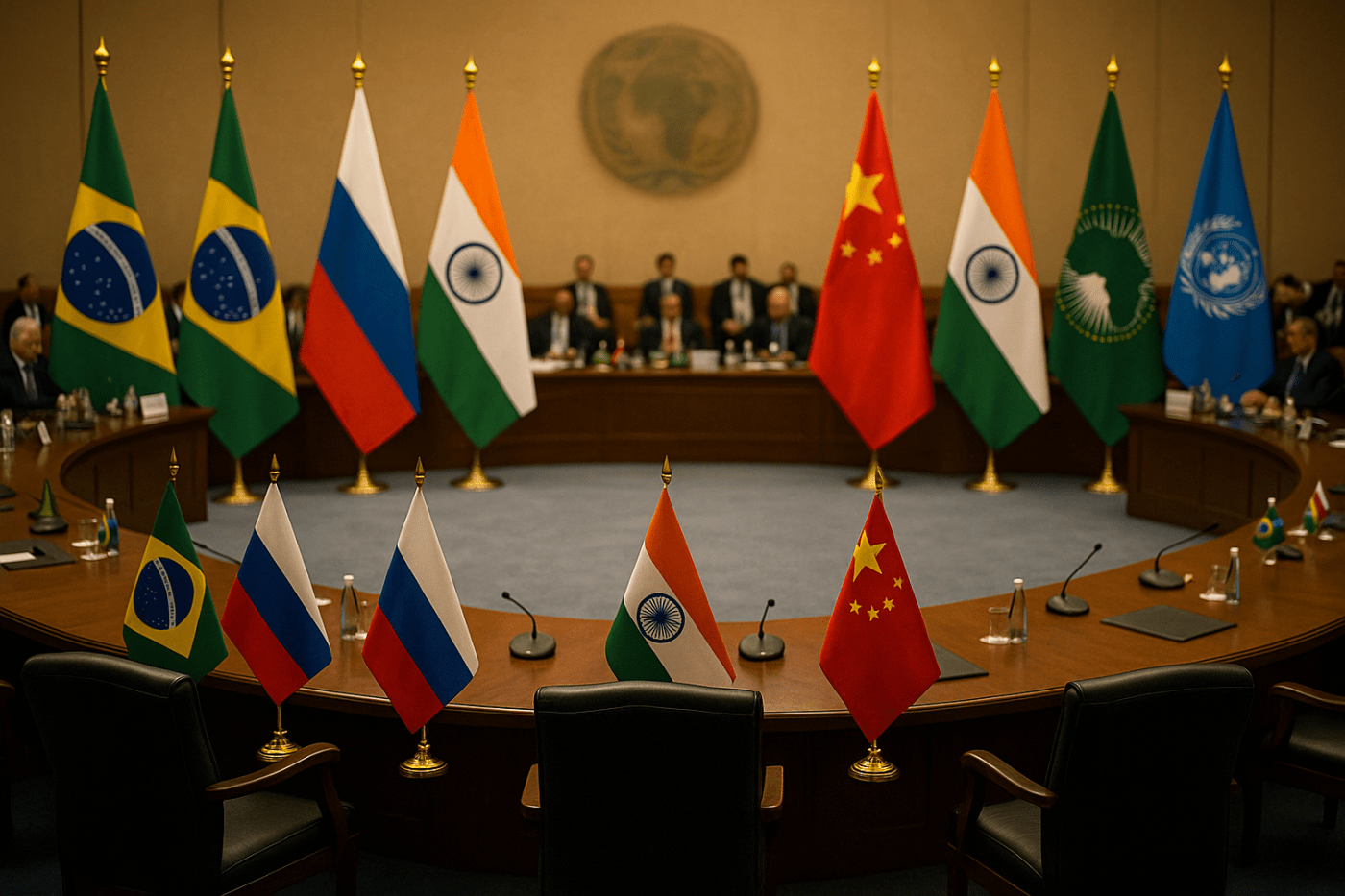
Why their absence was not a fracture—but a feature of the post-hegemonic world being born.
By Prince Kapone | Weaponized Information | July 11, 2025
When the West Counts Heads, the Global South Builds Structures
You can always tell when the empire is nervous—not by what it says, but by how much ink it spills to say nothing at all. In the aftermath of the recent BRICS summit, the imperial press has been on a propaganda blitz, frantically trying to turn a logistical footnote into a geopolitical obituary. Headlines screamed variations of the same imperial prayer: “Where is Xi?” “Why didn’t Putin come?” “Is Iran disillusioned with BRICS?” The question was never asked in good faith. It was asked the way a banker asks why a debtor missed a meeting—as if Global South nations still owed the West an explanation.
But here’s the thing: BRICS doesn’t answer to Washington, London, or Brussels. It answers to a new historical reality. And that reality terrifies the old order precisely because it doesn’t depend on showmanship. The absence of Chinese President Xi Jinping, Russian President Vladimir Putin, and Iran’s newly elected President Masoud Pezeshkian has been treated like some diplomatic disaster by the Western commentariat. In truth, their absence marks the maturity of the BRICS+ formation—its evolution from a personality-driven platform to a multipolar institution with distributed capacity, structural resilience, and regional initiative.
What the empire sees as “no-shows” are, in fact, quiet confirmations that BRICS has outgrown the need for its founding dyad to take center stage every time. It no longer requires Xi and Putin to set the tempo—it has a chorus of rising voices now. From Brazil to South Africa, from Egypt to Ethiopia, from India to Iran, the Global South is no longer waiting for orders from the top. It’s taking the wheel. And that is the real threat in the eyes of empire: not that BRICS is falling apart, but that it no longer needs the West, and increasingly doesn’t even need its own biggest members to move forward.
You wouldn’t know this from the way the Western press covered it. The Financial Times practically wrote its obituary for BRICS, while CNN speculated about a “fractured front” and “leadership vacuum.” It’s classic narrative warfare—projection wrapped in wishful thinking. When the G7 meets, and the U.S. president stumbles up the stairs or forgets what country he’s in, no one asks if NATO is collapsing. But when the Global South coordinates a summit with over 30 participating countries, settles trade in local currencies, expands financial mechanisms beyond the dollar, and lays down plans for post-Western development—and does it without the spectacle of big-power ego—suddenly the pundits panic.
What we are witnessing isn’t a crisis. It’s a transfer of initiative. Xi and Putin didn’t stay home because BRICS is faltering—they stayed home because they trust that it isn’t. That’s what real confidence looks like: the ability to hand over the reins and know that the horse won’t bolt. This was a summit led by other forces—by Lula in Brazil, by Ramaphosa in South Africa, by India (with all its contradictions), and by a cohort of African and Arab states hungry for real sovereignty. If you’re still looking for Cold War optics, you’ll miss the birth of something else entirely: a world where presence is tactical, not theatrical, and where the Global South is no longer a stage for superpower drama—but an actor in its own right.
China Didn’t Step Back—It Stepped Aside
Let’s talk about the so-called “missing man” at the BRICS summit: Xi Jinping. To hear the West tell it, his absence is a crisis, a snub, maybe even a secret retreat from the bloc he supposedly built. The reality? China isn’t stepping away from BRICS—it’s stepping back to let the rest of the multipolar world step forward. That’s not abdication; that’s architecture.
Xi sent Premier Li Qiang in his place—not a low-level bureaucrat, but the second most powerful man in the country, tasked with driving China’s economic strategy and international coordination. This wasn’t a symbolic downgrade—it was a message. China is not interested in hogging the mic. It’s laying the bricks of a new international order, brick by brick, relationship by relationship, and it doesn’t need a photo op to do it.
Why didn’t Xi come? Because the People’s Republic is managing serious internal contradictions: youth unemployment, economic recalibration, tech decoupling, and a Cold War 2.0 on its doorstep. Because China is deepening yuan-based trade in Asia, Africa, and Latin America, building alternative finance structures with Belt and Road partners, and expanding its influence through real infrastructure—not diplomatic theatre. Because China doesn’t need to prove it belongs at the center of BRICS. It is the center, and the center is secure.
In fact, Xi’s absence could be read—if the imperial press had a memory longer than a news cycle—as a subtle act of trust. It was China’s way of saying: the rest of the bloc is ready. Let Brazil lead a round. Let South Africa host. Let the African Union take its place at the table. That’s how power multiplies. That’s how hegemony dies—not with a bang, but with the quiet confidence of leaders who no longer need to dominate the room to shape its direction.
But instead of reading this for what it is—a sign of maturity, decentralization, and strategic depth—the Western commentariat panicked. The same voices who cry “authoritarian” when Xi takes the lead are now crying “disengaged” when he doesn’t. It’s a cheap trick: heads you lose, tails you’re illegitimate. But the Global South isn’t playing that game anymore. China is no longer performing for empire’s cameras. It’s building for its own future—and offering blueprints to anyone ready to tear up the old script.
Putin’s No-Show Was a Strategic Deployment
The imperial pundit class couldn’t help but gloat: “Putin didn’t show up either.” As if the President of a country under open NATO siege, managing a wartime economy and a multipronged Eurasian pivot, had simply forgotten to RSVP. The truth is plain if you bother to look: Putin’s absence wasn’t a gap in commitment—it was a wartime calculation. And his envoy, Foreign Minister Sergey Lavrov, wasn’t just filling space—he was executing a mission.
Let’s start with the obvious. Brazil, the host country, is an International Criminal Court signatory. There’s an active ICC warrant out for Putin’s arrest—a transparently political move rooted in the collapsing legitimacy of Western international law. That warrant didn’t stop Putin from joining the summit virtually, nor did it stop Lavrov from engaging in direct negotiations on de-dollarization, energy integration, and financial alternatives to SWIFT. If anything, it gave Russia the perfect opportunity to demonstrate what multipolar diplomacy actually looks like: not legal theater, but practical coordination.
Lavrov is no backup singer. He’s been Russia’s foreign minister since 2004, longer than most Western governments last in office. He helped lay the foundations of BRICS itself and has personally overseen Russia’s pivot away from Euro-Atlanticism toward Eurasian and Global South integration. His presence in South Africa wasn’t a downgrade—it was a wartime deployment. Putin didn’t need to fly in because Lavrov could carry the line. That’s called confidence, not chaos.
What this reveals—though the empire won’t admit it—is that Russia no longer needs to assert leadership at every summit to remain indispensable. It’s already doing the work: building bilateral currency swaps, coordinating oil policy outside of OPEC control, arming resistance states like Mali and Burkina Faso, and trading grain for infrastructure in Africa. Putin is leading the fight against the Western financial order from the battlefield to the bank—and he trusts his diplomats to anchor the rest.
This is what mature blocs do. They decentralize. They delegate. They resist becoming personality cults. The West, locked in a model where one confused man in Washington has to pretend he runs the planet, can’t imagine leadership without spectacle. BRICS, on the other hand, is becoming immune to the absence of any one figure—including Putin. That’s not dysfunction. That’s evolution. And it’s happening faster than the West can rewrite the script.
Iran Missed the Summit—but the War Didn’t
If you want to know how detached the Western press is from material reality, look no further than their spin on Iran’s absence from the BRICS summit. With smug detachment, they asked why Iran’s new president, Masoud Pezeshkian, wasn’t present—without mentioning that, just weeks earlier, his country was bombed by both Israel and the United States in an unprecedented escalation that could reignite at any moment. This isn’t diplomacy-as-usual. It’s war. And Iran is in the thick of it.
On June 13, 2025, the Israeli regime unleashed a full-scale assault on Iran’s nuclear and military infrastructure, firing hundreds of munitions in a coordinated blitz targeting Natanz, Fordow, Parchin, and IRGC installations. The attack was framed as “preemptive,” but anyone with a memory longer than a goldfish knows this has been decades in the making. In response, Iran launched the third phase of its “True Promise” retaliation campaign—this time with hypersonic missiles. Not drones, not bluffs. Hypersonics. They rained down on Tel Aviv, Haifa, and occupied military sites, punching holes in the Zionist regime’s sacred cow: the so-called “Iron Dome.” For the first time in its history, Israel looked not invincible, but vulnerable.
The United States, ever the imperial bodyguard of settler-colonialism, responded with bunker-buster bombs. On June 22, President Trump authorized simultaneous strikes on Fordow, Natanz, and Isfahan, targeting Iranian nuclear facilities in what the Pentagon dubbed “Operation Midnight Hammer.” But the hammer didn’t break the anvil. Iran survived, with uranium stockpiles intact and its sovereignty unshaken. The next day, Tehran escalated. Missiles were launched at the massive U.S. Al Udeid Air Base in Qatar—some intercepted, some not. The message was clear: We are not Iraq. We will strike back.
All of this—the airstrikes, the missile salvos, the public threats and backchannel ceasefire—unfolded in the weeks leading up to the BRICS summit. So no, Pezeshkian didn’t decline the invitation. He was leading a nation under siege. And yet, Iran still sent an official delegation. That alone tells you more about its commitment to multipolarity than any speech could. While the West counted missiles, Iran counted itself in the next global order.
What Western analysts read as absence was actually endurance. Iran’s revolutionary posture hasn’t shifted. If anything, its role in BRICS has only grown more essential: the bridge between West Asia, Central Asia, and Africa. The oil lifeline. The sanctions laboratory. The ideological thorn in the side of empire. The Islamic Republic doesn’t need to sit at every summit to assert its presence—it does that every time it survives another day of war and still refuses to kneel.
Pezeshkian’s absence isn’t a sign of doubt. It’s the signature of a government that remains on the frontlines of imperial confrontation, even as it helps shape the architecture of a new world. BRICS is not a spectator sport. It’s a survival strategy. And Iran, bloodied but unbowed, showed up through the very fact that it’s still standing—and still building.
This Bloc Was Built to Withstand Absence
Here’s what the West still doesn’t understand—what it can’t understand: BRICS+ isn’t built around personalities. It’s built around processes. The G7 needs cameras and choreography to feel real. It survives on the illusion of consensus held together by U.S. intimidation. BRICS, by contrast, is beginning to operate like something far more dangerous to empire: a resilient system. And systems don’t collapse when one or two people miss a meeting.
Xi, Putin, and Pezeshkian were not “missing.” They were where they needed to be—managing crises, commanding wars, navigating transitions. And still, the bloc moved forward. Still, local currency settlements were discussed. Still, financial architecture beyond the IMF was advanced. Still, new states pushed to join. This wasn’t a summit of absence—it was a summit of emergence. And what emerged was not a power vacuum, but a coordinated initiative that spoke with more voices, not fewer.
For the first time in history, Vietnam joined the summit as an official BRICS member. Let that settle in. The same Vietnam that defeated three imperial invasions in the 20th century—the French, the Americans, and the Chinese—has now fully aligned itself with the multipolar transition. Its presence wasn’t just symbolic. It was civilizational: a nation that clawed its way to sovereignty through blood and rice paddies is now building a future with fellow survivors of empire. And sitting beside it was Cuba—revolutionary Cuba, embargoed, besieged, and still breathing—participating as a BRICS partner and speaking the language of dignity, resilience, and collective development.
This is what haunts the imperialists. Not that China and Russia are dominating BRICS, but that they might no longer need to. That BRICS has begun to decentralize—to evolve into a truly multipolar system where power is diffuse, initiative is shared, and no single node can be isolated without the rest of the structure adapting. This is post-hegemonic diplomacy. A summit that functions without Xi or Putin isn’t weak—it’s strong in the very way empire is not. It’s not afraid to hand over the mic.
The shift is unmistakable. Brazil is leading on climate and Amazon sovereignty. South Africa is pushing reparative justice frameworks and debt restructuring outside IMF channels. India, for all its contradictions, is coordinating technology exchanges and digital payment platforms. Iran, even while ducking bombs, is laying the groundwork for a West Asian energy corridor that bypasses U.S. control. Vietnam is bringing hard-won developmental expertise to the table. Cuba, under siege, is reminding the world what revolutionary endurance looks like. This is the kind of distributed leadership that makes imperial command impossible. The West can’t sanction everyone. It can’t bomb every pipeline. It can’t crush every summit.
What we’re witnessing is the end of bloc dependency on dominant states. BRICS is no longer a duet. It’s becoming an orchestra. And while Washington and Brussels are busy counting heads like it’s roll call at empire’s last supper, the Global South is doing something else entirely: practicing sovereignty.
The Empty Chairs Were an Act of Faith
When Xi, Putin, and Pezeshkian didn’t show up, the West thought it spotted a fracture. But what it actually witnessed—though it couldn’t name it—was trust. Strategic trust. Revolutionary trust. The kind of trust you build not through spectacle, but through shared struggle. This wasn’t a summit of absences. It was a summit of handovers. A summit of deepening. A summit where the so-called “lesser” members—Vietnam, Brazil, South Africa, Cuba, Ethiopia, Egypt—didn’t wait to be led. They led.
The Global South is no longer asking who will deliver the future. It is delivering it. On its own terms. Through its own currencies. With its own bandwidth. It is building its own institutions because the old ones were designed to extract, to punish, to kill. The IMF tightens the noose. BRICS+ sharpens the blade to cut it. The World Bank builds debt. BRICS+ builds railroads. Washington hosts summits to discipline. Johannesburg hosts summits to decolonize.
And yes, the contradictions remain. India still plays its double game. Brazil is led by a developmentalist in a capitalist garment. South Africa walks a tightrope between people’s power and comprador capture. But this is the terrain of real politics—not the fantasy of pure alignment. Multipolarity doesn’t mean utopia. It means motion. It means momentum. It means the end of monopoly. And it’s precisely this messiness that makes the project dangerous to the empire. Because if the world can act without America, then America is just another country. And if the South can lead without the North, then history is no longer written in English.
The imperial press called it a vacuum. But vacuums only exist when there’s no substance. This summit was overflowing. With sovereignty. With alternatives. With the smell of a decaying order and the sound of something new being born. They looked at the empty chairs and saw weakness. We looked and saw a world no longer waiting on anyone to save it.
And that’s the lesson: BRICS doesn’t need the approval of those who built the chains we’re breaking. It needs only what it already has—nations willing to fight, to build, and to trust that history bends not toward moderation, but toward liberation.
 Weaponized Information
Leave a comment