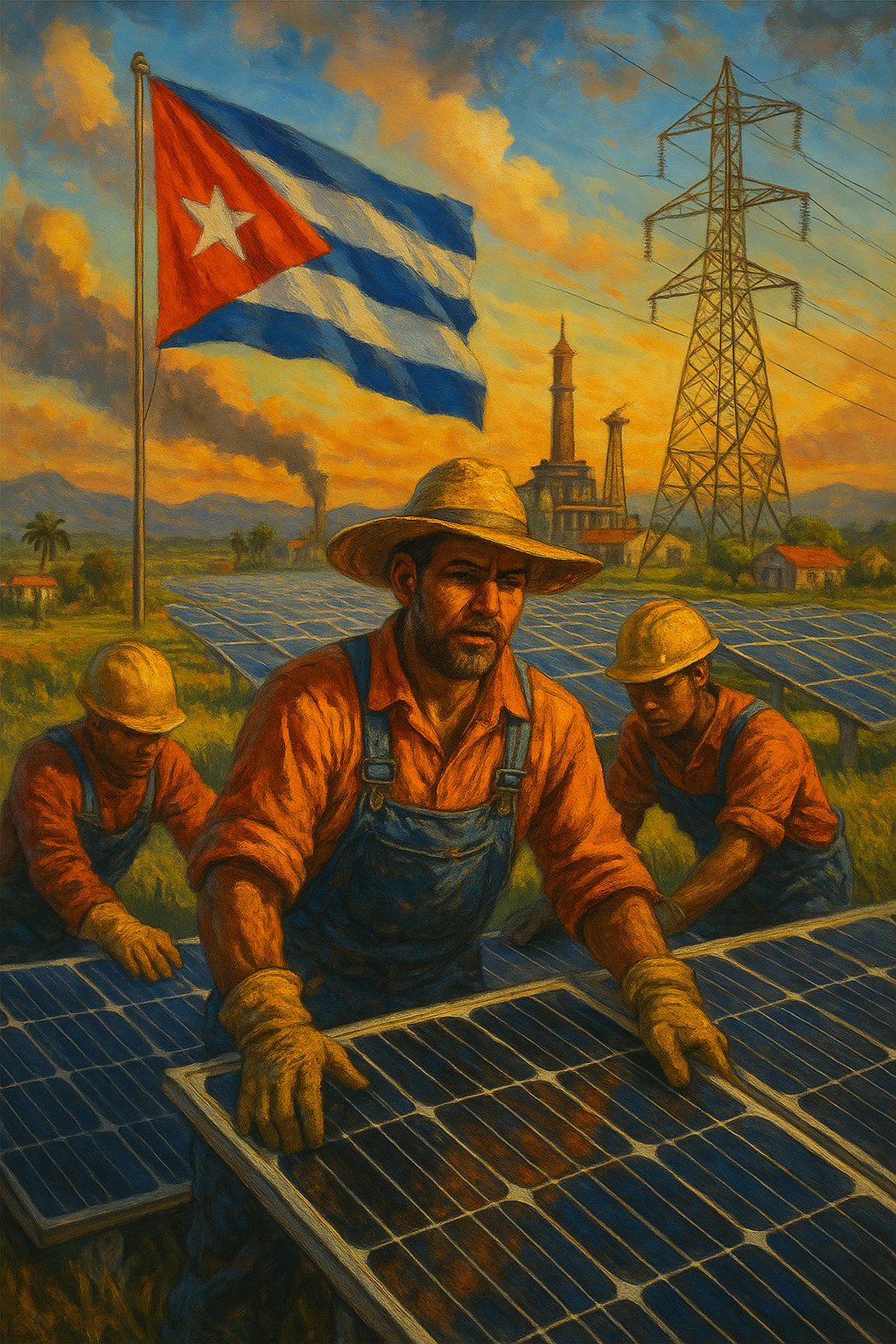
The Western media wants you to think Cuba is switching imperial sponsors. But the real story is one of solidarity, not supremacy. This is not a beauty contest. It’s a front in the global war against empire.
By Prince Kapone | Weaponized Information | July 1, 2025
“Supplanting” the Truth: Reuters and the Imperial Art of Narrative Control
On June 30, 2025, Reuters published an article claiming that “China is quietly supplanting Russia as Cuba’s main benefactor.” Don’t be fooled by the calm tone and the corporate sheen—this wasn’t journalism. It was imperial ventriloquism. The kind that tries to pass off a power play as analysis, turning Cuban sovereignty into a subplot in someone else’s movie. According to Reuters, Havana isn’t forging partnerships or pursuing energy sovereignty—it’s switching imperial sponsors like a desperate gambler looking for a new loan shark. The Global South, in their eyes, has no agency. Only dependencies to trade.
This piece was written by Dave Sherwood, a man whose career reads like a CV for cognitive warfare. He’s a product of the Knight International Journalism Fellowship and the Reuters Foundation—two elite grooming institutions that specialize in producing polite regime-change stenographers. His resume is thick with anti-Venezuela and anti-Nicaragua coverage, the kind that always seems to discover “corruption” just before a coup attempt or a fresh batch of U.S. sanctions. Sherwood is not reporting from Havana. He’s embedded—ideologically and institutionally—with the long arm of empire.
And what about Reuters itself? It’s not a newspaper. It’s a contractor. Owned by the Thomson Reuters Corporation, Reuters earns more than half of its revenue not from journalism, but from selling data services to banks, hedge funds, and Western governments. It has inked contracts with the U.S. Department of Homeland Security. Its board overlaps with the Atlantic Council, NATO’s propaganda lab. This isn’t independent media—it’s the Imperialist Media Apparatus, dressed in business casual. They don’t investigate empire. They are empire.
Naturally, Sherwood brings in the usual imperial chorus to bless the narrative. William LeoGrande from American University shows up to play the moderate liberal handwringer. Fulton Armstrong, a former CIA operative with a long history of Latin American meddling, floats in to offer expert-sounding nonsense about “aid patterns.” These aren’t analysts. They’re custodians of empire—keepers of the Overton window, sweeping out anything that smells like sovereignty.
The propaganda technique here is textbook. First, there’s the headline: “China is quietly supplanting Russia.” Not helping. Not collaborating. Supplanting. The word drips with Cold War rivalry. It frames Cuba not as a sovereign actor but as a prize to be won in a silent tug-of-war between rival empires. China isn’t cooperating—it’s scheming. Russia isn’t partnering—it’s losing. And Cuba? It’s not deciding. It’s being decided for.
Then comes the strategic omission. The U.S. blockade, now over sixty years old, goes completely unmentioned. Not a word about the economic strangulation, the medicine shortages, the energy cuts, the food insecurity—nothing. You’d think the Cuban crisis just floated in on a breeze. Reuters doesn’t have to lie. All they have to do is redact reality.
The emotional framing is equally manipulative. Cuba is described as crumbling—“decrepit sugar mills,” “horse-drawn carriages,” “desperate need.” It’s not a country in struggle. It’s a failing museum exhibit. The imagery is designed to evoke pity, not solidarity. It casts Cubans as helpless relics, not resilient revolutionaries.
And then, as if pulled straight from Edward Said’s notebook, the article stumbles into Orientalism. The Cuban people are stripped of subjectivity. We hear one bakery worker say, “We’ve seen no benefits here”—as if that line just happened to drift into the reporter’s microphone at the perfect moment. No mention of Cuban-led initiatives, state strategy, or popular planning. Just anonymous suffering, conveniently timed to echo the imperial script.
But the crown jewel of the piece is its subtle deployment of what we call Cognitive Warfare—the psychological operation that makes imperialism look like inevitability. Every sentence is curated to present Cuba’s alignment with China as a passive default, not an active choice. The reader is gently nudged toward one conclusion: Cuba has no plan, no agency, and no alternative. It’s just drifting from one patron to another—too weak to stand, too proud to beg, and too isolated to survive without a master.
But what Sherwood and Reuters can’t say—what they must not say—is that Cuba is not switching masters. It is breaking the rules. The ones written in Washington and enforced through banks, bombs, and bylines. The truth doesn’t fit the headline. So they bury it. That’s not reporting. That’s counterinsurgency by other means.
Facts in Chains: What Reuters Says, What Empire Hides
Strip away the imperial varnish, and the Reuters article reveals a jumbled mess of half-truths, amputated context, and misdirected emphasis. Some facts are technically correct. Others are shadows of truth, drained of meaning by selective framing. What matters is what’s missing—and why.
First, the surface-level data. Reuters reports that China is financing the construction of 55 solar parks across Cuba in 2025, with an additional 37 planned by 2028. Each park is projected to generate around 21 megawatts of power, amounting to more than 2,000 megawatts—roughly two-thirds of Cuba’s daytime electricity demand. Eight of these parks are already operational, delivering close to 400 megawatts according to Cuba’s state energy grid operator, UNE. The article also concedes—almost apologetically—that Cuba joined China’s Belt and Road Initiative in 2018, and that shipments of solar panels, fuel, and steel have arrived from Chinese ports.
The article likewise notes that Russia’s support for Cuba includes a $100 million investment in a major steel mill, announced in 2023 by Deputy Prime Minister Dmitry Chernyshenko. The plant was intended to produce 62,000 metric tons of steel bar by 2024, but only delivered 4,200 tons as of last reporting. Reuters references other Russian pledges—grain deliveries, tourism packages, trade zones—but frames them as broken promises and half-kept deals.
What it never tells the reader—not once—is that these efforts are taking place under the weight of a full-spectrum blockade. The United States has imposed over 240 coercive measures against Cuba since 2017 alone. The cumulative economic damage, according to the UN, exceeds $130 billion. This is not a minor omission. It is the foundational context of Cuba’s economic position—and its deliberate erasure is the scaffolding on which the rest of the Reuters narrative is built.
To understand how material that omission is, recall what we laid bare in “Starving the Revolution”: sanctions are not policy. They are siege. The U.S. blockade isolates Cuba from global trade, restricts access to fuel and pharmaceuticals, blocks remittances, freezes state assets, and penalizes third-party nations that dare engage. This is not diplomacy—it’s economic warfare.
That’s why China and Russia’s efforts aren’t about generosity. They’re about survival. These are not “gifts” to a failing state. They are joint responses to a coercive international regime. China’s state-run energy companies are building solar parks because Cuba cannot freely buy diesel or access international loans. Russia’s steel financing is delayed because its own economy is reeling from SWIFT expulsion and Western asset seizures. These shortfalls are not signs of abandonment. They’re the footprints of empire’s boot.
What Reuters labels as “competition” is, in fact, adaptive coordination. Cuba has forged long‑term deals with China through the Belt and Road Initiative, and with Russia via VEB.RF’s state development bank. That bank signed multiple inter‑ministerial agreements in 2023, outlined in official Russian government documents and corroborated by TASS reporting on loan agreement ratification. This isn’t opportunism. It’s a structural alignment—one born of shared exclusion from the imperial core.
Reuters also fails to mention that Cuba has participated in CELAC summits since 2022, joining other Latin American and Caribbean nations in calling for regional autonomy and multipolar cooperation. The summit speeches, including the one by President Díaz-Canel we reprinted in full in “Full Speech at the IX CELAC Summit,” point to a sovereign foreign policy—not a scavenger hunt for new imperial patrons.
In other words, what Reuters presents as strategic drift is better understood as strategic refusal. Cuba is not confused. It’s cornered. And within that corner, it has chosen to align with partners who—however imperfect—are willing to build outside of the U.S.-controlled system. What looks like aid is infrastructure. What looks like dependence is defiance. What looks like failure is the result of a financial noose.
That financial stranglehold takes many forms: denied SWIFT access, OFAC blacklists, secondary sanctions, frozen accounts, and forced rerouting through intermediaries. This is what we’ve called Financial Piracy—a regime of theft dressed up as law. Cuba doesn’t just have to build. It has to dodge, disguise, barter, and workaround.
And through all that, Cuba is building something real: an energy grid not dictated by BlackRock or Exxon, but by necessity and cooperation. Not for profit, but for survival. And that is precisely what Western reporting can’t afford to acknowledge. Because if Cuba’s model is working—even slowly, even painfully—then the whole edifice of imperial “development” begins to crack.
Not a Tug-of-War—A Struggle to Breathe
Step back from the fog of manufactured headlines and the picture becomes sharper: Cuba is not a passive arena where rival empires tussle for influence. It is an island under siege, fighting to breathe through a noose tightened by Washington. And what Reuters calls “supplanting” is actually a survival mechanism. It’s not rivalry. It’s resistance. Not confusion—but clarity under duress.
Let’s call the siege what it is: a Sanctions Architecture. A transnational web of restrictions, banking bans, currency freezes, asset seizures, and trade blockades, designed to discipline nations that disobey the imperial script. It’s not just the embargo. It’s the whole global system of financial coercion. SWIFT exclusion, secondary sanctions, the weaponization of OFAC lists—these are not technical tools. They’re instruments of war. And they don’t just squeeze Cuba. They punish anyone who dares help it.
In this architecture, the solar parks from China are not gifts. They’re countermeasures. They represent energy independence in a country denied oil. The fact that they’re built by a state-owned Chinese firm, not a Western utility cartel, is precisely what makes them intolerable to empire. A grid not governed by private shareholders? A power source that bypasses the dollar and the IMF? That’s heresy.
And the Russian steel that Reuters mocks as underdelivered? That’s not a failure of intent. It’s a casualty of Financial Piracy—the practice of looting sovereign assets and weaponizing global commerce routes to enforce submission. Russia itself is sanctioned, hounded, and hobbled by the very system it’s trying to subvert. The result isn’t betrayal. It’s the echo of a shared chokehold.
But you’d never know that from reading Reuters. Because this isn’t just misreporting—it’s Cognitive Warfare. The goal is not to inform. It’s to reprogram. To make the reader believe that Cuba is failing on its own terms, that its people are passive recipients of Chinese or Russian “help,” and that multipolar cooperation is just a new mask for colonialism. That’s the sleight of hand. Solidarity is recast as dependency. Resilience is coded as desperation. The very act of building becomes suspect, so long as it’s not done under U.S. supervision.
Nowhere in this framing is there space for Anti-Imperialist Sovereignty—the idea that nations like Cuba are not only capable of surviving empire, but of imagining systems beyond it. Not just surviving the storm, but rerouting its waters. What Cuba is doing—painfully, imperfectly, but deliberately—is constructing a life raft on the periphery of the collapsing imperial core. And that is what terrifies the architects of empire. Not because Cuba threatens their military dominance. But because it refuses to drown.
This is why Reuters can’t say the obvious: that Cuba’s relationship with China is strategic, not submissive. That the Belt and Road isn’t charity, but coordination. That the steel mill delays aren’t Russian indifference, but collateral damage in a sanctions war. Because if it said those things, the whole edifice would crack. If Cuba can survive without Wall Street, without USAID, without neoliberal reform—then the myth of empire’s benevolence collapses.
And make no mistake, that myth is essential. It tells the colonized that suffering is their own fault. That sovereignty is impossible. That socialism is outdated. That cooperation among the oppressed is a mirage. Break that myth, and something dangerous happens: hope begins to look realistic. Sovereignty starts to look possible. Solidarity starts to look strategic.
That’s what this article is trying to suppress—not just the facts, but the implications. Because what’s unfolding in Cuba is not just a shift in partners. It’s a shift in reality. From unipolar entrapment to multipolar negotiation. From imposed dependency to improvised independence. From surviving empire to outmaneuvering it. That’s not a geopolitical chess move. That’s a revolutionary act.
Solidarity Is a Verb: From Narrative War to Concrete Action
If Cuba is fighting to breathe under imperial siege, then we—those living inside the belly of the beast—have a decision to make. We can nod along with the headlines, feign confusion at the “complexities,” and disappear into the algorithm. Or we can act. Not out of charity. But out of commitment. Because the future Cuba is fighting to build is the same future we are being denied—one of sovereignty, dignity, and collective survival.
First, let’s name the battlefield: energy. The solar parks China is helping construct are not just infrastructure. They’re lifelines. Built outside of the fossil-fueled finance system, free from IMF austerity riders, they represent what development looks like when it isn’t dictated by Exxon or BlackRock. This is where the war is being fought now—not with missiles, but with megawatts. And Cuba’s refusal to privatize its grid is a direct strike against the imperial playbook.
That’s why solidarity must start with sabotage—economic sabotage of the institutions that uphold the blockade. If you’re in a union, a pension board, or a university endowment committee, demand full divestment from banks like JPMorgan Chase, Citigroup, and Santander. These are the financial brokers of the embargo—quietly processing the wire transfers that keep the noose tight. Target their reputations. Pressure your reps. Make it impossible for them to act without consequence.
Then, there’s the work of construction. If the empire wages siege by cutting off power, we respond by funding light. Support grassroots solar cooperatives working with Cuban engineers and energy planners. Channel resources into Cuban-run software collectives, digital infrastructure initiatives, and data storage nodes. These are not side projects. They are the front lines of a dual infrastructure: one rooted in autonomy, not extractivism.
On the information front, we need a counteroffensive. While the empire throttles speech and buries truth under the weight of search engine manipulation, we practice Proletarian Cyber Resistance. Mirror Cuban media outlets. Translate speeches like Díaz-Canel’s at CELAC. Circulate PDF archives of sanctioned materials. Create peer-to-peer backup nodes of Cuban government servers. Every megabyte we share is a blow against informational blockade.
And finally, we return to our most basic weapon: education. Organize teach-ins on the U.S. blockade. Build reading groups using our own archives—“Starving the Revolution”, “Lawfare and Loot”, and “Scapegoating Solidarity”. Don’t just memorize. Mobilize. The goal is not to study Cuba as a case—it’s to defend it as a comrade.
We stand in the shadow of the Venceremos Brigades, the internationalist teachers and workers who defied U.S. law to plant seeds of solidarity in Cuban soil. We inherit their unfinished work. But our terrain is different now—digitized, censored, and surveilled. Our job isn’t to romanticize the past. It’s to weaponize the present.
Because Cuba is not asking for permission to survive. It’s doing it. And that’s the danger. That’s why the media calls it desperate. That’s why the banks blacklist it. That’s why Washington panics at the sight of solar panels. The real threat isn’t collapse. It’s endurance. And our task is to amplify it—materially, digitally, politically—until Cuba is no longer isolated, but surrounded by comrades ready to fight alongside it.
 Weaponized Information
Leave a comment