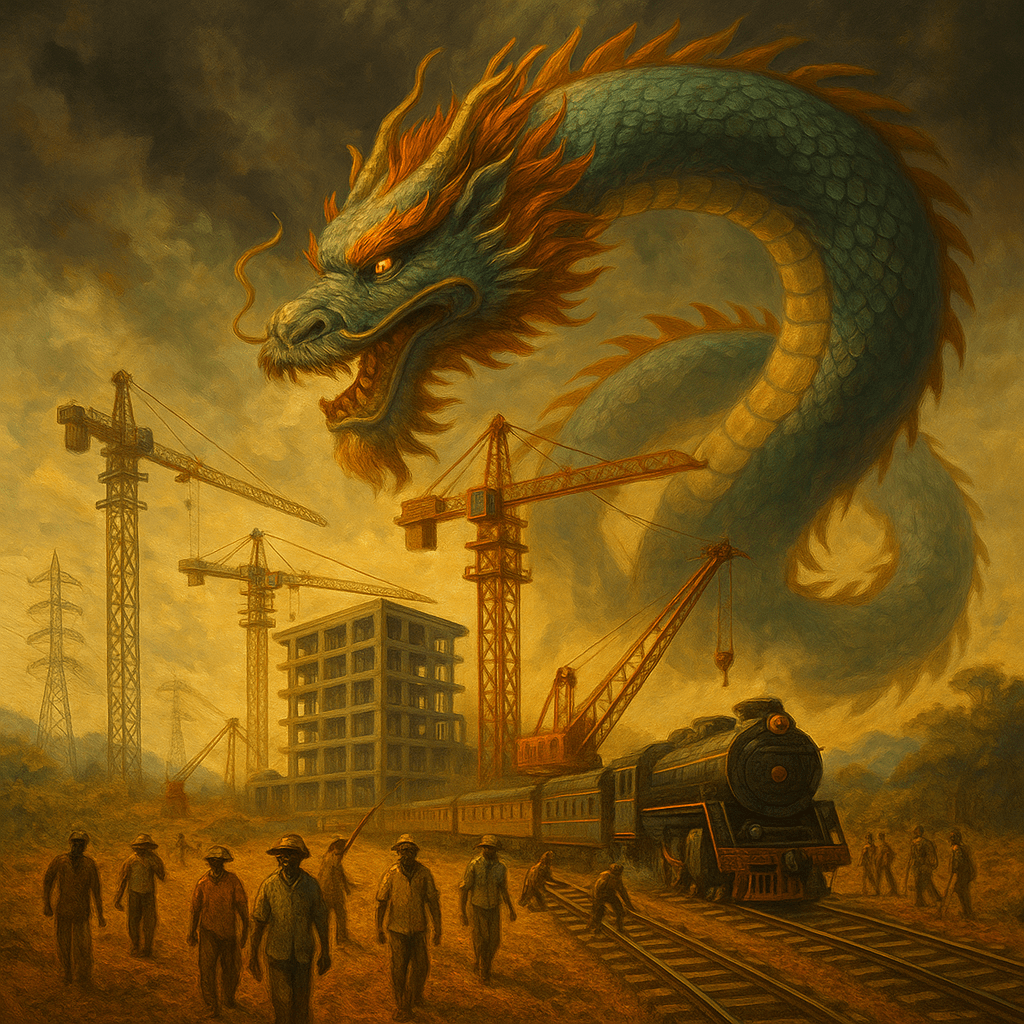
Reuters’ hit piece on China’s lending practices isn’t investigative journalism—it’s economic warfare in print. We tear the mask off the real debt colonialists.
By Prince Kapone | Weaponized Information | June 28, 2025
Part I: Imperial Optics—The Propaganda of “Neutral” Concern
On June 25, 2025, Reuters published an article claiming that China’s collateralized lending practices are undermining the financial sovereignty of Global South nations. The article summarizes a study by the World Bank’s Private Sector Infrastructure Finance Network (PSIFN) and AidData—a Western-funded research institution—arguing that China’s loan contracts burden poorer countries with hidden risks and coercive terms. According to Reuters, the report warns that “Chinese lenders increasingly demand commodity exports, land, or cash as collateral,” allegedly placing debtor nations in a precarious and opaque trap.
But let’s not pretend this is just journalism. The propaganda is baked into the architecture. Reuters—an outlet headquartered in London and structurally embedded in the financial aristocracy of the Global North—acts not as a dispassionate observer, but as a conveyor belt for imperial anxiety. The source of the story, the World Bank PSIFN, is not a neutral economic body. It’s a financial enforcer that emerged from Bretton Woods to secure the hegemony of the U.S. dollar, impose market reforms, and discipline the Global South through austerity. Its so-called “Private Sector Infrastructure Finance Network” is less a research forum and more a backchannel between Western banks, institutional investors, and state officials looking to privatize the developing world’s public goods.
Then there’s AidData—cited in the report and frequently mobilized as a “transparent” watchdog of Chinese development financing. AidData is housed within the College of William & Mary, a U.S. institution with long-standing ties to the U.S. State Department and Pentagon funding streams. It’s not an accident that its data is used by U.S. policymakers to target China’s Belt and Road Initiative (BRI) under the guise of academic neutrality. One of its core funders? USAID. So much for objectivity.
The article deploys classic Cold War narrative framing. China is depicted as opaque, extractive, and imperial—not because of what it does, but because it dares to compete with Western institutions on a global scale. By contrast, the IMF and World Bank are nowhere to be found in this article—not a single mention of their long legacy of economic sabotage, structural adjustment, forced austerity, or the massive outflows of wealth they have imposed on the very countries this study pretends to care about. There is no comparison to be found here—because comparison would obliterate the narrative. China’s faults are magnified; the West’s crimes are erased.
The propaganda technique at work is what we call preemptive narrative inversion. Rather than acknowledging the real critiques of Western finance—such as its role in transferring over $970 billion in net financial outflows from the Global South to the North in 2023 alone—the article flips the script. It accuses China of doing precisely what Western creditors have done for half a century. But here’s the trick: the article never actually shows China seizing collateral or defaulting a country into poverty. It only implies, insinuates, and strategically quotes “analysts” who sound alarm bells without supplying evidence. It tells us there is “a growing trend” but never identifies a single case of Chinese asset seizure through collateral enforcement.
What’s more, Reuters avoids any mention of China’s record on debt cancellation, interest-free loan forgiveness, and sovereign renegotiation—a track record far more generous and flexible than the IMF or Paris Club. It omits China’s participation in the G20 Debt Service Suspension Initiative. It fails to distinguish between state-to-state loans and private Chinese corporate deals. These are not accidents—they are structural omissions designed to frame the story as one of predatory authoritarianism vs benevolent liberalism.
This is not journalism—it is imperial storyboarding. It is war by narrative. And in this battle of framing, the working class must sharpen its tools. Because the issue is not whether China is perfect—it isn’t. The issue is whether imperialism gets to hide its crimes behind accusations it projects onto others. And the answer, comrade, is no.
Part II: Extracting Imperial Facts from an Engineered Narrative
Let’s clear the smoke first: the Reuters article isn’t a standalone report. It’s a delivery vehicle for a highly curated research paper produced by AidData and the World Bank’s Private Sector Infrastructure Finance Network (PSIFN). This is not a neutral academic intervention. It is an ideological weapon deployed by the very institutions whose monopoly over debt, credit ratings, and global finance is being directly challenged by China’s rise. The fact that Reuters functions as the conduit for this study should surprise no one—it’s an imperial stenographer in a business suit, not a journalist.
What does the report actually say? According to the PSIFN-AidData paper, China has used “collateralized lending” to protect its overseas loans, especially in the energy and transport sectors, often demanding commodity-backed guarantees (e.g., oil, minerals) from countries in Africa, Asia, and Latin America. The headline claim is that these “collateral demands” are “curbing emerging countries’ ability to manage finances”—suggesting that China’s state-backed loans are effectively seizing economic sovereignty. These are the “facts” cited by Reuters. But what’s missing from the story is just as important as what’s said.
First, the study does not provide evidence of China ever seizing collateral. Not once. In fact, it admits that no case of actual collateral enforcement has been verified. Instead, it theorizes that collateral arrangements could reduce a borrower’s fiscal flexibility. This is a speculative assumption, not an established fact. Reuters, of course, omits this nuance completely—spinning hypothesis into condemnation.
Second, the study does not meaningfully distinguish between Chinese state loans and private commercial deals involving Chinese firms or joint ventures. This elision is deliberate. By collapsing these categories, it creates the impression that all Chinese financial activity abroad is state-coordinated debt-trap diplomacy. But in reality, many collateral-backed loans identified in the study are issued by joint ventures or commercial consortia, not directly by the Chinese government or policy banks.
Third, while the report obsessively focuses on Chinese collateralization, it says nothing about the conditionalities attached to IMF and World Bank loans. It doesn’t mention that Western institutions regularly demand mass privatization, public sector layoffs, currency devaluation, fuel subsidy removal, and wholesale restructuring of national economies. No mention of the structural adjustment regimes that gutted public health systems across Africa, or the fact that over $971 billion in net capital was extracted from the Global South in 2023 alone.
The omissions don’t stop there. Reuters fails to contextualize Chinese lending within China’s broader record of debt restructuring and forgiveness. Between 2000 and 2019, China canceled over $3.4 billion in African debt. In 2022, it forgave 23 interest-free loans to 17 African countries—without demanding austerity or asset seizures. Not a word of this appears in the Reuters piece. Why? Because the truth disrupts the imperial script.
Most damning of all is the underlying hypocrisy. The West has collateralized the entire planet—through financial chokepoints, through SWIFT, through credit ratings, and through institutions like the IMF that write neoliberal doctrine into loan contracts. When the IMF lent to Argentina, it demanded pension reform. When it lent to Zambia, it demanded fuel subsidy cuts. When it lent to Pakistan, it demanded an end to food subsidies and the privatization of state utilities. These are not just conditionalities—they are imperial restructuring programs.
And yet none of these practices are described as “curbing sovereignty” in Reuters. The only villain is China, whose greatest offense appears to be offering countries loans that allow them to avoid IMF tutelage. What the study calls a “fiscal risk,” many in the Global South recognize as an exit strategy.
This is the core function of the AidData-PSIFN study and its media echo chamber: to delegitimize multipolar financial alternatives before they can fully mature. It’s not about empirical accuracy—it’s about narrative dominance. And like all imperial narratives, it depends on a precise combination of silence, distortion, and projection.
Part III: Building the Exit—Multipolar Finance as Material Liberation
Imperialists accuse China of creating “debt traps,” but what’s really under attack is the possibility of escape. Chinese loans—particularly those extended by state entities like the China Development Bank and the Export-Import Bank of China—represent an imperfect but real path to delinking from Western finance capital. And that’s precisely what the ruling class fears. Because what Washington calls “collateral,” many in the Global South recognize as sovereignty.
Unlike the IMF or World Bank, which tether every dollar to austerity and surveillance, Chinese financing often centers on infrastructure: power plants, hospitals, railways, ports. Consider the Ethiopia–Djibouti railway, a 752-kilometer electric cargo line linking Addis Ababa to the sea. Built by Chinese firms and financed with Chinese concessional loans, it reduced transport time from 3 days to 12 hours, slashing freight costs and increasing trade efficiency without imposing subsidy cuts or privatization mandates. That’s not a trap—that’s leverage.
Or take Angola, where post-civil war reconstruction was underwritten by Chinese oil-backed credit. Western lenders demanded shock therapy and market “liberalization”; China provided hospitals, roads, and water systems in exchange for crude—no IMF technocrats, no labor deregulation. Angola’s rail systems, telecoms, and national housing projects today stand as monuments to an alternative development pathway: one that builds instead of bleeds.
In Pakistan, Chinese loans through the China–Pakistan Economic Corridor (CPEC) powered up the national grid with 5,000+ MW of new energy capacity, revived dying textile zones with modern transit infrastructure, and laid fiberoptic cables across mountain passes—all without demanding Islamabad cut pensions or slash fuel subsidies. The results aren’t perfect. But they’re sovereign. No “reforms” were imposed from the outside. No central bank independence was handed to foreign creditors.
Meanwhile, China’s use of collateral is wildly exaggerated. As the China–Africa Research Initiative has shown, most Chinese loans are either concessional or backed by long‑term resource exchange, not seizures. Over $3.4 billion in debt was forgiven between 2000 and 2019. In 2022, Beijing canceled 23 interest-free loans across 17 countries—no riots, no coups, no demands to dismantle labor ministries. In fact, many of these nations are now forging South–South industrial projects—joint special economic zones, tech training hubs, and agro-processing plants—with China as a co-developer, not an occupier.
That’s what makes multipolar finance so dangerous to imperialism. It doesn’t just offer better rates—it offers better rules. When the African Union launched the Pan-African Payment and Settlement System (PAPSS) in 2022, with support from Afreximbank and Chinese digital clearing firms, it processed over $12 billion in intra-African trade in local currencies—dodging both SWIFT and the dollar. Likewise, China’s Cross-Border Interbank Payment System (CIPS) now clears 15% of its trade with Africa and Latin America, increasingly in yuan, rubles, or local currencies. This isn’t debt. This is delinking.
And the architecture is growing. The New Development Bank (NDB) of BRICS now offers infrastructure loans to member states without IMF-style oversight. In 2023, it financed highway development in Bangladesh and renewable energy in Brazil—in local currency, without austerity riders. These institutions don’t just compete with the IMF—they make it obsolete. Where the West sees borrowers to discipline, multipolarity sees partners to build with.
That doesn’t mean China’s role is without contradiction. As a major global creditor and emerging imperial force in its own right, China’s capital exports can serve state and commercial interests. But there’s a world of difference between lending that expands productive capacity and lending that enforces starvation. The U.S. and its satellites have used debt as a weapon of mass de-development. China’s model, for all its complexity, is materially rooted in building infrastructure, not demolishing sovereignty.
So yes, this is a reframing. And it’s necessary. Because the real trap isn’t China’s collateral—it’s the Reuters narrative itself. By equating Chinese state loans with IMF shock programs, they’re trying to deny the working classes of the Global South their most promising exit ramp. They want you to believe that all creditors are vampires so that you never notice who built the roads, kept the lights on, and didn’t charge you your dignity.
Multipolarity is not a slogan. It is a material process, rooted in new systems of trade, finance, and solidarity. And in that fight, China is not the enemy—it’s part of the battlefield. It’s time to stop parroting imperial talking points and start building a world that doesn’t kneel before bankers in Brussels, DC, or Beijing. Because the point isn’t to change creditors. The point is to abolish debt as a weapon of class war.
Part IV: From Complicity to Combat—The Global North Must Defect
If you’re reading this from New York, London, Berlin, Toronto, or Sydney, this much is true: you live inside the belly of the beast. The debt that shackles the Global South fuels the cheap consumption, speculative finance, and artificial stability of our lives in the North. Your pension fund owns the bonds. Your government writes the rules. Your media spins the lies. The question is—what will you do about it?
Imperial debt is not an abstract moral failure. It’s a structure of plunder. It’s how Wall Street props up the dollar. It’s how Brussels keeps Africa divided and dependent. It’s how our ruling class crushes any nation that dares to build roads, power grids, or steel plants without permission. Whether through IMF diktats or Reuters hit pieces, the objective is the same: deny sovereignty to the South so we can enjoy stolen stability in the North.
But here’s the truth they don’t want us to see: their order is cracking. Multipolarity isn’t a fantasy—it’s a process already unfolding. The BRICS are growing. The dollar is slipping. Whole continents are experimenting with new currencies, new banks, and new partnerships—sometimes with China, sometimes with each other. The old unipolar machine is malfunctioning. And our job—our duty—is not to repair it. It’s to sabotage it.
That starts with ideological defection. We must expose every lie they tell: that China is just the new IMF, that Global South governments are helpless victims, that the world needs Western oversight to survive. These are not neutral ideas—they are weapons of counterinsurgency, aimed not just at the South, but at us too. Because once we believe there is no alternative, we stop looking for one. And once we stop looking, we stop fighting.
We must name the real enemy: the Western finance oligarchy and their state collaborators. The BlackRocks and Vanguards. The World Banks and White Houses. The think tanks and PR firms. These are not saviors—they are system managers for an empire in decline. Their power rests not on strength, but on silence. Break that silence, and their edifice begins to wobble.
Next comes material solidarity. Not charity. Not “awareness.” But organizing to undermine the empire’s infrastructure of domination. Demand your union divest from Global South debt portfolios. Block new IMF packages from passing unchallenged. Build networks with migrant workers, diaspora organizers, and anti-imperialist forces from the South. Create media, campaigns, and institutions that don’t parrot imperial narratives but confront them. Use every crack in the system to grow a counter-system.
And finally, recognize that our liberation is bound up with theirs. The same class that exploits workers in Kinshasa and Karachi is the one that shuts down your factory, steals your pension, and floods your neighborhood with fentanyl. The global South is not “over there.” It is under our feet. It is in our blood. And if we don’t join their fight, we will be next.
Comrades in the North: it’s time to break ranks. It’s time to turn propaganda against the propagandists. To stand with multipolar sovereignty, not imperial nostalgia. To see Chinese finance not through the eyes of the Financial Times, but through the eyes of a miner in Zambia who finally got a paved road. This is not about defending Beijing. It’s about dismantling the empire that speaks in our name and feeds on their lives.
History will not remember those who explained the system. It will remember those who fought to destroy it. So let’s sharpen our theory, lift our fists, and get to work. Because another world isn’t just possible. It’s already under construction. And we have to choose: help build it—or be buried beneath it.
 Weaponized Information
Leave a comment