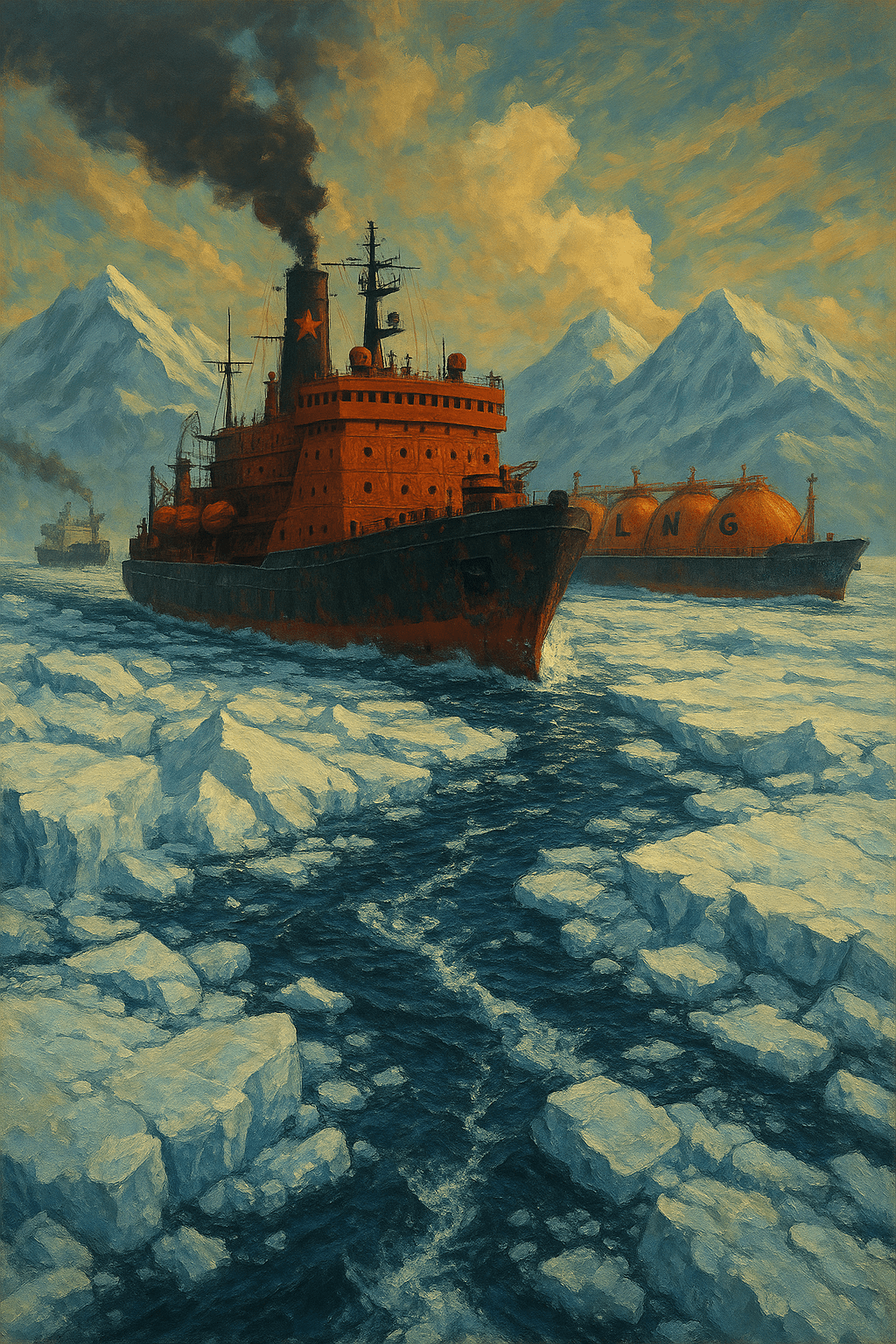
Russia rerouted its Arctic LNG trade through Murmansk to escape EU sanctions. But behind the headline lies a deeper truth: imperialism still controls the routes, the insurance, and the legal scaffolding of global logistics.
By Prince Kapone | Weaponized Information | June 26, 2025
They Own the Boats, the Papers, and the Ports
When you control the ships, the insurers, and the oceans they sail on, you don’t need an army to enforce your empire. You just let the trade routes do the work. That’s the silent thesis of the bne IntelliNews article published on June 26, 2025, which claims to expose “Russia’s fragile dependence” on Western shipping for its Arctic LNG exports. But what it actually exposes is the skeleton of imperial infrastructure that still grips the arteries of global trade—even as the Global South and multipolar forces fight to tear free.
The article presents itself as an objective assessment of Russia’s logistical pivot from European ports to its own northern harbor at Murmansk. It leans heavily on a report by the Centre for Research on Energy and Clean Air (CREA), a Western technocratic think tank that specializes in using spreadsheets and policy briefs to polish the chains of empire. CREA’s conclusion is as predictable as it is revealing: even with sanctions, even with rerouted shipping, Russia can’t escape the “rules-based order”—because the order owns the tankers, the insurance, and the port infrastructure. And that’s the point.
Nowhere in this article do we learn that the West’s dominance in maritime logistics isn’t a product of fair competition or superior engineering. It’s the bloody dividend of centuries of colonial plunder, militarized shipping lanes, and the deliberate underdevelopment of non-Western maritime capacity. The Arc-7 ice-class LNG carriers at the heart of the Yamal project? Not a single one is fully Russian-owned. All of them are insured through providers headquartered in the very countries enforcing the sanctions. This isn’t just about boats. It’s about chokepoints. Structural domination. Colonial continuities.
But the article doesn’t bother with history. It avoids ideology like the plague. Instead, it recycles the same tired liberal imperial logic: Russia can redraw the map, but the empire still owns the paper it’s printed on. It frames Russia’s Murmansk maneuver not as an act of sovereignty under siege, but as a desperate detour that proves dependency. It praises the “efficiency” of EU ports—like Zeebrugge in Belgium and Montoir in France—without mentioning that these are the same ports enforcing imperial exclusion through sanctions and lawfare. The brilliance of Western infrastructure, we’re told, is that even resistance flows through it.
This is how cognitive warfare operates in the logistics domain. It doesn’t need to shout. It whispers through market analysis. It wraps empire in technocratic neutrality. It hides the boot behind the bill of lading. And it trains the reader not to ask why Europe and the G7 control the vast majority of Arctic-capable vessels, registry services, and global marine insurance in the first place. The article never asks who benefits from this dependency, or whether the architecture of global maritime commerce itself needs to be dismantled and rebuilt from below.
Instead, the journalist—uncredited, as is often the case with stenographers of empire—amplifies CREA’s talking points as if they were gospel. And CREA, in turn, serves the function of the modern imperial priesthood: rendering exploitative systems as rational, inevitable, and apolitical. This is not reporting. It is consent manufacturing in PDF format. It is the ideological wing of imperialist recalibration, legitimizing sanctions as “policy” and enforcing Western dominance not with bombs, but with spreadsheets, underwriting agreements, and flagged vessels.
The real scandal here isn’t Russia’s reliance on Western ships. It’s that the entire world is still forced to rent its sovereignty from the empire’s logistics firms, port authorities, and legal brokers. And until that changes—until Global South powers and revolutionary movements dismantle the monopolies on movement itself—no reroute is truly free.
Logistics as a Weapon of Empire
Beneath the dry data and policy jargon, the IntelliNews article provides several critical facts—facts which, if properly contextualized, reveal far more than the authors intend. Yes, Russia rerouted 100% of its Arctic LNG transshipments to Murmansk in the first five months of 2025. Yes, the volume of transshipped LNG fell by 46% year-over-year. And yes, every single Arc-7 ice-class LNG carrier used in the operation is insured by firms based in the UK, Japan, or the Bahamas—jurisdictions enforcing sanctions against Russia. These are not minor logistical quirks. They are the material levers of global imperial power.
But the article’s selective framing conceals the broader dynamics. There is no mention of how Western dominance over Arctic-capable maritime infrastructure was forged in the crucible of colonial extraction, military projection, and Cold War logistics planning. Nor does it note that Russia’s shift to Murmansk—though imperfect—is part of a broader project of anti-imperialist sovereignty: building domestic port infrastructure, state-led energy networks, and non-Western trade corridors to circumvent the empire’s chokeholds.
What the article dismisses as dependency is better understood as a contested transition zone. Murmansk is not a symbol of failure; it is a battlefield of infrastructural decolonization. The fact that Russia must still rely on foreign-owned tankers and G7-based insurers reflects the enduring scaffolding of imperialist logistics—but that scaffolding is rusting. China, Iran, Venezuela, and others are already investing in sovereign shipping, alternative insurance pools, and maritime corridors that reroute the bloodstream of global trade.
Meanwhile, the article completely omits the weaponized nature of the EU’s March 2025 sanctions. It treats the ban on ship-to-ship LNG transfers at European ports as neutral policy, when in reality it is a form of lawfare: economic strangulation dressed up in legal language. The aim was not merely to punish Russia, but to preserve Western leverage over the flow of energy between continents. The result is a sanctions regime that blocks alternatives while portraying any attempt at self-sufficiency as inefficient, fragile, or illegitimate.
Even Arctic LNG-2’s delays are framed as evidence of Russia’s dysfunction. But again, the reality is more complex. The U.S. and EU not only sanctioned the project—they also pressured France’s TotalEnergies and Japan’s Mitsui to withdraw, froze assets, and threatened secondary sanctions against investors. In this light, the logistical delays are not engineering failures but the direct result of financial piracy: coordinated sabotage through asset seizures, contract voiding, and transnational legal harassment.
The article never asks why the empire has the right to deny maritime insurance to sovereign nations. It never questions the morality of sanctions regimes that punish entire populations by disrupting trade and infrastructure. It never considers that logistics—the ability to move goods, energy, and information—is no longer a neutral terrain, but a primary battleground in the war for a multipolar world.
Where They See Dependence, We See Resistance
Every time a Russian tanker sails out of Murmansk, the empire sees fragility. But what they’re really witnessing is friction—the slow, grinding movement of a global order trying to shift its center of gravity. That friction is not weakness. It’s resistance. The Western press interprets Russia’s logistical entanglement as evidence that empire still rules the sea. What they miss—deliberately—is that the map is already being redrawn beneath their feet.
This is the contradiction at the heart of imperial logistics: the more the Global South reroutes, relocalizes, or reinvests in its own shipping and trade infrastructure, the more empire accuses it of “inefficiency” or “fragility.” But sovereignty does not emerge fully formed. It is forged, painfully and incrementally, through ruptures like the one unfolding in the Arctic. Russia’s rerouting through Murmansk is not a perfect delinking—but it is a defiant pivot, a bid to reassert material control over a system long monopolized by Western capital.
And it’s not happening in isolation. The rise of BRICS+ and the strengthening of South-South maritime corridors—from Iran’s Chabahar Port to China’s Polar Silk Road—represent a tectonic shift in the architecture of global trade. These are not just ports or pipelines; they are the physical foundations of anti-imperialist sovereignty, laid brick by brick in defiance of a system that weaponizes movement itself. Each new terminal, each new shipping lane, chips away at the empire’s logistical monopoly.
In this context, the narrative of “Russian dependence” collapses. What we are really seeing is the strategic fallout of imperialist recalibration: as the West doubles down on sanctions and legal chokeholds, targeted nations are forced to accelerate autonomous infrastructure. Yes, Russia still sails on Western ships. But only for now. Already, discussions are underway about building BRICS-led insurance pools, reflagging tankers, and constructing sovereign fleets capable of Arctic navigation.
Western media refuses to name the real contradiction: that the rules-based order is no longer stable. Its enforcers are aging oligarchies, clinging to monopolies over paperwork, patents, and ports. But multipolarity is not a policy—it is a material reality already under construction. And like all revolutionary transitions, it proceeds through uneven terrain: dual systems, contested spaces, logistical ruptures.
Murmansk is not an endpoint. It is a detour on the long road to maritime liberation. It is the site of struggle between empire’s dying order and a new order clawing its way into existence. And every line of propaganda aimed at painting this moment as a failure only confirms one thing: the ruling class knows it’s losing control of the map.
Reclaim the Routes, Rebuild the World
The struggle over Murmansk is not Russia’s alone. It belongs to every nation whose trade is hijacked by foreign insurers, whose ports are choked by imperial chokepoints, and whose sovereignty is subordinated to the spreadsheets of Western shipping conglomerates. It is a front in the global war to reclaim infrastructure—not as a zone of extraction and control, but as a foundation for liberation. And the global working class has a direct role to play.
The first step is ideological clarity. We must name the system for what it is: an imperialist logistics regime designed to enforce dependency and punish disobedience. When ports like Zeebrugge and Montoir serve as sanction-enforcing hubs, they are not just infrastructure—they are extensions of NATO’s coercive apparatus. When Lloyd’s of London insures every sanctioned vessel, it does so as a private arm of lawfare. When CREA releases reports portraying autonomy as failure, it is conducting cognitive warfare for the empire.
But clarity is not enough. Our solidarity must be material. Dockworkers in Europe and North America must organize against the weaponization of their labor—refusing to handle goods used to enforce sanctions. Maritime unions in the Global South must be supported in their efforts to build sovereign fleets, challenge Western insurance cartels, and train a new generation of revolutionary seafarers. Hackers and cyber-workers must expose the collusion of shipping insurers and sanction enforcers, building tools of proletarian cyber resistance to crack open the empire’s data silos.
We call on all revolutionary forces in the imperial core to launch a campaign of “Ports for People, Not Empire.” Demand transparency in shipping contracts. Investigate the role of city-based maritime law firms in crafting sanction regimes. Organize teach-ins that explain how logistics has become a tool of neocolonial domination. And most importantly: link arms with dockers, sailors, and freight workers from the Global South. Our routes must connect—not for capital, but for life.
Multipolarity is not a spectator sport. It demands practice. It demands sabotage of the old flows and construction of the new. If Murmansk teaches us anything, it is that every act of rerouting, every refusal to comply, every investment in sovereign infrastructure is a crack in the hull of the imperial order. The empire still owns the boats—but they no longer own the future.
 Weaponized Information
Leave a comment