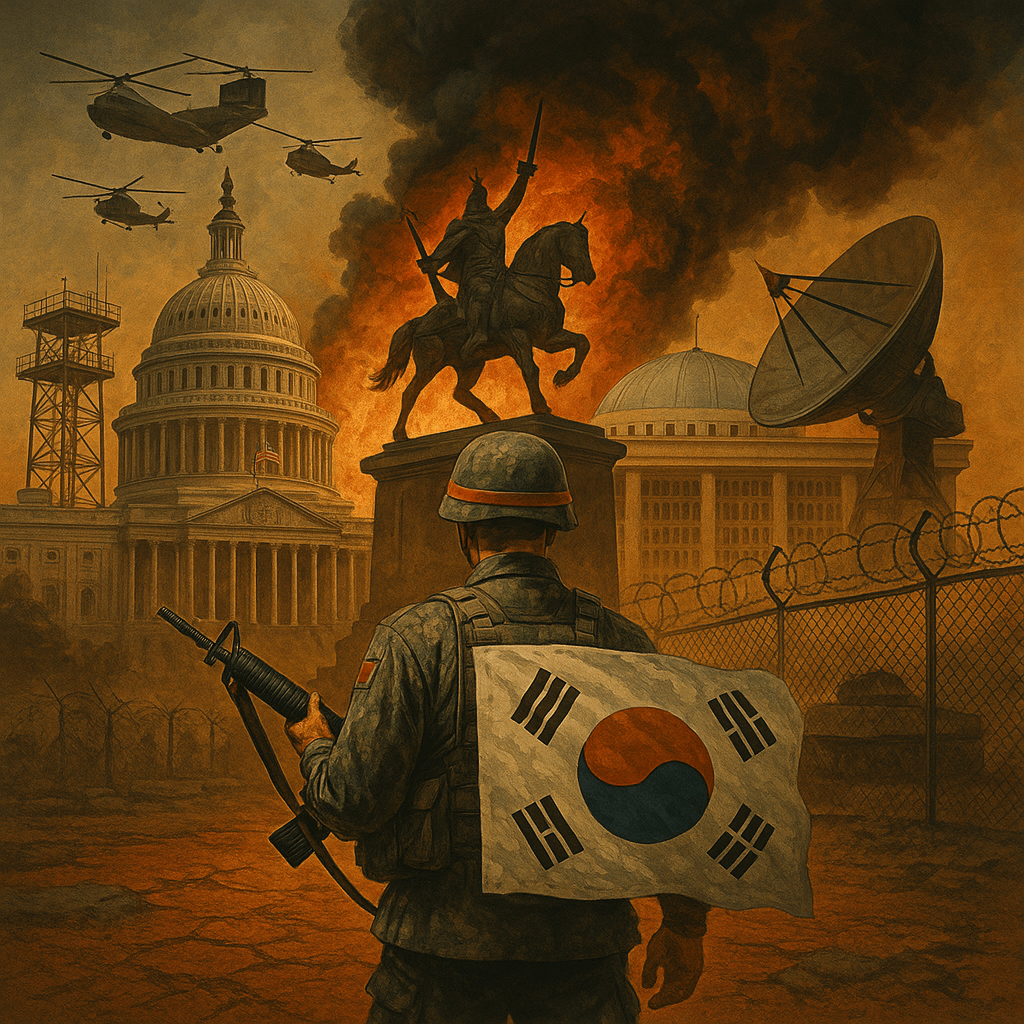
How a U.S.-engineered war machine enabled a martial law power grab in Seoul—and why the next one might not fail.
By Prince Kapone | Weaponized Information | June 24, 2025
1. Armistice Empire: How a War That Never Ended Became the Legal Foundation for Occupation
In 1953, guns fell mostly silent on the Korean Peninsula—but peace never came. What we got instead was an armistice, a legal pause button that kept the war technically alive. South Korea didn’t even sign it. And in the silence that followed, the United States got to work building something more permanent than peace: a war machine with Seoul as its front line and Washington behind the controls.
That’s how we ended up here, with 28,500 U.S. troops still stationed in South Korea, not as guests, but as landlords of empire. Not one of those soldiers is there because the Korean people asked for them. They’re there because the U.S. decided that Korea would serve as a garrison state for its Cold War ambitions—a role it still plays, seven decades later, under a new name: “strategic partnership.”
At the center of this occupation is the U.S.–ROK Combined Forces Command, a military arrangement where—get this—a U.S. general controls the entire South Korean army in wartime. It’s called “OPCON,” or operational control, but what it really means is this: if war breaks out, South Korea doesn’t command its own forces. The Pentagon does. The soldier defending your home doesn’t answer to your government. He answers to Washington.
This isn’t a relic of history. It’s an active system, wired into every node of South Korea’s military command. Every time tensions rise with the North—or with China, or Russia, or whomever the White House is wagging its finger at—the switch flips, and South Korean sovereignty gets overridden by U.S. military priorities.
This is what they mean by “alliance.” But it’s not an alliance between equals. It’s a leash disguised as a handshake. The unresolved status of the Korean War—engineered by the U.S.—is the legal cover for this arrangement. As long as there’s no peace treaty, the U.S. can claim it’s just doing what’s necessary to “protect” its ally. But if you look at who controls what, it’s obvious: this isn’t protection. It’s possession.
And to make sure the leash doesn’t snap, the U.S. stacked the deck with legal shackles. Under Status of Forces Agreements (SOFAs), American troops stationed in Korea enjoy all sorts of privileges: legal immunity, extraterritorial rights, access to land and infrastructure without consent. When U.S. soldiers commit crimes—and many have—they’re whisked out of Korean jurisdiction like VIPs on a private flight. Justice, like command, is outsourced.
The bases are called “joint,” but they operate like colonial outposts. Camp Humphreys, now the largest U.S. military base on Earth outside America, isn’t there to defend South Korea. It’s there to project U.S. power across the entire region—from the Yellow Sea to the Taiwan Strait. Its drones, missiles, and surveillance systems don’t respond to the will of the Korean people. They answer to the logic of the U.S. empire.
So when someone like Yoon Suk Yeol reaches for martial law—when he tries to shut down Parliament and call the military into the streets—we shouldn’t pretend he’s acting alone. He’s pulling a lever built by Washington. A lever greased with Cold War paranoia, wired into Pentagon command chains, and designed from the beginning to keep the Korean people under control—even if it’s their own president who pulls the trigger.
This isn’t about one bad president. It’s about a structure—a machine. One that doesn’t need to stage coups because it was built to absorb them. One that doesn’t pretend to be democratic. It just wears the clothes of democracy while keeping its boots firmly on someone else’s neck.
2. From Gwangju to Yoon: The Blueprint for Martial Law Was Always There
South Korea has seen this play before. The names change. The flags change. But the script? The script stays the same.
In May 1980, General Chun Doo-hwan declared martial law, occupied cities, and unleashed the military on his own people. The city of Gwangju became a slaughterhouse. Thousands of citizens—mostly workers, students, and farmers—rose up against dictatorship. Hundreds were massacred. Their bodies dumped, burned, hidden. The state called them “rioters.” The people called them martyrs.
And where was the United States? Right there, in the chain of command.
At the time, South Korea’s military—just like today—operated under the U.S.-led Combined Forces Command. Which means: no major troop movements, no mass deployments, no martial law, without U.S. visibility or coordination. And as the 5.18 Truth Commission and declassified State Department cables now confirm, Washington wasn’t caught off guard. It was looped in. Fully.
U.S. officials met with Chun. They knew his plans. They didn’t stop them. Some documents even show U.S. military intelligence shared lists of “subversives” with Korean authorities—people to arrest, neutralize, or eliminate. That’s not “oversight.” That’s complicity.
After the blood dried, Washington distanced itself, of course. Denied knowledge. Issued the usual platitudes about “democracy” and “restraint.” But the record speaks louder. Chun was their guy. His dictatorship stabilized a key outpost in the Pacific war machine. The Gwangju Massacre wasn’t a policy failure—it was a success, in imperial terms. Order was restored. At what cost? That’s someone else’s problem.
Fast-forward to 2024, and we see the same ghost rise again—this time wearing a civilian suit. Yoon Suk Yeol, elected president but governing like a prosecutor with a grudge, declared the National Assembly a threat to the nation. Called Parliament a “North Korean fifth column.” Ordered troops into the capital. Set the stage for martial law.
He didn’t invent this playbook. He downloaded it. Word for word. From the archive of Cold War statecraft, authored by generals, fine-tuned by intelligence agencies, and trial-tested on Korean bodies. Just like Chun before him, Yoon dressed dictatorship in the costume of counterterrorism.
And just like in 1980, the U.S. didn’t sound the alarm. Didn’t pull the plug. Didn’t say a damn thing—until the coup failed. Then suddenly Washington was “concerned.” Suddenly it was “monitoring the situation.” Suddenly it was shocked, shocked, that its prized ally might use the very levers it had installed.
But if the Americans were surprised, then they are the worst intelligence agency on Earth. And we know they’re not. This wasn’t about ignorance. It was about insurance. Let the coup play out. If it succeeds—great. If it fails—disown it. That’s the beauty of imperial architecture: it allows you to outsource repression, while keeping your hands just clean enough to shake at the next summit.
Yoon’s martial law attempt didn’t collapse because of American pressure. It collapsed because of Korean resistance—from lawmakers, workers, and civil society who remembered Gwangju and refused to let it happen again. The streets that once ran with blood in 1980 held the line in 2024.
But don’t confuse failure for retreat. The blueprint remains. The command structure remains. The system that made Gwangju possible is still live—waiting for the next crisis, the next strongman, the next justification. The names change. The blood stays the same.
3. Why Yoon Did It—And Why the U.S. Likely Let Him
📉 Domestic Breakdown, Elite Panic
By late 2024, Yoon Suk Yeol was bleeding politically. His approval ratings had cratered. Scandals were piling up like trash in a city with no sanitation workers. His wife was under investigation for bribery. His interior minister had just resigned. The opposition-controlled National Assembly was moving toward impeachment. And across the country, people were fed up with his hardline, pro-corporate, anti-worker agenda.
But this wasn’t just a politician in trouble. This was a class project in crisis. Yoon had spent his term opening South Korea up to deeper U.S. military integration, pushing NATO expansion into East Asia, privatizing public goods, cracking down on unions, and selling anti-China hysteria like it was state policy. That program wasn’t his invention—it was the South Korean expression of U.S.-led imperial realignment in the Indo-Pacific.
So when Parliament stood in the way—when the electoral process threatened to reverse his agenda—Yoon did what many comprador elites do when democracy stops working for them. He reached for the gun. Or more precisely, the legal framework that allows the gun to come out wrapped in a national security memo.
🧨 Martial Law as Strategic Reset
Yoon wasn’t trying to stop a rebellion. He was trying to stop a vote. His declaration that the legislature was a “North Korean fifth column” was not just absurd—it was textbook. Every U.S.-backed dictatorship from Pinochet to Park Chung-hee has used the same excuse: democracy is a communist plot, so cancel democracy.
This was never about national security. It was about elite continuity. Yoon’s political allies—from generals to corporate donors—were looking at a political landscape where their power was about to slip. Martial law was their emergency button. The same one Chun pressed in 1980. The same one the U.S. has wired into every proxy regime it calls a partner.
Yoon’s bet was simple: shut down Parliament, flood Seoul with troops, and force a constitutional crisis that would allow him to reset the system—on terms more favorable to him and his backers. It didn’t have to work forever. It just had to work long enough to block impeachment and keep the machine running.
🧠 Why the U.S. Likely Backed It (Silently)
Washington claimed to be “surprised.” But let’s be serious. Yoon didn’t cook this up overnight. It took months of planning, coordination across military and intelligence channels, and the mobilization of forces whose chains of command are cross-wired with U.S. authority. The idea that the Pentagon, the CIA, or U.S. Forces Korea were caught flat-footed is laughable.
The reality is this: the U.S. didn’t need to approve the coup. It just needed to not stop it. And given Yoon’s record—pro-NATO, anti-China, anti-reunification—Washington had every reason to let the plan play out. He was their man. His policies advanced their Indo-Pacific strategy. His politics mirrored their own shift toward militarized technofascism.
No major CFC operation happens without U.S. oversight. U.S. military personnel are embedded throughout the ROK chain of command. Many of the generals backing Yoon’s martial law attempt were trained by U.S. officers, in U.S.-run programs, using U.S.-authored doctrine. The silence from Washington wasn’t absence—it was strategy.
Because that’s how empire works in the post-coup age. You don’t send in the Marines. You build the systems, train the enforcers, and let your client state run the play. If it fails, you disavow. If it succeeds, you congratulate “stability.” Either way, you win.
The coup didn’t need a green light. It just needed a silent nod.
And when it failed—when the Korean people pushed back, when the opposition refused to back down, when Yoon overplayed his hand—Washington didn’t lose sleep. Because Yoon may have failed, but his program didn’t. The bases remain. The war machine spins. And the next comprador is already being vetted.
4. The Coup Failed—But the Command Structure Remains
Yoon is gone. The tanks are off the streets. The coup attempt collapsed before it could consolidate. His impeachment sailed through the National Assembly. His inner circle is facing indictments. His generals are being grilled in televised hearings. His legacy is ash.
But the deeper system—the real scaffolding of power—didn’t even flinch.
The Combined Forces Command is still intact. OPCON has not been returned. The Status of Forces Agreement still shields U.S. troops from Korean law. Camp Humphreys still hums with activity, plugged into global surveillance grids and long-range missile systems. The U.S. still holds wartime authority over the entire South Korean military.
And while the new president, Lee Jae-myung, has promised to accelerate the transfer of operational control—just like every liberal president before him—history tells us not to hold our breath. This pledge has been made before. And every time, something gets in the way: a North Korean missile test, a diplomatic “incident,” a sudden “crisis” that conveniently reaffirms the need for U.S. command.
That’s the trap. The United States has built a permanent state of exception into South Korea’s national security architecture. The war never ends. The transfer never happens. And every time South Korea moves toward autonomy, someone finds a reason to yank the chain.
Even Yoon’s failed coup didn’t trigger a systemic review of that structure. Why would it? From Washington’s perspective, the system worked. A U.S.-aligned comprador tried to defend empire. It didn’t pan out, but the apparatus that enabled him—surveillance, command, legal immunity, institutional control—remains untouched. In fact, it was stress-tested. And it held.
That’s the irony. Yoon’s downfall was individual. His ambition overreached. His timing was off. His execution was clumsy. But the structure that gave him the power to try in the first place—that wasn’t his invention. That was inheritance. An imperial inheritance passed down from dictator to democrat, from general to prosecutor, all wired into a system built to serve Washington first and Korea last.
And that system didn’t die with Yoon. It survived him. Because it wasn’t his to begin with.
The threat of martial law didn’t die with Yoon. It lives inside the architecture—wired into every cable and command channel that links Seoul to Camp Humphreys.
5. OPCON as Mirage: How U.S. Crisis Management Blocks Korean Sovereignty
The idea of South Korea regaining wartime operational control—OPCON—has been dangled like a carrot in front of the Korean public for decades. Politicians promise it. Ministries draft timelines. Military leaders announce “phased transfers.” But when the dust settles, the chain of command still runs straight to the Pentagon.
That’s because the U.S. never intended to hand it over—not really. It just needed to make it look like autonomy was on the horizon. In practice, OPCON is a revolving door of broken deadlines, fake milestones, and manufactured threats used to justify the same old arrangement.
The first serious discussion of returning OPCON began in the mid-2000s, when growing public pressure demanded an end to South Korea’s subordinate military status. But Washington moved the goalposts at every step. North Korea launched a missile test? “Now’s not the time.” Protests erupted over U.S. base expansion? “Too unstable.” South Korea elected a progressive government? “Let’s reassess readiness.”
In 2007, an agreement was reached to transfer OPCON by 2012. That timeline was pushed to 2015. Then to the early 2020s. Then “conditions-based.” Then indefinite. Today, in 2025, wartime command still rests with a U.S. general. The leash was never cut—it was just repainted.
Every time Korea inches toward military autonomy, a crisis appears on cue. A border skirmish. A missile test. A new “provocation” that reminds the public how dangerous the neighborhood is—and how lucky they are to have Uncle Sam keeping watch. These crises don’t just delay sovereignty. They manufacture consent for dependency.
And while the Korean public has increasingly demanded peace, reunification, and demilitarization, the U.S. has used every opportunity to stall. Because for Washington, South Korea is not a partner. It’s a launchpad. A missile shield. A listening post. A proxy staging ground in the larger containment war against China.
OPCON is not just about who gives the orders in wartime. It’s about who decides when war begins—and who benefits from its shadow. So long as the U.S. controls that switch, South Korea will remain trapped in a colonial logic of crisis. War becomes not an emergency, but an instrument of command. And sovereignty remains forever “almost.”
OPCON is a mirage—always just over the horizon, always disappearing when it’s time to act.
Conclusion: American Command + Korean Crisis = Structural Coup Potential
The failed coup of December 2024 wasn’t a glitch. It was a feature. Yoon didn’t invent the tools he used—he inherited them. He simply reached for the levers that the United States built, installed, and normalized over seven decades of military occupation disguised as alliance.
What Yoon attempted was not some aberration from democratic norms. It was the logical outcome of a system where sovereignty is conditional, the war never ends, and the military answers to a foreign power. The coup was a symptom—not of Yoon’s authoritarian personality, but of the colonial machinery humming beneath the surface of South Korean politics.
As long as the 1953 armistice remains in place, the Korean Peninsula will exist in a legal state of war. And that state of war is the fuel that powers the entire U.S. command apparatus. Every base, every troop deployment, every drone and satellite orbiting above Seoul is justified by a conflict that was never allowed to end. The war is over in fact—but it lives on in form, as imperial infrastructure.
And because the war is never allowed to end, every political crisis—whether domestic or engineered—can be turned into a pretext for repression. The architecture is already there: operational control in U.S. hands, a public conditioned by decades of anti-North Korean paranoia, and a comprador class trained to act in lockstep with Pentagon interests.
This is how empire operates in the 21st century. It doesn’t always need to send in troops. It just builds the command lines, installs the switches, and lets its “partners” do the dirty work. If the plan fails, it walks away. If it succeeds, it calls it stability. Either way, the machine keeps running.
But the Korean people are not passive. Civil society has long demanded a real peace treaty, the full return of military sovereignty, and the dismantling of foreign command structures that override the will of the people. Unions, student groups, reunification movements, and anti-base activists have carried this struggle for generations. They know the coup didn’t fail because of U.S. oversight—it failed because Koreans resisted.
The fight is far from over. As long as the U.S. retains wartime authority over South Korean forces, as long as the bases remain wired into global command grids, and as long as the armistice holds the peninsula hostage, the possibility of another coup—successful next time—remains very real.
🧠 “The most dangerous thing about Yoon’s failed coup isn’t that it failed. It’s that the next one might not.”
 Weaponized Information
Leave a comment