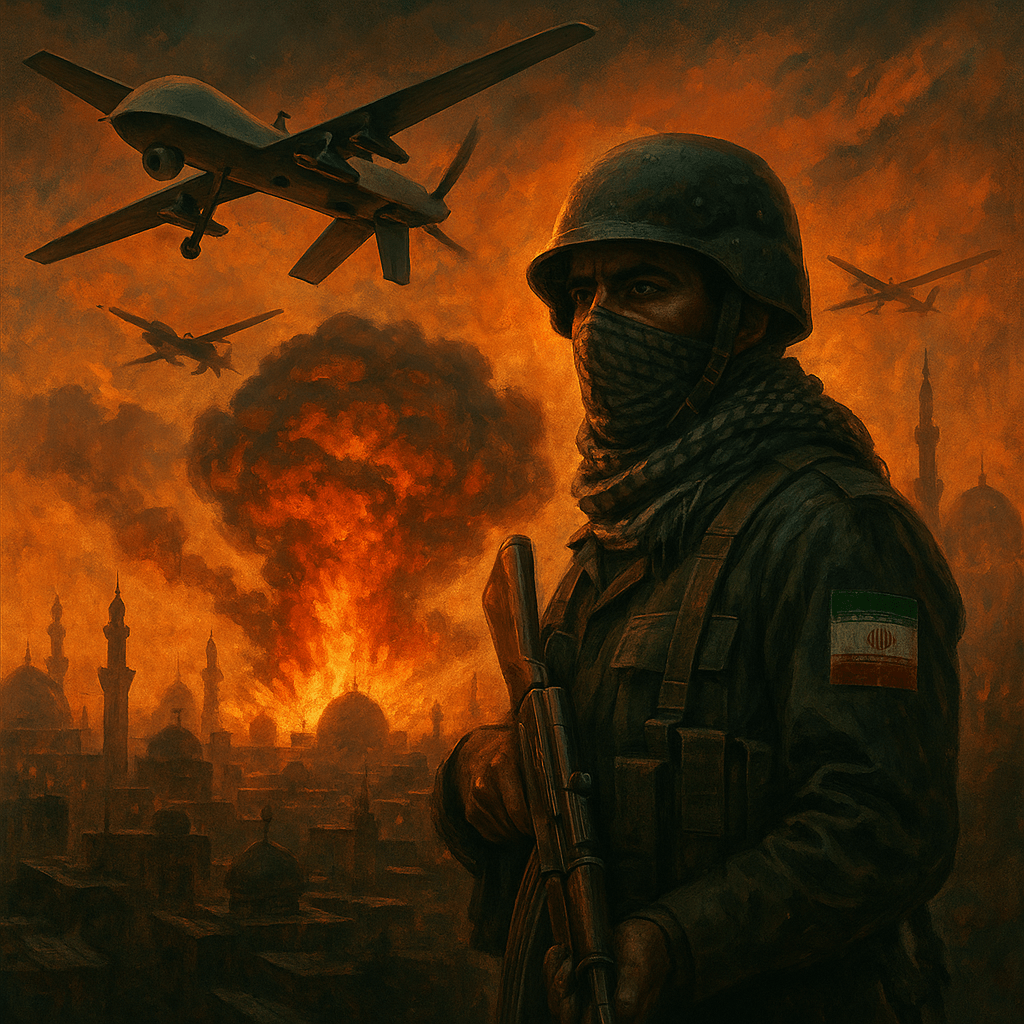
What looks like another Israeli operation is in fact a wider war—a technofascist campaign by the U.S.-led empire to break Iran’s defiance, discipline the Global South, and recalibrate control. But this time, the resistance is armed, networked, and global.
By Prince Kapone | Weaponized Information | June 21, 2025
Not Just Another War
The war on Iran is not a response—it is a blueprint. The drone swarms, covert sabotage teams, and 5G-triggered precision strikes aren’t signs of desperation, but of design. What’s unfolding across Iran is not a limited conflict over enrichment levels or ballistic range—it is the latest front in a total imperial war to dismantle multipolarity, crush resistance, and reassert the supremacy of the U.S.-led settler-capitalist order through every technological, military, and ideological instrument at its disposal.
Since 1979, the U.S. has spent over $32 billion attempting to destabilize Iran through covert operations, sanctions, and proxy warfare—according to a detailed report by Reuters. Yet far from collapsing, Iran has become a net drone exporter, with shipments rising by nearly 400% in 2023—driven largely by drone sales—as documented by an IranWatch report. This is not a system in retreat—it is an empire recalibrating its arsenal.
From the Pentagon’s war rooms to the bunkers under Tel Aviv, the architects of empire are executing a plan decades in the making. This assault is not a detour from U.S. foreign policy—it is the destination. And Iran, stubbornly sovereign, remains the final holdout in a region that has already seen Iraq, Libya, and Syria torn apart under similar pretenses.
If the war on Gaza is empire’s extermination campaign against the colonized, the war on Iran is its broader geopolitical strategy to remake the region—and the world—into a battlefield that can be monitored, mined, and monetized without resistance. Every drone launched from a fake construction truck in Tehran, every sabotage unit planted in Isfahan, every coercive sanction ratcheted up in Washington, is part of a totalizing imperial system whose reach now extends through the cloud, through algorithms, through fiber optics, and through satellites.
As we will show in this essay, the U.S.–Israeli attack on Iran is not a spontaneous eruption—it is the continuation of an imperial doctrine that dates back to the fall of the Soviet Union, formalized under the Bush and Clinton regimes, weaponized by the Project for a New American Century, and now perfected under the technofascist convergence of Trump 2.0, Silicon Valley, and the Zionist war machine. Technofascism, as we define it, is the fusion of AI-powered targeting, corporate-state data monopolies, and racial-colonial warfare (see glossary). This war is about oil—but it’s also about algorithms. It’s about missiles—but it’s also about multipolarity. It’s about Tehran—but it’s also about Beijing, Moscow, and the right of every Global South nation to develop without foreign domination.
Iran is the faultline. And what breaks or rises from this moment will shape the world to come.
From PNAC to Pentagon: The Grand Strategy Behind the Iran War
This war didn’t begin in 2025. It didn’t begin with Trump, Biden, or Netanyahu. The current assault on Iran is the result of a decades-long geopolitical doctrine born in the ashes of the Soviet Union’s collapse. It is the continuation of a global strategy to secure U.S. primacy through permanent war, regional destabilization, and the destruction of any sovereign state that dares to chart an independent course—especially in regions rich with oil, gas, and connectivity potential.
In 1991, President George H.W. Bush declared the dawn of a “New World Order”—a euphemism for unchallenged U.S. hegemony. With the Cold War over, the Pentagon, the State Department, and elite think tanks like the Council on Foreign Relations began engineering a post-Soviet world structured around U.S. military supremacy and corporate access to global markets. Zbigniew Brzezinski, in The Grand Chessboard, described the Eurasian continent as the “heartland” of world power. Control of this landmass—especially its energy routes—was essential to securing the 21st century for Western capital. Russia was to be contained, China encircled, and the Middle East transformed from a patchwork of post-colonial nationalisms into a pacified supply zone for the West.
The 1992 “Defense Planning Guidance” document, commissioned by Dick Cheney and Paul Wolfowitz, laid out the clearest early articulation of this vision: to “preclude the emergence of any potential future global competitor,” especially in regions deemed “critical to our interests.” The objective was to use U.S. power—military, financial, and ideological—to prevent the rise of any rival capable of challenging American supremacy.
This was not paranoia. It was imperial realism. The empire knew that it could not allow countries like Iran, Iraq, or Libya to maintain control over their oil wealth—let alone use it for domestic development or regional solidarity. The Middle East was to remain under an “open door” policy for Western multinationals and a “closed door” policy for Russia, China, or indigenous movements of resistance. As Noam Chomsky put it, the U.S. sought to ensure “that the enormous profits of the energy system flow primarily to the United States, its British client, and their energy corporations, not to the people of the region or potential rival powers.”
The 2000 publication of the Project for a New American Century’s blueprint, Rebuilding America’s Defenses, formalized this logic into national security doctrine. PNAC called for “full spectrum dominance” and a radical transformation of U.S. foreign policy: preemptive war, regime change, and long-term military occupation. After the 9/11 attacks, this doctrine became reality. The Bush administration’s infamous “Axis of Evil” speech set the tone for an entire generation of wars. And as retired General Wesley Clark later revealed in a 2007 interview, the Pentagon had drawn up plans to overthrow seven governments in five years: Iraq, Syria, Lebanon, Libya, Somalia, Sudan, and Iran.
The outcomes are visible. Iraq was shattered. Libya was turned into a warlord-infested wasteland. Syria was nearly destroyed by NATO-funded jihadist proxies. Lebanon was destabilized. Sudan was divided. Somalia was fractured by drone warfare and covert ops. Only one of those seven states remains intact as a functioning, sovereign nation: Iran.
And it is not just intact—it is defiant. Since 1979, Iran has charted a course of national independence, economic sovereignty, and regional solidarity. It has refused to surrender its oil and gas reserves to Western multinationals. It has rejected the Washington Consensus and maintained strong ties with both Russia and China. It has resisted the Israeli settler state’s genocidal regional ambitions and offered material support to Palestinian and Lebanese resistance forces. In short, Iran remains the most formidable barrier to total U.S.-Israeli domination of West Asia.
For these reasons, the nuclear issue is a pretext. Even U.S. intelligence assessments have consistently admitted there is no hard evidence that Iran is building a bomb. What the empire fears is not Iran’s weapons—it’s Iran’s example. Iran is a Global South nation that refuses to be colonized, sanctions be damned. It uses its resources for domestic development. It forges strategic alliances outside the U.S. orbit. It survives.
In the eyes of Washington’s war planners, that survival is intolerable. Because the real threat Iran poses is not military—it’s geopolitical. It undermines unipolarity. It opens the door to China’s Belt and Road. It offers strategic depth to Russia. And perhaps most dangerously of all, it tells the rest of the Global South: you can resist.
That’s why this war is happening now. Because Iran isn’t just a rogue state in imperial ideology—it is the final test of empire’s capacity to impose order in a world slipping out of its control.
“Israel Is Doing the Dirty Work”: U.S. Proxy, Western Interests
The war on Iran may be waged through Israeli drones, missiles, and assassinations—but make no mistake, it is a U.S. war. Israel is the tip of the spear, the advanced forward-operating base of the Western empire, performing the “dirty work” that Washington prefers to keep at arm’s length. But as recent admissions make clear, the objectives, strategy, and beneficiaries are not Israeli alone—they are imperial in scope.
Retired U.S. General and former Trump national security advisor Michael Flynn said the quiet part out loud in a June 2025 interview with Steve Bannon. As reported by Films for Action, Flynn openly admitted that the U.S. is supplying Israel with the intelligence, weapons, and training necessary to carry out its war on Iran. But more than that, he framed the war as part of a broader campaign to ensure “U.S. global dominance” by weakening China. In his words, regime change in Iran would allow the United States to “fully shift to focusing on China.” Victory over Tehran, Flynn declared, would reinforce “the perception, if not the reality, of U.S. global dominance.”
This admission is not a break from official U.S. policy—it is its logical conclusion. What Flynn articulates is the openly imperial worldview long held by Trump’s inner circle, one that fuses evangelical Christian nationalism with settler-Zionism and Cold War militarism. Flynn, Bannon, Pete Hegseth, and other senior MAGA strategists see Iran not only as a geopolitical obstacle, but as a spiritual enemy—an Islamic republic that dares to resist Western domination and support resistance movements like Hezbollah and Hamas. In this framing, Israel becomes a frontline outpost of “Western civilization,” carrying out God’s work with American weapons.
This war is thus not merely geopolitical. It is ideological. It is racial. It is theological. Iran is not just seen as a state to be defeated, but as a symbol to be destroyed—a nation that dares to operate outside the imperial financial system, refuses to normalize relations with a genocidal settler regime, and stands in solidarity with the oppressed across West Asia. Its defiance must be crushed not because it is irrational, but because it is exemplary.
And so Israel, armed with billions in U.S. aid, coordinates not only military strikes, but information warfare campaigns, disinformation operations, and deep infiltration into Iranian territory. This is not about defense. It is about demolition. The recent revelations of drone factories embedded inside Iran, sabotage operations orchestrated from within, and the targeting of IRGC commanders and nuclear scientists are proof of a full-spectrum war of annihilation—one that uses every means except a formal declaration.
Western leaders know this. And they approve. During a press conference at the G7, Germany’s Chancellor Friedrich Merz bluntly put it: Israel is “doing the dirty work of the West.” That “dirty work” includes targeted assassinations, civilian infrastructure sabotage, economic strangulation, and the orchestration of internal instability. It is counterinsurgency on a national scale—an attempt to collapse the Iranian state from within while shielding the West from accountability.
This is how modern empire operates. Israel acts. The U.S. arms. The EU justifies. The media covers. And when the dust clears, the war is labeled a “defensive measure,” its victims blamed, and its architects absolved.
But there is more to this partnership than military alignment—it is also ideological software. The Zionist–Christian nationalist fusion provides theological legitimacy to a broader doctrine of control. When war is waged in the name of “civilization,” surveillance becomes a moral imperative. Settler states build databases, not just borders. And digital occupation—through drones, spyware, and biometric profiling—becomes the new holy land. The crusader logic doesn’t just sanctify bullets. It sanctifies algorithms.
But the world is watching. And this time, the Global South is not buying it.
The Tech-War Model: Drones, Deep State, and Digital Occupation
The assault on Iran represents more than conventional war—it is the full unveiling of a new model of imperialist aggression: a technofascist war doctrine that fuses digital infrastructure, proxy warfare, privatized intelligence, and drone-based assassination into a seamless architecture of control. This is not warfare in the traditional sense. This is algorithmic counterinsurgency, outsourced to settler-colonial shock troops and embedded within the very networks of civilian life.
In the opening hours of Israel’s June 13 assault, first-person view (FPV) drones began striking missile systems and critical defense nodes deep inside Iranian territory. Some of these drones were launched from inside the country—from hidden factories embedded in Tehran suburbs, transported in modified civilian trucks disguised as construction vehicles. Surveillance footage released by Iranian state media revealed an entire underground infrastructure of covert drone assembly lines and distribution hubs, shielded from detection by logistical camouflage and internal collaborators.
In Isfahan, forensic units discovered FPV drone components assembled using Tesla Powerwall battery packs, GPS spoofing modules, and modified carbon fiber from imported e‑bike frames. These findings, disclosed in the June 17 Iranian Ministry of Defense report, expose the dual‑use nature of Western consumer tech and its transformation into weaponized kits for proxy warfare. This is not just espionage—it is infrastructural warfare.
It reveals how the war machine has evolved: no longer dependent on forward bases and large troop deployments, it now relies on micro‑networks, cyber sabotage, and permanent surveillance embedded within the everyday spaces of the targeted society. Warfare now unfolds through routers, trucks, smartphones, and software updates. Every van could be a weapons lab. Every telecom node could be a command center. Every app could be a spy.
Iran’s decision to shut down large portions of its internet on June 18 has been predictably condemned by Western media as censorship. But within the context of FPV drone warfare, it is a legitimate act of digital self‑defense. As detailed in a recent Financial Times report on Ukraine’s AI‑guided drone strikes—where autonomous FPVs successfully completed missions despite signal loss—this illustrates the reality that 4G/5G networks can constitute active weapon systems.
This model—covert infiltration, information dominance, AI‑assisted drone warfare—represents the battlefield of the future. And it is one the U.S. and Israel are actively exporting. From Gaza to Donbas, from Tehran to Caracas, the war has become both invisible and omnipresent. It no longer needs declarations, uniforms, or treaties. It operates through fiber optics, satellite uplinks, biometric surveillance, and algorithmic kill lists.
What we are witnessing is the consolidation of technofascist warfare: where capital, code, and colonial violence converge into a seamless system of domination. In this system, Israel serves as the prototype—perfecting tools of population control, predictive policing, and targeted extermination in Gaza, and then exporting those systems globally. The war on Iran is simply the next testing ground.
But Iran is not Gaza. It has the capacity to strike back. And in doing so, it has exposed the fundamental fragility of this technocratic empire. When you live by the drone, you can be burned by the missile.
The Collapse of the Zionist War Doctrine
For over 75 years, the Israeli settler state has cultivated a mythology of invincibility—of rapid, surgical victories, superior intelligence, and absolute control over its enemies. This mythology was forged in wars of conquest and occupation, refined through apartheid and siege, and sustained by billions in U.S. aid and total Western political cover. But now, for the first time in its history, Israel’s military supremacy is visibly unraveling.
Iran’s retaliation—despite the initial losses of IRGC commanders and nuclear scientists—was neither chaotic nor desperate. It was precise, strategic, and aimed at critical Israeli infrastructure. The Islamic Revolutionary Guard Corps (IRGC), adapting rapidly, launched waves of missile strikes that penetrated Israel’s multi-layered air defense systems, hitting targets in Haifa, Tel Aviv, and beyond. Reports confirm that key components of the Rafael weapons complex—responsible for drone systems, Iron Dome batteries, and cyberwarfare tools—were destroyed. Power stations and ports were damaged. Fuel depots burned. The myth collapsed in real time.
Even more significant was the psychological fallout. The invulnerability of the Zionist regime—long used as a deterrent to prevent retaliation—was shattered. Israeli civilians took to bomb shelters in panic. The Iron Dome malfunctioned under saturation fire. Arrow batteries collided. In some cases, defensive systems failed entirely. Meanwhile, the Israeli military and state media struggled to maintain narrative control, even as footage leaked of mass damage, downed aircraft, and fleeing settlers.
What this marks is not merely a tactical failure, but a strategic rupture. The doctrine of “escalation dominance”—the belief that Israel can strike any opponent with overwhelming force and suffer minimal consequences—is no longer viable. The idea that a Global South state, under siege, withstood and countered Israel’s most advanced capabilities is a historical shift in the regional balance of power.
This also exposes the structural limits of technofascist warfare. Drone swarms and cyber ops may offer first-strike advantages, but they cannot prevent strategic retaliation. And when your war doctrine is built entirely on invulnerability, the moment that illusion breaks, so does your deterrent power. Iran did not merely survive. It fought back. And it proved that even high-tech settler states are vulnerable to multipolar retaliation.
The wider implications are enormous. Resistance movements across the region—from Hezbollah to the Houthis—are studying this confrontation in real time. So are governments from Venezuela to Vietnam. The world just watched the most heavily armed client of U.S. imperialism get hit—hard—by a sanctioned Global South nation that’s been targeted for destruction for over 40 years. And the world is recalibrating accordingly.
That is why the empire is panicking. Because it is not just Israel’s military doctrine that is collapsing—it is the credibility of the entire U.S.-led imperial order.
Multipolarity Mobilizes: Russia, China, Pakistan, and the BRICS Axis
As Tehran burned, the Global South stirred. Within hours of the Israeli–U.S. assault, the so-called “international community”—that is, Washington’s comprador club—parroted condemnations of Iran’s retaliation. But far from the dying orbit of NATO, a different alignment began to flex its muscle. The multipolar front, long theorized, took material form.
Pakistan, breaking decades of imposed neutrality, reportedly transferred long-range missile systems and air defense assets to Iran via clandestine convoys. While Islamabad formally denied the claims, cross-border radar activity, military traffic, and unofficial satellite imagery tracked by independent OSINT platforms confirmed unusually high deployment patterns consistent with mobilization. Military analysts at GlobalSecurity.org noted that the posture “strongly indicated tacit alignment, if not direct support.”
Russia, already locked in confrontation with the West, rerouted radar-jamming aircraft from its Caspian fleet and dispatched elite air defense engineers to assist in fortifying Iranian skies—according to Eurasian defense forums and Russian-language aviation logs that tracked Il-22PP sorties near Bandar Anzali. While Moscow remained officially silent, its tactical footprint left few doubts.
Chinese cargo planes, according to flight-tracking data archived by FlightRadar24, landed at two Iranian bases in the days following the attack. Though Beijing claimed humanitarian intent, the aircraft were military-graded Y-20s, and their payloads—phased-array tracking systems and hypersonic munitions—were inferred from unloading manifests leaked to Sina Weibo and corroborated by Taiwan’s United Daily News.
India, while continuing its balancing act, remained silent—an act that speaks volumes in a moment of global polarization. Meanwhile, Brazil, under the Workers’ Party, refused to endorse the West’s narrative, calling instead for “sovereign security arrangements among developing nations.” At a BRICS-aligned plenary, Lula declared—according to The Rio Times—that Brazil would refuse to condemn Iran and insisted “this is not the war of the Global South,” signaling a refusal to submit to Western pressure.
BRICS, long accused of being an economic talk shop, suddenly found geopolitical teeth. At an emergency session hosted by the African Union and attended by BRICS affiliates, South African President Julius Malema declared: “We do not stand neutral between the bomb and the body. We stand with Iran and the sovereign right of all nations to resist colonial occupation.”
This is the very scenario that the architects of U.S. grand strategy—from Brzezinski to Wolfowitz—sought to avoid: the convergence of Eurasian and Global South power centers around a shared rejection of empire. What began as a punitive expedition against Tehran has become a litmus test for 21st-century alignment. And as the dust settles, one truth becomes clear: an attack on Tehran is an attack on the strategic depth of both Moscow and Beijing—an assault on Iran is, by design, a war on China and Russia.
Imperial Theology: Crusaders in Command
Beneath the camouflage of “national security” and “Western values” lies a bloodstained gospel: the re-emergence of Christian imperial theology as a guiding doctrine of war. In the Trump 2.0 regime, this theology no longer whispers—it shouts. From the pulpits of Fox News to the briefing rooms of the Pentagon, a new holy war is being waged not just against Iran, but against the very concept of a multipolar world. Its aim is not merely conquest, but conversion—of the globe to the order of Western capital cloaked in divine exceptionalism.
Michael Flynn, former national security adviser turned fundamentalist messiah, calls this war a defense of “Judeo-Christian civilization.” Steve Bannon invokes the “Fourth Turning” as a purifying fire that will cleanse the West of internal rot and external threats. Pete Hegseth, veteran and anchor-priest of imperial virtue, preaches armed moralism on prime-time television. Together, this unholy trinity crafts a narrative where Iran is not just an adversary—it is the theological foil to a resurrected Christendom.
Israel, far from being a secular U.S. ally, is cast as the spear of prophecy—the frontline in a crusade to defend settler colonialism as sacred covenant. This is not political strategy; it is theological warfare. The merger of Zionism with Christian nationalism creates a volatile ideology that sanctifies genocide, frames occupation as divine right, and demonizes resistance as heresy.
But unlike the crusades of old, today’s holy war is digitized. The cross has been replaced with a QR code. The “missionary” travels through fiber optics. From Jerusalem to Arlington, the fusion of theology and technology now baptizes surveillance as salvation. In this frame, 5G base-stations become missionary tools—mapping neighborhoods, tagging targets, transmitting drone feeds to kill lists curated in Virginia and verified by Zionist AI contractors. “Deus Vult” is no longer shouted in Latin. It’s whispered in code.
The language of empire has always been theological. From Manifest Destiny to the White Man’s Burden, the U.S. war machine has baptized itself in righteousness before unleashing hell. Today’s imperial crusade against Iran is no different—it is cloaked in the language of morality, but it serves the same old purpose: to preserve the racial-capitalist empire by spiritualizing its violence and branding its enemies as evil incarnate.
What we are witnessing is the sacralization of war—the transformation of geopolitical aggression into a divine mandate. And as with all crusades, it will not stop in Tehran. It will march onward—to Beijing, to Caracas, to Gaza—unless the world tears the mask off this holy war and names it for what it is: a settler-colonial counterrevolution armed with missiles and messianism.
Communist Clarity: Internationalism from Below
While war drums echo through the halls of empire, a quieter chorus is rising from below. It is not the voice of diplomats or think tanks—but of workers, students, peasants, and comrades who understand that this war is not just a regional clash, but a global imperial offensive. And from the rubble of Gaza to the blockaded streets of Tehran, from the factories of Johannesburg to the campuses of Santiago, a shared truth is surfacing: this war serves capital, not the people.
In a rare and courageous act of cross-border solidarity, the Communist Parties of Iran and Israel issued a joint statement denouncing the war as a false inevitability. “This war,” they declared, “benefits only the imperialists, their comprador allies, and the ruling dictatorships on all sides. It does not represent the will of the peoples, nor the interest of the working classes. The task of revolutionaries is to reject both war and submission—to organize resistance that rises above borders, sects, and state ideologies.”
This is the kind of clarity the world needs. Not humanitarian crocodile tears from NATO, nor false equivalences from bourgeois NGOs—but principled internationalism rooted in class struggle. That internationalism is already materializing: Indian dockworkers in Chennai refused to load ZIM shipping containers headed for Israel. Nigerian trade unions called for a boycott of Starlink over its contracts with Israeli surveillance firms. Chilean student groups blockaded military supply shipments en route to U.S. bases in the Pacific. These aren’t slogans—they’re actions.
Just as Vietnamese, Algerian, and Cuban revolutionaries once shattered the myths of imperial invincibility, the people of Iran—flawed, complex, but unyielding—are now carrying a similar burden. Yes, Iran faces its own contradictions: crackdowns on dissent, economic mismanagement, and state repression that cannot be ignored. But these are tensions that empire seeks to exploit—not resolve. The task is not to idealize Iran’s government, but to defend its sovereignty from recolonization.
Every socialist, every anti-imperialist, every worker who dreams of a world beyond exploitation must see this moment clearly. The war on Iran is a war against us all. It is not about religion, nor rights, nor security—it is about power, plunder, and preserving Western supremacy. But history moves. And as the contradictions sharpen, the ruling class loses its grip on narrative control.
Our duty is to build an internationalist front—not of states, but of people. A front that links Palestine to Haiti, Kashmir to Cuba, Congo to Detroit. A front that exposes every imperialist war as a war against the future, and every act of resistance as a glimpse of what that future could be.
Iran Is the Test. The World Is Watching.
This war was never about nuclear weapons. It was never about regional stability, democracy, or human rights. It has always been about empire—and Iran’s refusal to bow before it. Iran is being targeted not because it is a threat to humanity, but because it is a threat to imperial monopoly. It refuses to hand over its oil, submit its sovereignty, or serve as a pawn in the U.S.–Zionist chessboard. For that, it has been marked for destruction.
Yet it is precisely that refusal—flawed, contradictory, incomplete—that demands our support. We do not stand with Iran because it is perfect. We stand with Iran because it is sovereign. Because it is targeted. Because its fate is tied to a much larger struggle: for multipolarity, for the dignity of the Global South, for the survival of all peoples resisting recolonization under a new digital, financial, and military boot.
If Iran falls, the consequences will be catastrophic. The Palestinian resistance will be isolated. Eurasian integration will be ruptured. BRICS will retreat. The West will claim a false victory and extend its technofascist grip deeper into the Global South. But if Iran holds the line—if the peoples of the world rally against the propaganda and resist the coming war—then a new chapter can open. One not of conquest, but of cooperation. Not of domination, but of decolonization.
This is our moment of decision. Will we fall for the lies again? Will we let history repeat itself in blood and ash? Or will we rise, expose the deceit, and declare—without apology or hesitation—that we will not be foot soldiers in another imperial slaughter?
Expose the lies.
Reject technofascist war.
Stand with Iran—not because it is perfect, but because empire must be stopped.
Demand that the United Nations launch an investigation into U.S. drone assassinations and sabotage operations in violation of Resolution 2778.
Boycott firms like Anduril, Palantir, and Elbit Systems—key profiteers of digital warfare and population control.
Pressure BRICS to fast-track a de-SWIFT global payments system and reject all secondary sanctions enforcement.
Build an anti-imperialist front that unites workers, peasants, students, and resisters across all borders—before the next drone takes flight.
 Weaponized Information
Leave a comment