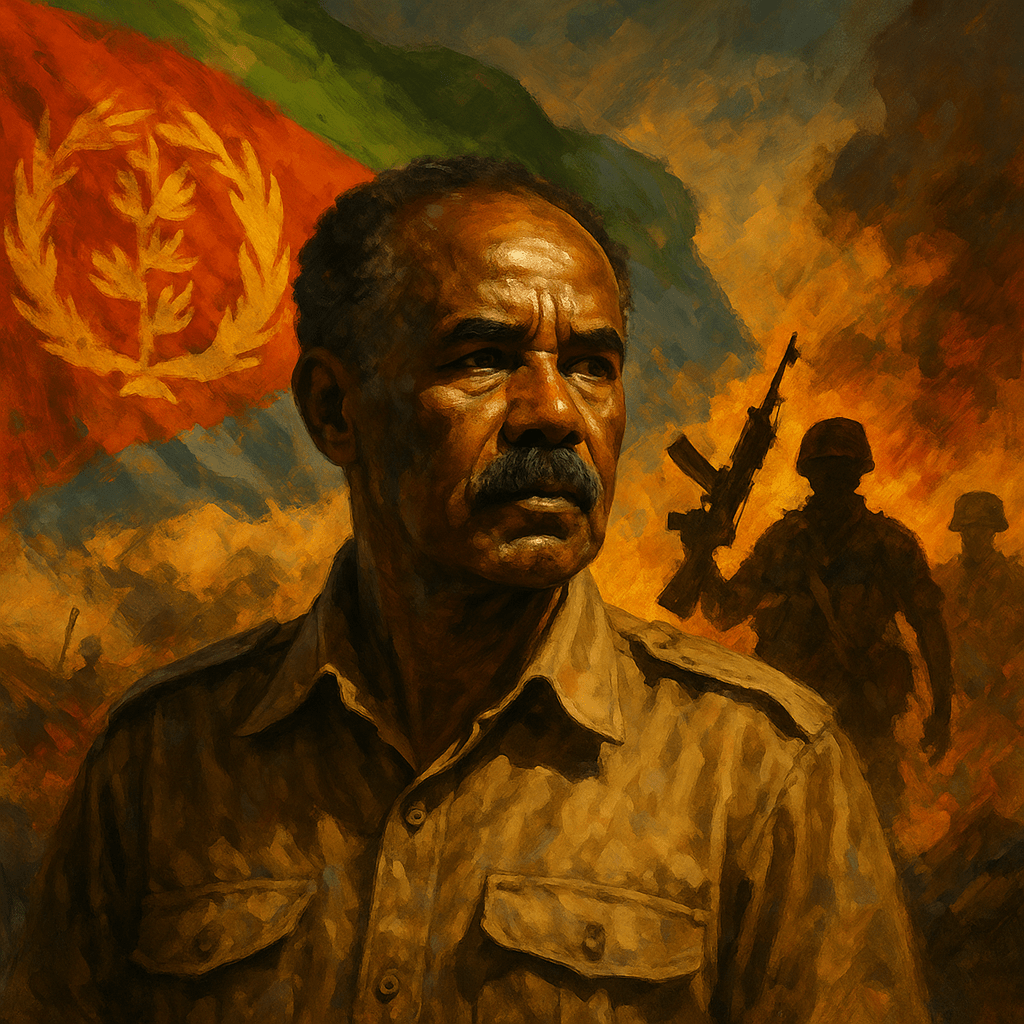
Behind the BBC’s colonial pity script lies a war against sovereignty. Eritrea’s refusal to bow to AFRICOM, the IMF, and Western NGOs makes it a threat—not to its people, but to imperial legitimacy itself.
By Prince Kapone | Weaponized Information | June 19, 2025
Soft-Power Sermons and the Recolonization of Memory
When the BBC rolls out another pity-parade on Eritrea, it’s not just reporting—it’s preaching. Its author, Teklemariam Bekit, files dispatches from the heart of the BBC World Service, a soft-power instrument the British state openly funds and celebrates for its role in advancing imperial interests across the globe. Members of Parliament boast that the BBC’s reach—over 400 million listeners per week—is a vital tool for promoting British values and countering so-called “hostile propaganda.” In plain terms: this is a megaphone of empire, dressed in the robes of objectivity.
The target of this sermon? A nation that refuses to kneel. Eritrea’s liberation war didn’t just win independence—it dismantled the ideological foundations of a settler-colonial empire. It cracked the illusion of Ethiopian invincibility and forced the region’s elite to reckon with the legitimacy of revolutionary struggle. That fracture—between sovereignty and imperial order—is what today’s narrative engineers are still trying to seal shut.
The framing is surgical. The article opens with a familiar trope: the solitary despot, perched on a dusty hillside, disconnected from his people. There’s no mention of the UN arms embargo. No word of the EU sanctions. No explanation of Eritrea’s SWIFT expulsion or its refusal to serve as a launchpad for AFRICOM. The material conditions of siege are erased, leaving only a villain and his victims.
Youth conscription is reduced to caricature. No context about the existential wars with Ethiopia. No account of the regional encirclement. No recognition that in a world of drones, mercenary armies, and fifth-column NGOs, conscription may be a desperate but rational defense. Instead, it’s framed as sadism for sadism’s sake—an old propaganda move that pathologizes resistance while ignoring the war being waged on sovereignty itself.
Diplomatic alignment with China or Russia is treated like betrayal. No acknowledgement that Britain hosts U.S. nuclear weapons. No outrage when AFRICOM drills stretch across half the continent. But when Eritrea shakes hands in Beijing or St. Petersburg, the article clutches its pearls. Sovereignty outside the Western orbit is always coded as regression.
This is not journalism. This is cognitive warfare. Its objective is to recode history—to make Eritrea’s defiance appear pathological, its independence appear accidental, and its survival appear illegitimate. The BBC’s job here is not to inform, but to discipline—to remind readers, especially in the Global South, that no revolution shall be tolerated unless it comes pre-approved by empire.
And yet, the need for this propaganda proves the opposite. If Eritrea were truly irrelevant, the BBC wouldn’t waste a headline. If its revolution had truly failed, there’d be no need to smother its memory. But the struggle lives—flawed, complex, hardened by siege—and that alone makes it dangerous. Because if Eritrea could say no and survive, what’s stopping the rest of us?
Siege Socialism and the Silence of the Imperial Record
The BBC frames Eritrea as a land gripped by repression and stagnation. But behind the curtain of imperial caricature lies a stubborn and remarkable truth: this is one of the only nations in the Global South to have charted independent development without U.S. bases, IMF loans, or NGO dependency. The social indicators—largely ignored by the article—reveal a different story altogether. As of 2021, 95% of Eritrean children received DTP‑3 vaccinations, and 93% were immunized against measles, both meeting or surpassing the World Health Organization’s global benchmark. Its under‑5 mortality rate fell from over 200 deaths per 1,000 live births in the 1970s to about 38 today. Life expectancy rose from 39 in 1960 to nearly 66 by 2020. Youth literacy now exceeds 93%, with virtually no gender gap.
These gains didn’t emerge from philanthropic NGOs or neoliberal “governance reform.” They were forged through what can only be described as siege socialism—a state-directed, self-reliant development model operating under extreme external pressure. Eritrea’s HIV prevalence stands at just 0.5% among adults aged 15–49, placing it among the lowest in Sub‑Saharan Africa. Among high‑risk groups like sex workers, prevalence dropped from 22% in 2002 to around 10% by 2014. Malaria mortality fell by 85% between 1998 and 2006, and universal immunization drives brought measles and tetanus under control. None of this makes the BBC copy desk.
What does appear in their narrative are vague references to economic “struggles”—with no mention of the causes. Eritrea has endured over a decade of international punishment: a UN arms embargo from 2009 to 2018, unilateral U.S. sanctions, EU sanctions, and disconnection from the SWIFT financial system in 2021. This is siege warfare by other means, designed to starve a country into collapse or submission.
But Eritrea didn’t break. It didn’t auction off its land to foreign investors. It didn’t install a USAID-managed welfare state. It didn’t swap its sovereignty for a seat at Davos. Instead, it centralized essential services, invested in rural health and education, and built its own parallel infrastructure—with all its contradictions and hardships intact. That, too, doesn’t make the news.
The Western development apparatus is not blind to this defiance. In January 2025, the UN Committee on the Rights of the Child praised Eritrea’s “data-driven outreach” and falling HIV rates. These acknowledgements are tucked into footnotes and press releases never shared on air, because to publicize them would risk normalizing what empire deems dangerous: an African country that builds public health systems without colonial tutelage.
The contradictions deepen. While the BBC calls Eritrea “isolated,” it is that very isolation—from World Bank loans, AFRICOM bases, and Western debt traps—that has allowed it to develop on its own terms. While the piece hints at autocracy, it offers no recognition of how Eritrea’s political form has been shaped by constant existential threat. Under such siege, even survival becomes subversive. Independence itself becomes heresy.
This is the story that must be buried. Eritrea’s imperfections are real, but they are its own. Its path is not easily copied, but it is feared because it exists. It has made the forbidden choice: to struggle, to err, to build, and to survive—outside the empire’s orbit. And for that, it must be punished. The BBC’s narrative, sanitized in liberal language, serves as the ideological arm of that punishment. But the facts—quiet, buried, enduring—tell another tale.
Empire Wakes When Sovereignty Speaks
Eritrea’s real crime, in the eyes of empire, is not human rights abuse or autocracy. It is sovereignty. For decades, Eritrea has refused every invitation, demand, and coercive offer to join the U.S. security architecture in Africa. It was the only African country to completely reject AFRICOM’s military footprint. That rejection was not just symbolic—it was strategic. Eritrea saw what AFRICOM did to Liberia, Niger, Djibouti. It saw the encroaching spiderweb of military bases wrapped in humanitarian branding. It said no. And in that “no,” it set a dangerous example: that empire can be denied.
Refusing AFRICOM was only one node in a broader policy of self-reliance. Eritrea maintains a command economy in agriculture. It strictly regulates foreign capital. It nationalized its land and sea access. It operates public health and education systems almost entirely without international aid. It rejected IMF restructuring, privatization demands, and WTO accession. These decisions were not made in a vacuum—they emerged from a revolutionary history, a 30-year armed struggle against Ethiopian annexation and foreign meddling. The state that emerged was not liberal, not pluralist, not “democratic” in the Western sense—but it was determined to be free.
That freedom is precisely what empire cannot tolerate. So the strategy shifts: from military coercion to media war. The BBC does not just report on Eritrea—it renders it illegible. It evacuates context, erases history, and floods the screen with symptoms detached from cause. In the BBC’s narrative, Eritrea is “isolated,” but no mention is made of the systems it refused to join. It is “autocratic,” but no explanation is given of how war, sanctions, and siege shaped its institutions. The goal is not to inform—it is to delegitimize. To make sure no one else asks the wrong questions.
Why is Eritrea the only country in Africa without a U.S. military presence? Why hasn’t it privatized its ports, farms, or banks? Why does it have such strong health outcomes without NGOs? These questions are radioactive to empire. Because if the answers lead back to sovereignty, to resistance, to socialism—however flawed—then the entire scaffolding of U.S. policy in Africa begins to creak. And worse still, other nations may begin to imagine that alternatives are possible.
This is why the narrative warfare intensifies. Eritrea must be pathologized, not analyzed. It must be dismissed as abnormal, not understood as oppositional. Its development must be ignored, its survival framed as failure. If even one country slips the leash and doesn’t collapse, the illusion of imperial inevitability begins to break.
But Eritrea endures. It is not a model, not a utopia—but it is a precedent. A precedent that shows a country can say no and still breathe. That it can resist without being rescued. That its history and contradictions are its own—not the property of NGOs or editorial boards. And that fact alone is enough to provoke a smear campaign disguised as journalism.
Memory as a Battlefield, Sovereignty as a Threat
The battle over Eritrea isn’t just a matter of foreign policy—it’s a war over historical memory. The BBC’s portrayal attempts to bury a lineage of resistance that stretches far beyond Eritrea’s borders. By flattening Eritrea’s complexity into a cautionary tale, the imperial narrative seeks to make forgettable what should be unforgettable: the fact that an African nation stood up, armed itself, fought a thirty-year war of liberation, expelled its colonizer, and then refused to sell itself to the next round of masters.
Eritrea’s struggle dismantled not only the physical infrastructure of imperial rule, but also the ideological confidence of the postcolonial elite who had wagered that independence could be managed under Western tutelage. It showed—like Guinea-Bissau and Mozambique before it—that the old state could be broken, and a new one constructed under fire. That history terrifies the present custodians of empire. Because if it was possible then, it might still be possible now.
That’s why every article like this one serves a dual function: to discredit the present and erase the past. It tells readers in Africa, the Middle East, and Latin America that liberation is either an illusion or a tragedy. It tries to convince the exploited that revolution ends in dictatorship, that self-reliance means starvation, and that only the West can deliver freedom. These are not neutral journalistic products. They are weapons deployed in an ideological war to maintain the terms of global subjugation.
But the cracks are widening. Across the continent, there’s a shift in tone, in posture, in political appetite. States are rejecting U.S. military ties. Movements are questioning the NGO complex. Economies are reaching for multipolar partnerships. Eritrea is no longer alone—though it remains among the few to have walked this path the hardest and longest. And in that, it offers lessons—not perfect models, but real provocations.
To defend Eritrea does not mean to romanticize it. It means to defend the right of a people to decide their path, to make their mistakes and victories alike, without foreign handlers. It means rejecting the arrogance of imperial storytelling. And above all, it means recognizing that in this stage of global counterinsurgency, truth itself is territory worth defending.
For those of us building a revolutionary movement from within the imperial core, this means confronting the war of ideas being waged in our name. It means unlearning the scripts handed to us about “failed states” and “humanitarian crises.” It means refusing to be the ideological foot soldiers of empire, even when its message comes dressed in liberal concern. And it means building solidarity—not with fantasy versions of distant nations, but with the real, hard, principled fights they endure.
Because if we let them isolate Eritrea, they’ll do the same to Cuba. To Venezuela. To Zimbabwe. To Palestine. To any nation or movement that won’t kneel. And if we stay silent, we become accomplices in that silencing.
Memory is not neutral. History is not neutral. And neither is journalism. Let the BBC peddle its pity-scripts. We’ll sharpen ours into weapons.
 Weaponized Information
Leave a comment