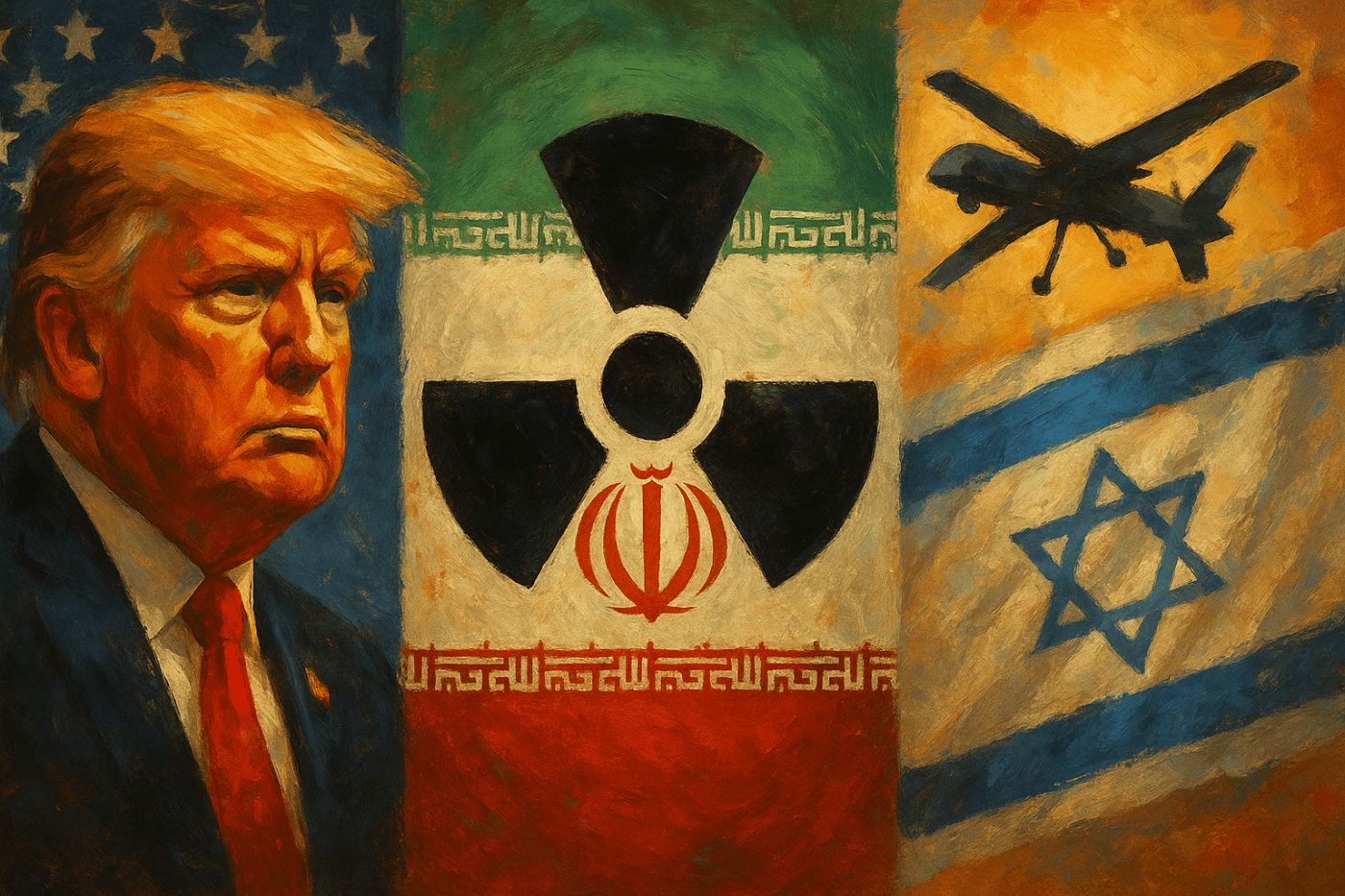
Deconstructing AP’s mafia-style propaganda, exposing the technofascist logic behind Trump’s threats, and reframing Iran’s refusal to kneel as revolutionary resistance to U.S.-Israeli hyper-imperialism
By Prince Kapone | Weaponized Information | June 17, 2025
Part I – “Know Where He Hides”: Excavating the Gangster Ultimatum
When the Associated Press blasted Donald Trump’s latest threat across the wires, it didn’t read like journalism—it read like a mob shakedown posted on official letterhead. The U.S. president boasted that he knows exactly where Iran’s Supreme Leader is “hiding” and could “take him out”—but won’t. Not yet. As if sparing the life of a sovereign leader were a diplomatic concession. In the age of technofascism, this is what passes for statesmanship: the naked language of assassination softened only by a smiley-face emoji and a White House seal. The article reports this threat without irony, without outrage, without even the courtesy of a historical reference. This is how empire speaks when it no longer bothers with the mask.
The bylines belong to Aamer Madhani and Chris Megerian, veteran stenographers of imperial power whose careers have been spent embedded in the Beltway press corps. Their reporting follows the standard choreography of access journalism: proximity to power as a proxy for truth, briefings as scripture, and neutrality as a sacred myth. These are not rogue propagandists. They are obedient technicians of consensus, trained to move words in alignment with the State Department’s gravitational pull. If Washington says jump, they file copy before their feet leave the ground.
Their platform, the Associated Press, pretends to be a neutral cooperative but functions as a syndicate for the imperialist narrative. It is the wire service of empire, transmitting Washington’s line to every news desk in the world. Its political economy runs on corporate contracts, Silicon Valley distribution algorithms, and a cozy relationship with state power. The AP doesn’t just report the news—it manufactures the perception of what news even is. If the State Department whispers, AP shouts. If a missile hits Tehran, AP checks the stock market.
And those who benefit from the blast radius? You know their names. They sit in boardrooms at Lockheed and Raytheon. They huddle in war rooms with Netanyahu. They flood cable news panels and Senate subcommittees with just enough credibility to sound concerned, and just enough bloodlust to cheerlead another bombing campaign. They are the chorus that turns a threat of decapitation into “strong leadership.”
The propaganda techniques in this article aren’t crude. They’re precise. The first is the illusion of restraint. Trump’s statement that he “won’t kill [Khamenei]—for now” is offered as evidence of moderation, not menace. The article doesn’t interrogate the absurdity of this framing. It simply repeats it, allowing a public assassination threat to pass as reasoned diplomacy. Second, the writers amplify Trump’s claim of “complete control of the skies” over Tehran, as if it were an objective military fact rather than an imperial hallucination. There is no skepticism, no counterpoint, no context. Just a dangerous boast printed as gospel.
Then there’s the Orientalist script. Trump tells the people of Tehran to “flee for their lives,” and the article reproduces this line as though the Iranian people are helpless characters in a Hollywood disaster film, waiting for the cowboy president to save or smite them. Their resistance, their sovereignty, their humanity—none of it exists here. Tehran is a city of shadows, and America is the bringer of light or fire. And finally, there is the quiet violence of omission. Nowhere does the article mention the civilian casualties from Israel’s five-day bombardment. Nowhere does it mention that Iran has complied with international law, or that the IAEA has found no evidence of a bomb. The suffering of Iranian people is invisible, because in this narrative, they are not people—they are a problem.
This is how cognitive warfare works. Not with lies, but with arrangements of truth so carefully manicured that the lies become unnecessary. The threat becomes a warning. The victim becomes the aggressor. The war becomes inevitable. The AP doesn’t need to fabricate. It just needs to structure the story in a way that renders imperial violence rational, and resistance insane. This isn’t journalism. It’s the lubrication of empire’s next move. Our task is not just to call it propaganda—but to name the structure, expose the frame, and prepare the counterattack. Because the words they publish today are the weapons they deploy tomorrow.
Part II – Context Is a Weapon: History, Hegemony, and the Real Nuclear Threat
There’s a reason the Associated Press doesn’t mention the JCPOA. There’s a reason it never reminds the reader that Iran’s nuclear program has been legal under the Non-Proliferation Treaty, that Tehran complied with the 2015 nuclear deal until the United States unilaterally shredded it in 2018, or that even U.S. intelligence agencies have repeatedly affirmed there is no evidence Iran is building a nuclear weapon. The article leaves these facts out not by mistake, but by design. Because including them would unravel the whole moral logic of the story. And imperial storytelling cannot survive truth in the wrong sequence.
This is not a new war. It is the latest chapter in a decades-long siege. The U.S. has never forgiven Iran for refusing to kneel. Not after the 1979 revolution kicked out the CIA’s Shah, not after the nationalization of oil, not after Iran forged partnerships outside the dollar system, joined security pacts with China and Russia, or offered diplomatic solidarity to Palestine, Venezuela, and Syria. Tehran’s “crime” isn’t nukes—it’s defiance. It’s the fact that Iran still imagines it has the right to develop, defend, and define itself without Washington’s permission. That is what makes it dangerous to empire. That is what makes it next.
The media won’t tell you that. But we have the receipts. Reuters and the AP have run back-to-back stories laundering thin allegations through the International Atomic Energy Agency (IAEA)—a body that pretends to be neutral but functions as the nuclear arm of imperial lawfare. The IAEA has never flagged Israel’s actual nuclear arsenal, never sanctioned France or Britain, and has never once referred the United States for its illegal bombing of nuclear infrastructure in other nations. Its role is not to prevent proliferation—it’s to prevent sovereignty. And its reports on Iran are as political as any Pentagon press release. They provide the legal smokescreen for what is, in truth, a military and economic siege.
This is part of what we call hyper-imperialism: a phase where declining empires abandon long-term strategy and instead deploy spasmodic violence—military, financial, and narrative—anywhere resistance threatens the structure of global power. The United States no longer dominates by building. It dominates by denying others the right to build. Bomb a pipeline here. Collapse a currency there. Cut off medical supplies. Spread a lie, destabilize an election, assassinate a leader, declare it defense. This is not policy—it’s gangsterism with global logistics. It’s not war in the traditional sense. It’s the constant threat of war as a tool of economic management and geopolitical containment.
The U.S.-Israeli axis, as we exposed in “Trump’s Tightrope Was a Trap,” has long prepared for this moment. The so-called “surprise escalation” is anything but. War games, strategic drills, diplomatic walkouts—this was the trajectory all along. The article makes it seem like a crisis born of Trump’s impulsiveness, a response to recent missile strikes. In reality, this has been a staged campaign of provocation, baiting Iran into a conflict to justify what has already been decided: a U.S.-backed Israeli strike to permanently degrade Iran’s military, economy, and global alliances.
Meanwhile, the machinery moves. Sanctions have already crippled Iran’s medical supply chains. Financial blockades have targeted its banking systems. Military threats are paired with algorithmic disinformation campaigns to sow panic and manufacture consent. The AP article doesn’t mention any of this. But behind every line, you can hear it humming: the strategy of exhaustion. Drain the enemy of options, isolate it diplomatically, destabilize it internally, then strike when it breathes.
This is not journalism. This is imperial choreography. And unless we interrupt it—unless we expose the historical record, amplify the silences, and remind our people of the real coordinates of this conflict—it will keep repeating itself. Iraq was a lie. Libya was a lie. Syria, Venezuela, Afghanistan—each justified by myth, each followed by blood, collapse, and silence. We excavate these stories not to debate the empire, but to prepare the people to defeat it.
Part III – Reframing the Narrative: From Threat to Resistance, From Empire to Multipolarity
The real story here is not about Iran’s nuclear program. It’s about empire losing its grip. It’s about a declining hegemon terrified that it can no longer dictate terms to a world that is no longer listening. What frightens Washington isn’t a warhead—it’s a world where Iran, Venezuela, Cuba, China, Russia, Mali, and the rest of the defiant Global South don’t ask for permission. And what terrifies the U.S. ruling class even more is that their own working class, their own youth, their own precarious poor might begin to see these nations not as enemies—but as comrades in a common struggle for survival and dignity.
This is why the U.S. doesn’t just bomb cities. It bombs meaning. It wages war on language, memory, and coherence. The AP headline isn’t just a signal to generals—it’s a signal to our minds. That surrender is peace. That threats are diplomacy. That technofascist ultimatums issued from Twitter should be treated as respectable foreign policy. This is what cognitive warfare looks like in the age of algorithmic governance: state terror framed as rational precaution, imperialist violence narrated as moral defense, and genocide sanitized through passive syntax.
But history doesn’t submit so easily. Iran is not a footnote in someone else’s strategy. It’s not a crisis actor, not a rogue state. It is a nation with five thousand years of history, a deep revolutionary tradition, and a political culture shaped by struggle. From resisting the Shah and U.S.-British coups, to outlasting sanctions, sabotage, and war, Iran has endured more in a decade than most empires could withstand in a century. Its people have bled not for a bomb, but for sovereignty. For dignity. For the right to live and develop without external chains.
This is what we must reframe: Iran’s resistance is not a threat to peace—it is a threat to unipolarity. It is a frontline battle in the broader war over what kind of world shall survive this epoch of collapse. And in that context, the U.S. demand for “unconditional surrender” is not a policy position. It is a colonial fantasy. One that cannot be reconciled with reality except through force, spectacle, and mass deception.
It is no accident that this war has been preloaded through every tool of technofascism. The convergence of Big Tech, Big Arms, and Big Data has made empire faster, more agile, and more vicious. War is no longer declared—it is streamed. Hostilities don’t begin with tanks—they begin with trending hashtags. This is the logic of technofascism: when traditional mechanisms of legitimacy collapse, the ruling class fuses surveillance, spectacle, and violence into a seamless infrastructure of domination. Iran is the current target. But the system is aimed at all of us.
That’s why our reframing is not merely rhetorical—it’s strategic. Where the empire sees instability, we must recognize resistance. Where it sees “authoritarianism,” we must uncover sovereignty. Where it cries terrorism, we must expose counterinsurgency. Iran is not perfect, nor uncontradictory. But perfection is not the standard of solidarity. Struggle is. And in this struggle, Iran stands not as a lone actor, but as part of a broader front of Global South defiance, anti-imperialist sovereignty, and multipolar renewal.
It is this broader horizon we must reclaim. A horizon where nations build without permission. Where water and wheat matter more than weapons and warheads. Where sovereignty is not criminalized, and survival is not contingent on submission. This is the horizon that haunts empire’s dreams and galvanizes ours. And it is here—in the cracks of this crumbling order—that a different future begins to breathe.
Part IV – From Exposure to Action: Revolutionary Solidarity in the Age of Technofascism
To excavate imperial propaganda is not just an intellectual act—it is a revolutionary responsibility. Because if we don’t name the narrative, it will name us. The AP’s coverage of Trump’s ultimatum wasn’t just sloppy reporting—it was ideological warfare. It laid the groundwork for missiles under the cover of moderation, for assassinations disguised as diplomacy, for total war dressed in polite grammar. But exposure alone is never enough. We must act. We must turn analysis into ammunition, and solidarity into strategy.
Our first line of unity is with the people of Iran—not with their government as such, but with the masses: the workers, the poor, the students, the rural communities, and the women who bear the brunt of sanctions and bombardment alike. We do not romanticize their suffering, nor do we flatten their contradictions. But we stand with them against a common enemy: imperialist domination and technofascist siege. And we affirm what the imperial press refuses to say—that Iran’s right to defend itself is not only legal under international law, but legitimate under any ethical standard born of history, struggle, or human dignity.
We also affirm our solidarity with the global constellation of resistance. With Venezuela, Cuba, Bolivia, Nicaragua, Mali, Burkina Faso, Palestine, Yemen, China, and every other node of rebellion that refuses to let the U.S. empire dictate the terms of life. We affirm our unity with the BRICS+ bloc not as cheerleaders, but as revolutionaries watching the tectonic plates of world order begin to shift. Multipolarity is not a utopia. It is a contradiction—a contested terrain where oppressed nations may find room to breathe, regroup, and resist. It is a strategic opening in the chokehold of unipolar domination. And we must defend it.
What can be done? Start where you are. Build antiwar coalitions in your city. Expose the weapons contractors in your district. Track their lobbyists. Sabotage their legitimacy. Target the banks that finance the bombs and the tech companies that stream their spectacle. Refuse to let your silence become another kind of sanction. If you’re in the U.S., demand the repeal of the sanctions regime and withdrawal of all forces from the Gulf. Demand congressional defunding of Israeli aggression. Amplify Iranian and Palestinian voices on every platform. Build alliances between Arab, Iranian, African, Asian, Indigenous, and Latin American communities inside the imperial core.
If you’re in the diaspora, link your material support to political demands. Humanitarian aid without resistance becomes charity. Resistance without coordination becomes martyrdom. But together, they form the architecture of dual and contending power—a world within this one, struggling to be born. Organize teach-ins that connect Iran’s struggle to the broader history of imperial war: from Iraq to Haiti, Libya to Vietnam. Break the generational disinformation that clouds memory. Host film screenings, share reading circles, translate revolutionary documents, and de-Westernize the syllabus.
This moment is not isolated. It is structural. It is the convergence of imperialist decay, ecological crisis, economic contraction, and mass ideological disorientation. The ruling class has no answers, so it offers blood. It cannot offer justice, so it sells punishment. And when the contradictions of empire become unbearable, the system turns toward spectacle war to manage domestic instability. This is the logic of fascism. And in the age of big data and drone diplomacy, it becomes technofascism: algorithmic authoritarianism wedded to perpetual war.
But there is another logic too. The logic of revolutionary rupture. The logic that built Cuba’s clinics and South Africa’s freedom. The logic that carried Vietnam through carpet bombs and birthed the resistance of Fallujah. That logic is alive in the rubble of Gaza, the mountains of Kurdistan, the hunger strikes in U.S. prisons, and the barricades in Paris and Port-au-Prince. It is alive wherever people organize against the logic of capital and the violence of empire. Our task is to fan that flame into a fire.
So yes, let us excavate the headlines. Let us expose the lies. But let us also build the networks, sharpen the tools, and prepare the fronts. Because this is not just about Iran. This is about all of us. And the war they are preparing over there is a test run for the repression they intend to unleash here. If we do not resist it now, we will find ourselves surrendering by default. But if we rise with discipline, clarity, and courage, we may yet turn their war machine into rubble—and from its ruins, build something worth calling peace.
 Weaponized Information
Leave a comment