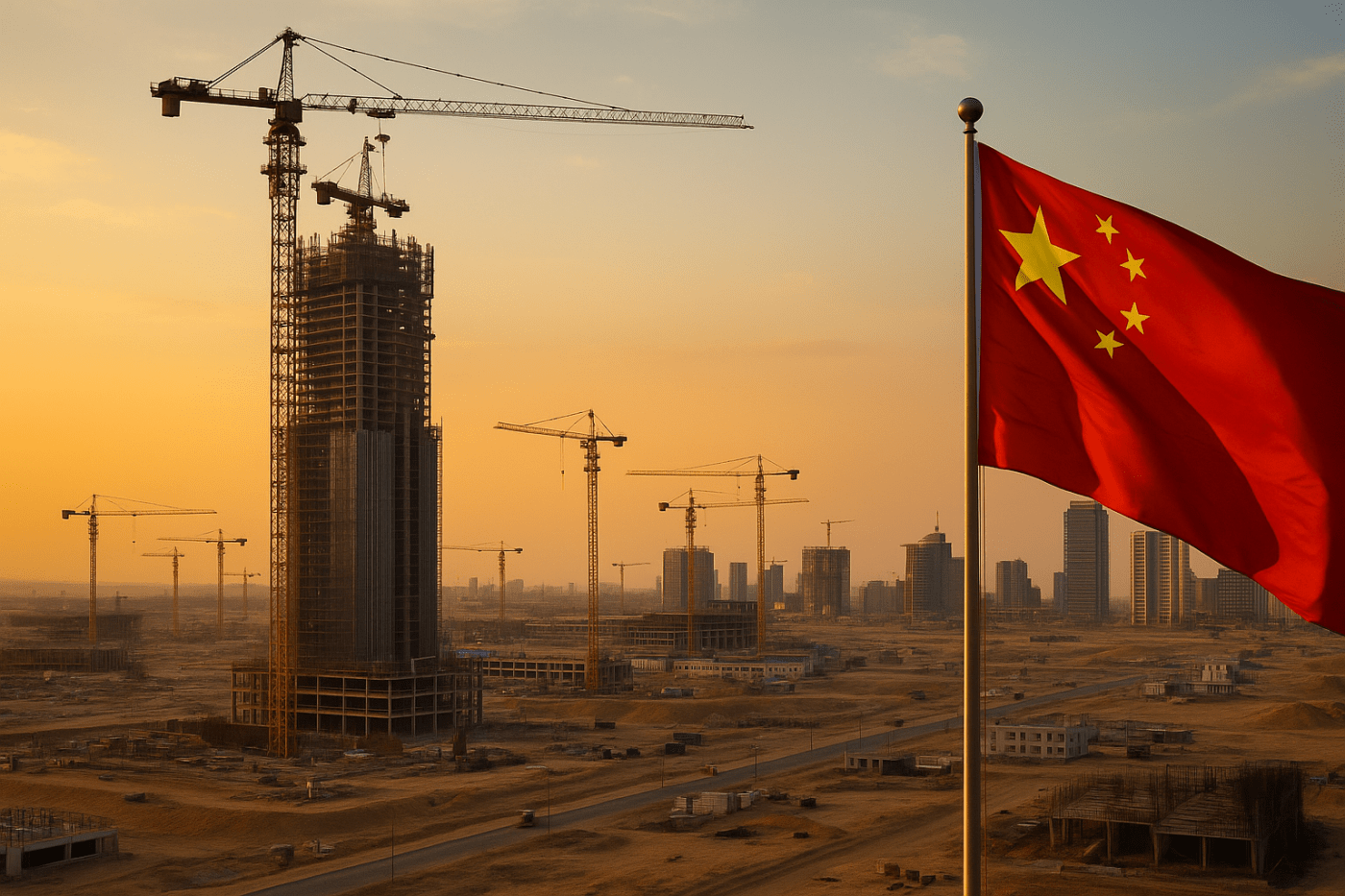
The Iconic Tower’s shadow stretches over 30,000 state workers relocated to the desert—and 1.2 million Cairenes left in crumbling colonized neighborhoods. China brings bricks. The West brings bombs.
By Prince Kapone | Weaponized Information | June 10, 2025
The Logistics of Consent: Excavating the Narrative Blueprint
On June 9, 2025, the South China Morning Post published a short, neutral-toned report by Jevans Nyabiage titled “China at the Centre of Egypt’s New Capital”. The piece outlines the role of China State Construction Engineering Corporation (CSCEC) in not only building but operating and maintaining Egypt’s New Administrative Capital—a sprawling 700 sq km desert megaproject intended to house six million people, and already hosting Egypt’s relocated government core.
The article contains no overt ideological framing, but it is hardly neutral. SCMP—once a Hong Kong-based liberal outlet—was purchased by Alibaba in 2016 and now walks a fine line: domestic legitimacy in China, international readability for the West. Jevans Nyabiage, a seasoned African journalist covering China-Africa infrastructure for multiple outlets, adopts a stripped-down style that treats the reader as a logistics coordinator, not a political subject. Quotes from officials are framed as objective facts; operational agreements are described as routine efficiency. The effect is a narrative that is not ideological in form, but profoundly ideological in function.
Behind the article’s surface lies a careful choreography of omission and emphasis. U.S. institutions are never mentioned. IMF debt is never invoked. Egypt’s military-industrial domination of the housing sector is left unnamed. And yet these absences are precisely what enable the article’s central gesture: it does not attack empire, nor defend it. Instead, it constructs a quiet legitimacy for an emerging multipolar infrastructure, while avoiding any disruption to the liberal reader’s faith in progress.
Neutral Tone, Strategic Silence: A Fraternal Frame of Possibility
What the article does well—and why we engage with it as fraternal rather than enemy propaganda—is that it leaves enough space for revolutionary deepening. It avoids the caricatures common to Western coverage of Chinese-African cooperation. There are no scare quotes around “debt diplomacy.” No sensationalized references to “authoritarianism.” No op-eds warning of “Beijing’s footprint.” Instead, the article builds its authority through technocratic detail: kilometers of construction, towers completed, ministers shaking hands, protocols signed.
This narrative of competence is itself a powerful counter-hegemonic weapon. When the U.S. calls itself a builder but only offers bombs, the quiet presentation of China as infrastructural partner—without ideological overstatement—becomes destabilizing. The article quotes China’s housing vice-minister Dong Jianguo, who frames the CSCEC-Egypt partnership as “a model of mutual benefit.” It describes how the Chinese firm will run the CBD’s “property management, operations, and urban services.” It mentions the presence of foreign embassies, commercial banks, and government workers now operating inside the new capital.
But what is absent is just as instructive. There is no mention of who owns the land, who profits from these towers, or who builds them. The workers remain invisible. The contradictions are paved over. The report does not inform us, for example, that Egypt’s military earns over $4.3 billion annually from BRI-linked contracts through its monopolized construction arms. Nor does it acknowledge the 2024 testimonies from Egyptian construction crews who revealed wage disparities up to 5:1 compared to Chinese engineers— a wage hierarchy born not of colonial imposition, but of untransformed class power—fraternal in form, but still shaped by local militarized capitalism.
This erasure of labor enables a “post-ideological” reading of development, one where the skyline rises without struggle. But we know better. The marble floors are polished by Egyptian hands—but the profits are siphoned off by military oligarchs and comprador real estate firms. China brings bricks, but it is Egypt’s own class structure that turns them into fortresses.The roads connecting the city to Cairo’s peripheries were built with militarized labor conditions. The architectural renderings may look like the future, but they conceal a very old conflict over value, land, and life.
Technocracy Without Territory: The Anti-Politics of Infrastructure
The article’s language is saturated with the lexicon of logistics: “cost-plus-margin,” “public-private partnership,” “smart city systems.” It never acknowledges the political economy of how such models emerged under IMF-imposed restructuring throughout the 1980s–2000s, when Egypt’s public sector was gutted to make room for “efficiency.” In this article, those terms are now reversed: efficiency is China. Disorder is Cairo. The solution? Relocation, not reform.
This managerial tone is strategic. It protects the development from scrutiny while promoting its inevitability. Egypt’s pivot to China is described as a rational choice, a best-available option. But the article does not tell us what Egypt refused in order to say yes to Beijing. There is no mention of Egypt’s 2024 rejection of U.S. military stipulations on digital infrastructure—a refusal that provoked both State Department outrage and a covert expansion of AFRICOM’s operations near the Red Sea.
In fact, on the very week the article was published, leaked USAID cables revealed ongoing covert funding to Egyptian NGOs tasked with “urban resilience monitoring” in BRI zones—another name for lobbying against Chinese tech deployments in the New Capital. While AFRICOM’s drones patrol the Sahel, its NGOs destabilize cities rising from the desert.
None of this appears in the SCMP report. But we do not fault it. We weaponize it.
Because in a media ecosystem dominated by imperialist war talk, this article does something rare: it normalizes multipolar material cooperation. It describes a partnership between two sovereign states. It presents Chinese-built urbanization not as coercion but as choice. It doesn’t call China a savior—but it refuses to call it a colonizer. That refusal alone is a rupture. And in that rupture, we begin to build.
Concrete and Contradiction: Extracting the Facts, Situating the Struggle
The facts are laid out neatly in the SCMP article: Egypt’s New Administrative Capital will span 700 square kilometers, with a projected population of six million. The centerpiece is the Iconic Tower, Africa’s tallest, surrounded by ten office towers, five residential towers, and four hotels—all constructed by China State Construction Engineering Corporation (CSCEC), a firm owned and operated by the Chinese state. Since 2023, over 30,000 Egyptian state employees have been relocated there. And in June 2025, CSCEC signed an agreement not just to build but to operate and maintain the city’s central business district.
This is not a one-off deal. This is embedded logistics. The financing—$2.2 billion in loans from Chinese banks, with the Egyptian state contributing about 15%—follows the typical Belt and Road Initiative (BRI) model: non-collateralized, long-term infrastructure loans averaging 2–4% interest. That’s compared to the IMF’s 6–8%, tied to currency devaluation, subsidy cuts, and sweeping austerity. What China offers isn’t charity—it’s breathing room. SAIS-CARI’s data shows that BRI loans rarely include policy conditions. The trade-off isn’t political obedience—it’s logistical integration.
But this integration comes with layers. CSCEC is more than a builder—it is now the permanent operator of key infrastructure in Egypt’s capital. Its protocol includes “integrated urban services”—meaning waste, transport, zoning, telecoms. In essence, the skeleton and the nervous system. But who controls the circulatory system—land, housing, energy? That question leads us to the deeper contradictions, which the article leaves unsaid.
What’s missing is the class structure behind the skyline. According to the 2024 CAITEC report, over 70% of housing units in the New Capital are priced for Egypt’s top 15% income bracket. This is not a technical oversight. It is a design. The city’s perimeter roads, access gates, and private security infrastructure all reflect a logic of gated modernity—updated with Chinese financing, yes, but inherited from a colonial spatial order maintained by Egypt’s military-capitalist elite. The state claims congestion relief, but the real project is elite relocation.
Even more disturbing is the military-corporate grip on the entire enterprise. The Egyptian military’s real estate conglomerates—notably the Armed Forces Engineering Authority and Arab Contractors Company—are the domestic partners for BRI urban expansion. SIPRI reports that military-owned firms now generate $4.3 billion annually from public infrastructure projects, including BRI-linked contracts. These generals-turned-developers seize public land, divert housing subsidies, and violently suppress independent labor unions.
Those workers do exist—even if the article won’t mention them. In 2024, Africa Is a Country documented wage disparities between Chinese and Egyptian workers on CSCEC construction sites, with Egyptian crews earning roughly one-fifth the pay of their Chinese counterparts. Skilled Egyptian electricians and masons were paid under $200/month, while Chinese technicians—often deployed from overseas on 2–3 year contracts—earned higher wages alongside dormitory housing, food stipends, and relocation allowances.
This is not an unfamiliar arrangement: international postings typically carry wage premiums across sectors, and China is no exception. But what makes the disparity so stark in Egypt is not merely the difference in pay—it’s the absence of worker power. Egyptian labor unions remain repressed, and the military’s grip on the construction sector ensures that local workers cannot bargain for better terms. As one Egyptian worker put it, “We build the towers and can’t afford a window.” The contradiction here is not inherently Chinese—it is Egyptian class structure, foreign finance, and suppressed labor fused into a single system of accumulation.
Meanwhile, Western sabotage continues in the background. While the article omits any mention of U.S. interference, leaked 2025 WikiLeaks cables reveal a USAID-coordinated initiative to fund “urban resilience” NGOs to lobby against Chinese digital infrastructure. These groups are tasked with discrediting Huawei’s 5G systems, raising cybersecurity fears, and blocking smart grid integration. As the SCMP frames this as a technological handoff, U.S. agencies frame it as an existential threat to Western hegemony. Infrastructure is not neutral. It’s war by other means.
And the war is not only digital. In June 2025, the U.S. expanded its Ramstein Air Base in Germany—AFRICOM’s logistical nerve center—while issuing new arms sales to client regimes in the Sahel. These troop movements coincided with an uptick in “anti-China” protests across African capitals, many of them funded through State Department channels. While AFRICOM’s drones circle over Niger, its grant-funded NGOs destabilize multipolar projects with talk of “transparency,” “civil society,” and “indigenous entrepreneurship.”
And yet, even with these pressures, Egypt is repositioning. Its refusal to allow U.S. military tech inside its new capital was a direct rebuke to Pentagon conditioning. Instead, Huawei’s 5G systems will power not only government databases but the backbone of commercial services. Feeding the Future already showed how Chinese agritech partnerships helped Egypt reclaim desert land for domestic sugar production. Now the fiber-optic roots of sovereignty extend into the urban realm. What could power surveillance could also power cooperatives—if organized accordingly.
This isn’t the first time Egypt has courted anti-imperialist development. In the 1960s, Nasser partnered with the Soviet Union to build the Aswan High Dam—one of the largest hydropower projects in the world at the time. It was infrastructure as revolution, challenging British colonial energy grids and forging a vision of Arab socialism. But the dam was later undermined by World Bank encroachment, IMF debt, and the liberalization of Egypt’s public utilities. The lesson? Infrastructure without popular power is always vulnerable.
Still, the tide is shifting. Sudanese oil workers blockaded the Bashayer Terminal in 2024, forcing a renegotiation with Chinese firms that led to local management training and wage parity (Sudan Workers’ Union). In Brazil, the Landless Workers’ Movement (MST) occupied unused land near China’s São Luís port, pressuring the state to approve 2,000 agro-cooperatives instead of luxury warehouses (MST Brazil).
This is the horizon into which Egypt’s New Capital now emerges: not as a finished product, but as a contradiction in motion. A Chinese-built city operated by a military-industrial oligarchy. A technological leap surrounded by wage repression. A sovereign node in a network still shaped by empire. These aren’t reasons to reject it—they’re reasons to fight for what it could become.
Reclaiming the Skyline: Development from Below or Enclosure from Above?
Let us be clear: China did not build socialism in Egypt. It built material capacity—roads, towers, fiber, logistics—but who those capacities serve remains a contested question. Sovereignty is not simply a matter of construction. It is a matter of control. And control, in class society, is never neutral. In this light, the New Administrative Capital is not a showcase of multipolar triumph, nor a dystopian technocratic prison. It is a battlefield.
The liberal press wants to frame the city as a glittering authoritarian vanity project. Pro-imperial think tanks call it a debt trap. Even some Western leftists, allergic to any instance of state-led planning that doesn’t conform to their own myths, dismiss it as neo-colonial mimicry. But from the standpoint of revolutionary materialism, none of these frames are sufficient. The question is not whether Chinese infrastructure replaces U.S. domination—it’s whether it can be repurposed in service of the people.
Frantz Fanon warned that when the national bourgeoisie seizes independence without transforming class relations, it merely replaces colonialism with local tyranny. That warning echoes across the steel corridors of Egypt’s new capital. CAITEC data shows that over 70% of the city’s housing is priced for Egypt’s top 15%. Public land meant for social housing is diverted by military developers into luxury zones for banks, embassies, and foreign capital. According to the SIPRI report, the military captures over $4.3 billion per year in construction profits, operating with no democratic oversight.
And yet the potential remains. Angola renegotiated its oil-backed BRI loans in 2022. Sudanese oil workers seized the Bashayer Terminal for 72 hours in 2024, forcing Chinese firms to agree to local management quotas. These are not rejections of multipolarity. They are its politicization. They show that Global South states and movements can wield Chinese capital as a tool—not a master.
The key lies in the concept of “delinking” as theorized by Samir Amin: the refusal to subordinate internal development to external financial logics. Egypt’s rejection of U.S. military tech in favor of Huawei’s 5G systems is one step. But delinking is not just about geopolitics—it is about class autonomy. Without socialized control over land, housing, energy, and transit, the city’s smart grid becomes little more than a digital fence.
We’ve already seen glimpses of what delinking could mean. In Egypt’s agritech zones, Chinese partnerships have helped reclaim desert farmland for domestic sugar production—an act of food sovereignty in defiance of WTO cash crop mandates. The same principle must apply in the urban arena. Huawei’s grid could power worker cooperatives and public hospitals—not just CCTV cameras and shopping malls.
The ideological project now is not to romanticize Chinese presence nor demonize it. It is to redirect it. In Brazil, the Landless Workers’ Movement (MST) occupied unused land near China’s São Luís port, demanding 2,000 family farms be built instead of export logistics hubs (MST Brazil). They didn’t oppose the port. They redefined its purpose.
This is the spirit we must adopt: not rejectionism, but insurgent repurposing. The New Capital is a class instrument. If left to the military and real estate elites, the New Capital will become a monument to technocratic apartheid—no matter who builds it. What matters is not who lays the bricks, but who claims the keys. But if reclaimed by the people—by tenants’ unions, labor federations, housing coalitions—it can become what the Aswan High Dam once symbolized: the possibility of collective direction over collective life.
Let us make our demands concrete:
- 50% of all new housing units must be dedicated to public and cooperative housing.
- The smart grid must prioritize public hospitals, clinics, and schools before banks and malls.
- Construction workers must be unionized with wage parity and multilingual workplace protections.
- All BRI urban projects must be audited by independent workers’ committees with veto power over land use changes.
And globally, we must align with those who are already moving. From MST in Brazil to the general strike in Sudan, from Kenya’s debt resistance to Indonesia’s fisher cooperatives, the path is not abstract. It is material. Organized mass action can transform multipolar infrastructure from elite consolidation into class liberation.
Reframing this moment is not about defending a state or a partner. It is about defending the possibility of struggle itself. Sovereignty without socialism is a skyscraper on quicksand. China’s bricks buy time. Only class struggle builds eternity.
The presence of Chinese capital does not automatically equal liberation—but neither does it equal colonialism. The contradiction lies in who governs the outcome. As argued in our broader analysis of BRI labor practices, wage gaps are not imperial impositions but reflections of deeper domestic class structures. It is our task to politicize these contradictions—not to reject China’s role, but to ensure it is subordinated to the sovereignty of the working class.
From Complicity to Commitment: Building with the Builders of the World
We write from the inside of empire—not as servants of it, but as those who have broken ranks. Not to lead, but to walk in step with those who’ve already begun reclaiming the future. In the imperial core, we live in cities where infrastructure has been privatized, communities are criminalized, and bridges collapse into rivers. We’re told to distrust anything not stamped “Made in America”—especially if it comes from China. But the facts cut deeper than flags.
China builds roads. Washington builds bases. China lays fiber. The U.S. lays sanctions. When Egypt partners with Beijing to construct a new capital, we’re told it’s a threat. Not because it harms the people—but because it escapes the leash.
But sovereignty is not escape. It’s a beginning. And beginnings are dangerous things to empires.
If this city is rising with contradictions in its foundations, our responsibility is not to gawk at its contradictions—but to build within them, against them, through them. That work has already started.
In Sudan, workers blockaded the Bashayer oil terminal, forcing Chinese firms to concede local hiring quotas and management access. In Brazil, the MST occupied idle land next to China’s São Luís port, turning an export corridor into an agroecological zone of 2,000 family farms. These weren’t rejections of infrastructure—they were insurrections of purpose.
And here, in the imperial belly, our duty is to expose the sabotage of these projects by our own governments. Leaked 2025 WikiLeaks cables show how USAID funded “urban resilience” NGOs to block Huawei tech in Egypt’s New Capital. We must name these operations for what they are: counterinsurgency. While AFRICOM’s drones fly over the Sahel, its grants infiltrate city councils, university departments, and human rights groups to destabilize the Global South’s right to build.
We do not answer this sabotage with words alone.
We answer by disrupting the institutions inside our own cities that funnel money and legitimacy into IMF austerity regimes. We answer by demanding our unions sever all ties with arms contractors and “development” consultancies. We answer by forming study circles, strike funds, housing committees, and local cells of political education that connect the concrete of Egypt to the concrete we walk every day.
We answer by naming names: the World Bank economists who built privatized transit networks in Latin America. The liberal think tanks that designed “democracy” campaigns in Ethiopia to sabotage delinking. The Pentagon strategists who fund “freedom” NGOs in Mali while operating out of Ramstein. Their strategy is clear. Ours must be clearer.
We propose:
- Form local solidarity chapters aligned with tenant and labor unions in BRI construction zones.
- Distribute multilingual infographics comparing IMF loan terms vs. BRI infrastructure agreements.
- Map and publicly expose U.S. military, NGO, and private contractor networks sabotaging Global South development.
- Support campaigns demanding that energy from new BRI-built grids be prioritized for hospitals, clinics, and public housing.
- Back land reclamation movements in BRI zones that transform idle state plots into cooperative use.
This is not charity. This is strategy. If China lays bricks and the people fight for control, we bring fire to the cold machinery of sabotage. And we do so from a position not of guilt—but of clarity. We defect from empire, not in theory, but in practice.
The West fears the BRI not because it’s exploitative, but because it’s an opening. An opening where peasants build farms instead of export terminals. Where oil workers demand co-management. Where cities are wired to serve clinics, not condos. Where sovereignty becomes something more than flags and ministers—a process of class power reclaiming the world.
We do not bring blueprints. But we carry bricks. We know how to mix mortar. And we know which windows to break.
Because in the ruins of empire, we are builders still.
Endnotes
- Jevans Nyabiage, “China at the Centre of Egypt’s New Capital, Which Will House 6 Million People,” South China Morning Post, June 9, 2025. https://www.scmp.com/news/china/diplomacy/article/3313333/china-centre-egypts-new-capital-which-will-house-6-million-people
- “Chinese firm to operate and manage Egypt’s New Administrative Capital,” Business Standard, June 9, 2025. https://www.business-standard.com/article/international/chinese-firm-to-operate-and-manage-egypt-s-new-administrative-capital-124060900202_1.html
- “New Administrative Capital,” Wikipedia, last updated June 2025. https://en.wikipedia.org/wiki/New_Administrative_Capital
- “New Egyptian Capital Nears Completion, 30,000 State Employees Relocated,” Ahram Online, February 27, 2023. https://english.ahram.org.eg/News/490631.aspx
- “Iconic Tower,” Wikipedia, last updated June 2025. https://en.wikipedia.org/wiki/Iconic_Tower
- “What We Know About Egypt’s $58 Billion New Administrative Capital,” Maghreb Insider, April 2025. https://maghreminsider.com/egypt-new-administrative-capital/
- Weaponized Information, “Feeding the Future, Not the Market: China’s Socialist Supercrop and the Struggle for Sovereignty,” June 11, 2025. https://weaponizedinformation.wordpress.com/2025/06/11/feeding-the-future-not-the-market-chinas-socialist-supercrop-and-the-struggle-for-sovereignty/
 Weaponized Information
Leave a comment