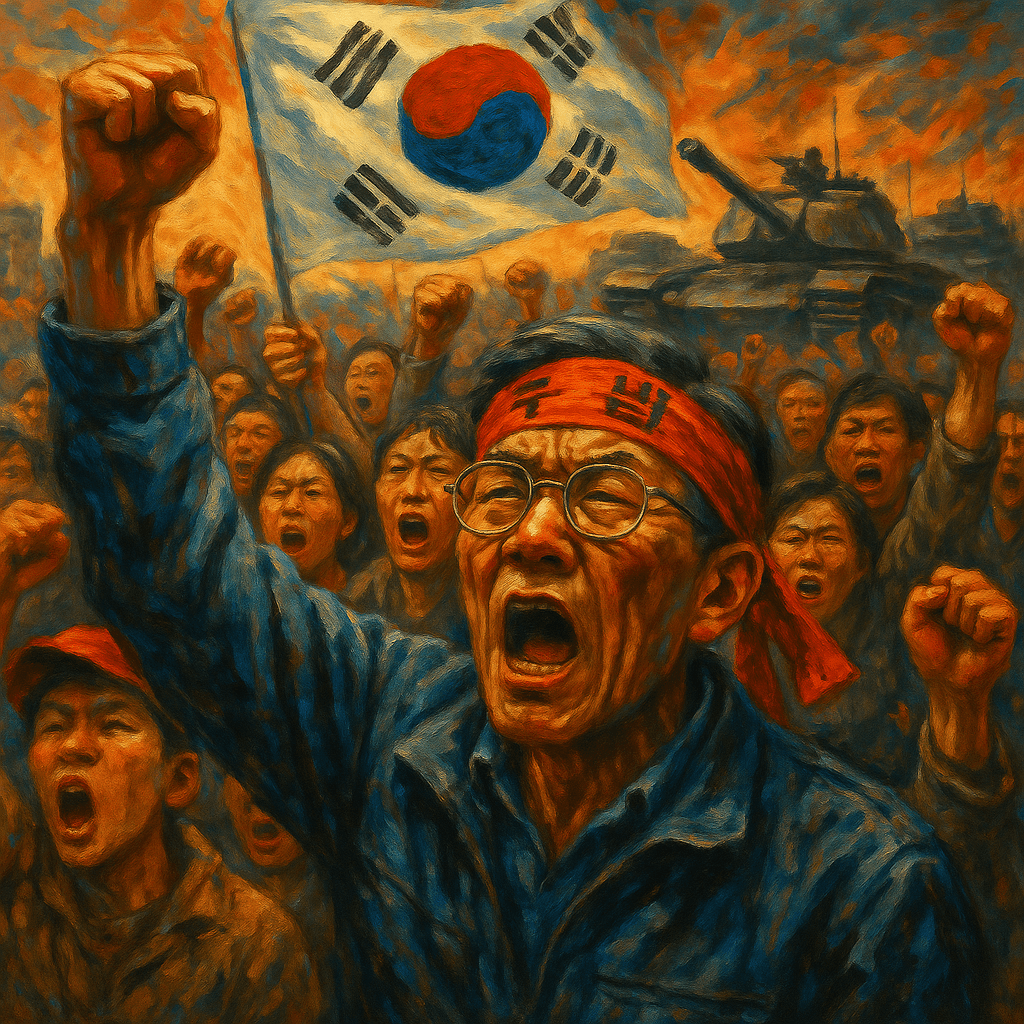
Excavating the fall of a U.S. puppet, the rise of popular resistance, and the imperial media’s desperate attempt to bury Korea’s break with comprador rule beneath fear, framing, and cognitive warfare.
By Prince Kapone | Weaponized Information | June 7, 2025
They Don’t Call It a Coup—They Call It “Democracy in Crisis”
The New York Times’ June 6 report on the fall of South Korea’s U.S.-backed president reads less like news and more like a Pentagon press release in mourning. Yoon Suk-yeol, who declared martial law in December to suppress mass protests, has been impeached. In his place, the people elected Lee Jae-myung—a former factory worker, longtime opposition figure, and thorn in the side of the chaebol class. But instead of welcoming this as a democratic correction, the Times paints it as a crisis. They label Lee “divisive,” warn of “fragile alliances,” and grieve the “uncertainty” of it all. Translation: the wrong guy won, and the empire’s grip just got a little weaker.
The NYT: Not a Newspaper, but an Imperial Megaphone
The article’s author, Choe Sang-Hun, is not some rogue freelancer. He’s a Pulitzer-winning professional with deep ties to the Anglo-American media establishment. For years, he’s narrated Korean politics through Washington’s lens—sanitizing U.S. military occupation, demonizing northern resistance, and spinning austerity as “reform.” He doesn’t write for Koreans. He writes for investors, State Department briefings, and think tank panels. His class allegiance is clear: not to workers or farmers, but to the soft-power wing of empire.
And the New York Times itself? Let’s be honest. It’s not a journalistic institution—it’s a narrative weapon. It helped sell every U.S. war of the last thirty years. It launders coups as “democratic transitions” and sanctions as “pressure campaigns.” It doesn’t report on empire; it works for empire. Owned by financial elites, operating in sync with U.S. intelligence and foreign policy networks, the Times exists to defend the worldview of the Atlantic ruling class—and punish any deviation from it.
Choe’s framing is echoed and reinforced by a chorus of imperial echo chambers: the Korea Times, the Brookings Institution’s East Asia policy wing, chaebol executives from Samsung and Hyundai, and the bureaucrats at Indo-Pacific Command. These are the operators and benefactors of comprador governance. What frightens them isn’t Lee’s rhetoric—it’s that the people might start believing they deserve something better than subservience.
The Narrative Machine: How Empire Manufactures Instability
The NYT doesn’t call this moment what it is: a backlash against decades of inequality, foreign domination, and elite corruption. Instead, it reaches for its favorite Cold War vocabulary—“populist,” “divisive,” “uncertain.” Yoon’s martial law is minimized as “controversial.” Lee’s working-class background becomes a red flag. The mass uprisings that pushed this shift? Barely mentioned. When the colonized fight back, imperial media doesn’t hear the people. It hears chaos.
This is textbook cognitive warfare. It’s not just what they say—it’s what they leave out. They erase the long arc of U.S. counterinsurgency in Korea. They sidestep the bloody legacy of military rule backed by Washington. They never mention the student uprisings, labor movements, or decades of resistance that brought us to this point. Instead, they imply that democracy itself is dangerous when it steps outside U.S. supervision.
This is not journalism. It’s an ideological firewall. It tells readers—especially liberal ones—that nothing good can come from breaking with empire. That democracy is only legitimate when it doesn’t threaten capital. That sovereignty is fine as long as it stays within the lines drawn by Washington and Wall Street.
But beneath the panic, there’s a confession: the empire is scared. The NYT doesn’t run damage control for no reason. What fell in Korea wasn’t just a president—it was a node in the hyper-imperialist network. And what rose in its place wasn’t a messiah—but a possibility. And that’s what imperial propaganda always fears the most.
Behind the Headlines: Facts, Context, and the Empire’s Amnesia
Let’s strip the propaganda and gather what facts we can. According to the NYT article: South Korea’s President Yoon Suk-yeol was impeached after declaring martial law in December. Massive protests broke out in response to economic collapse, corruption, and police violence. Elections were held. The winner: Lee Jae-myung, a former steelworker and longtime opposition figure. Lee’s party, the Democratic Alliance for Justice, also secured a parliamentary majority—giving them the ability to push through reforms for the first time in decades. The NYT admits all this, but drenches it in doubt, warning of instability, market anxiety, and “strained ties with Washington.”
What the article doesn’t say tells us everything. There’s no mention of Yoon’s deep ties to U.S. intelligence and military interests, his brutal crackdown on labor unions, his use of anti-communist rhetoric to justify authoritarian rule. There’s no mention of the long history of U.S.-backed regimes suppressing leftist movements on the Korean peninsula—from the U.S.-installed Syngman Rhee dictatorship to the mass slaughter of suspected communists during the Korean War. There’s no mention of Jeju Island, of Gwangju, of the permanent U.S. military presence in Korea that continues to function as a colonial occupation force in everything but name.
And what about Lee? His campaign spoke to deep-rooted class grievances: skyrocketing housing costs, youth unemployment, the corporate stranglehold of the chaebol, and the failure of U.S.-imposed neoliberal reforms. He ran on a platform of social spending, labor protections, and foreign policy realignment. That’s why working-class and rural voters backed him. Not because they’re confused—but because they’re tired of being crushed.
The imperial media frames all this as a glitch. But it’s not a glitch. It’s a crack. And the crack runs deep. It runs through a peninsula that was forcibly divided by U.S. occupation forces in 1945. It runs through a country whose industrial boom was built on the backs of hyper-exploited workers under U.S.-aligned military dictators. It runs through the foundations of a global system where sovereignty is allowed only if it doesn’t threaten capital.
And it runs through Asia at large—through the unraveling of the U.S. Indo-Pacific strategy, the collapse of regional consent to empire, the failure of Washington’s economic decoupling agenda, and the growing legitimacy of BRICS+ and South-South cooperation. Korea’s fracture isn’t isolated—it’s part of a regional and global pattern. The age of unipolar obedience is ending. And empire knows it.
Which is why the article doesn’t just misinform—it disarms. It removes the historical memory of U.S. coups, of CIA-engineered lawfare, of Cold War propaganda networks like Radio Free Asia. It replaces material analysis with psychological projection: the people are angry, the future is uncertain, the problem is “divisiveness.” But the real problem—for empire—is that the people are remembering what it feels like to choose.
From Crisis to Clarity: Reframing the Struggle on Our Terms
What the New York Times calls a crisis, we recognize as possibility. Not because Lee Jae-myung is a revolutionary—he isn’t—but because his election signals a break, however limited, in the seamless fabric of comprador control. A former worker, elected by workers, in a country long treated as a client state? That’s not just a change in leadership—it’s a tremor beneath the foundations of empire.
But we shouldn’t romanticize. Lee is not a threat because he’s radical. He’s a threat because he emerged from popular discontent—and he may not be able to contain it. The South Korean ruling class, the chaebols, the Pentagon, and Washington’s diplomatic machine aren’t worried about Lee’s policies. They’re worried about the people behind him. The workers, students, and farmers who are beginning to believe they have a right to shape their own future.
This is why the propaganda is so thick. The enemy isn’t confused—they’re afraid. Because this moment exposes something deeper: the structural weakness of hyper-imperialism. The fact that even in its strongholds—even in tech-rich, heavily militarized South Korea—the empire is losing narrative control. The fact that the myth of U.S.-led “stability” no longer holds when food prices rise, wages stagnate, and young people can’t see a future.
Lee’s election is not a revolution. It’s not even a rupture. But it is a destabilization of the technocratic order that has ruled South Korea since the end of U.S. military dictatorship. It reveals the limits of electoral sovereignty under occupation. It shows what happens when the masses begin to assert their agency within a system designed to suppress them. And it reminds us that even the most tightly managed client states can fracture under pressure from below.
We reframe this not as a Korean anomaly, but as a global pattern. The colonized are pushing back—from Thailand to Colombia, from Niger to Peru. The propaganda calls it “instability.” We call it what it is: the slow unmaking of an imperial world system in decline. And within that process, even partial victories, even contested openings, carry meaning—if they’re used to build dual and contending power from below.
Stand with the People, Not the Puppets: Toward Revolutionary Solidarity
We stand with the Korean working class—not because we expect salvation from Seoul’s presidential palace, but because the people who put Lee Jae-myung there are the same class forces rising across the world: young, precarious, exploited, and determined to break free. These are the same workers who’ve been locked out of the chaebol economy, policed by U.S. military bases, and fed austerity in the name of “security.” They are our comrades, whether or not they know our names.
We remember Jeju. We remember Gwangju. We remember how U.S.-backed regimes massacred students, tortured labor organizers, and crushed dissent. And we remember how the people kept fighting—organizing in underground networks, building unions, and refusing to forget. That memory lives on, not just in Korea, but in every occupied territory and every empire in decline.
So what do we do, here and now?
- We build study groups to learn the history of Korean resistance—starting with the Jeju uprising, the Korean War, and the Gwangju rebellion.
- We uplift and share independent Korean media that resists U.S. hegemony—like Pressian, OhMyNews, and worker-run outlets aligned with popular movements.
- We oppose U.S. militarism in East Asia—by targeting the Pentagon, PACOM, and every base that occupies Korean soil under the guise of “peace.”
- We draw the line between the Korean struggle and our own—between South Korean labor crushed by Samsung and Amazon warehouse workers crushed by the same supply chains.
- And we prepare—not to cheerlead elections, but to organize revolutionary power on both sides of the Pacific. Dual and contending power doesn’t wait for permission—it grows wherever people refuse to be ruled.
Because in the end, Korea’s story is not just about Korea. It’s about the whole crumbling structure of U.S.-led empire, and what rises in its place. Let the NYT mourn its puppet. We’ll keep building with the people.
 Weaponized Information
Leave a comment