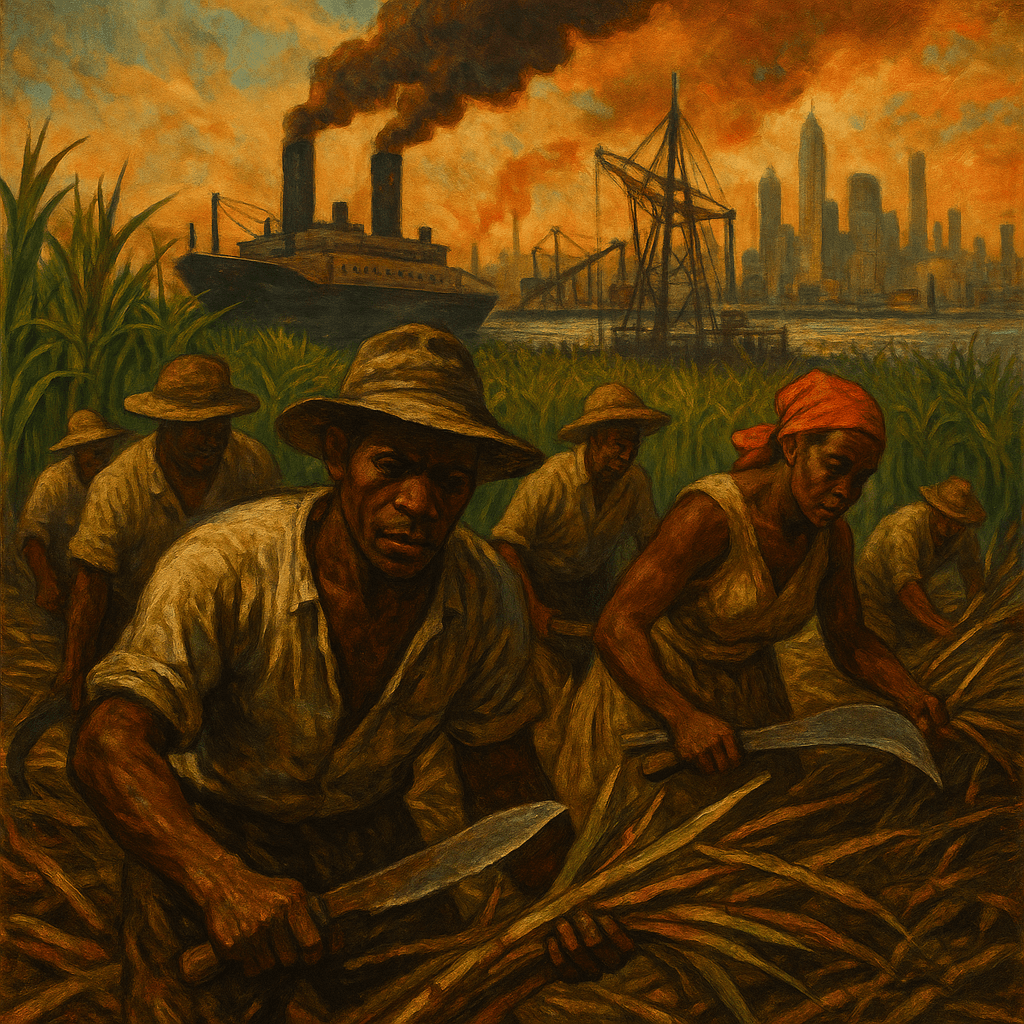
Revisiting the colonial foundations of global capitalism—and the revolutionary path forward
By Prince Kapone | Weaponized Information
May 31, 2025
I. Globalization Was Never Global—It Was Colonial From the Start
Back in the 1990s, they sold us a fairy tale. They called it globalization. We were told it would bring prosperity, connection, and opportunity to every corner of the planet. The iron curtain had fallen, capitalism had triumphed, and the flat Earth crowd—armed with nothing but spreadsheets and stock options—promised that history was over. But behind the pixelated facade of the “information age,” what was really unfolding was a massive counteroffensive: a coordinated, technocratic class war waged from the heights of finance, logistics, and Western military power.
Globalization didn’t unite the world—it recolonized it. It wasn’t about erasing borders. It was about redrawing them to ensure that capital could flow freely while labor stayed trapped in place. It was a recalibration of the old imperial division of labor: extraction in the South, consumption in the North. Plantation logic dressed in digital clothing.
Neoliberalism provided the software. The IMF, WTO, and World Bank were the installation tools. And the global working class? We were the data input—fed into their algorithms of accumulation, disciplined by structural adjustment, and discarded as surplus when no longer useful. They called it a miracle. We call it the modern plantation.
From the outset, globalization has been a project of imperial domination, not mutual development. In Latin America, Africa, and South Asia, it was ushered in at gunpoint—sometimes literally, sometimes through debt peonage disguised as “free trade.” Entire public sectors were gutted, farmers were forced off the land, and national industries were dismantled under orders from Washington and Wall Street. This was not some accident or unfortunate byproduct of globalization—it was the plan.
The mainstream story still claims that globalization “lifted millions out of poverty.” But as always, we ask: whose poverty, and at whose expense? The expansion of capitalism into the Global South created new markets, yes—but only by destroying pre-existing systems of communal life, subsistence farming, and self-reliance. What they call “growth,” we call enclosure. What they call “development,” we call dispossession.
And who benefited? Not the peasant forced into urban slums. Not the garment worker in Dhaka making 15 cents an hour. Not the migrant worker suffocating in a Qatari labor camp. The real beneficiaries have been the monopolies—tech giants, agribusinesses, extractive conglomerates—and the finance capitalists who grease their gears. All while settler labor in the imperial core got their flat-screen televisions, $5 t-shirts, and the illusion of class mobility—subsidized by global plunder.
So no, globalization was not a neutral process. It was a calculated, colonial-class war—fought not just with bombs and embargoes, but with trade deals, media myths, and market discipline. The global plantation was never dismantled. It was upgraded. And now, as the system begins to break down under its own contradictions, the ruling class scrambles to secure its fortresses with technofascism, border walls, and digital counterinsurgency. But beneath the plantation’s surface, a new world is stirring.
II. From Sugar to Silicon: The Global Plantation Evolves
The plantation never disappeared—it just changed shape. What began with chains and cane fields now operates through supply chains and cloud platforms. But the logic remains the same: extract maximum labor, enforce minimum rights, and funnel the surplus to the top. If the original plantation was a crucible of racial capitalism, then today’s global economy is its digitized descendant. Different crops, same empire.
The historical roots of this system run deep. The transatlantic slave trade and colonial extraction built the foundational capital of Western Europe. The gold from the Americas, the cotton from the American South, the rubber from the Congo—this was the original “development aid” extracted at gunpoint. And with each wave of accumulation came a new round of imperial restructuring: direct colonialism gave way to neocolonial “independence”; plantations were renamed export processing zones; overseers were replaced by investment consultants and NGO administrators.
What unites these eras is the core structure: a small class of capitalists in the Global North living off the labor and land of the colonized South. The mechanisms evolve, but the class relation remains. And in the neoliberal era, the plantation logic has been perfected—not just through brute force, but through data, finance, and logistics.
Under globalization, the world was sliced into a chain of value—each link specializing in one part of production. But the real value is captured at the top. A Congolese child mining cobalt earns pennies. A Chinese factory worker assembling an iPhone gets a fraction of the final sale. But Apple, headquartered in California, walks away with 60% of the profit margin. This is what John Smith called “imperialism in the 21st century”—not just unequal trade, but systematic value transfer from South to North, from poor to rich, from Black and Brown hands to white-collar portfolios.
The numbers are staggering. According to UNCTAD and other global economic data:
- Roughly $2.2 trillion in value is extracted annually from the Global South via unequal exchange.
- Over 80% of the world’s manufacturing workers reside in Asia, Africa, and Latin America—but less than 20% of the income from global manufacturing returns to them.
- Meanwhile, Global North-based corporations and shareholders capture the lion’s share of surplus value, often reinvested into speculative finance or tech monopolies.
This is not “comparative advantage.” It’s enforced dependency. The conditions that make labor cheap in the South—poverty, repression, privatization, land dispossession—are manufactured, maintained, and policed by the imperial system. The plantation model depends on keeping whole nations in structural underdevelopment, stripped of sovereignty, forced to export raw materials and import overpriced finished goods. The South grows the cocoa; the North eats the chocolate.
And now, as digital capitalism takes center stage, the plantation expands into the virtual realm. Data has become the new cash crop. Platforms like Facebook, Google, and Amazon harvest human behavior, monetize attention, and consolidate control. Behind the glitter of Big Tech lies a vast global infrastructure of extraction: energy-intensive server farms, lithium mines in Bolivia, copper theft from Zambia, outsourced click-farms in the Philippines, and content moderation sweatshops in Nairobi. The so-called “green transition” is nothing more than an eco-wrapped reboot of colonial plunder.
The Global Plantation never died. It globalized. It digitized. And with every update, the core principle remains: Empire lives off what it does not produce. The wealth of the Global North—its infrastructure, its technology, its middle-class lifestyles—rests on a world economy built to siphon labor, time, and life from the majority of humanity. The only thing that’s changed is how invisible this exploitation has been made to appear.
III. Global Inequality Is a Colonial Relationship, Not a Statistical Anomaly
When liberal economists speak of “inequality,” they often frame it as a technical problem—something to be solved with better tax codes, inclusive growth, or a few more decimal points of GDP trickle-down. But for the vast majority of the world’s people, inequality is not a glitch in the system. It is the system. It is the structure through which imperialism reproduces itself—materially, politically, and ideologically.
We’re not interested in vague moral outrage about the “1%.” We are interested in the colonial structure of accumulation that allows even the poorest settler in the U.S. or Europe to consume more than the average worker in Africa, Asia, or Latin America. And yes—the data confirms it.
As of 2023:
- The bottom 50% of the global population—roughly 4 billion people—own less than 1% of global wealth.
- The top 1% own nearly half of all global wealth—$213 trillion, according to Credit Suisse.
- But even more striking: the average American worker ranks in the top 10–15% of global wealth holders, and even many of the so-called “poor” in the U.S. fall into the top global quintile in terms of income.
The global working class is not a flat, universal category. It is stratified by empire. The labor aristocracy in the imperial core—especially among white workers—has historically benefited from the superexploitation of colonized peoples abroad and at home. Settler workers in the United States have fought for higher wages not just through struggle, but through the spoils of conquest: slavery, Indigenous dispossession, imperial wars, and outsourced exploitation.
Global inequality, then, is not just about numbers. It is about who works, who eats, and who commands. A child in Burkina Faso may live on $2 a day, while a teenager in suburban Texas throws away $2 in leftovers. The food, fuel, and fiber that sustain life in the North are ripped from the hands of the South. This is not “market failure.” It is the result of centuries of violent intervention—military coups, trade embargoes, loan conditionalities, corporate land grabs, and proxy wars—all aimed at maintaining a world system where value flows upward and outward.
The institutions of global governance—the IMF, World Bank, WTO, G7, and now increasingly NATO—function as the armed accountants of this order. They manage the debt, discipline the dissenters, and enforce the rules of capitalist profitability. Their job is not to reduce inequality. Their job is to protect the ruling class and its supply chains. Period.
And yet, these same institutions now pretend to care about “inclusive growth,” “development goals,” and “sustainable capitalism.” It’s a sick joke. They want us to believe that charity will solve what theft created. That philanthropy will atone for plunder. That sprinkling a few billion in “aid” will somehow compensate for the trillions extracted annually through labor exploitation, illicit capital flows, and rigged trade terms.
But as revolutionaries, we are not confused. We don’t want better statistics. We want power in the hands of the poor. We want sovereignty over stolen wealth. We want a world where the South is not forced to feed the North at gunpoint. Until that world is won, inequality will remain—not as a side effect, but as the central operating logic of capitalism in the era of globalization.
IV. Hunger Is Not an Accident—It’s a Policy
Every year, the UN publishes a grim report. It says that hunger is rising. It says that we are “off track” from ending food insecurity. It says that progress is uneven. What it does not say is this: Hunger is manufactured. It is not the product of scarcity. It is the product of a system that produces more than enough, but denies it to those without the power to pay. Hunger is a policy. And capitalism is the author.
In 2023, the world produced 11 billion tonnes of food—enough to feed not just the 8 billion people on the planet, but another 3 billion more. The problem is not supply. The problem is distribution, access, and the violent economic system that hoards abundance in one part of the world while condemning the other to slow starvation.
Let the facts speak:
- Over 733 million people faced chronic hunger in 2023.
- One in nine people on Earth went to bed hungry, most of them in the Global South.
- Meanwhile, the North wastes billions of meals per day—with food loss at the retail and household level accounting for two-thirds of all waste.
This isn’t mismanagement. It’s class war through agriculture. As the Tricontinental Institute notes, wars, poverty, and inequality—not overpopulation—are the engines of hunger. In Sudan, vast fertile land lies fallow because warlords, many backed by foreign powers, have turned the countryside into killing fields. In India, farmers burn their crops out of desperation, driven into debt by seed monopolies and market fluctuations. In Haiti, the U.S. dumped subsidized rice that undercut local growers and destroyed self-sufficiency. Every case reveals the same pattern: imperialism kills food sovereignty.
And the numbers back this up:
- Roughly 80% of the world’s hungry people live in conflict zones or countries under some form of imperialist intervention.
- Over 700 million people live on less than $2.15 a day and cannot afford adequate food, even if it’s available.
- Indigenous peoples—who make up less than 5% of the world’s population—constitute 15% of the extreme poor and suffer disproportionately from food insecurity.
The very structure of capitalist agriculture ensures that hunger persists. Crops are not grown for local consumption, but for export. Land is not used for subsistence, but for profit. Vast tracts of arable land in Africa, Asia, and Latin America are seized to grow coffee, cotton, and biofuels for Western markets. Water is diverted for luxury tourism or mining operations. And when drought strikes or prices spike, it is the poor—not the profiteers—who starve.
Meanwhile, the imperial core disguises its culpability behind the mask of philanthropy. The Bill & Melinda Gates Foundation, USAID, and the World Food Programme claim to “fight hunger” while investing in agribusiness monopolies like Monsanto and Cargill. These actors promote genetically modified seeds, privatized supply chains, and digital farming apps that deepen dependency and strip communities of autonomy. They do not end hunger. They manage it—on behalf of capital.
But there is another path. China, despite its contradictions, lifted over 800 million people out of poverty in less than four decades and officially eradicated extreme hunger by 2021. Vietnam and Kerala are charting similar courses—through land reform, local food systems, and social investment. Burkina Faso, under Sankara and now Traoré, linked food sovereignty to national liberation. As Sankara once said: “He who feeds you controls you.” That is why our struggle is not simply to feed the hungry—it is to build systems of self-reliance, rooted in sovereignty, equality, and revolutionary transformation.
V. The Global Plantation: How Capitalism Organizes Exploitation Across Borders
The phrase “global supply chain” is a euphemism. What it really refers to is the global plantation—a system of imperialist extraction where workers in the Global South labor under violent and degrading conditions to produce the material foundation for life in the North. This is not a metaphor. It is a political economy.
Just as the colonial slave plantations of the 17th and 18th centuries organized the extraction of sugar, cotton, and tobacco for European accumulation, so too do today’s factories, mines, farms, and export-processing zones organize the production of iPhones, cocoa, lithium, cobalt, coffee, and cheap garments for Euro-American consumption. The model hasn’t disappeared. It has been digitized, deregulated, and globalized.
Marx wrote that “capital comes into the world dripping from head to foot, from every pore, with blood and dirt.” Today, it arrives shrink-wrapped in Amazon Prime, but the blood hasn’t dried. The new plantations span continents:
- In the Congo, children dig through radioactive dust in cobalt mines so Tesla can electrify its supply chain and Wall Street can speculate on green futures.
- In Bangladesh, women labor 12 hours a day in sweatshops making fast fashion that sells for $4 at H&M, while the factory owners and European brands split the profits.
- In Honduras, U.S.-backed coups cleared the way for export enclaves where labor organizers are assassinated and unions criminalized.
- In the Philippines, rice farmers drown in debt because of “free trade” deals that gutted food sovereignty and empowered agribusiness monopolies.
This system of globalized exploitation is not some accidental outcome of deregulated capitalism. It is the deliberate structure of global production designed to maximize surplus extraction from colonized labor, while minimizing costs, accountability, and resistance. The imperial core does not just benefit from this structure—it enforces it, through debt traps, military bases, intelligence operations, sanctions, and proxy regimes.
Globalization, then, is not the spread of prosperity. It is the reorganization of imperial domination. Through financialization and outsourcing, Northern capital has repositioned itself—not to share wealth with the world, but to intensify its grip on the periphery. This is what the likes of Samir Amin, Utsa Patnaik, and John Smith have all understood: that the exploitation of labor across the colonial divide is the hidden engine of capitalist profit.
Meanwhile, Northern workers are told that their enemies are immigrants, refugees, or “foreign competition.” But the truth is, their bosses are outsourcing production not to empower the South, but to undermine wages and crush unions at home. Instead of uniting with the colonized workers of the world, many in the North are seduced by nationalism, racism, and right-wing populism—defending the crumbs of empire while the global capitalist class feasts.
It is not the 1% versus the 99%. That’s a convenient fiction for those who want to ignore imperialism. The real contradiction is this: those who profit from global theft versus those who are robbed by it. And within that, even the poor in the North occupy a position of relative privilege vis-à-vis the colonized world. Not morally—but structurally.
This doesn’t mean the settler poor are to blame. It means they have a choice: to unite with empire, or to defect from it. To become defenders of the plantation, or its gravediggers. The future of the world depends on which path they take.
VI. Rupture or Ruin: The Struggle for Food Sovereignty and Global Liberation
If capitalism has globalized hunger, it has also globalized resistance. The same system that robs the soil of nutrients, the people of their labor, and the planet of its future has also—by necessity—sown the seeds of rebellion in every corner of the Earth. From Kerala to Caracas, from the Sahel to Soweto, from Oaxaca to the occupied Black ghettos of the U.S., the question is no longer whether the system is unjust. The question is: what are we going to do about it?
Let us begin where the imperialists fear the most: with food sovereignty. As the late Thomas Sankara understood, the ability to feed your own people is the foundation of real independence. “He who feeds you controls you,” he declared—linking agriculture to anti-imperialist self-reliance. That vision lives on today in Burkina Faso under Captain Ibrahim Traoré, who has rejected foreign dependency and revived the revolutionary spirit of local control over land and production.
Across the world, the fight for food is the fight for freedom:
- In Venezuela, despite U.S. sanctions and economic sabotage, grassroots communes and cooperatives continue to feed communities and resist recolonization.
- In Cuba, agroecology and urban farming are not just survival tactics under blockade—they are pillars of socialist resilience.
- In India, the largest farmers’ protest in human history forced the Modi regime to retreat, exposing the fragility of capitalist agriculture.
- In Kerala, state investment in food distribution, education, and health has lifted millions out of poverty, ahead of schedule and without IMF “reform.”
These are not isolated exceptions. They are proof that another world is not only possible—it’s already being built. But make no mistake: that world is under siege. Every act of self-reliance is punished by sanctions, coups, assassinations, media slander, or starvation blockades. The imperial core cannot tolerate independence in the periphery, because it depends on that dependency for its own survival.
That is why this is not just an economic fight. It is a geopolitical war. Hyper-imperialism, as the Tricontinental Institute explains, is the updated stage of imperial domination: integrating finance, media, military, and technology into one unified machine of control. And it is this machine that is now being challenged—from BRICS realignments and Sahel sovereignty, to revolutionary processes in Latin America and the peasant movements of La Via Campesina.
But global realignment is not enough. We need global revolution. Not just new trade partners, but a new system. Not just sovereignty, but socialism. Because hunger will not end while profit remains sacred. Because dignity will not grow while land is held hostage by capital. Because liberation is not something the oppressed request—it is something they seize.
That seizure requires class clarity. It requires ideological organization. It requires the workers of the North to choose solidarity over chauvinism, decolonization over privilege, and rupture over reform. No more illusions about “making globalization fair.” No more fairy tales about the middle class. As the world burns, we do not need better managers of the plantation—we need arsonists.
The hour is late. The system is crumbling. And the only choice left is this: Empire or emancipation. Hunger or humanity. Ruin or revolution.
VII. Conclusion: The End of Illusions, The Beginning of Struggle
It is not enough to “raise awareness.” The numbers are already there: trillions in hoarded wealth, billions going hungry, tens of thousands dying each day for want of food, water, and shelter in a world of obscene abundance. We are not suffering from a crisis of information—we are suffering from a crisis of power.
What we face is not a broken system. It is a system functioning exactly as designed: to extract, exclude, and exploit. Global capitalism does not fail to feed the world because of inefficiency or mismanagement. It starves the world because starvation is profitable, because hunger disciplines labor, because scarcity serves empire.
We must therefore reject every narrative that pretends the system can be made more humane through charity, aid, or better governance. The answer is not philanthrocapitalism. It is not a fairer IMF. It is not universal basic income underwritten by surveillance platforms and lithium extraction. The answer is rupture—the organized dismantling of imperialist, settler-colonial, capitalist power.
And that rupture must begin with clarity. Clarity that the true divide is not between “rich and poor” in the abstract—but between the imperial core and the colonized world, between the North’s comfort and the South’s deprivation, between those who consume without producing and those who produce without consuming. That clarity must become theory. That theory must become practice.
So where do we begin? We begin with alignment. We align with the world’s hungry, not by donating scraps, but by joining their struggle to reclaim land, labor, and life. We align with food sovereignty, not food banks. We align with the revolutionary poor—not the progressive wing of capital. We align with movements that name the enemy and dare to fight it, that raise the red flag not in protest, but in power.
As revolutionaries in the heart of empire, we have a duty far beyond moral sympathy. We must sabotage the mechanisms of extraction that link our own daily comforts to distant exploitation. We must expose and oppose the policies, corporations, and state apparatuses that uphold this global apartheid. And we must break with every tradition that treats the North as the subject of history and the South as its footnote.
Let this not be just another essay. Let it be a weapon. A call to build revolutionary unity—between the colonized and the defectors within the colonizer class. Between the landless and those who will help them reclaim the land. Between the hungry and those willing to destroy the system that feeds off their hunger.
Let it be said of us, not that we watched the world starve and turned away, but that we saw the plantation for what it was—and set it ablaze.
 Weaponized Information
Leave a comment