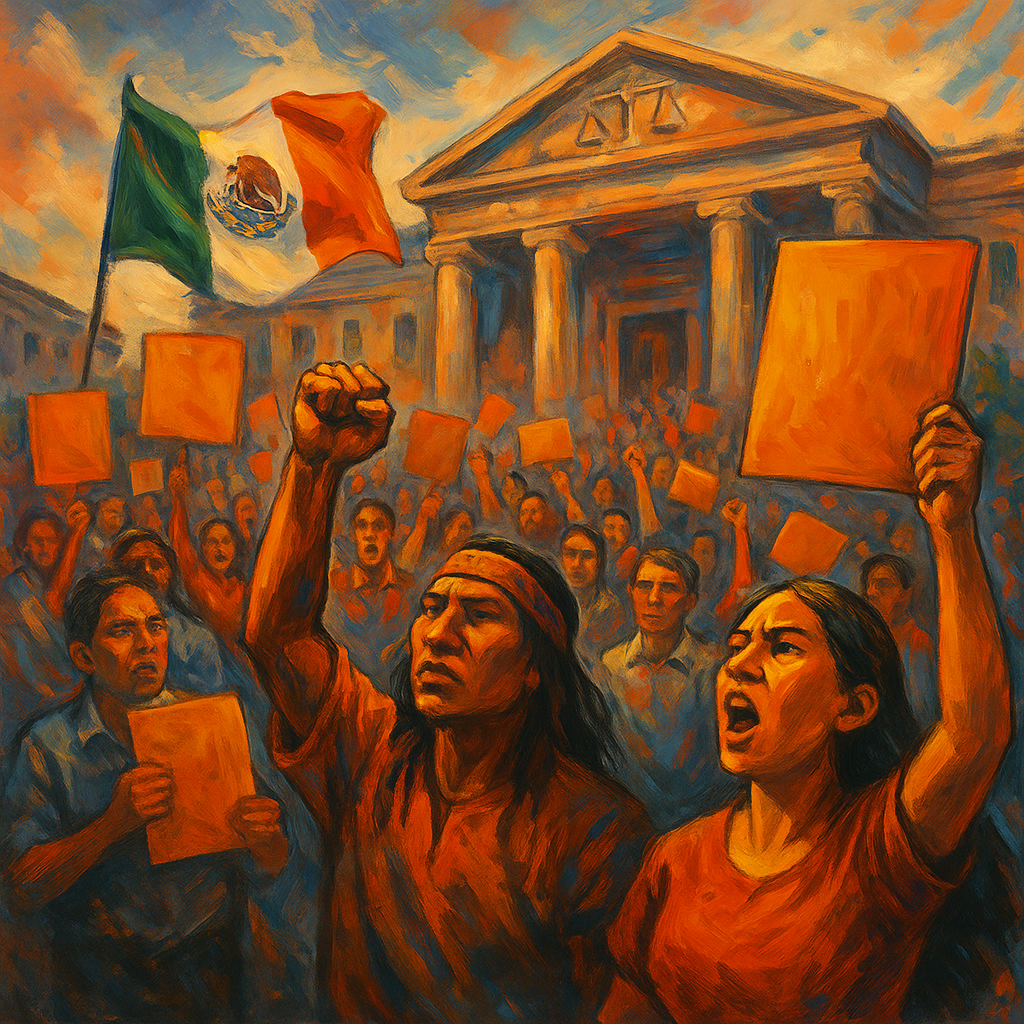
As Mexico’s people prepare to elect their judges, the comprador elite and its imperial sponsors cry foul. But this isn’t a descent into chaos—it’s the first tremor of justice clawing its way out from under centuries of legal colonialism.
By Prince Kapone | Weaponized Information | May 30, 2025
When Judges Are Chosen, Empire Screams “Dictatorship”
Emiliano Polo, the author of the Foreign Policy article denouncing Mexico’s judicial reform, is not some neutral observer offering legal wisdom from the mountaintop. He is a corporate lawyer and associate member of the Mexican Council on Foreign Relations—an elite think tank modeled after its imperial benefactor in Washington. His class allegiance is to a narrow bloc of technocrats and comprador elites trained to speak in the language of “democracy” while defending the rule of capital. The outlet he writes for, *Foreign Policy*, is the in-house magazine of the U.S. imperial brain trust—a journal that exists not to report reality, but to narrate the world as Washington wishes it to be: orderly, obedient, and under corporate management.
The article lines up the usual defenders of empire: the Inter-American Commission on Human Rights, Moody’s credit rating agency, the International Crisis Group, and former U.S. Ambassador Ken Salazar. Each is presented as a guardian of democracy. But scratch the surface and you find the same script: protect private property, discipline the periphery, and panic when poor people start choosing their own judges.
What’s most revealing isn’t the noise—but the silence. There is no mention of the centuries-old concentration of legal power in the hands of a white, landowning caste in Mexico. No reference to the countless court decisions favoring foreign mining companies while Indigenous communities were jailed or disappeared. No discussion of how Mexico’s so-called “independent judiciary” has consistently sided with capital against labor, landlords against tenants, and police against protestors. Instead, Polo insists—with a straight face—that it is electing judges that will “undermine democracy.”
The rhetorical sleight-of-hand is elegant in its cynicism. Judicial corruption? Real—but only as a justification to keep corrupt elites in place. Popular voting? Too complex for the poor to understand. Lack of judicial transparency? Blame the reformers, not the opaque institutions they’re trying to overhaul. Criminal influence? A problem, but only now that the courts might answer to the people instead of the party bosses and bankers. Polo transforms every symptom of elite control into an argument against dismantling it.
Even the Tribunal of Judicial Discipline—a body created to investigate and sanction corrupt judges—is presented as a political weapon, as though the current system isn’t a fortress of impunity. The truth is simple and dangerous: if judges start answering to the masses rather than the masters, the whole neoliberal scaffolding starts to shake. And that’s what Foreign Policy can’t say aloud. So instead, it sneers in legalese.
From Courtrooms to Command Posts: What the Article Says and What It Hides
The article offers just enough truth to hide the lie. It tells us that Mexico’s Congress passed a sweeping judicial reform under the tail end of AMLO’s presidency, during a rare supermajority window. It confirms that 881 federal judicial posts—including Supreme Court justices—will be elected in June, and nearly 2,000 local posts will follow. It admits that the judiciary is deeply corrupt, and even concedes that foreign companies have benefited from a pliant legal system. But it stops there, cutting the cord between cause and consequence, severing the truth from its political context.
What it refuses to acknowledge is the long-standing role of Mexico’s judiciary as an instrument of class warfare and colonial rule. For generations, it has served as a blunt tool of repression—used to evict Indigenous communities, criminalize labor organizing, and legalize privatization. The courts have consistently protected the comprador class and their foreign patrons, blocking nationalization, striking down social programs, and shielding transnationals from labor or environmental accountability. In short: the law in Mexico has never been neutral. It has been a weapon wielded by the elite against the majority.
None of this appears in Polo’s analysis. Nor does the fact that this reform was not crafted in a vacuum. It emerged from below—from the grassroots assemblies in Oaxaca, the anti-mining struggles in Guerrero, the Zapatista zones of Chiapas, the teachers’ union mobilizations, and Indigenous rights organizations like the Congreso Nacional Indígena. It was shaped by decades of struggle for legal accountability, for justice that does not serve the highest bidder. But according to Foreign Policy, the real threat is not that the courts have failed the people—but that the people might now have a say in how they are run.
The article’s obsession with ballot complexity is also revealing. It casts doubt on the legitimacy of the reform by pointing to the high number of candidates, voter confusion, and low turnout projections. But nowhere does it ask why ordinary Mexicans are disengaged from a system that has never served them. It treats political apathy as proof of popular ignorance, rather than as the residue of systemic betrayal. It paints the people as too dumb to elect judges, while forgetting that the judges they never elected presided over generations of theft, violence, and impunity.
And when it speaks of foreign investment, treaty obligations, and credit ratings, the veil slips entirely. The real anxiety is not democratic dysfunction. It’s that legal power might shift out of imperial hands. That a judge might one day block a land grab, or sanction a foreign corporation, or uphold an Indigenous community’s right to territory. That the law might cease being a tool of expropriation and become, however tentatively, a site of resistance. That is what the article omits. And that is why it was written.
Decolonizing the Courts: From Legal Reform to Class Struggle
The struggle in Mexico is not over ballots. It’s over power—who holds it, who enforces it, and who gets to define justice. The judicial elections are only the first strike in what must become a prolonged, organized campaign to dismantle the colonial scaffolding of law and build something rooted in the sovereignty of the people. We are not romanticizing electoral reforms. We are recognizing their potential when seized and expanded by mass movements with revolutionary vision.
For grassroots forces in Mexico, this is the time to push harder—not only to elect judges, but to transform what it means to practice justice. Indigenous communities, unions, women’s collectives, and student organizations should move to establish local accountability assemblies to monitor judicial behavior. They must fight for mechanisms of recall, public trials, and the right to challenge and remove corrupt or comprador judges from below. This is the terrain of dual and contending power—not just participating in the colonial state, but undermining its authority while constructing the people’s own.
For revolutionaries in the imperial core, the role is to rupture the narrative. Expose the real function of U.S.-backed legal “norms.” Show how “rule of law” becomes the velvet glove over expropriation. Build campaigns to abolish investor-state dispute settlement clauses in NAFTA/USMCA and challenge the use of U.S. and Canadian courts to attack Mexican sovereignty. Support efforts to de-link legal education and judicial training from foreign-funded NGOs and elite law schools that reproduce comprador ideologies.
Our media workers and guerrilla intellectuals must document this moment for what it is: a juridical insurrection. We must produce articles, documentaries, podcasts, and teach-ins that make clear what the Financial Times and Foreign Policy will never say—this is not a slide into authoritarianism. This is a people kicking in the door of a centuries-old fortress.
The law has always been a terrain of class war. The question is whether it remains a weapon for empire, or becomes a tool for emancipation. Mexico has made its move. It’s our turn to echo it, defend it, and learn from it. Because if the people can elect their judges, they might one day elect their revolutionaries—and then, Comrade, the real trials will begin.
This Isn’t a Reform—It’s a Revolt Against Legal Colonialism
The reform unfolding in Mexico is not just an institutional shakeup—it’s a direct blow to a centuries-old system of judicial apartheid. For the first time in modern Mexican history, ordinary people are being asked to choose their judges. That may not sound radical to a reader trained in Western liberalism, but in a country where courts have always served the landlords, the foreign investors, and the political oligarchy, it is nothing short of revolutionary. The law is being pried from the hands of the comprador elite—and they are howling.
This is why the article in Foreign Policy is less an argument than a tantrum. Because for the empire and its junior partners, judicial independence has never meant independence from power—it has meant insulation from accountability. The judiciary was “independent” as long as it struck down worker protections, approved militarized policing, and blocked energy nationalization. But once that judiciary faces scrutiny from below—once judges are asked to stand before the people they’ve ruled over without consent—it’s suddenly a crisis of democracy.
What we are witnessing is a crack in the colonial consensus. The consensus that says law must be written in a foreign tongue, interpreted by foreign-trained elites, and enforced in ways that maintain the racial and class hierarchies of the past. The consensus that legal legitimacy flows from Washington, or Brussels, or Moody’s—not from the communities brutalized by those institutions’ rulings. That consensus is collapsing. And Mexico’s judicial reform—however messy, incomplete, or flawed—is part of that collapse.
The Tribunal of Judicial Discipline is painted as a mechanism of authoritarian control. In reality, it is a modest institutional gesture toward a much deeper demand: that the law serve the people, and that those who administer it be accountable to something other than capital. If that tribunal even partially succeeds in sanctioning the untouchables—judges long shielded from consequence—it will mark a historic breach in Mexico’s settler-legal order.
This is why the battle over Mexico’s judiciary matters far beyond its borders. It’s not just about one country’s constitution—it’s about whether law can ever be reclaimed from the elite. Whether a justice system built on colonial theft, racial hierarchy, and capitalist impunity can be dismantled and remade. Whether a nation can begin to construct—slowly, haltingly—a system where the rule of law is not the rule of the rich. That is the threat. And that is the promise.
 Weaponized Information
Leave a comment