By Prince Kapone | Weaponized Information | May 27, 2025
Land, Labor, Liberation
In an era when Silicon Valley titans speak of AI farms on Mars and the IMF preaches “digital inclusion” to starving peasants, the question must be asked: who still feeds the world? The answer—painful, simple, revolutionary—is: the dispossessed. The global peasantry, often dismissed as premodern or obsolete by the bourgeois academy, still produces over 70% of the world’s food on less than a quarter of the world’s agricultural land (La Via Campesina).
This article takes up the agrarian question not as a nostalgic detour, but as a central contradiction of global capitalism in crisis. We speak here in the tradition of Mao Zedong, who built revolution from the countryside; of Samir Amin, who exposed the structural dependence of the imperial core on the exploitation of peasant labor in the periphery; and of Amílcar Cabral, who declared that “the people are not fighting for ideas, but to win material conditions for a better life.”
Urbanization and the Myth of Modernity
Today, more than 57% of the world’s population lives in urban areas, and by 2050, that number is expected to climb to 68% (UN DESA). Capitalism celebrates this as the inevitable march of progress. In truth, this urbanization is the forced migration of peasants displaced by monocrop exports, climate disaster, and IMF-structured hunger.
But here lies the trap: the majority of these migrants do not become factory workers in the Marxist sense—they become informal, surplus humanity, laboring in gig economies, slums, and shadow markets. These are dispossessed peasants turned urban lumpenproletarians, stripped of land but not integrated into production. The agrarian question becomes the urban question. They are two sides of the same contradiction.
Technofascism and the Digital Enclosure of the Land
Global agriculture is now increasingly controlled by a handful of monopoly capitalists: BlackRock owns farmland; Bayer-Monsanto owns seeds; Bill Gates owns the narrative of “sustainable farming.” This is the face of technofascism: the fusion of finance capital, biotech, and state surveillance to dispossess, discipline, and displace rural communities.
Under the guise of “precision farming,” satellites monitor land use; drones patrol Indigenous forests; blockchain tokenizes water rights; and AI predicts which crops “deserve” to grow. This is not innovation—it is digital counterinsurgency against peasant autonomy.
Peasant Resistance and the Revolutionary Road
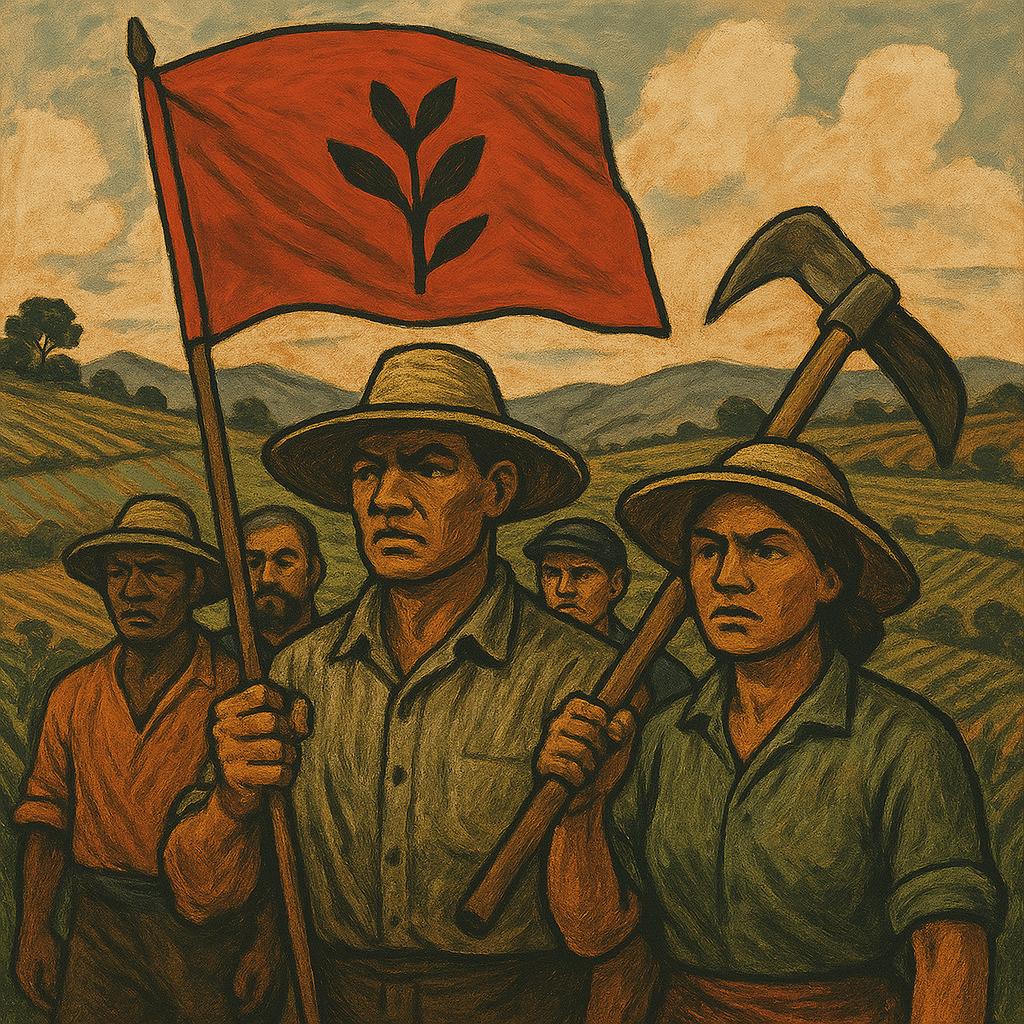
Yet the peasantry is not a passive victim. From the Landless Workers’ Movement (MST) in Brazil to Dalit farmworkers in India, rural people are fighting back. Their struggles often take forms alien to the NGO-industrial complex or Western leftist orthodoxy—but they are material, class-based, and revolutionary.
Mao Zedong taught us that the countryside is not merely the site of reactionary backwardness—it is where the contradictions of capitalism manifest most starkly. When organized, the peasantry becomes a strategic force of revolutionary transformation.
Samir Amin argued that any attempt to industrialize the periphery without solving the agrarian question would result in dependent development and comprador accumulation. He was right. Today, neoliberal “green revolutions” do not bring sovereignty; they bring debt, dependence, and ecological collapse.
The Ecological Dimension: Agroecology vs Climate Capitalism
Industrial agriculture is one of the main drivers of global warming—yet the very communities least responsible for climate change suffer its worst effects. Small farmers, Indigenous communities, and pastoralists are not just food producers—they are custodians of the Earth’s remaining biodiversity and carbon sinks.
The struggle for agroecology, food sovereignty, and land reform is now an existential battle for the future of planetary life. The agrarian question is now a climate question. And it is the proletarian ecology of the Global South—not Elon Musk’s carbon credit scams—that holds the key to survival.
Land to the Tiller, Earth to the People
The agrarian question in the 21st century is not a relic of the past—it is the strategic battleground of the future. It connects the struggles of African farmers resisting land grabs, South Asian sharecroppers rebelling against caste feudalism, Latin American peasants fighting for redistribution, and displaced peasants in megacities resisting starvation wages and police repression.
Revolution will not come from the blockchain or the ballot box. It will come, as it always has, from the land—from those who work it, fight for it, and refuse to be erased by empire.
Let the imperialists build their vertical farms and geoengineered seeds. Let the comprador class eat lab-grown protein. The revolutionary future belongs to the peasants, the landless, and the workers of the Earth.
Land to the tiller. Water to the people. Earth to the world’s oppressed. That is the program. That is the path. That is the future.
Read Part II – Climate Catastrophe and the Rural Proletariat: From Somalia to Sri Lanka
 Weaponized Information
Leave a comment