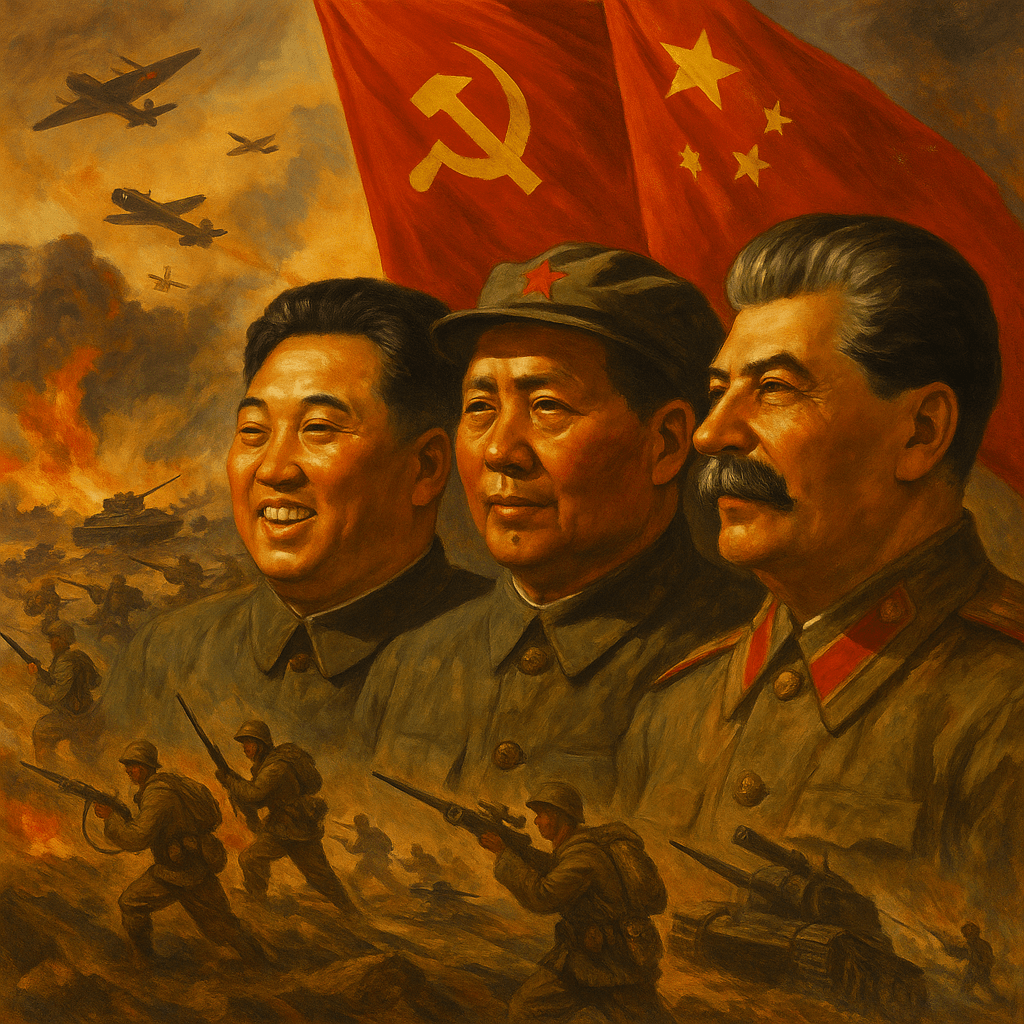
This is not the story of a Cold War chess match or a border conflict spun out of control. This is the story of a revolutionary people defending their land and their future against the most brutal empire in human history—and winning. Korea did not collapse. It stood, with the full force of China and the strategic backing of the Soviet Union beside it. This is the forgotten war that empire tried to erase—and the living memory of proletarian internationalism at its highest level.
By Prince Kapone | Weaponized Information
May 26, 2025
Part I – The Revolution That Would Not Die: From Colonized Soil to People’s Power
When Japan finally surrendered in August 1945, Korea didn’t fall to freedom—it stumbled into a new cage. The Korean people had just survived 35 years of colonial strangulation under the Empire of the Rising Sun. Their language outlawed, their rice shipped to Tokyo, their daughters stolen as sex slaves, and their sons dragged off to die for the Emperor’s dreams. As Stephen Gowans puts it, the Japanese occupation turned Korea into a “granary and a factory” for Tokyo, and Koreans into beasts of burden. Some of Korea’s future capitalist elite made their fortunes then—collaborating with the occupiers, helping to crush rebellion, selling out the nation for gold watches from Emperor Hirohito.
But the Koreans never stopped fighting. Guerrillas like Kim Il Sung led underground resistance from Manchuria, striking blows against Japanese military posts in the frozen forests, laying the groundwork for what would later become the Korean People’s Army. They fought without foreign sponsors, without recognition, and without mercy. When Japan finally fell, it wasn’t the Stars and Stripes that liberated Korea—it was Soviet tanks rolling into the North and guerrilla units rising from the countryside. It was the Korean people themselves, soaked in revolutionary blood and memory, who tried to seize the moment to finally create a Korean Korea.
But empire wasn’t done with them. The United States, which had contributed nothing to the anti-Japanese resistance in Korea, landed troops in the South three weeks after Japan’s surrender. Not to help Korea build freedom—but to prevent it. They drew a line across Korea’s chest at the 38th parallel—dividing a unified people with the stroke of a Pentagon pen. The South was handed over to Syngman Rhee, a Princeton-trained exile who hadn’t stepped foot in Korea in 40 years, who had spent more time lobbying U.S. officials than fighting for his own people’s freedom. Meanwhile, U.S. occupation forces recruited every available Japanese collaborator they could find—police, landlords, military officers—and reinstalled them as administrators of the new U.S.-aligned “Republic of Korea.”
As Bruce Cumings documents, this wasn’t accidental—it was policy. The very same Yongsan base that had been the hub of Japanese military control in Seoul was simply taken over by the U.S. Army, repurposed to enforce American interests in the region. “I can’t think of another capital city quite like it,” Cumings writes, “where you turn a corner and suddenly see a mammoth swatch of land given over to a foreign army.” If you wanted to understand South Korea’s role in the new world order, you didn’t have to read a treaty—you just had to walk the streets of Seoul and see the flags.
In the North, however, the revolution surged forward. Land was redistributed. Japanese and collaborationist industries were seized. Schools were rebuilt. Literacy soared. Power was placed in the hands of workers, peasants, and ex-guerrillas. This was not the creation of a Soviet puppet—it was the political birth of what Gowans calls “the patriot state.” A state built not on imported blueprints, but on the lived reality of anti-colonial war and socialist reconstruction. The founders of the DPRK were not technocrats flown in from Moscow. They were the same Koreans who had bled in the hills and starved in the prisons of Japanese fascism. They had earned their legitimacy—not in Ivy League classrooms, but in revolutionary struggle.
The imperialists could not allow this to stand. Washington understood that if Korea were allowed to unify on its own terms—on the basis of anti-imperialism, land reform, and people’s power—it would set fire to the entire region. Vietnam, Laos, Malaya, Indonesia—they were all watching. The defeat of the French in Indochina, the fall of Chiang Kai-shek in China, and the rising tide of communism in Japan’s shattered economy all signaled to U.S. planners that Asia was slipping away from the grasp of capital. As Gowans makes clear, U.S. officials feared that “emancipatory movements” would take root if Korea was not split and contained. So they split it. They contained it. They put a boot on the South and declared war on the North before the first shot was ever fired.
Let us be absolutely clear: the war did not begin in June 1950. The war began in 1945, when the United States sabotaged the pan-Korean elections that the Soviets and Koreans had demanded. It continued in 1948, when Syngman Rhee began murdering leftists and peasant organizers with U.S. weapons and CIA direction. It escalated in 1949, when the South’s anti-communist death squads began massacring entire villages—men, women, and children—under U.S. military command. The Northern advance of June 1950 wasn’t an “invasion.” It was a counteroffensive in a war that had already consumed tens of thousands of lives.
And yet, U.S. media told a different story: that the North was a puppet, that Stalin pulled the strings, that Kim Il Sung was just a Korean Stalin. But as we’ll show in the next section, the actual historical record—the telegrams, the deliberations, the debates between Stalin, Mao, and Kim—tell another story entirely. They reveal that the Korean people were not passive victims or pawns. They were agents of history, acting with vision and audacity to finish a revolution that imperialism has never forgiven them for beginning.
Part II – Not Puppets, But Comrades: The Alliance That Terrified Empire
The Cold War mythmakers have always needed an enemy too dumb to think and too disciplined to resist. That’s how they framed the Korean War: Stalin the puppeteer, Mao the echo, and Kim Il Sung the marionette with a red star for a brain. But history—real history, drawn from meeting transcripts, military memoranda, and diplomatic cables—renders this narrative not just wrong, but ideologically perverse.
Let’s start with the most important correction: Stalin did not order the war. He insisted that the Korean revolution must be owned, initiated, and led by Koreans themselves. As Stephen Gowans notes, Stalin’s role was defined by restraint—not cowardice, but careful revolutionary strategy. He knew that if the Soviet Union were seen as the instigator, it could provoke a direct conflict with U.S. forces, possibly nuclear. So, Stalin made it clear to Kim Il Sung: if you move forward, it must be your people’s revolution. The USSR would support logistically—military equipment, medical aid, financial backing—but not with boots on the ground beyond limited air support. The Korean people had to light the fire themselves.
That wasn’t abandonment. It was fidelity to the core principle of self-determination. Kim Il Sung, a veteran guerrilla leader who had fought the Japanese from the forests of Manchuria to the banks of the Yalu, wasn’t some Moscow apparatchik. He knew his people, their suffering, and the stakes. And when he saw the South descending into chaos—massacres, uprisings, purges of leftists, U.S. military buildup—he concluded, rightly, that the window for reunification was narrowing.
Before moving, Kim met not only with Soviet advisors but with Mao Zedong. And Mao didn’t offer immediate support either. The newly victorious People’s Republic of China was still stabilizing; its resources depleted, its army exhausted, and its international position fragile. But Mao agreed: if the revolution in Korea was to be defended, China must act—not to dominate Korea, but to honor internationalist duty. The Chinese intervention was based on revolutionary solidarity, not Soviet instruction.
Telegram diplomacy between Stalin, Mao, and Kim reveals three things. First, none of them were reckless. This was not some Red Axis conspiracy to provoke war. Second, all of them acted with deference to the Korean people’s sovereignty. And third, the alliance was structured not by imperial hierarchy, but by revolutionary coordination. The Soviets provided military hardware, radar equipment, medical infrastructure, and a critical edge in aerial combat—often via Soviet pilots flying anonymously under North Korean insignia. The Chinese provided hundreds of thousands of volunteers—most of them peasants—who crossed the Yalu not for territorial conquest, but to defend a comrade people from imperial annihilation.
Bruce Cumings reinforces this point: the Soviets “stayed in the background and let Koreans run the government,” putting anti-Japanese resistance leaders like Kim Il Sung forward and backing reforms driven from below—land reform, women’s emancipation, cooperative industry. Stalin didn’t plant a regime. He nurtured a revolution that was already erupting from Korean soil.
So let’s call it what it was: a revolutionary alliance. Imperfect, strategic, sometimes tense—but rooted in mutual respect, shared sacrifice, and collective liberation. And that’s exactly what made it so dangerous to the United States. If three independent socialist revolutions could coordinate without central command, if people from Korea, China, and the USSR could bleed for one another without coercion, then imperialism’s entire ideological foundation—the myth of Western rationality vs. Eastern obedience—crumbled.
The puppet narrative was always projection. The real strings ran from Washington to Seoul, from Langley to Rhee’s torture chambers, from General MacArthur’s desk to the charred rubble of Pyongyang. It was Syngman Rhee who depended on foreign bayonets. It was the Republic of Korea that was born from foreign occupation and staffed by ex-collaborators. The DPRK, by contrast, was formed by peasants who seized land, workers who took over factories, and guerrillas who returned from exile carrying not briefcases, but rifles.
In this war, the empire feared not Stalin’s command, but something far more terrifying: that the colonized could rise and organize themselves. And that three revolutions—Korean, Chinese, and Russian—could synchronize not as slaves to an empire, but as comrades in arms.
Part III – When Empire Brought the Fire: Scorched Earth and the Gospel of Containment
The U.S. didn’t just go to war in Korea—it came to annihilate. What began as a colonial intervention quickly escalated into a campaign of extermination. The American war machine unleashed its full arsenal on the Korean Peninsula not to defeat an army, but to obliterate a revolution. This was not a conflict between two states. This was the thermonuclear fury of an empire in crisis, smashing everything it could not control.
Within the first weeks of intervention, General Douglas MacArthur made his objectives crystal clear: “Every installation, factory, city, and village north of the 38th Parallel should be leveled to the ground.” And that’s exactly what happened. By 1951, every major North Korean city was reduced to rubble. Pyongyang was flattened. Wonsan was bombed for 861 consecutive days. Hydroelectric dams were bombed to flood rice paddies and starve civilians. Forests were incinerated. Crops destroyed. As Bruce Cumings documents, U.S. pilots often flew “slaughter sorties,” attacking refugee convoys, fishing boats, even ox carts.
This was no accident. It was the doctrine of total war—an old imperial policy dressed up in Cold War rationalizations. The U.S. dropped more bombs on Korea than in the entire Pacific theater of World War II. Napalm, a weapon of pure sadism, was used indiscriminately. It clung to skin, melted flesh to bone, turned human bodies into torches. And it was dropped on cities, schools, and even hospitals. As I.F. Stone reported in The Hidden History of the Korean War, American officials often refused to distinguish between “military targets” and “areas of resistance”—because to them, a revolutionary people was the enemy, and their very existence was resistance.
By the time the smoke cleared, over 3 million Koreans were dead. Most were civilians. The U.S. killed 20% of the North’s population. That is not a war—it is a war crime. It is genocide by aerial firepower. And it was not done in error. It was done to “send a message” to the world: that no anti-colonial revolution would be allowed to survive without paying a blood price beyond comprehension.
And yet, they didn’t win. Despite the bombs, the napalm, the mass executions, the scorched earth strategy, the DPRK did not fall. Despite being encircled, blockaded, and demonized, the revolution survived. The Korean People’s Army regrouped. Chinese volunteers poured in. Soviet pilots provided cover. The people dug in—literally. They built underground schools, factories, and hospitals to continue life in defiance of death.
Let us be clear: the Korean War was the empire’s first full rehearsal for the counterrevolutionary wars that would follow. Vietnam. Indonesia. Chile. Iraq. Libya. All of them carried the Korean template: bomb the people, murder the leadership, carpet the countryside with terror, and call it “freedom.” The real objective was not merely to contain communism—it was to contain the example of independent development, self-determination, and people’s power. It was to burn into the collective memory of the colonized world that revolution would not be tolerated.
The American press covered it all with a smile. Stories of brave GIs and evil “Commie fanatics” saturated headlines. Massacres were buried or blamed on “reds.” Photos of napalmed children were either censored or recontextualized. The U.S. public, still flushed with post-WWII arrogance, bought the story wholesale: we were saving Korea. But the Koreans never asked to be saved. They asked to be left alone. And that was the one thing empire could never allow.
The Korean people were not collateral damage. They were the target. Because they dared to fight. Because they dared to build. Because they dared to say that Korea belonged to Koreans, not to generals, missionaries, or Wall Street. And in that resistance, they taught the world a lesson that still haunts Washington today: that even under napalm, even under the mushroom cloud, a revolution can survive.
Part IV – China Enters the Fray: The People’s Volunteers and the Duty of Revolution
By the fall of 1950, American tanks were rolling toward the Yalu River. Cities lay in ashes, the DPRK was fighting for its life, and the U.S. command—bloated with MacArthur’s arrogance—was preparing to occupy all of Korea. For Washington, this wasn’t just about Korea anymore. It was about encircling China, threatening the Soviet Far East, and sending a global warning: resist us, and we will burn your country to the ground.
But that advance stopped cold in the mountains of North Korea, because China did the unthinkable. The People’s Republic, barely a year old, exhausted by civil war, under threat from Taiwan and U.S. gunboats, decided it would not stand by and watch the Korean revolution be snuffed out. China crossed the Yalu.
And they didn’t send their army. They sent the people. Hundreds of thousands of workers and peasants volunteered to defend Korea, not as a foreign state, but as a fraternal revolution. The “People’s Volunteers” didn’t march under red flags or regular army command—they crossed frozen rivers at night, carrying what weapons they could, wrapped in rags, led by commanders who had fought both the Japanese and the Kuomintang. They brought no tanks, few radios, and minimal air support. What they brought was will.
The Western press called it madness. But Mao understood something the Pentagon never could: that revolutionary commitment is stronger than steel. In meetings with Stalin, Mao had insisted that if the U.S. crossed the 38th parallel, it would no longer be a civil war but a colonial conquest—and China would act. Not out of vanity, not out of strategic ambition, but because the Chinese Revolution owed its life to internationalism, and now it was time to return the favor.
As Stephen Gowans emphasizes, this was no Soviet directive. Stalin did not demand intervention. In fact, he hesitated, warning Mao that direct confrontation could trigger World War III. But Mao was clear: revolution must defend revolution. China would not allow a U.S. protectorate to be planted on its border. Nor would it allow the defeat of a fellow people struggling for national liberation. Not after what Japan had done. Not after what the Chinese peasantry had endured.
The Chinese counteroffensive was a shock to U.S. command. MacArthur’s forces, arrogantly spread thin and convinced the war was won, were routed from the north. Seoul changed hands. American soldiers, trained to believe in racial supremacy and technological invincibility, found themselves overwhelmed by what one general called “human waves.” But these weren’t mindless masses. They were cadre-led fighters with deep political education, disciplined logistics, and battlefield experience from decades of struggle.
And they came not to conquer—but to protect. To preserve what the Korean people had built. To prevent the re-enslavement of the peninsula under a client regime of Washington. China made it clear: once the U.S. threat was pushed back to the 38th parallel, they would not pursue further conquest. Their goal was not domination, but defense of the revolution.
Let us be clear: this was not just military support. This was political education in action. Every Chinese volunteer who fought and died in Korea was carrying not just a rifle, but a worldview—that the revolutions of the colonized world must stand together, or fall one by one. The Chinese knew that imperialism would not stop at Korea. Vietnam, Laos, Indonesia, Africa—this was the front line of a planetary struggle. And China chose to fight it early, and decisively.
The Western media called it aggression. But the world’s oppressed saw something else. They saw a nation rise to defend another. They saw poor peasants from one land fight to protect poor peasants in another. They saw an Asian power say no to white empire, and mean it. And they learned that revolution, when defended by the people, can endure—even when surrounded by fire.
Part V – The Victory of the Stalemate: Revolution Did Not Retreat
By July 1953, the Korean War had reached a grinding halt. No flags were planted, no treaties of surrender signed, no grand parades of victory marched. The line dividing North and South remained almost exactly where it began—near the 38th parallel. For the imperialists, this was spun as a draw. But for the revolution, for the peasants and workers of Korea, for the global South watching with clenched fists, this was a victory carved out of fire.
Let’s be clear: the United States came to Korea to conquer. They came to crush the revolution, install a puppet across the whole peninsula, and turn Korea into another Japan—a base of operations, a capitalist outpost, and a dagger aimed at the heart of China and the Soviet Union. And yet, they failed. The North survived. The socialist state held. The line did not fall. The revolution withstood the full weight of empire and lived.
The U.S. military, the most technologically advanced force the world had ever seen, unleashed everything short of atomic weapons. They dropped more tonnage of bombs on Korea than they had during the entire Pacific theater in World War II. Entire towns were erased. More civilians were killed in North Korea per capita than in any modern war since. And still, the people stood their ground.
Why? Because this was not a war between machines. It was a war between systems. On one side: imperial capitalism backed by ex-collaborators, landlords, and comprador generals. On the other: a people’s state rooted in land reform, industrial transformation, and the armed memory of anti-colonial resistance. One side fought for domination. The other for liberation.
The Western press called it a “stalemate.” But as Stephen Gowans and Bruce Cumings remind us, in revolutionary terms, this was nothing less than a strategic victory. The revolution was preserved. The socialist state remained. Korea did not become another Philippines or South Vietnam. And every empire that followed had to think twice before deploying troops again in Asia.
The costs were catastrophic, yes—but so was the meaning. For the first time, a peasant-led, worker-powered state stood toe-to-toe with the American empire and was not defeated. It was a global event. Across Africa, Asia, Latin America, insurgents and organizers looked to Korea and saw the future. If the Koreans could survive napalm and come out standing, then maybe Algeria could break France. Maybe Vietnam could beat the U.S. Maybe Cuba could hold off the Yanquis. Maybe revolution wasn’t impossible—it was inevitable.
Washington knew it, too. That’s why it buried the war in silence. No ticker tape, no national holiday, no glorious Hollywood epics. The war that was supposed to teach the world a lesson about “communist aggression” ended up teaching the empire a different lesson: that when the people are armed with history, conviction, and solidarity, they can defy the impossible.
To this day, Korea remains divided. But in the North—besieged, sanctioned, demonized—the people still live under a system their ancestors bled to build. That’s not a footnote. That’s not a frozen conflict. That’s a living revolution. And it survived the most merciless assault the modern imperial system could throw. If that isn’t victory, what is?
The truth is: empire didn’t lose the war on the battlefield. It lost in the hearts and minds of the oppressed. Korea proved that the Third World could fight. That colonial borders could be defied. That airstrikes can’t kill ideas. And that a people’s determination—when backed by comrades, strategy, and history—could hold a line against the most powerful military in human history.
They called it a draw. But history will call it what it was: a defiant victory of the wretched of the earth.
Part VI – Memory Under Siege: The War That Never Ended
The Korean War never ended. There was no peace treaty. Only an armistice—an imperial pause button. And in the decades that followed, the United States waged a different kind of war: a war against memory. It censored, distorted, and buried the truth so deep that even radicals today often forget that Korea was the first battleground of the postwar imperial order, and the first place where that order was fiercely, bloodily, and successfully resisted.
The American propaganda machine labeled Korea “the Forgotten War.” But that forgetting was not organic. It was engineered. U.S. history books painted it as a heroic stand against communism, glossing over napalm, massacres, and mass death with sanitized euphemisms like “containment” and “police action.” Hollywood erased the genocide. Schools skipped it. Liberals ignored it. The result: a war that shaped the postcolonial world order was rendered invisible.
Why? Because if people knew the truth, they would ask dangerous questions. They would ask why the United States killed millions of civilians in a country it claimed to be liberating. They would ask why General MacArthur wanted to drop 26 atomic bombs on China. They would ask why the Republic of Korea was built on Japanese collaborators and CIA paychecks. And they would ask why the people who fought and survived in the North are still being punished with sanctions, isolation, and demonization seven decades later.
As Stephen Gowans documents, U.S. policymakers made a deliberate choice to “freeze the outcome” of the war, using economic siege, psychological warfare, and military encirclement to suffocate the DPRK into collapse. But the collapse never came. The North rebuilt from ashes—without Marshall Plan aid, without access to Western finance, and under relentless blockade. In the face of that, its mere survival became a historical defiance.
The South, meanwhile, was remade into an obedient client state: first through military dictatorship, later through export-led capitalism under U.S. guidance. Its economy boomed, yes—but behind that boom was the blood of unionists, dissidents, and organizers tortured and disappeared under regimes trained by the very same U.S. military that had once carpet-bombed the peninsula. The memory of popular resistance was scrubbed from textbooks, drowned in neon lights and Samsung slogans.
Bruce Cumings calls it “the geopolitics of amnesia.” A deliberate effort to erase not just the violence of the war, but the revolutionary hope that animated it. That’s why North Korea isn’t just demonized—it’s dehumanized. Portrayed as insane, robotic, alien. Because to admit its history is to admit that it arose from struggle, from anti-colonial resistance, from a social base rooted in land reform and people’s power. To admit that is to recognize that the war wasn’t about ideology—it was about empire’s need to stop a people from choosing their own destiny.
Today, the Korean Peninsula remains one of the most militarized zones on earth. The U.S. still maintains tens of thousands of troops in the South. It still holds annual war games simulating the invasion and decapitation of the North. It still imposes some of the harshest sanctions in the world, not just on the DPRK’s government, but on its people—punishing children for the dreams of their grandparents.
And yet, the memory persists. Not in textbooks, not in Netflix documentaries, but in the bones of the revolution itself. In the underground factories. In the partisan songs. In the sheer endurance of a people who have refused, generation after generation, to submit. The Korean War is not over. It lives on in the siege. It lives on in the lies. And it lives on in the unbroken spine of the Korean people, who faced the full might of empire—and never kneeled.
To remember Korea is to remember that revolution is possible. That it comes with fire, famine, and fury—but it also comes with dignity. And that even when history is rewritten by the victors, the truth still echoes in the soil of a people who chose liberation, and still pay the price for keeping it.
 Weaponized Information
Leave a comment