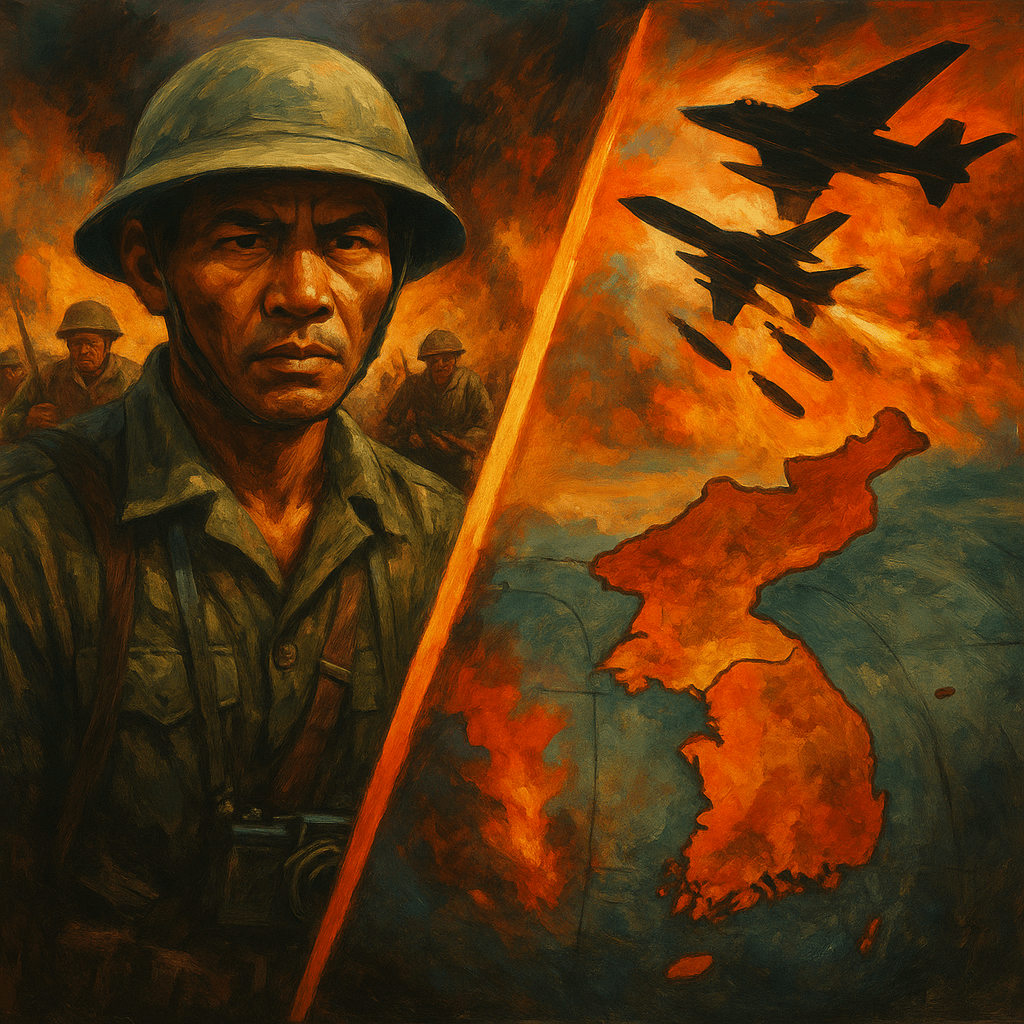
Korea was carved. Vietnam refused. Two revolutions, two outcomes—both exposing the fragility of U.S. empire and the enduring power of people’s war. This is the story of partition as counterrevolution, of counterinsurgency as colonial relapse, and of liberation carved not in treaties but in blood and resolve.
By Prince Kapone | Weaponized Information
May 26, 2025
Part I – From Japanese Chains to American Bayonets: Betrayal at the Dawn of Liberation
In 1945, the world cheered the defeat of fascism. But for the colonized peoples of Asia, the war didn’t end—it simply changed uniforms. The Nazis may have surrendered, but the empire did not. In both Korea and Vietnam, the very forces that claimed to have liberated the world from tyranny immediately turned their guns on anti-colonial revolutionaries. The United States, Britain, and France were not interested in freedom—they were interested in reconquest.
Take Korea. For decades, it had suffered under Japanese colonial rule. But in the wake of Japan’s surrender, the Korean people formed local people’s committees—grassroots organs of popular democracy, hundreds of them, emerging from the ruins of fascism. They declared a new republic. The people had spoken. So what did the United States do? It landed troops in the South, declared the Korean state “nonexistent,” and installed Japanese collaborators and colonial police in the new administration. They didn’t even pretend to hide it. U.S. General Hodge openly relied on the same Japanese officials who had brutalized Korea for 35 years. In place of liberation, the Americans brought occupation. In place of self-rule, they brought Syngman Rhee—a reactionary exile trained in the West, with no base in the Korean struggle.
Now look to Vietnam. There too, the people had fought Japanese occupation tooth and nail. The Viet Minh, under the leadership of Ho Chi Minh and the Indochinese Communist Party, liberated vast swaths of the countryside. On September 2, 1945, they stood before the world and declared the birth of an independent Democratic Republic of Vietnam. But what did the so-called Allies do? The British marched into the South, rearmed the Japanese, and helped the French return to reclaim their colonial spoils. Imagine that—imperialism so desperate that it needed to bring the fascists back to crush a communist-led independence movement. The United States bankrolled it all. Truman’s administration funneled military aid to the French colonial army as it waged a bloody war to recolonize Vietnam under the banner of “Western civilization.”
This is the hidden symmetry that binds the Korean and Vietnamese revolutions: in both cases, World War II ended not with decolonization—but with neocolonial betrayal. The U.S. and its allies didn’t just oppose socialism—they opposed independent sovereignty in the Global South. They didn’t see Koreans or Vietnamese as nations—they saw them as real estate. Strategic territory. Resources. Markets. Buffer zones.
And so they drew lines on maps. The 38th parallel in Korea. The 17th in Vietnam. Both sold to the world as “temporary” partitions. Both used to divide revolutionary nations, prop up comprador regimes, and crush mass movements from the countryside. Both birthed puppet states that served imperial power, not their own people. These partitions weren’t accidents—they were weapons.
But here’s the twist: where Korea was stalled—frozen in stalemate—Vietnam never accepted the line. It saw what happened in the North and said never again. The Vietnamese revolutionaries didn’t just fight colonialism. They refused to be divided by it. They learned from Korea’s unfinished liberation and resolved to carry theirs to the end.
This is the beginning of the story. Not of “two Vietnams,” but of one nation refusing to be carved up by imperial cartographers. Not of civil war, but of a continuing revolution. A revolution that began long before the Americans showed up with helicopters—and one that still echoes in the bones of empire today.
Part II – The Long War Begins: France Bleeds, America Schemes
The war against America didn’t begin with Johnson’s bombs or Kennedy’s advisors. It began with the French, bayonets drawn, drunk on colonial nostalgia, clawing their way back into Indochina with British and American blessing. From 1946 to 1954, Vietnam fought a war not just to drive out foreign occupation, but to bury the colonial world once and for all.
France called it “la mission civilisatrice”—the civilizing mission. In reality, it was forced labor, stolen rice, and massacres in the name of profit. The Vietnamese knew this. They had lived it. That’s why, when the Japanese occupation collapsed in 1945, they rose up. Ho Chi Minh didn’t wait for permission from London or Washington—he declared independence. In his hand were the words of Jefferson. In his sights were the armies of colonial Europe.
But the war-ravaged West wasn’t about to let go of its holdings. France was humiliated by Hitler and determined to rebuild its empire. Britain, ever the enabler, rearmed Japanese troops to help the French suppress Vietnamese revolutionaries in the South. And the U.S.? The self-declared champion of freedom? It quietly funded the French war machine, pouring millions into a recolonization project while preaching democracy at home. Truman didn’t see Vietnam’s revolution as justice—he saw it as a threat to the emerging Cold War order.
So the Vietnamese went underground, then aboveground, then all out. The First Indochina War became a crucible of national liberation. The Viet Minh mobilized peasants, educated cadres, and built a people’s army with limited arms but unlimited commitment. They didn’t just fight the French—they organized the land they liberated, redistributing property, setting up health clinics, and forming revolutionary governance from the ground up. This was war as praxis.
The French couldn’t win. Not because they lacked firepower, but because they lacked legitimacy. Every village razed, every civilian tortured, every rice field poisoned—strengthened the revolution. By 1954, the decisive battle at Dien Bien Phu shattered the illusion. A small, agrarian people had encircled and crushed a European colonial army. It was the first major military victory of a colonized nation against a colonial empire in the modern era. And it echoed far beyond Vietnam.
But victory came with its own contradiction. At the Geneva Conference, the big powers swooped in to “mediate” peace. What they really did was divide Vietnam in half. The Viet Minh agreed—reluctantly—to a temporary demarcation line at the 17th parallel, with national elections scheduled for 1956. But anyone paying attention knew what was coming. Just like in Korea, the imperialists had no intention of honoring that agreement. And the Vietnamese knew it too.
Ho Chi Minh once said, “You can kill ten of my men for every one I kill of yours. But even at those odds, you will lose, and I will win.” He wasn’t bluffing. The Viet Minh may have signed the Geneva Accords, but they never stopped preparing for the next war. Because they knew the enemy wasn’t finished—it was merely changing flags. The French were out. The Americans were coming in.
So the long war continued. Not in spite of Geneva, but because of it. The 17th parallel was never a real border—it was the beginning of the next phase of struggle. And for the Vietnamese revolutionaries, the task was clear: finish what they started. Not just independence—but unification. Not just resistance—but revolution. The enemy had changed. The mission had not.
Part IV – Hearts, Minds, and Mass Graves: The Counterinsurgency State Is Born
By the mid-1960s, it was clear to the U.S. ruling class that Vietnam wasn’t going to be Korea. The Vietnamese weren’t just resisting—they were advancing. The National Liberation Front had built a shadow state in the South. U.S.-backed military raids only deepened popular support for the revolution. So the empire changed tactics. If it couldn’t crush the movement with raw force alone, it would try to dissect, demoralize, and dismantle it from within. This is when counterinsurgency—modern counterinsurgency—was truly born.
They called it “winning hearts and minds.” But what they really meant was breaking the will of a people. The Strategic Hamlet Program was the first attempt: take entire rural populations, displace them from their ancestral land, dump them in U.S.-supervised camps, and surround them with fences, guns, and suspicion. It was a scorched-earth approach to community: tear up the roots, then plant loyalty like a crop. It failed spectacularly. But not before displacing over eight million Vietnamese and turning hundreds of villages into free-fire zones.
When that failed, the U.S. turned to a darker science. Operation Phoenix was a CIA-led campaign of targeted assassination, psychological warfare, and “interrogation.” It didn’t just go after soldiers—it went after teachers, nurses, monks, union organizers—anyone suspected of aiding the revolution. Death squads stalked the countryside. Torture centers sprang up like gas stations. Files were kept on tens of thousands. The goal was not military victory. It was social annihilation. They wanted to kill the revolution in the womb.
And all of it was cloaked in euphemisms: pacification, rural development, neutralization. Words designed to make extermination sound like aid. This was not a war against communism. It was a war against the very possibility of grassroots power. Against self-organization. Against the idea that the poor might govern themselves without foreign supervision.
But repression has a dialectic. Every village bombed became a recruiting ground. Every tortured cadre became a martyr. Every mother forced to flee became a revolutionary. The more the empire tried to surgically remove the revolution, the more they revealed their own disease. U.S. troops burned crops, poisoned water, and sprayed millions of gallons of Agent Orange across the countryside—chemical warfare in defiance of every international law. They dropped napalm on schoolchildren. They massacred entire villages like My Lai and called it “clearing an area.”
Meanwhile, the NLF dug tunnels, built schools in the jungle, organized clinics, and trained children in literacy and resistance. This wasn’t just a military struggle. It was a clash between two civilizations: one rooted in extraction, domination, and death; the other in liberation, collective survival, and human dignity. And the world was watching.
By the late ’60s, it was clear the U.S. could not win. But the war continued—because to lose would be to admit that a peasant army, backed by students, workers, and farmers, could defeat the most technologically advanced war machine in human history. That kind of truth would be contagious. So the bombs kept falling. But the tide was turning.
Vietnam showed the world that counterinsurgency is just the empire’s word for counterrevolution. And it doesn’t work forever.
Part V – Tet and the Shattering of Illusions
By 1968, the United States had dropped more bombs on Vietnam than were dropped in all of World War II. They had deployed half a million troops, built thousands of bases, and turned the South into an occupied laboratory of death. But for all their data, all their dollars, all their delusions of “domino theory” logic—they couldn’t see what was coming: Tet.
The Tet Offensive wasn’t just a military operation—it was a psychological earthquake. In one coordinated strike, the National Liberation Front and the People’s Army of Vietnam hit over 100 cities, military bases, and government outposts. They reached the U.S. Embassy in Saigon. They cracked open the myth of invincibility. For the empire, it was unthinkable. For the Vietnamese, it was revolutionary inevitability made manifest.
Militarily, the offensive was costly. Thousands of Vietnamese fighters died. But politically, it was decisive. The whole world saw what the Vietnamese had known all along: the Americans were not winning. They had no strategy. No legitimacy. No future. Tet laid bare the contradiction at the heart of the war—the more the U.S. tried to pacify Vietnam, the more Vietnam exposed U.S. imperialism as a paper tiger with a nuclear mouth and no revolutionary heart.
Back home, the war was unraveling. Black and brown soldiers came home in body bags while Wall Street reaped contracts. The Black liberation movement called it what it was: a war of empire against a colonized people. Dr. King spoke out against it. SNCC, the Panthers, the Young Lords—they all saw the connection between the burning ghettos of the U.S. and the bombed-out hamlets of Vietnam. Muhammad Ali refused to fight. Students rose up. Workers struck. The streets of America echoed with a simple truth: “Hell no, we won’t go.”
But the Vietnamese didn’t wait for U.S. conscience to catch up. They escalated. They dug deeper. They organized the countryside, city by city, from below. They outlasted five U.S. presidents. They watched as the empire cycled through slogans, escalations, and massacres. And still, they fought.
By 1973, the U.S. signed the Paris Peace Accords, a document that looked like a truce but read like a confession. The U.S. agreed to withdraw. They left behind a shattered puppet regime in the South and a people who had never accepted partition, never surrendered, and never stopped organizing.
Two years later, in April 1975, the tanks of the People’s Army rolled into Saigon. Helicopters scrambled from the U.S. Embassy rooftop. South Vietnam collapsed—not because it was defeated, but because it had never existed except on CIA maps and Pentagon spreadsheets. The red flag rose over the palace. The war was over. The nation was whole.
And in that moment, Vietnam did what Korea had been denied: it expelled the occupier, overthrew the comprador class, and unified its land through revolutionary struggle. It did what no empire believed possible: it won. Not just militarily, but morally, politically, historically. It made the American empire bleed, not just in the jungle, but in its imagination. It proved, once and for all, that the people—organized, disciplined, and armed with a vision—could outlast and outfight even the greatest military in the world.
The Tet Offensive was not just a turning point in the war. It was a turning point in the 20th century. It was the moment the mirror cracked, and the empire saw its reflection—not as liberator, but as liar, butcher, and paper tiger. And it never fully recovered.
Part VI – Revolution Between Two Giants: The Struggle to Stay Independent in a Divided Socialist World
While U.S. imperialism waged total war on the Vietnamese revolution, another contradiction was simmering behind the red curtain. The global socialist camp was fracturing. The alliance that had stood strong in Korea—Moscow, Beijing, and Pyongyang—was now splintering. The Sino-Soviet split had opened a wound that ran straight through the heart of the international communist movement. And Vietnam found itself caught between two patrons, two powers, two lines.
China and the Soviet Union both supported Vietnam—on paper. They sent arms, advisors, and aid. But they also sent messages, conditions, and demands. For China, the war in Vietnam was a frontline struggle against American hegemony—but also a check against Soviet influence in Southeast Asia. For the Soviet Union, it was an anti-imperialist war—but also a geopolitical chessboard where China’s rise needed balancing. Neither side wanted to appear soft. Both feared the other’s expansion. And Vietnam? Vietnam had to navigate this Cold War within the Cold War with surgical precision.
To do this, the Vietnamese revolutionaries relied on what had always sustained them—not ideology from above, but organization from below. They knew how to stretch resources, build dual power, and manage contradictions without losing direction. They took aid from both Moscow and Beijing but refused to become a proxy for either. They had their own line, rooted not in slogans or superpower alliances, but in the lived experience of three decades of revolutionary struggle.
Ho Chi Minh was not just a nationalist or a Marxist—he was a practitioner of revolutionary diplomacy. He maneuvered between Mao’s radicalism and Khrushchev’s reformism. He balanced Soviet tanks with Chinese rifles, all while maintaining the political initiative on the ground. This was no easy feat. The revolution survived assassination attempts, embargoes, ideological pressures, and betrayals. But it never abandoned its fundamental principle: the Vietnamese people would decide their own destiny.
Even after reunification in 1975, the contradictions didn’t end. Vietnam entered into tense disputes with China, culminating in the Sino-Vietnamese War of 1979. It strengthened ties with the Soviet Union, but never fully surrendered its independence. While the socialist world was falling into factionalism and eventual collapse, Vietnam continued to chart its own course—clumsy, contradictory, but sovereign.
This ability to survive, navigate, and overcome internal and external contradictions is part of what makes the Vietnamese revolution such a profound historical event. It wasn’t pure. It wasn’t perfect. But it was principled, grounded in the real material conditions of the Vietnamese masses. It was forged not in conference rooms, but in rice paddies, tunnels, and burned-out schools. And it endured—because it refused to become anyone’s pawn.
Where many revolutions drowned in Cold War tides, Vietnam stayed afloat. Where others collapsed under ideological rigidity or superpower dependence, Vietnam held firm. It is perhaps the clearest example of revolutionary sovereignty in the 20th century—a people’s war that neither Moscow nor Beijing could control, and which Washington could never contain.
In the end, Vietnam didn’t just win a war. It navigated the most treacherous terrain a revolution can face: victory in a world that doesn’t want you to exist. And it did so on its own terms.
Part VII – Two Roads, One Struggle: Korea, Vietnam, and the Limits of Empire
In Korea, the revolution was stalled. In Vietnam, it triumphed. But both struggles were branches of the same historical tree: anti-colonial resistance, rooted in land and labor, confronting the most militarized empire the world had ever seen. The U.S. lost in both—strategically in Korea, totally in Vietnam. And in losing, it revealed the structural weakness of its rule: no empire can permanently suppress a people determined to be free.
Korea remains divided not because the North failed, but because the South was captured—by force, by capital, by counterrevolution. The U.S. froze the conflict in place, entrenching a permanent military occupation, and propping up a comprador dictatorship that evolved into a neoliberal showcase. But even today, the shadow of reunification haunts the peninsula. The North endures, not just as a state, but as a living defiance of American domination.
Vietnam, by contrast, refused division from the start. It accepted Geneva in form, but not in spirit. It endured French brutality, American napalm, and Cold War betrayal—but never forgot its unfinished mission. Its revolution was disciplined, protracted, and steeped in the lessons of Korea. It understood that temporary partition was a trap. That imperialism doesn’t share power—it delays surrender. So the Vietnamese stayed the course until total liberation. And when Saigon fell, it didn’t fall into chaos. It fell into history.
What ties these two together is not just geography or ideology—it’s the imperial playbook they confronted. In both cases, U.S. power sought to divide and conquer, install puppets, suppress land reform, criminalize communism, and destroy any structure of people’s power. In both cases, the revolutionaries responded by building infrastructure, forging unity, and refusing surrender. Korea exposed the strategy. Vietnam broke it.
And the lessons live on. From Haiti to Gaza, from Congo to Colombia, the revolutions of Korea and Vietnam remain lodestars. They remind us that even the most militarized empire can be forced to retreat. That colonial borders can be broken. That people’s war, when grounded in mass support and national liberation, can outlast bombs, sanctions, and disinformation.
Empire adapts, yes—but it also forgets. It forgot the lessons of Korea and repeated them in Vietnam. It forgot the lessons of Vietnam and tried again in Iraq, in Afghanistan, in Syria. And now, in its moment of crisis, the American empire claws desperately to reassert its dominance across the globe, haunted by the specter of insurgents it could not kill and revolutions it could not stop.
For those of us organizing today, Korea and Vietnam are not just history—they are prophecy. They show us that unity matters. That self-reliance matters. That understanding your enemy matters. And that revolution, when rooted in the people and sustained with discipline, can win. Not overnight. Not easily. But permanently.
As Frantz Fanon once wrote: “Each generation must, out of relative obscurity, discover its mission, fulfill it, or betray it.” The Vietnamese fulfilled theirs. The Korean people are still struggling to fulfill theirs. And we—standing in the belly of the beast—must learn from both. Because the next revolutionary wave will not come from textbooks or manifestos. It will come from the land, from the people, and from memory.
Korea was the warning. Vietnam was the answer. Now it’s our move.
 Weaponized Information
Leave a comment