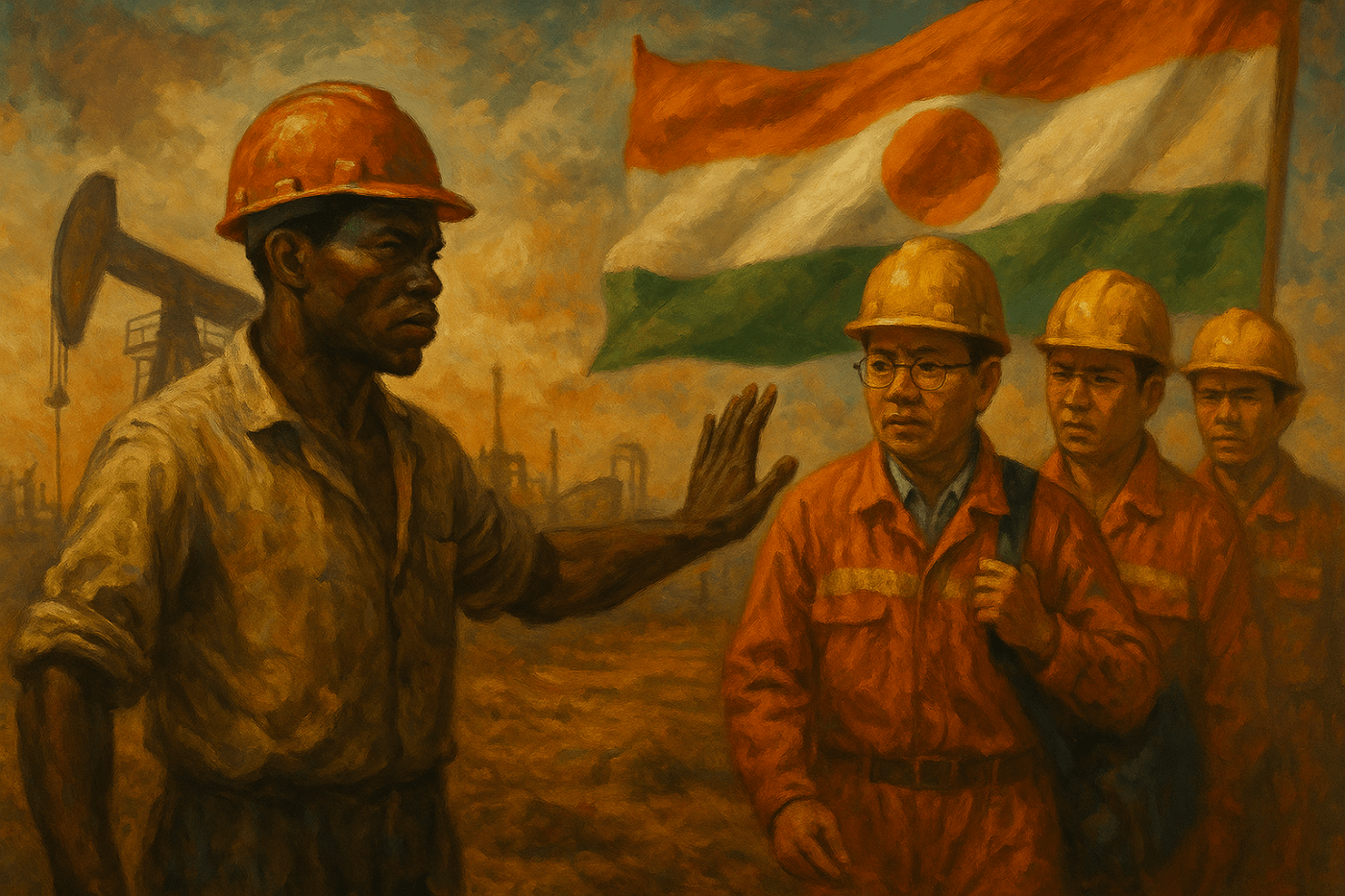
Western media calls it instability. We call it sovereignty. Behind the headlines about “expulsions” lies a deeper truth: Niger is not turning away from China—it’s turning toward itself.
This Isn’t a “Breakup”—It’s a Recalibration Toward Sovereignty
By Prince Kapone | Weaponized Information
May 26, 2025
Part I – When Sovereignty Speaks, Empire Sends In the Spin Doctors
The original article was published by CNB Cbgist, a tabloid-chic infotainment outlet disguised as news, owned and managed under the legal umbrella of Global South Media Holdings—an outfit incorporated in Delaware with board members sporting résumés from NATO think tanks, USAID subcontractors, and public relations firms that once ghostwrote copy for AFRICOM press releases. These aren’t journalists; they’re image consultants for empire, posing as “regional analysts.” Their product isn’t information. It’s narrative alignment—massaged, optimized, and ghostwritten to preemptively discredit any act of national self-determination that isn’t pre-approved by Brussels or Langley.
As is standard practice in cognitive warfare, this article doesn’t launch a frontal attack on Niger’s leadership. That would be too crude, too obvious. Instead, it hides the blade in neutral language. Niger didn’t reclaim labor rights or restructure extractive contracts—it “expelled” companies. The framing casts Niger as the unpredictable, hotheaded partner, jeopardizing “stability” through irrational moves. No mention is made of Nigerien workers earning a tenth of what Chinese engineers make. No history is given of CNPC’s joint ventures, of Niger’s long struggle to renegotiate its foreign entanglements, or of the broader regional project of economic decolonization. Just a neat headline: “Niger kicks out China.” A single sentence that erases a century of struggle and flattens the dialectic into clickbait.
This isn’t an article—it’s a PR memo. And like all imperialist propaganda, its true crime isn’t what it says, but what it doesn’t. Nowhere does it acknowledge that Niger is part of the Alliance of Sahel States (AES), a tri-state political formation uniting Niger, Mali, and Burkina Faso in a coordinated campaign to dismantle French military occupation, reclaim resource sovereignty, and pursue multipolar partnerships outside the grip of the U.S.-EU security-finance axis. Nowhere does it mention that Niger, after ousting the French military, has moved rapidly to nationalize its uranium reserves—cutting off Areva (now Orano) from its colonial piggybank in Arlit and Agadez. And nowhere does it mention that these expulsions—of CNPC managers and French energy monopolies alike—are part of a coherent policy program rooted in a very simple principle: that a people’s resources should benefit the people, not disappear into offshore accounts in Paris or Beijing.
What we’re seeing isn’t a rupture between China and Niger. It’s a recalibration. And that’s precisely what the imperialist media apparatus wants to suppress. The goal is not to defend China; it’s to sow division within the Global South. To weaponize legitimate grievances—like labor inequality or management imbalance—into Cold War talking points. To convince the world that BRICS+ is just another IMF in disguise, and that the only “stable” development model is the one with NATO soldiers guarding the contracts. This is the liberal wing of counterinsurgency: narratives that neutralize sovereignty by redefining it as chaos.
Let’s be clear: Chinese investment in Niger is not beyond critique. But critique made within the camp of anti-imperialism is fundamentally different from sabotage executed through the mouthpieces of empire. When Niger renegotiates a labor contract with CNPC, it is not “breaking from China.” It is exercising sovereignty—something France would have responded to with sanctions, SWIFT blocks, or a coup. China, for all its contradictions, responded with continued negotiation. That difference matters. Not because China is pure, but because its position in the world system is structurally distinct from that of colonial powers.
To lump them together—to say that Niger “expelling Chinese companies” is the same as Mali expelling French troops—is not just intellectually lazy. It is politically dangerous. It conflates multipolar contradictions with imperialist violence. It equates South-South trade tensions with neocolonial extraction. And worst of all, it primes revolutionary-minded people in the West to distrust the very movements they claim to support. This is the psychology of disintegration. And the ruling class knows exactly what it’s doing.
And while the article is marketed as “news,” it plays its final trick like a magician slipping a card into your sleeve. Scroll past the labor dispute and you’re suddenly knee-deep in tabloid muck—Macron slapped by his wife, Trump bans foreign students, Nigerian kids write exams by flashlight. This is not incompetence. It’s anesthetic. A media strategy designed to numb your capacity for political analysis through overstimulation. So you click, laugh, forget, and move on—while Niger’s struggle for liberation is reduced to background noise beneath the hum of empire’s daily gossip.
But we don’t forget. We refuse. We remember that Niger, like all nations under the boot of hyper-imperialism, has the right to experiment, correct, revise, and assert. That sovereignty is not granted by headlines—it is fought for in the mud, the union hall, the oilfield, and the parliament. And we remember that the true threat to empire is not China, or BRICS+, or even AES. It’s the emergence of a new political logic—one where Global South nations no longer ask permission to breathe, build, or bargain.
So no, this isn’t a breakup. This is something far more dangerous to the imperial world order: it’s a working relationship learning how to speak the language of power from below.
Part II – What the Article Says, and What It Refuses to Say
Let’s take the piece at face value for a moment and sift through the sediment of its carefully chosen words. The headline tells us that Niger has “expelled” Chinese companies and “seeks to take control of its natural resources.” We’re told that Chinese workers earned an average of $8,678 per month, while Nigerien workers in equivalent roles received just $1,200. That three CNPC executives were expelled in March. That the Oil Minister, Sahabi Oumarou, cited managerial overrepresentation by foreigners and a sidelining of local talent. That Niger is “seeking to assert greater control” over its oil sector. All technically accurate. But none of it means what they want you to think it means.
The numbers are real. The wage disparity is real. But what the article deliberately fails to mention is the context—and that context makes all the difference. It fails to mention that in the same period that Niger was demanding fairer labor terms from CNPC, it was also tearing up the colonial-era contracts signed with France’s Orano—the nuclear behemoth formerly known as Areva—which had been extracting uranium under royalty agreements as low as 0.3%. For decades, Niger received crumbs while Orano sold yellowcake to Électricité de France and the French military. Niger powered France’s homes while 82% of its own population lived without electricity. That’s not “inequity.” That’s neocolonial theft—codified into law and guarded by Foreign Legion boots.
And yet the article makes no mention of France. No mention of the fact that in 2023, following the popular uprising that installed the military-led government, Niger expelled French troops and began nationalizing its resource sectors. No mention of the fact that the Orano subsidiary lost its license at the Imouraren uranium site in 2024, or that the government seized control of the Somair mine, cutting off another $300 billion colonial revenue stream. Instead, the article tells us that Niger is picking a fight with China. The goal here is not accuracy—it’s division. It wants to position China not as a flawed but adaptable partner, but as the new colonial master. And it wants to convince the reader—especially in the Global North—that there’s no such thing as non-exploitative development. That if China is just like France, then maybe France wasn’t so bad after all.
But we’re not fooled. Niger’s demands are not reckless—they’re rational. What’s being asked is that foreign partnerships evolve in the interest of local labor and national development. And unlike the Western powers, China has thus far responded without violence, sanctions, or regime-change threats. When Niger renegotiated its 2024 MoU with CNPC, the Chinese agreed to increase the state’s oil stake to 35%, triple local hiring quotas, and initiate a new phase of technology transfer—including training 500 Nigerien engineers in Xi’an. That’s not charity. That’s leverage. And Niger earned it.
The article also fails to mention that 40% of payments in that same deal are now being conducted in yuan through CIPS (China’s alternative to SWIFT)—a direct move against the West’s financial piracy architecture. By decoupling from dollarized transactions, Niger shields itself from the same economic warfare that’s been waged against Venezuela, Iran, Zimbabwe, and every other Global South nation that dared chart its own course. In doing so, Niger joins a broader BRICS+-aligned effort to build an alternative to U.S.-EU economic hegemony. The article doesn’t want you to know that. Because the more that countries trade in yuan, rupees, or rubles, the less power the dollar has. And if the dollar goes, so too does the whip hand of Western empire.
It’s no coincidence that while Niger was negotiating better labor terms with CNPC, France and the EU were actively working to sabotage its economy. After the French military was expelled, Paris retaliated by freezing $700 million in uranium revenues and pressuring the European Central Bank to cut off Niger’s access to CFA reserves. The IMF stepped in with a “rescue” loan—at 9.8% interest, triple China’s rate—on the condition that Niger reopen its mines to Orano. This is not a coincidence. It’s imperialist recalibration. The West is trying to use every tool at its disposal—lawfare, financial strangulation, media narratives—to prevent a functioning model of multipolar development from taking root. Because once it does, the rest of the Global South might follow suit. And the whole rotten order starts to shake.
But the article doesn’t mention any of that. It doesn’t talk about the Alliance of Sahel States. It doesn’t mention BRICS+. It doesn’t even say the words “sovereignty” or “self-determination.” Instead, it tries to paint Niger as erratic, unstable, and ungrateful. The logic is old colonial wine in new clickbait bottles. Be grateful for the investors, they say. Accept the wage gap—it’s the price of development. Never mind that Niger’s uranium lit up the Eiffel Tower while its own children read by candlelight. Never mind that CNPC, for all its issues, built refineries where the French left only shell companies and command posts.
There’s one more silence worth naming. As Niger recalibrates its economy, it is also greening its cities—planting urban forests in schoolyards in Niamey and Maradi. These trees reduce heat, provide fruit, offer shade, and improve education. The state is using its oil revenue not just to build roads, but to teach students composting, soil health, and tree maintenance. This is what sovereignty looks like. It’s not abstract. It’s mango trees in schoolyards and blueprints for refineries. It’s workers trained in petroleum engineering and students sitting in the shade of something they planted themselves. But you won’t read that in the original article. Because stories like that don’t serve empire—they undermine it.
So yes, Niger expelled some foreign executives. Yes, it demanded better wages for its workers. Yes, it raised its national stake in key oil projects. And yes, it continues to negotiate with China—not from a place of desperation, but from a place of strength. That’s not chaos. That’s power. That’s what it looks like when the colonized refuse to stay colonized. And that’s what the article refused to say.
Part III – The New Arithmetic of Sovereignty: Reframing the Story from Below
If you listen to the imperialist media apparatus, sovereignty is chaos. Sovereignty is dangerous. Sovereignty is the moment the natives forget their place and start making decisions without first asking Paris, Washington, or the IMF. But if you listen to the ground in Niamey, Maradi, or Agadez, sovereignty is something else entirely. It’s mango trees in schoolyards. It’s engineers learning to run their own refineries. It’s a nation refusing to rent out its soil and soul to the highest bidder.
Let’s reframe this narrative, not from the ivory towers of investment analysts, but from the red soil beneath the oil rigs. Niger is not breaking with China. It is refining the terms of engagement—insisting that partnership must serve the people, not just the shareholders. This is not a rupture. It’s a demand for parity, made from a position of strength, not supplication. And the fact that this recalibration occurred through administrative negotiation—not sanctions, coups, or drone strikes—tells you everything you need to know about the difference between a fraternal contradiction and a colonial relationship.
Under French rule, Niger got 0.3% uranium royalties and foreign troops guarding the mines. Under CNPC, Niger has already raised its oil share to 35%, received training for hundreds of engineers, and launched refinery infrastructure that—while imperfect—remains in Nigerien hands. When France was expelled, it sabotaged processing plants and froze assets. When China was asked to adjust the contract, it stayed at the table. That’s the material difference. Not because China is “better,” but because the relationship is still open to struggle, negotiation, and national assertion. The Western project, by contrast, is closed—it only knows how to dominate or destroy.
That’s what multipolarity actually means. It’s not a utopia. It’s not a promise of benevolent hegemons. It’s a contested terrain, where former colonies can leverage global contradictions to carve out space for development on their own terms. Multipolarity doesn’t erase the need for vigilance—it gives it a battlefield. And Niger is fighting on that terrain, not by retreating into isolation, but by asserting its conditions within broader alliances. It’s saying: if we are to work with China, Russia, Turkey, or anyone else, it will be on the basis of respect, reciprocity, and sovereignty—not wage apartheid, not managerial neocolonialism.
And this matters far beyond Niger. Because if one Sahel state can demand better terms, so can another. If one government can reject the CFA Franc and trade in yuan, others can follow. If one people can see a refinery as more than a foreign-built monument to dependency—but as something they can manage, modify, and eventually own outright—then the entire architecture of hyper-imperialism begins to wobble. The multipolar realignment is not just about geopolitics. It’s about political imagination. It’s about breaking the West’s monopoly on the future.
We should be clear-eyed about China’s contradictions. Its state-owned firms are still entangled in global market logic. Its investments are not always equitable. There are real issues of wage disparity, managerial imbalance, and environmental risk. But those contradictions exist within a framework that still permits adjustment, negotiation, and popular pushback. The West’s framework permits only obedience—and punishes deviation with bombs, blockades, and coups. That is not a small difference. It is the difference between survival and surrender. Between building socialism from within contradiction, and being strangled by capitalism at gunpoint.
We must also foreground Niger’s broader vision. This is not just about oil. It’s about building dual and contending power within the wreckage of colonial institutions. It’s about greening schoolyards in Niamey and Maradi, planting fruit-bearing trees that cool the air, feed the students, and teach them that nature is not a metaphor—it’s a method. It’s about turning students into botanists and builders, children into caretakers of soil and sovereignty. When Niger invests oil revenue in urban forestry instead of foreign debt payments, it’s not just budgetary. It’s ideological. It’s a rejection of the IMF model, where capital is a leash. It’s a pivot toward a new arithmetic—where the sum of a nation’s worth is no longer measured in commodities extracted, but in lives dignified and futures reclaimed.
This is the arithmetic of liberation: 1 refinery + 500 trained engineers = technological sovereignty. 1 hectare of mango trees + 60 urban schools = ecological resilience + food security. And most importantly: 1 expelled French battalion + 1 recalibrated Chinese contract = a model for fraternal struggle in a multipolar world. This is how you turn contradictions into tools. This is how you dismantle empire without mimicking its logic. Not by burning every bridge, but by refusing to cross them unless you walk as equals.
We must also confront the psychological warfare embedded in the imperialist media. They want us to believe that every struggle in the Global South is failure, chaos, or regression. That no nation can govern itself without Western guidance. That every misstep is proof of incompetence, and every demand for dignity is a threat to “stability.” But Niger is showing us the opposite. It’s proving that stability built on silence is no stability at all—and that disorder, when it arises from struggle, can be a gateway to real order: one rooted in justice, not in debt and dependency.
When a state expels foreign executives for paying poverty wages, that is not chaos—it is class struggle. When a government demands local control over its oil, that is not instability—it is revolutionary accounting. When a people insists that their children study under trees they plant themselves, instead of foreign flags they did not choose, that is not rejectionism—it is rebirth. Niger is not “in crisis.” It is in transition. From colony to country. From subordination to sovereignty. And from being studied to being the authors of their own syllabus.
That is the reframing the media refuses to do. But we will do it. We will name this moment for what it is: not a diplomatic hiccup, not a developmental backslide, but a political inflection point. A new equation is being written on the red soil of the Sahel. And when you write the equation from below, the numbers finally start to add up.
Part IV – Revolutionary Duty Across Borders: From Niamey to the Neighborhoods Where We Live
What’s happening in Niger is not a domestic matter. It is a signal flare to the entire Global South, and a challenge to those of us in the belly of the beast. The terrain of anti-imperialist sovereignty is not confined to Sahelian sand or uranium-rich soil. It extends into the concrete of U.S. ghettos, the barrios of Latin America, the favelas of Brazil, and the banlieues of France—anywhere the long fingers of capital and coercion try to dictate who deserves to live with dignity. Niger has drawn a line in that soil. Now it’s our job to stand on the right side of it.
This is not charity. This is duty. When Niger asserts its right to restructure Chinese labor contracts, reject IMF usury, and banish French occupation, it is not just defending itself—it is defending the possibility of a world beyond the rules written in Washington and Paris. It is defending the logic of multipolarity not as brand alignment, but as revolutionary opportunity. And when the imperialist media calls that instability, we call it insurgency against empire’s arithmetic.
From our vantage point inside the imperial core, our task is not to watch passively or theorize from a distance. It is to actively dismantle the financial, military, and ideological systems that suppress nations like Niger when they step out of line. That means calling out not just the banks and generals, but the journalists, think tanks, and university professors who reproduce colonial logic in liberal packaging. That means building dual and contending power where we stand—abolitionist mutual aid, worker cooperatives, land trust collectives, people’s education projects, independent revolutionary media.
We must also materially support the real-world initiatives Niger is building: ecological restoration through urban forestry; oil sovereignty through domestic refining; curriculum decolonization through tree-based education. These aren’t just policies—they’re revolutionary seeds. We must water them with resources, attention, and defense. We must help build a barricade of information around Niger’s victories so they cannot be buried under a flood of imperialist disinformation.
Comrades in the U.S., Europe, and settler-colonial outposts must also turn their focus inward. Ask yourselves: where are your country’s corporate ties to Orano, CNPC, Shell, or Chevron? Where are your universities invested in uranium and oil extraction? Where is your tax money underwriting AFRICOM operations or training private contractors that prop up the very mining regimes Niger is fighting to break? This is not theory. This is infrastructure. And it must be exposed, sabotaged, and dismantled from within.
We call on all readers, organizers, and revolutionaries to:
- Host teach-ins, reading groups, and forums on Niger’s revolutionary recalibration—center the struggle as part of the broader fight for anti-imperialist sovereignty and multipolar resistance.
- Translate and amplify Nigerien voices—from students planting trees to engineers building refineries. Let them speak in their own words, not filtered through Western analysis.
- Support grassroots climate resilience projects and agroecology movements in the Sahel—connect urban forestry in Niamey to land justice struggles in Chicago, Oakland, or Marseille.
- Expose corporate and institutional complicity in neocolonial extraction—trace Orano’s supply chains, CNPC’s subcontractors, and IMF influence operations back to boardrooms and foundations in the imperial core.
- Pressure left organizations to move beyond empty anti-colonial rhetoric and into real solidarity with AES states and BRICS+ partners resisting hyper-imperialism.
This is not just a moment—it’s a test. And the test is this: when the people of Niger stand up not just to the West but to contradictions within their own partnerships, will we stand with them? Will we recognize that true sovereignty is messy, nonlinear, and fought in boardrooms, classrooms, and oilfields alike? Or will we let empire define the terms of resistance, again?
We know our answer. We stand with Niger. We stand with the Sahel. We stand with every nation clawing its way out of the suffocating grip of settler capital and technocratic dictatorship. We stand with the children learning under mango trees and the engineers welding together the foundations of a sovereign future. And we do so not as allies, but as comrades with skin in the game and blood on the line.
Because when the West calls that disorder, we call it revolution in motion. When they call it mismanagement, we call it negotiation from below. When they call it expulsion, we call it the sound of a door slamming shut on 500 years of theft.
And when Niger picks up the pen to rewrite its future, our job is not to correct its grammar. It’s to protect its script.
From Niamey to Nairobi, from Port-au-Prince to Palestine, from Detroit to Delhi—the world is shifting. And we either shift with it, or we become what we once swore we’d overthrow.
Weaponized Information stands in full ideological and material unity with Niger’s anti-imperialist recalibration and the sovereign struggles of the Sahel. Forward to decolonization. Forward to socialism. Forward to multipolar revolution.
 Weaponized Information
Leave a comment