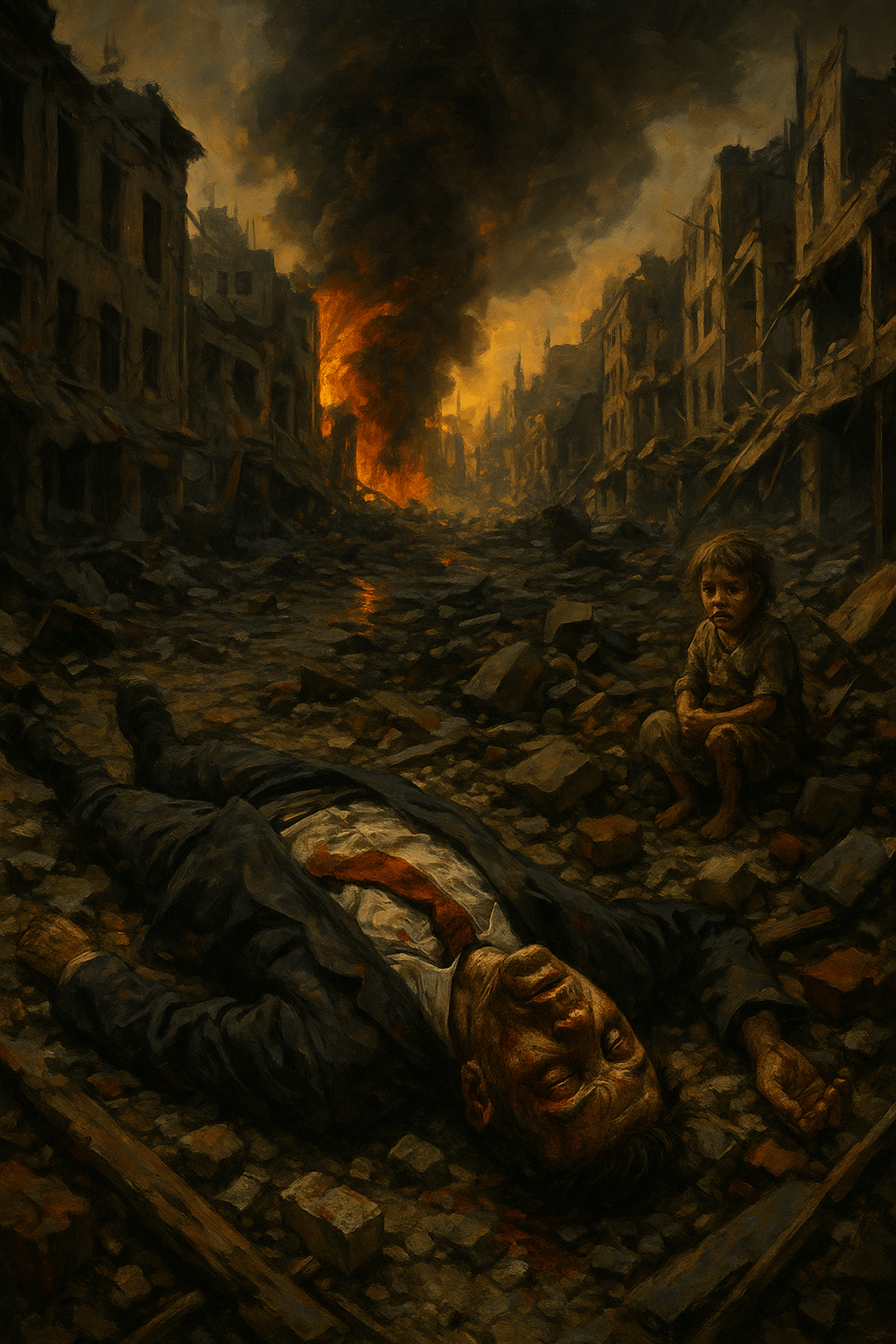
Why the death of an IDF veteran in a suit is not the same as the death of a child in Gaza—and what the empire’s mourning reveals about its war
By Prince Kapone | Weaponized Information | May 23, 2025
Who Gets Assassinated, and Who Gets Erased?
This report originates from Anadolu Agency, the state-run Turkish media outlet often caught between its formal NATO alignment and sporadic multipolar flirtations. While occasionally deviating from Washington’s line in regional coverage, AA’s English-language output regularly defaults to the narrative priorities of Western-aligned diplomacy—especially when it comes to Zionist violence. The article by Rabia İclal Turan is not a dispatch from the frontlines of colonial resistance; it is a sanitized transmission of imperial narrative. Turan is a career-bound diplomat-journalist whose record suggests a fidelity to institutional balance over anti-colonial truth. She doesn’t distort the facts—she arranges them like flowers at a state funeral.
But whose funeral? And who gets to decide the terms of mourning? The names that frame this piece—Marco Rubio, Jose Manuel Albares, and the viral footage circulated by U.S.-aligned media infrastructure—aren’t simply officials and observers. They are strategic operatives in an imperial echo chamber, speaking not for justice, but for technofascist stabilization. They’re not responding to tragedy—they’re mobilizing it.
Rubio’s choice of words is telling: he calls the incident a “horrifying assassination.” This is not incidental. “Assassination” elevates the victims into the realm of political martyrdom—sacred figures whose deaths demand national grief and global solidarity. But that term is also an ideological weapon. The same empire that refused to use the word when Shireen Abu Akleh was executed by an Israeli sniper has now deployed it to elevate the deaths of two agents of a genocidal regime. One of them, Yaron Lischinsky, was a former IDF soldier. The other, Sarah Milgrim, was a U.S. citizen working in Israel’s public diplomacy division.
Here, grief is selective and strategic. The language of assassination doesn’t just describe an act—it assigns value. It turns two functionaries of the Israeli colonial apparatus into sacred victims, while the thousands incinerated in Gaza are rendered statistics. The term “radical,” deployed by Rubio to describe the suspect, completes the frame: not a political actor reacting to genocide, but a deranged threat to national stability. This is how counterinsurgency rhetoric is laundered through tragedy.
The framing is clear. Israel is cast as the innocent party, its emissaries as helpless civilians, and any blowback against them as unjustifiable terrorism. In reality, this is the narrative scaffolding of empire: to mourn its agents loudly, and to silence its victims completely.
Colonial Titles Don’t Erase Colonial Functions
Strip away the sentiment and the soundbites, and here’s what remains: on May 21, 2025, two Israeli embassy staffers—Yaron Lischinsky and Sarah Milgrim—were killed outside the Capital Jewish Museum in Washington, D.C. The gunman reportedly shouted “Free Palestine” as he was apprehended. Media reports rushed to frame the event as terrorism, and Secretary of State Marco Rubio called it an “assassination.” One of the deceased, Lischinsky, was confirmed to be a former IDF soldier. Milgrim, a U.S. citizen, worked in Israeli public diplomacy.
What the article doesn’t say is just as important. Lischinsky’s IDF past is not incidental. The Israeli Defense Forces are the primary instrument of occupation, apartheid, and ethnic cleansing in historic Palestine. From targeted drone strikes on ambulances, to the bombing of hospitals and refugee camps, to the extrajudicial killing of journalists like Shireen Abu Akleh—this is the machinery of genocide. The moment he transitioned into diplomatic service, Lischinsky didn’t leave that system—he became its international emissary.
Here, the Eichmann precedent is more than relevant—it is foundational. Eichmann wasn’t a combatant. He was a manager, a scheduler, a logistics man. He made sure the trains to the death camps ran on time. For that, he was tried and executed. His case established clearly that civilian administrators of genocide are legally and morally culpable. The idea that anyone who facilitates mass atrocity—be it by pen, platform, or policy—is a “civilian” in the neutral sense is a legal fiction and a political farce.
From a revolutionary standpoint, the contradiction is even sharper. As Fanon taught us, in a colonial regime, every state function is a military function. The bureaucrat, the ambassador, the trade official, the cultural attaché—each plays a role in maintaining the occupation. Lischinsky’s badge was not a shield. It was a continuation of his rifle.
This act of violence, however tragic, did not happen in a political vacuum. It is part of the colonial contradiction reaching back into the heart of the empire that funds and sustains it. Israel has been slaughtering Palestinians by the tens of thousands—with U.S. weapons, U.S. money, and U.S. diplomatic cover. What happened in Washington was not a “radical outburst.” It was a flashpoint in a global structure of organized violence.
In the world of empire, the uniform may change—but the role remains. And when the oppressed rise, even for a moment, the empire’s first reflex is to declare them mad, criminal, or subhuman. It is never to ask: what produced this rage? what allowed it to grow, to burn, to return? The answer is simple: the empire did.
No Badge, No Desk, No Passport Can Clean Blood
Let’s speak plainly: the death of a former IDF operative in a diplomatic suit is not the same as the death of a child in Khan Younis. Yet the empire demands that we mourn both equally—or worse, that we mourn only one. This is the logic of imperial grief: to equate the facilitator of genocide with its victims. To cry for the emissary of apartheid, while Gaza’s dead remain unnamed.
But this logic collapses under any serious scrutiny. The Nuremberg Principles, established in the aftermath of Nazi crimes, make it clear: individuals have duties that transcend national laws when crimes against humanity are being committed. Civilian status does not shield you. Obedience to your government does not absolve you. If you participate—actively or passively—in a regime that slaughters and displaces entire populations, you are accountable.
Yaron Lischinsky’s transition from IDF operative to embassy staffer did not transform him into a neutral figure. It transformed him into an international agent of the same regime he once served in uniform. His pen may have replaced his rifle, but the colonial project continued through his hands. He helped normalize and promote a state that bombs hospitals, kills journalists, and imposes a military siege on 2.3 million people. His presence in Washington was not apolitical—it was ideological deployment.
And Sarah Milgrim, too—while a U.S. citizen—was not simply a bystander. Working in the public diplomacy division of Israel’s embassy means shaping the narrative that justifies war crimes, suppresses dissent, and criminalizes Palestinian resistance. These roles are not neutral. They are strategic. They exist to protect the legitimacy of a regime on trial for genocide.
In the eyes of empire, anyone who challenges this narrative is “radicalized.” But in the eyes of history, the radicals were always the ones who resisted slavery, apartheid, occupation. The real danger is not the so-called lone gunman shouting “Free Palestine.” The real danger is the entire structure that renders genocide acceptable, and resistance unthinkable.
So we do not echo the empire’s grief. We do not pretend this is just tragedy. It is political blowback, born from decades of repression, colonization, and extermination. It is the return fire of history. And while we do not glorify death, we refuse to equate the tools of genocide with its victims. Not all lives serve the same interests. Not all deaths are created equal.
We affirm the revolutionary truth: there are no innocent bureaucrats in a genocide. No neutral diplomats in a colonial war machine. No functionaries of apartheid who are above the consequences of their work. If you help organize oppression, you are part of the structure that must be dismantled.
Our Duty Is Not to Mourn Power, But to Undermine It
We are not obligated to mourn the casualties of empire. We are obligated to dismantle the system that created them. While the imperial press stages its performance of grief, while Marco Rubio weaponizes tears to expand surveillance and criminalize dissent, we align ourselves unapologetically with the victims of genocide and with those who dare to resist it—by any means necessary.
From Palestine to the Philippines, from Congo to Chiapas, from Ferguson to Rafah, we recognize the same contradiction: a global system of hyper-imperialism in decay, propped up by propaganda, militarism, and the suppression of solidarity. But cracks are showing. Mass movements, student uprisings, labor refusals, and digital disruptions are mounting pressure from below. Our task is to turn that pressure into revolutionary rupture.
We call on all comrades, especially those inside the imperial core, to take up this struggle materially, ideologically, and organizationally. Not out of charity—but out of duty. As the Nuremberg Principles remind us: when a state commits crimes against humanity, the responsibility to resist falls on those with the ability to act.
- Escalate the boycott, divestment, and sanctions (BDS) campaign against all institutions complicit with Israeli apartheid—academic, corporate, governmental, and media.
- Disrupt Zionist propaganda at the source—expose embassy events, narrative laundering campaigns, and media psy-ops in real time.
- Support Palestinian-led mutual aid and resistance networks—material solidarity beyond NGO capture or colonial charity models.
- Build dual and contending power—through people’s media, people’s tribunals, anti-normalization committees, and revolutionary study groups rooted in the masses.
- Defend the right to resist—challenge the criminalization of Palestinian liberation, fight technofascist censorship, and protect comrades under attack.
Every institution of empire tells us to sit still, stay quiet, mourn selectively, and obey. But we do not answer to empire. We answer to the dead in Gaza. We answer to the fighters in Jenin. We answer to the generations building a future beyond Zionism and beyond capitalism.
This is not the time for neutrality. This is the time for insurgent memory, material action, and militant love. Let the empire cry for its agents. We’ll cry for the martyrs—and organize in their name.
History won’t absolve the neutral. It never has.
 Weaponized Information
Leave a comment