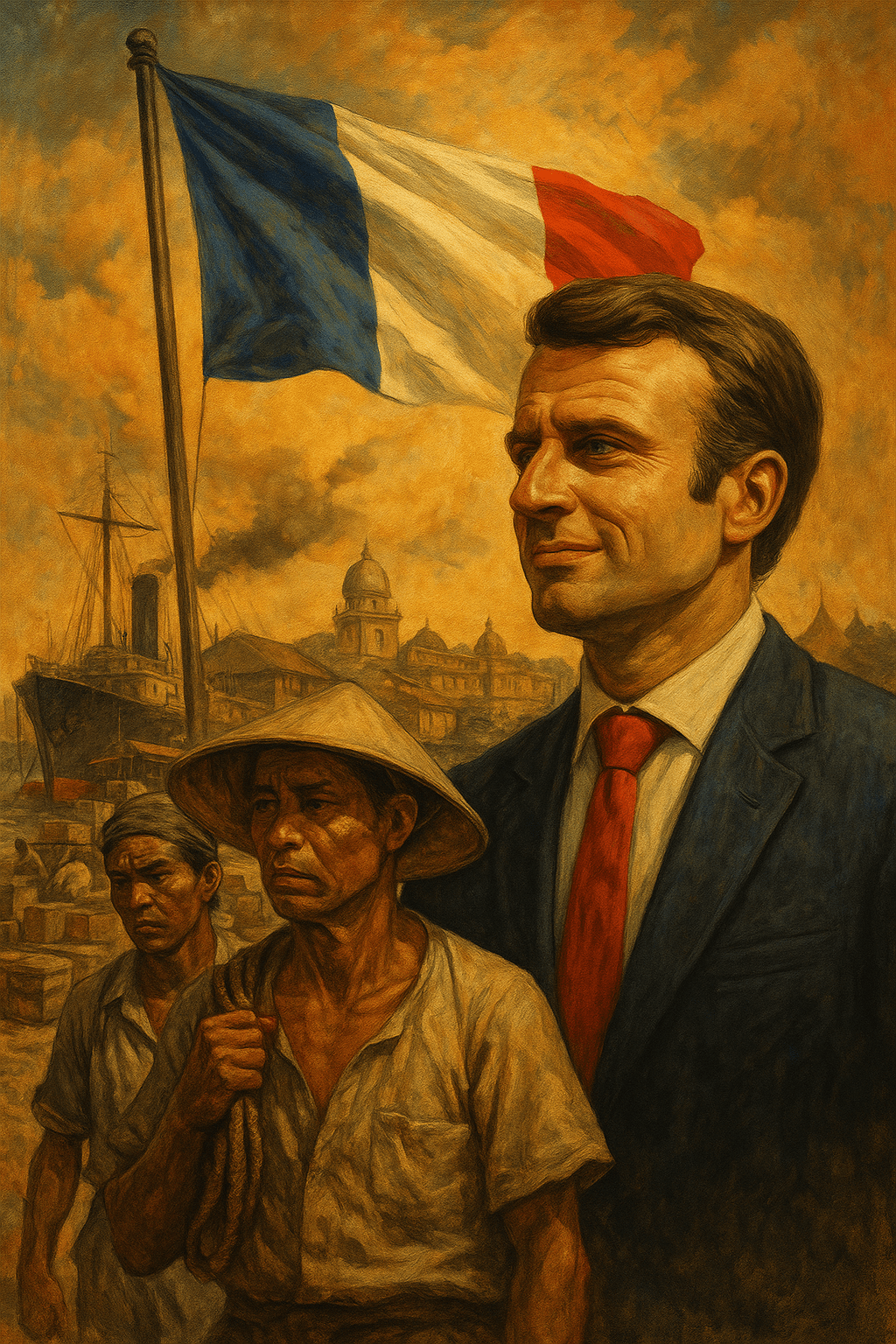
Thrown out of Africa by the people, France arrives in Asia with the same agenda, just softer words. But the empire is still the empire—no matter the accent.
By Prince Kapone | Weaponized Information
May 22, 2025
Part I – Rebranding Empire: How France Launders Its Colonial Past Into Diplomacy
This piece of propaganda comes to us courtesy of CNA, Channel News Asia—a regional media outlet based in Singapore, but ideologically docked in the port of Western finance and U.S.-EU foreign policy consensus. While it markets itself as a neutral news agency, CNA functions as a subcontractor for the imperialist media apparatus, dutifully recycling Reuters wire copy and providing ideological cover for liberal imperialism across Asia. The article in question carries no byline—because its authorship is irrelevant. It is a transmission, not a critique. A script, not a story. France says it’s a “reliable partner,” and CNA nods along like the well-trained relay station it was built to be.
The voices amplified here are not the people of Vietnam, Indonesia, or Singapore. They are Macron’s press team, French defense officials, European economic planners, and ASEAN diplomats who’ve made a career out of juggling Western capital and Chinese trade while pretending neutrality. Their job isn’t to report—they’re there to maintain the illusion that France, a dying empire, still has a legitimate role to play in the future of Asia.
And the framing? It’s classic imperialist recalibration with a human face. Macron’s charm tour is presented as “soft power,” “economic diplomacy,” “rules-based cooperation.” France, we’re told, is the friendly face in a room full of bullies—unlike the “coercive” U.S. or the “predatory” Chinese. This is the same France that looted Southeast Asia for rubber, rice, and bodies. The same France that trained death squads in Algeria and deployed troops in Rwanda. The same France that is now being evicted from West Africa by popular demand. But somehow, in CNA’s telling, France is just an honest broker with no colonial baggage, no corporate agenda, no blood on its hands. It’s a farce—but it’s a deliberate one.
The language is pure velvet: “no strings attached,” “mutual cooperation,” “strategic diversification.” But behind every phrase is a buried power dynamic. France doesn’t offer trade deals out of kindness. It’s peddling fighter jets, energy contracts, and port logistics in exchange for regional influence—because it has lost its grip in Africa and is now looking east. This is France’s Plan B: if you can’t dominate the Sahel, try the Mekong. If the old colonies rebel, pitch the same lies to the next generation of comprador elites.
The article tells us Macron will reassure ASEAN countries that France doesn’t operate like the U.S. or China. But it doesn’t tell us why France is there in the first place. It doesn’t mention the EU’s Indo-Pacific strategy. It doesn’t mention France’s arms sales to Indonesia. It doesn’t mention Vietnam’s colonial trauma or France’s long-standing military ties to Singapore. This is cognitive warfare by omission—make the empire sound reasonable by erasing its history, muting its motives, and polishing its boots before the next deployment.
Part II – Macron in Motion: What the Article Says and What It Can’t Say
Here’s what the article says on the surface: French President Emmanuel Macron is making a three-nation tour of Southeast Asia—Vietnam, Indonesia, and Singapore—pitching France as a “reliable partner” with “no strings attached.” His trip coincides with growing tensions between the U.S. and China over trade, regional influence, and military encirclement. Macron will give speeches, sign trade deals, meet with university students, and speak at the Shangri-La Dialogue in Singapore, a top security conference historically dominated by NATO-aligned talking points. He’ll offer French fighter jets, clean energy partnerships, and some diplomatic sweet talk about “rules-based order.”
So far, so liberal. But context is everything. Macron’s Asia pivot doesn’t come from a position of strength—it comes in the wake of defeat. France has been expelled from Mali, Niger, and Burkina Faso. It’s in the process of withdrawing from Senegal. Its neocolonial military presence in Africa is collapsing under the weight of popular revolt and a new era of anti-imperialist sovereignty. What we’re seeing in Southeast Asia is not a proactive diplomatic strategy—it’s a scramble. France is looking for new markets, new allies, new supply routes, and new footholds in the Global South before the door slams shut.
The media calls this “diversification.” We call it imperialist recalibration: when a declining power shifts its tactics but not its goals. Macron is not selling peace. He’s offering old empire with a new accent. He’s trying to reposition France as the polite alternative to Washington’s militarism and Beijing’s assertiveness. But what he’s really doing is rebranding France’s corporate and military infrastructure for the post-Africa era. If the gun didn’t work, maybe the handshake will.
What’s also missing is the class dimension. Macron doesn’t just represent France—he represents TotalEnergies, Dassault Aviation, and every European conglomerate looking to lock down supply chains in the Indo-Pacific. He’s not visiting Southeast Asia to talk about human rights. He’s there to push deals on defense, energy, ports, and surveillance infrastructure. And the so-called “no strings attached” pitch? It’s a lie. Every agreement comes with quiet terms: political alignment, resource access, and a seat at the table of strategic decisions already being made in Brussels, Paris, and Washington.
The article also fails to mention what Southeast Asians actually want: not another imperial mediator, but real independence from Cold War-style alliances. The people of Vietnam remember French occupation. The people of Indonesia remember European arms and IMF shock therapy. The people of the region do not need another empire “balancing” the U.S. and China—they need all three powers out of their politics, out of their ports, and off their backs. Macron’s tour is framed as a gesture of peace, but it’s a signal of desperation. France is losing relevance—and like any cornered power, it’s smiling while it reloads.
Part III – France Isn’t Back: It’s Just Lost Somewhere Else
Let’s be clear: this isn’t a new chapter in French diplomacy—it’s a rerun. Macron isn’t building a new relationship with Southeast Asia. He’s just bringing the same colonial playbook with a different title. The French empire that once pillaged Vietnam, carved up Laos, and colonized Cambodia has traded its tricolor for trade agreements. But the logic is the same: extract, dominate, stabilize the region in Europe’s favor. The props are just updated—now it’s lithium, shipping corridors, arms contracts, and “green” infrastructure instead of rubber, rice, and opium.
What Macron is really doing is staging France’s next act in the theater of declining imperial powers. Kicked out of Africa by revolutionary movements and anti-colonial governments, France is trying to find another place to plant its flag. This isn’t leadership—it’s drift. This isn’t foreign policy—it’s empire in retreat, looking for softer ground to land on. And Southeast Asia—caught in the crosshairs of U.S.-China rivalry—is being presented with another colonial option, this time framed as moderation. But how does one moderate between thieves?
Macron says France is different. Not like the U.S. with its bases, not like China with its deals. France, he says, offers “no strings attached.” But the Global South has seen this movie before. The strings are in the fine print, the private meetings, the advisory councils, the surveillance systems, the weapons deals, the IMF conditions waiting in the next phase. You don’t have to be a revolutionary to see it—you just have to be paying attention.
And this is why reframing the story matters. This isn’t a choice between three global giants. This is a moment where Southeast Asia—and the broader Global South—can reject the entire imperial setup. Not pick a side in a new Cold War, but break the table entirely. The people of Asia are not prizes. They’re not strategic pawns. They are workers, farmers, students, and organizers who remember what colonialism looks like, even when it smiles and shakes hands.
France isn’t neutral. It’s not moderate. And it’s not returning as a friend. It’s showing up again because it has nowhere left to go. Because Africa said no. Because the streets of Niamey and Bamako and Dakar said basta. And now Paris is knocking on Asia’s door, hoping the past has been forgotten. It hasn’t. And if the people of Southeast Asia say no as loudly and clearly as the people of West Africa did, this time there may be nowhere left for empire to run.
Part IV – Say No in Every Language: The Empire’s Pivot Is Our Cue to Push Harder
We salute the peoples of Southeast Asia—workers, students, farmers, and revolutionaries—who continue to resist imperial recolonization in all its forms. Whether the flag is American, Chinese, or French, the principle remains: self-determination is non-negotiable. Macron’s soft-power tour is a propaganda campaign to whitewash France’s defeat in Africa and redirect its imperial project toward Asia. That means the Global South must treat this moment not as a shift in diplomacy, but as an escalation in the war for sovereignty.
Across Asia and the world, the resistance is already in motion. In Indonesia, mass protests have targeted arms deals and resource theft. In Vietnam, youth organizations are demanding political autonomy in the face of foreign influence. In the Philippines, anti-bases movements are rising again. And across Africa, groups like the Black Alliance for Peace and Pan-African Community Action are showing us how to build uncompromising movements against hyper-imperialism—rooted in the local, but connected across continents.
We call on comrades and internationalists across the Global South and imperial core to:
- Expose Macron’s Asia tour for what it is: imperialist recalibration, not “partnership.” Launch teach-ins and media campaigns tracing France’s historical and ongoing role in Asia’s colonial and postcolonial exploitation.
- Track and publicly map French corporate, military, and financial entanglements in Southeast Asia—including energy contracts, arms sales, and surveillance infrastructure.
- Link movements resisting neocolonial penetration in Asia with those fighting imperialism in Africa and Latin America. Macron’s pivot is global—our solidarity must be too.
- Amplify local Southeast Asian radical voices—organizers, land defenders, educators, workers—who are resisting these so-called partnerships on the ground.
- Disrupt French embassies, trade delegations, and cultural propaganda platforms when they arrive in your cities. If France is trying to launder empire through diplomacy, then diplomacy must become a site of insurgent refusal.
This is the time to draw the lines boldly. To say with one voice—from Dakar to Hanoi to Jakarta: we will not trade one empire for another. We will not pick a colonizer based on accent. We want sovereignty. We want liberation. And we will not be fooled again.
As Thomas Sankara once said, “You cannot carry out fundamental change without a certain amount of madness.” Let us now bring that madness—organized, principled, internationalist—to every door Macron knocks on. Let us make it impossible for empire to find a home anywhere on this planet.
 Weaponized Information
Leave a comment