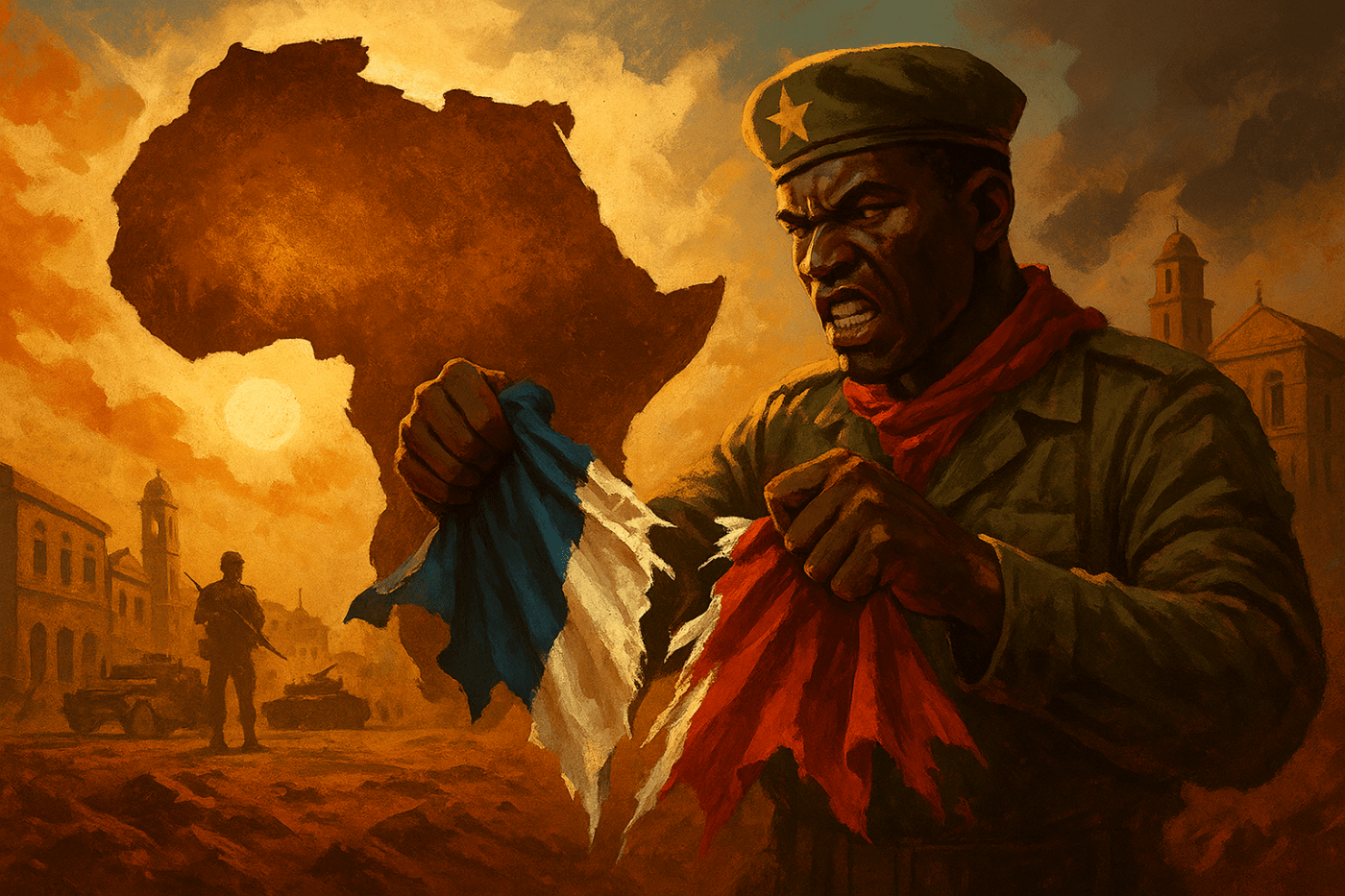
France isn’t withdrawing. It’s being expelled. And the empire’s hold on Africa is beginning to crack at the roots.
By Prince Kapone | Weaponized Information
May 22, 2025
Part I – From “Security Agreement” to Occupation: Digging Up the Quiet Language of Empire
The original article was published by MENAFN, the Middle East North Africa Financial Network—a regionally based financial news outlet that acts less like a watchdog and more like a polite stenographer for imperial capital. While not one of the big Anglo-American war-media firms like Reuters or The Guardian, MENAFN functions as a repeater node in the larger imperialist media apparatus. Its target audience is not the working poor or the colonized masses—it’s financiers, investors, diplomats, and contractors who want updates on their assets and proxies without the discomfort of historical context or revolutionary analysis.
The article bears no author byline, which is itself telling. It allows for plausible neutrality while acting as a conveyor belt for sanitized language—terms like “defense agreement,” “foreign presence,” and “security cooperation”—with zero interrogation of the underlying power dynamics. And while it doesn’t overtly praise the French, it does them the greater service of leaving their crimes unmentioned. That’s the subtle craft of counterinsurgency journalism: don’t lie—just amputate the truth until nothing bleeds.
The geopolitical structure behind this silence includes the French Defense Ministry, AFRICOM spokespeople, and technocrats in Brussels and Paris who’ve spent two decades calling colonial militarism “development.” These are the planners, funders, and stabilizers of a West African occupation whose legitimacy is now crumbling under the weight of popular resistance.
The propaganda here isn’t loud. It’s quiet, which is how it gets under your skin. The article reduces the expulsion of French forces to a policy update, as if Ousmane Sonko were changing parking regulations instead of ending 60 years of military neocolonialism. Nowhere does it mention the colonial roots of France’s presence, its post-independence military pacts, or its direct role in training and arming counterinsurgents. There’s no discussion of how these foreign troops have served as security for uranium mines, gold exporters, and European pipelines—how they’ve protected capital, not people.
Instead, we get a timeline of base closures, a few quotes about “sovereignty,” and a cautious nod to “security capacity.” What’s missing is the political meaning: this is not just a withdrawal—it’s an eviction. The French aren’t leaving out of courtesy. They’re being thrown out. By a government that understands the difference between national independence and anti-imperialist sovereignty. By a people who’ve learned that no amount of aid or diplomacy will ever be worth the price of permanent military occupation.
Part II – What the Article Says, and What It Refuses to Say
Here’s what we’re told: Senegal’s Prime Minister Ousmane Sonko has announced that all foreign military forces must leave the country by the end of July. The French military, operating under a 2012 “defense agreement,” has already begun its retreat—base by base—handing over naval and ground facilities in a phased withdrawal. In a televised interview, Sonko made it plain: Senegal’s sovereignty is not compatible with foreign bases. President Bassirou Diomaye Faye has echoed that line since day one. This move, we are told, is part of a broader push to bolster national defense capacity.
All of that is factually correct. But on its own, it means almost nothing. What the article doesn’t tell you is that this decision didn’t emerge from nowhere. It is part of a rising tide of popular resistance that has already forced France to the gates in Mali, Burkina Faso, and Niger. It follows the rise of anti-colonial movements and military-led governments that have rejected French hegemony, expelled foreign troops, and begun building new alliances—including with China, Russia, Iran, and BRICS+. Senegal, until recently a “stable partner” of the West, is now aligning with the regional pivot away from the hyper-imperialist order.
What the article also omits is France’s real role in Senegal. These aren’t just “defense” bases—they are command centers for surveillance, control, and extraction. They have protected gold mines, phosphate lines, and foreign companies—not Senegalese people. They’ve trained counterinsurgency units and coordinated drone surveillance flights across the Sahel. They’ve enforced the neoliberal political economy of the CFA franc zone. And through AFRICOM, they’ve helped anchor U.S. logistics across West Africa under the same imperial roof.
This is why Sonko’s statement matters. When he says Senegal’s army is capable of defending its territory, he’s not just talking about national pride. He’s cutting at the heart of the colonial logic: that African security must be outsourced to Western armies. That independence means waving a flag while foreign boots stay on your soil. This is the ideological rupture that the article sidesteps. And it’s the one the West fears most: a political and military realignment that puts anti-imperialist sovereignty back on the table—not as an aspiration, but as a program.
The expulsion of French troops is not just a diplomatic rebalancing. It is part of a historic break with the infrastructure of neocolonial extraction and military dependence that has kept Africa subordinate for over half a century. And it signals that the architecture of empire—from Paris to Washington to NATO’s southern flank—is more brittle than it looks.
Part III – This Is What a Revolutionary Break Looks Like
They’ll try to call it symbolic. A gesture. Maybe even a strategic “realignment.” But what just happened in Senegal isn’t symbolic at all—it’s material. It’s revolutionary. When a state tells the French military to pack up and go, and when that same state does it publicly, on camera, backed by the will of the people, that is not diplomacy. That is rupture. That is decolonization with teeth.
Sonko and Faye didn’t invent this momentum. They are riding a regional wave that’s been building for years—from Mali to Burkina Faso to Niger—where the people have had enough of foreign armies protecting foreign capital. This is what it looks like when the myth of Western “security partnerships” is shattered by the reality of imperial boots on the ground. For decades, France used terrorism as a pretext to militarize the Sahel. It said it was protecting Africa from collapse—when in truth, it was enforcing collapse for profit. What Senegal is doing now is calling that bluff, and forcing empire to retreat in daylight.
This isn’t about isolation. This is about multipolarity. About Africa choosing its own path—not just outside of France, but outside of the U.S.-EU command structure that has long strangled the continent through debt, drones, and diplomatic blackmail. What Sonko and Faye are signaling—quietly but firmly—is that Senegal will no longer be a forward-operating base for hyper-imperialist logistics. That the days of leased sovereignty are over. That anti-imperialist sovereignty isn’t just a slogan—it’s policy.
Of course, the fight is far from finished. France may leave militarily, but its banks still extract through the CFA franc. Its corporations still dominate key sectors. And its intelligence networks will not vanish without a fight. The same goes for AFRICOM and the U.S., which have long used Senegal as a coastal foothold for surveillance, training, and maritime operations. But make no mistake: the ground is shifting. A wall has cracked. And the world is watching.
When a state asserts the right to control its own security, its own ports, its own soil—it sends a signal. Not just to Paris or Washington, but to every other colonized people still shackled to the logic of “strategic partnership.” Senegal just reminded us that these partnerships are not partnerships at all. They are contracts written in blood and silence. And the people of the Sahel are tearing them up, one base at a time.
Part IV – Pan-African Uprising, Global Duty: From Senegal to the Streets Where We Stand
We salute the Senegalese people—and the Sonko-Faye government—for taking this bold step toward real sovereignty. This is not just a national act. It is a regional spark, a continental challenge, and a global call. For too long, imperialism has ruled Africa through guns, debt, and silence. But now, from Niamey to Bamako to Dakar, that silence is being broken. What the world is witnessing is not just military withdrawal—it is the erosion of an entire colonial architecture. And our task, wherever we stand, is to strengthen it.
In the belly of the beast, organizations like the Black Alliance for Peace (BAP) have long been exposing the crimes of AFRICOM and its role as the armed wing of U.S. imperialism in Africa. BAP’s “U.S. Out of Africa” campaign has tirelessly documented the 46 known U.S. military outposts across the continent, the training of African soldiers for counterinsurgency missions, and the use of NGOs and aid agencies as camouflage for military expansion. They’ve made it plain: AFRICOM doesn’t protect—it pacifies. It doesn’t build stability—it enforces extraction. And now is the time to amplify their work like never before.
BAP is not alone. Pan-African Youth networks, grassroots anti-imperialist collectives, and radical diasporic scholars have all played a role in reviving the long-denied project of African liberation. From solidarity teach-ins in Chicago to direct actions outside French consulates, the resistance is alive and growing. It’s time we align with them—not in word alone, but in practice.
We call on comrades everywhere to:
- Organize public forums and study circles that expose the role of AFRICOM and French military bases in Africa as tools of militarized imperialism and neocolonial extraction.
- Join and materially support the campaigns of Black Alliance for Peace’s U.S. Out of Africa Network, which demands the immediate dismantling of AFRICOM and the closure of all U.S. bases on the continent.
- Coordinate direct actions, teach-ins, and protest campaigns at AFRICOM command hubs, French embassies, and weapons manufacturers profiting from Sahel militarization.
- Build cross-border coalitions with African organizers resisting U.S., French, and EU presence, and uplift the revolutionary voices from the continent demanding full liberation—not just from foreign troops, but from foreign control.
- Create revolutionary media that centers African anti-imperialist leadership, not Western analysts. Publish, broadcast, share, and amplify the real story—told by those fighting on the front lines.
The empire is being pushed out by those who were never meant to rise. Senegal has shown what’s possible. Now it’s our duty to match their courage with action. If the Sahel is shaking off its chains, then we, in the heart of the imperial core, must become accomplices in their liberation—not just in theory, but in deed.
As Kwame Nkrumah taught: “We face neither East nor West—we face forward.” And as long as empire marches, we march forward with our backs to its lies, and our fists raised toward the freedom yet to come.
 Weaponized Information
Leave a comment