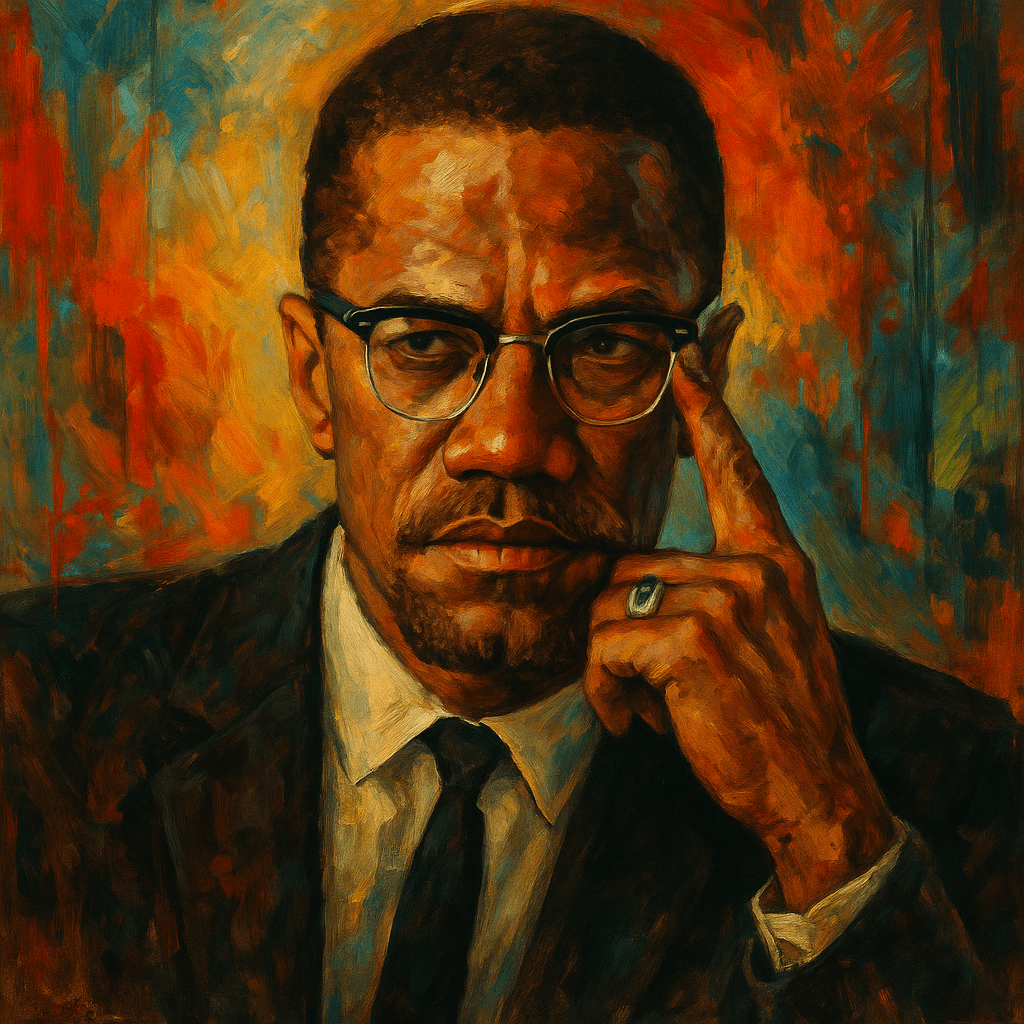
He spoke the language of the oppressed, mapped the empire’s skeleton, and dared to name capitalism as the disease. That’s why they killed him—and why we must carry his revolution forward.
By Prince Kapone | Weaponized Information
May 19, 2025
The Fire This Time: Born Into the Belly of the Beast
Malcolm was not born with a manifesto in his hand. He was born into the violence of American capitalism—the kind that wears a sheriff’s badge, burns your house down, and calls it “justice.” Before he ever touched a Quran, before he ever studied Fanon or talked socialism in Cairo, he learned the world through the barrel of white terror. Born Malcolm Little in Omaha, Nebraska on May 19, 1925, his first memories were formed around the crushing weight of settler violence. His father, Earl Little, was a Garveyite organizer, a man bold enough to tell Black folks they were a nation, not property. So, the Klan did what the Klan does—they lynched him and called it an accident.
Malcolm’s mother, Louise, was institutionalized—driven mad by the slow genocide America calls “policy.” The family was broken up by the state. Young Malcolm was sent through foster homes, juvenile facilities, and white charity institutions, where he was taught to dream of being a “noble Negro” while being caged like an animal. This wasn’t just racism. This was class warfare, colonial policy—the systematic liquidation of resistance through psychological, cultural, and economic violence. And the man who would become the most dangerous Black voice in the empire first had to survive it all.
He wasn’t raised in a seminar room. He was raised in the plantation afterlife—the ghetto, the prison yard, the factory floor. And by the time he landed in prison, after a series of hustles and robberies born not of moral collapse but of structural abandonment, the U.S. state had already mapped his trajectory: another dead Black man or another silent one.
But Malcolm flipped the script. In that prison cell, he devoured books. Not just for knowledge—but for liberation. He studied history, philosophy, language, religion, and political theory. He did what the system feared most: he thought. Not just critically, but radically. And when he emerged, he was no longer Malcolm Little. He was Malcolm X. The “X” was not just a rejection of his slave name—it was a rejection of the whole system that branded, bred, and broke Black people for profit.
This was the raw material of revolution. Not academic posturing. Not liberal integrationism. But lived contradiction. Malcolm X came out of prison not to beg for inclusion but to expose the lie America told the world. He stood at the intersection of Blackness and class, nation and empire, dignity and despair—and he refused to kneel.
His words were fire because his life was forged in fire. When he spoke, the oppressed heard more than anger. They heard analysis. They heard strategy. And they heard the faint echoes of the next world trying to be born through the ashes of this one.
Malcolm didn’t need to read Marx to see class war. He lived it. He didn’t quote Lenin to understand imperialism. He watched his father’s blood soak into the soil of the American heartland. He didn’t study Gramsci to recognize the cultural hegemony of white supremacy. He had it screamed into his face by every teacher, judge, and police officer he ever met. And still, he rose—not as a victim, but as a weapon.
From Black Nationalism to Global Liberation
Malcolm X wasn’t static. That’s what scared them most. He evolved. He dared to change. And unlike the polished liberals and pre-packaged radicals of today, he did it publicly, painfully, and with revolutionary honesty. The Nation of Islam gave him discipline, gave him a name, gave him a platform. But it couldn’t contain him. His vision was too big for the temple, too sharp for respectability, and too international for American nationalism.
By 1964, Malcolm had broken with the NOI—not out of betrayal, but out of necessity. He saw that Black liberation could not be reduced to religious doctrine or personal morality. It was a political struggle. A class struggle. A global war. And he said it plainly: “You can’t have capitalism without racism.” That sentence alone carried more revolutionary truth than entire volumes of liberal race theory.
Malcolm’s turn wasn’t a soft pivot—it was a seismic shift. He traveled to Africa and the Middle East not as a tourist, but as a comrade. He walked the streets of Accra, Cairo, Algiers, and Lagos with leaders of postcolonial revolutions, studying how nations wrenched themselves free from European chains. He met with Kwame Nkrumah. With Gamal Abdel Nasser. With Ahmed Ben Bella. With the FLN, with Pan-Africanists, with Marxists, with Muslim revolutionaries. And through those encounters, Malcolm’s worldview crystallized: Black people in America were not a “minority”—they were a colonized nation. And their liberation had to be tied to the global anti-imperialist movement.
He stopped speaking as a Black American. He started speaking as a freedom fighter. And that made him dangerous. Because suddenly, Malcolm wasn’t just talking about civil rights—he was talking about human rights. About bringing the United States before the United Nations for crimes against a people. About forging unity between African Americans and African revolutions, between the Black ghetto and the Third World.
This is where the Marxist undertones begin to thunder like distant drums. Malcolm may not have quoted Marx chapter and verse, but his analysis was undeniably historical materialist. He located racism not in the hearts of men, but in the structure of systems. He understood that the police didn’t “fail” Black people—they were the domestic arm of colonial rule. That poverty wasn’t an accident—it was the function of capitalist extraction. That the ghetto wasn’t a social mistake—it was a labor reserve, managed by violence and media lies.
He denounced both the liberal establishment and the Black comprador elite—the ones who sold speeches to white foundations while their communities were bleeding out. He said the Democrats were wolves in sheep’s clothing, and the Republicans were just wolves. He exposed how electoral politics functioned as a pacifier, a plantation overseer with a ballot instead of a whip.
And he saw clearly what most still refuse to admit: that the real contradiction in the U.S. wasn’t simply race—it was colonial capitalism. That Black people were not merely oppressed—they were occupied. And that liberation required not reform, but revolution.
In his final speeches, the echoes of Marx, Lenin, and Fanon are all there—not as citations, but as conclusions reached through struggle. When Malcolm said the U.S. was “a society with the heart of a beast,” he wasn’t being poetic. He was issuing a structural indictment. And when he called for a “world revolution,” he wasn’t fantasizing. He was identifying the only real path out.
Enemies Within and Without: Why Malcolm Had to Be Eliminated
Revolutionaries don’t die of natural causes under empire. They are targeted, isolated, neutralized. And Malcolm was no exception. Once he stepped beyond the controlled orbit of the Nation of Islam, once he stopped preaching moral reform and started building global class unity against U.S. imperialism, his death warrant was effectively signed. Not just by jealous rivals or internal dissenters—but by the state itself.
The FBI had been watching Malcolm since at least 1953, when he was still organizing temples for the NOI. By 1958, he had an entire FBI file fattened with wiretaps, surveillance, and informants. They didn’t just monitor his speeches—they studied his cadence, tracked his movements, infiltrated his circle. The CIA took notice after his travels to Africa and the Middle East. Malcolm wasn’t just considered a “domestic threat.” He was now a transnational destabilizer—a Black revolutionary connecting the ghetto to the global South.
J. Edgar Hoover’s COINTELPRO program marked Malcolm for “disruption.” That was the term they used—sanitized, bureaucratic. But what they meant was: destroy him. Discredit him. Divide him from the masses. Turn allies into enemies. Sow paranoia. Feed misinformation. And if that doesn’t work—kill him. And so they did, with plausible deniability and a smear campaign still echoing today.
By 1965, Malcolm was forging alliances with the Organization of African Unity. He was speaking of socialism without saying the word. He was calling for Black resistance—not just in courtrooms and protests, but in self-defense and structural disruption. He was educating the lumpen—not just to vote, but to organize, arm, and rise.
What scared them wasn’t just what Malcolm said. It was what he was becoming. A disciplined, charismatic, globally-connected revolutionary with mass appeal. He had already transcended the framework of American civil rights. He was now speaking in the language of global class war. And in a country built on slavery, settlerism, and oil wars, that kind of clarity is treason.
So they silenced him. Or so they thought. Because while Malcolm’s body was buried, his politics multiplied. His assassination wasn’t the end. It was the spark. And like every revolutionary martyr before him—from Lumumba to Martí to Sandino—Malcolm’s death forced millions to re-examine their chains and start sharpening keys.
What He Saw That Others Couldn’t Say: Zionism, the UN, and the Third World Front
Malcolm X didn’t just name white supremacy. He named its coordinates. He mapped it onto the globe, onto institutions, onto ideology. And unlike the liberal race hustlers or the red-white-and-blue Marxists who refused to leave the safety of Western frameworks, Malcolm tore through the veil and called the whole empire to account. He wasn’t just fighting for Black freedom in America. He was fighting against the global colonial system that made the American dream possible.
Let’s talk about Palestine. Malcolm X spoke out against Zionism when most American liberals were still clapping for Golda Meir. In his 1964 article “Zionist Logic,” he compared the occupation of Palestine to the settler theft of Native lands in the U.S., calling Zionism a form of white colonial aggression dressed up in religious legitimacy. He didn’t mince words: Zionism, he said, was an extension of Western imperialism—a proxy settler regime meant to police the Arab world and suppress anti-colonial revolution.
This wasn’t popular then. It’s not popular now. That’s exactly why it matters. Malcolm understood that if you claim to oppose racism in America but support colonialism abroad, you’re not a revolutionary—you’re a hypocrite. And he didn’t just say this in private. He put it in print. He said it to Arab audiences. He said it in front of international bodies. And in doing so, he connected the Black freedom struggle to the Palestinian cause, long before that was a fashionable slogan on a college campus.
Then there was the United Nations. While Dr. King was writing cautious letters and LBJ was selling integration with a Southern drawl, Malcolm was drafting petitions to bring the United States before the world for crimes against humanity. His plan? Expose America’s dirty war against its Black population as a violation of international law. Frame police violence, economic apartheid, and political repression not as “domestic issues,” but as forms of internal colonialism—akin to South African apartheid or French repression in Algeria.
Malcolm wasn’t looking for sympathy. He was building strategy. If the U.S. couldn’t be pressured from within, it had to be isolated globally. That was the real threat—not just a loud Black man, but a disciplined internationalist organizing solidarity from Harlem to Havana to Hanoi.
He saw the Third World—not as a victim zone, but as the rising revolutionary front. He recognized that the oppressed peoples of Africa, Asia, Latin America, and the Middle East were not backward or inferior. They were the vanguard. The ones who had dared to pick up rifles, storm barracks, and evict their colonizers. And he wanted Black people in the U.S. to see themselves not as a hopeless minority, but as part of this global army of liberation.
This is why Malcolm’s later speeches crackle with Marxist energy—even if he never said the word. He spoke of global capital, of land expropriation, of the need to control production, of revolution over reform. He spoke of neocolonialism as the new face of empire. He denounced comprador elites and puppet regimes. And he saw through the tricks—how the imperial core disguises its violence through NGOs, elections, media, and peace conferences.
He understood what many radicals still refuse to grasp: that U.S. democracy is built on colonial denial, and that every imperialist war abroad is connected to the violence at home. That you cannot separate the hood from Haiti, Gaza from Gary, Detroit from Damascus. He said: “You can’t have a revolution in a reactionary situation.” He meant it. The real struggle is global. And the real enemy is systemic.
That’s why Malcolm had to die. And that’s why we’re still quoting him.
Malcolm and the Lumpen: The Revolutionary Potential of the Street
Malcolm never looked down on the so-called “criminal element.” He didn’t sneer at hustlers, gangsters, or drug dealers. He had been one. He knew that beneath the surface of street life was something more than nihilism—it was the deformed scream of a colonized people, forced into illegality by structural abandonment. And while bourgeois Black leaders held their noses and begged for “respectability,” Malcolm walked straight into the streets and called the forgotten what they truly were: the most potentially explosive force in America.
He didn’t romanticize the lumpenproletariat. He politicized it. He knew the system had no place for them, and that made them dangerous. Free from illusions about inclusion. Conditioned by violence. Organically opposed to the police. Malcolm saw that, if armed with political consciousness and revolutionary discipline, the lumpen could become shock troops of liberation. “We don’t need allies who are more afraid of your militancy than they are of the oppressor,” he said. “We need brothers and sisters ready to fight.”
This wasn’t theoretical. In the final years of his life, Malcolm had begun quiet collaborations with radical formations like the Revolutionary Action Movement (RAM). RAM wasn’t a fan club. It was an underground, Marxist-influenced, Black nationalist organization with a serious analysis of U.S. empire, ghetto colonialism, and armed struggle. Malcolm’s speeches and strategy shaped their work—particularly his framing of the Black condition as a national-colonial contradiction rather than a mere civil rights grievance.
RAM cadre, including figures like Max Stanford (later Muhammad Ahmad), saw Malcolm not just as an orator but as an emerging revolutionary theorist. They helped disseminate his messages in Harlem, worked security for his events, and engaged in strategic dialogue. When Malcolm founded the Organization of Afro-American Unity (OAAU), RAM saw it as a bridge toward revolutionary organization and mass base-building.
And it was Malcolm’s post-NOI trajectory—his clarity on self-defense, his emphasis on internationalism, and his class-based reading of Black struggle—that laid the intellectual and strategic foundation for what would soon emerge in Oakland and Harlem. Huey Newton and Bobby Seale, founders of the Black Panther Party, credited Malcolm directly. His image was on their walls. His speeches were required reading. But it was the New York chapter of the Panthers that most fully embodied his line—urban, armed, nationalist-internationalist, and rooted in the lumpen base.
From there, the line of continuity is unmistakable. The Black Liberation Army (BLA), emerging from disillusioned and repressed Panther forces, carried Malcolm’s revolutionary militancy into the underground. Prison breaks, expropriations, urban guerrilla warfare—these weren’t wild deviations. They were expressions of Malcolm’s call to meet violence with organized resistance. He didn’t advocate random chaos. He advocated revolutionary strategy.
Even the Republic of New Afrika (RNA)—that audacious Black nationalist project to claim the U.S. South as independent territory for Black self-determination—was infused with Malcolm’s late-period analysis. The RNA picked up his framing of Black people as a nation, oppressed by an internal settler colonial regime, with the right to land, sovereignty, and independence. They built on his argument that the U.S. was not a democracy, but an empire—and that the colonized had every right to secede from it.
Malcolm never lived to see these movements fully take shape. But his fingerprints are all over them. Not in slogans, but in strategy. Not in fanfare, but in formation. He didn’t just inspire revolutionaries. He helped midwife the revolution.
They Murdered Him—But They Couldn’t Kill the Message
On February 21, 1965, Malcolm X was assassinated in the Audubon Ballroom in Harlem. But let’s be clear, because too many have twisted this history into confusion and cowardice: Malcolm was killed by the U.S. government. Full stop. The men who pulled the trigger were Black, yes—but they were weapons of a white supremacist state that feared Malcolm more than any man alive. He wasn’t killed by “Black-on-Black violence.” He was executed by empire, using infiltrators, provocateurs, and psychological warfare as its instruments.
COINTELPRO didn’t just monitor Malcolm—they engineered his demise. They stoked division between Malcolm and the Nation of Islam. They leaked threats, sabotaged alliances, and made sure that when the time came, he would be isolated, unprotected, and vulnerable. The New York Police Department’s Bureau of Special Services (BOSSI) pulled its officers from the ballroom just before the assassination. The FBI knew it was coming. And they let it happen. Because it wasn’t just about silencing Malcolm—it was about sending a message to every colonized person who dared to think beyond the ballot box.
For decades, the official story was that three Black men—Talmadge Hayer (a.k.a. Mujahid Abdul Halim), Norman 3X Butler (Muhammad Abdul Aziz), and Thomas 15X Johnson (Khalil Islam)—were responsible. But in 2021, after years of pressure, the convictions of Aziz and Islam were vacated. The state admitted what many had known all along: they were innocent. The FBI and NYPD had withheld exculpatory evidence. They had lied. Two Black men spent decades in prison for a crime the state knew they didn’t commit.
This is not just injustice—it’s counterinsurgency. It’s colonial warfare dressed in due process. And we must name it as such. Because if we don’t, we let the state off the hook. We let the very system that killed Malcolm rebrand itself as justice-seeking. We let the architects of assassination hide behind the shadows of the shooters.
It doesn’t matter if the bullets came from Black hands. The order came from the white supremacist state. And the motive was clear: Malcolm was no longer containable. He had outgrown their labels. He had refused their bribes. He had made the leap from nationalist to internationalist, from minister to revolutionary. He had become a threat not just to white liberals or segregationists—but to capitalist empire itself.
He refused to play by the rules. He exposed both sides of the American duopoly. He showed the limits of electoral politics and the fraudulence of token representation. He called out the United Nations for ignoring colonial violence in the U.S. He denounced Zionism, stood with Algeria, supported the Vietnamese, and affirmed the Cuban Revolution. He told the Black masses that liberation would not come through handshakes, but through struggle, solidarity, and sovereignty.
So they silenced him. Or tried to. Because while they buried the man, they couldn’t bury the movement he fertilized. His death sparked a wildfire. It ignited RAM, the Panthers, the BLA, the Republic of New Afrika. It radicalized a generation. It split the false unity of American liberalism wide open and exposed the brutal fault lines underneath.
Malcolm’s assassination was the price of political clarity under empire. And every revolutionary since—from Fred Hampton to George Jackson to Assata Shakur—has known the cost. But they’ve also known the inheritance. Because Malcolm didn’t die with his hands outstretched. He died standing. And that’s how we must remember him—not just as a martyr, but as a militant. Not just as a preacher, but as a planner. A strategist. A revolutionary.
Malcolm and the Era of Technofascism: What He Teaches Us Today
If Malcolm were alive today, they wouldn’t just surveil him. They’d algorithmically throttle him, shadowban his words, label him a domestic extremist, and flood his movement with counterrevolutionary bots and AI-fed infiltrators. He would be no less dangerous today than he was in 1965—in fact, he might be even more so. Because in an age of digital lies and liberal illusions, the kind of clarity Malcolm carried would burn through the fog like a torch.
We live now in the belly of the beast’s upgrade. Capitalism in its technofascist form. A regime where the police wear body cams but still kill with impunity, where elections happen but choices don’t, where identity is commodified and struggle is defanged by sponsorships. The contradictions Malcolm exposed have not disappeared—they’ve been digitized, dressed in the language of progress, and sold back to us through curated timelines.
Malcolm warned us of this. Not by predicting algorithms, but by identifying patterns. He told us about the house Negro and the field Negro—the collaborator and the rebel. He warned of liberal allies more dangerous than overt racists. He explained how the system manipulates public opinion, uses media to manufacture consent, and neutralizes dissent not only with bullets, but with co-optation. What is technofascism, if not the perfect synthesis of these tactics?
He told us not to look to Washington for freedom. Not to trust the ballot alone. Not to invest in symbols while the system remains intact. He told us to organize. To internationalize. To speak the truth even when it’s fatal. And he showed us what it meant to transform—from criminal to leader, from preacher to revolutionary, from subject to sovereign.
That’s why they still try to sanitize him. They hang his picture in classrooms and strip his words of their militancy. They quote him on justice while hiding his calls for self-defense. They sell hoodies with his face while ignoring the fact that he called for the fall of empire. They don’t fear Malcolm’s image—they fear Malcolm’s politics.
And we owe it to him—not with nostalgia, not with hashtags, but with action. With study. With strategy. With organization. With revolutionary discipline. Because the same system that killed Malcolm is still here—only now it wears a hoodie, speaks in hashtags, and uploads its propaganda faster than ever.
Malcolm taught us to ask: Who profits from our suffering? Who controls the means of repression? Who controls the narrative? These are still the right questions. But he also gave us something rarer: an unshakable belief in the potential of the oppressed. A confidence in the capacity of the lumpen, the poor, the colonized, to rise—not by permission, but by power.
In this era of drones, databases, and digital disinformation, we must weaponize the clarity Malcolm died for. Not to mimic his speeches, but to apply his method. To trace the lines between race, class, and empire. To build solidarity across artificial borders. To organize the organized—and the disorganized—into a revolutionary force that can’t be bought, paused, or banned.
Malcolm X is not a relic. He’s a roadmap. A mirror. A call to arms. And on this May 19th, let it be known: the message lives. The fire still burns. And those of us carrying it forward do so with full knowledge of the price—and the promise.
 Weaponized Information
Leave a comment