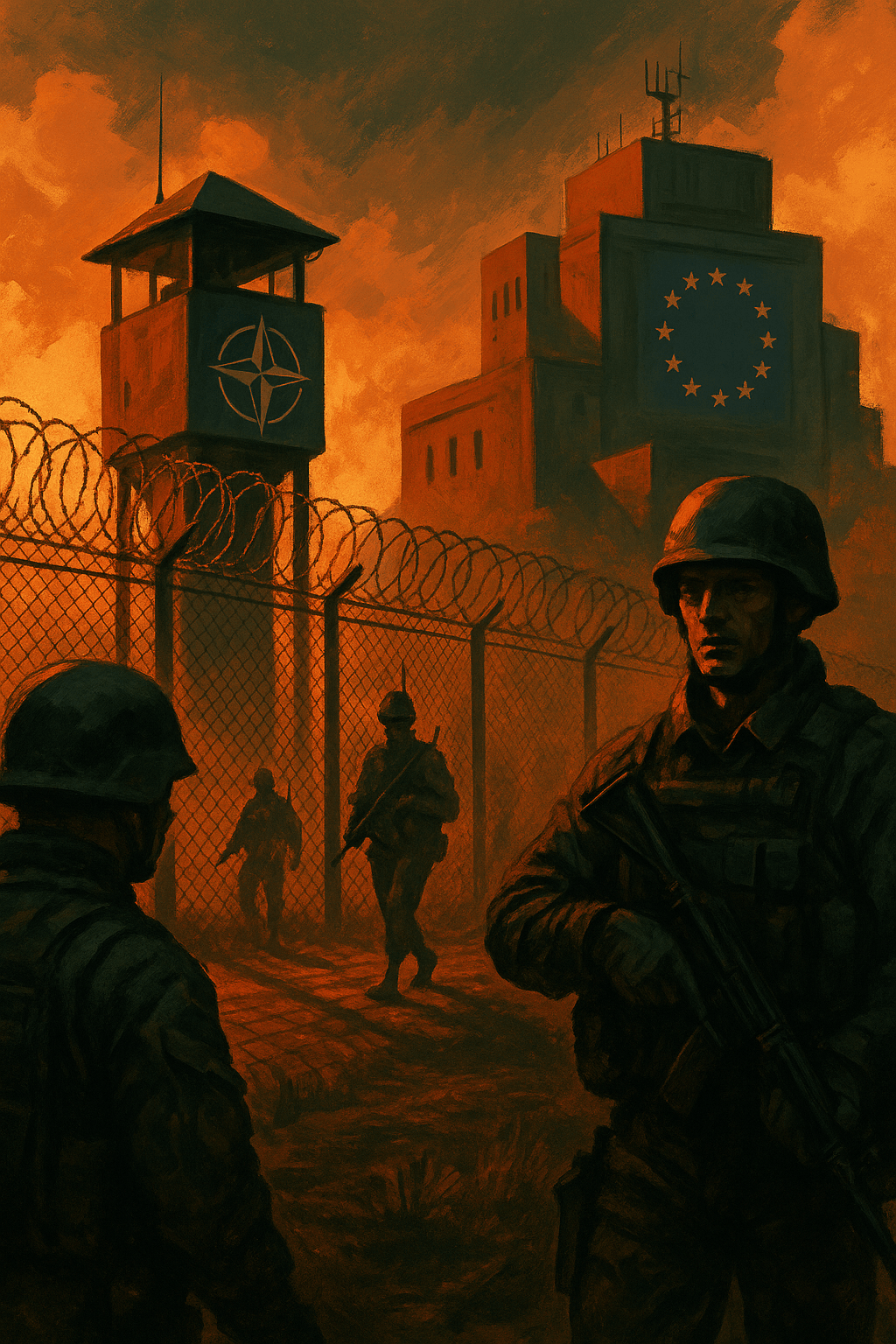
What looks like collective defense is really coordinated imperialist recalibration. NATO demands tribute; the EU builds a digital garrison. Both march under the flag of permanent war.
By Prince Kapone | Weaponized Information
May 15, 2025
They Call It Journalism, But It Marches With the Generals
Let’s begin where the mask slips. Alice Tidey of Euronews is not just a journalist—she’s a salaried narrator of Europe’s imperial ambitions, an embedded functionary inside the machinery of continental militarism. From her desk in Brussels, she translates NATO doctrine into neutral-sounding press copy, stripping it of its blood and price tag. Tidey has built her career reporting on EU institutions and “defense cooperation,” a beat that demands proximity to power and rewards ideological obedience. Her employer, Euronews, presents itself as a “pan-European” voice but operates under the institutional wing of the European Commission itself—functioning more as a public relations engine for imperial Europe than an actual news outlet. The Associated Press, meanwhile, is the global stenographer of the American empire. Its reporters—Matthew Lee, Lorne Cook, and Suzan Fraser—have spent years laundering Washington’s wars in the antiseptic language of diplomacy, never once calling an invasion what it is, nor naming the profiteers by name.
And who appears, again and again, as the serious men in suits guiding us through these dangerous times? General Robert Brieger, presiding chair of the EU Military Committee. Mark Rutte, NATO’s new Secretary-General and longtime Dutch enforcer of austerity. Marco Rubio, Washington’s new imperial mouthpiece disguised as Secretary of State. And behind them, of course, sits the European Commission—offering €150 billion in loans for bullets, missiles, and digital firewalls, all in the name of “interoperability.”
But make no mistake—this ain’t about peace or defense. This is cognitive warfare in full deployment. The language is loaded, not with truth, but with euphemism and erasure. NATO’s push for 5% of GDP in military spending is presented as a rational adjustment to “21st century threats.” But the real threat, as always, is empire’s collapse. The AP piece floats this demand like it’s weather: unavoidable, natural, and detached from political economy. What it conceals is that this is a tribute system—a massive funneling of public wealth from workers to weapons firms, from welfare to warfare. In the Euronews piece, Tidey rehearses the script handed down by the EU military brass, calling for “operationalizing Article 42.7” like it’s a software patch, not a strategic shift toward militarized federalism and continental war planning. Terms like “critical infrastructure protection” and “military mobility” mask what they really are: highways for tanks, ports for warships, datacenters for drone command.
Nowhere in these pieces will you find mention of the working class, of the hospitals that won’t get built, the wages that won’t get raised, or the schools that will go without heat so Rheinmetall and Lockheed can balance their ledgers. There are no voices of dissent, no analysis of historical patterns, no admission that this is not defense—it’s imperialist recalibration. These articles do not report. They discipline. They do not inform. They instruct. And what they instruct us to do is obey—pay up, shut up, and march.
Tribute, Territory, and the Logistics of Empire
Once we strip away the varnish of official language and corporate journalism, what are we left with? A straightforward set of facts: the United States, under the Trump 2.0 regime, is demanding NATO countries increase military spending to 5% of GDP by 2032. This is broken down into 3.5% for direct military budgets—tanks, guns, drones, soldiers—and another 1.5% for “defense-related infrastructure”: roads, ports, bridges, airports, seaports, and digital systems. The EU, for its part, is operationalizing Article 42.7—its mutual defense clause—with a proposal for €800 billion in military integration spending, including €150 billion in debt-backed loans. This money is earmarked for what they call “priority capabilities”: AI warfare, cyber-operations, quantum command systems, missile networks, and mobility enhancements for rapid deployment across the continent.
But to understand the meaning of these numbers, we must ask: why now? Why this scale? And what purpose does this serve? The answer lies in what we at Weaponized Information call imperialist recalibration—the strategic adaptation of Western empire as it loses economic hegemony and seeks to compensate through militarized dominance, digital control, and fiscal coercion. As multipolarity accelerates and BRICS+ expands, the U.S.-EU imperial bloc finds itself increasingly isolated. Sanctions regimes are failing, proxy wars are backfiring, and the post-Cold War unipolar order is in visible decline. The result? A structural crisis of imperialism.
And empire in crisis always does the same thing: it militarizes. It builds walls, moves bases, reorganizes production, and disciplines its allies. The U.S. pivot to Asia—specifically its buildup against China—requires Europe to take on new military responsibilities. But these aren’t responsibilities in the sense of sovereignty—they’re obligations of loyalty. Europe is being told to arm itself not as an independent actor, but as an obedient junior partner in a global order built to protect U.S. supremacy. This is not collective defense. It is tribute extraction. It is a form of financial piracy imposed under the flag of NATO.
Let’s not forget: the current 2% NATO spending target was only formalized in 2014. It was never met by most members until Trump began threatening to abandon the alliance. Now, under Rubio and Trump 2.0, the goalposts have moved again—aggressively. The 5% target isn’t based on any proven threat analysis. It’s a strategic economic directive. It serves two purposes. First, it provides long-term contracts and stable profit margins for the transatlantic military-industrial complex: Lockheed Martin, Thales, Rheinmetall, Airbus, Raytheon. Second, it reorients Europe’s fiscal and industrial infrastructure toward permanent war-readiness. This isn’t Keynesianism. It’s military Keynesianism—a war economy used to artificially stimulate capitalist growth under conditions of terminal stagnation.
The EU’s push to operationalize Article 42.7 must also be placed within this dialectic. Historically, Article 42.7 has been toothless, used once in 2015 after the Paris attacks, and largely symbolic next to NATO’s Article 5. But the new effort to give it teeth—to make it “operational”—coincides with growing European anxieties over U.S. reliability. That anxiety, however, is not producing sovereignty. It’s producing layered dependency. The EU is building an army, yes—but not one that will defend Europe from the U.S. It’s building a second-tier war machine designed to integrate with NATO’s command structure while centralizing military power in Brussels. What emerges is a kind of militarized federalism where the European Commission serves not only as a technocratic economic manager but as a supranational war coordinator.
The push to spend €800 billion is not just about missiles and drones—it’s about logistics and surveillance. Military mobility, critical infrastructure protection, cyber resilience, and AI-enhanced targeting are all euphemisms for dual-use infrastructure: roads that carry tanks, data centers that coordinate drone strikes, telecom grids built to filter, surveil, and command. These are not defensive measures. They are structural investments in the suppression of dissent and the projection of force. And let’s be clear: these technologies will not only be aimed at Russia or China. They will be used to pacify Europe’s own proletariat, whose pensions, wages, and rights will be liquidated to fund this war machine.
The political function of these transformations is clear. This is the construction of Fortress Europe: a war-ready, digitally fortified, austerity-driven imperial platform designed to enforce U.S.-aligned global order while preparing for autonomous intervention. It will bomb where NATO says bomb, sanction who Washington says sanction, and surveil whoever Brussels says looks suspicious. But if the U.S. pivots too far, Fortress Europe is being primed to carry out its own missions—from the Sahel to the Mediterranean to the Caucasus. This is the long-term trajectory of what we call hyper-imperialism: a multipolar imperialist bloc rooted in shared economic decay, militarized economic planning, and class war at home masked by security rhetoric abroad.
What both articles conceal—beneath the talk of deterrence, readiness, and modernization—is that this is a war against the future. A war to foreclose alternatives. A war to lock the working classes of Europe and the Global South into a system of endless extraction, surveillance, and militarized austerity. The facts, once contextualized, don’t just reveal a defense strategy. They reveal a plan of discipline—to integrate Europe into a permanent war economy, governed by debt, policed by drones, and animated by fear.
From War Economy to People’s Defense: Reframing the Barricades
If we were to rewrite this story from below—from the ground floor of a Greek hospital stripped of funding, or a French rail yard threatened with privatization, or a bombed-out Libyan city whose destruction began with NATO’s “humanitarian” concern—we’d see the 5% GDP target not as defense, but as declaration. A declaration that the ruling class of Europe, under U.S. command, is preparing for permanent war: war against rivals, war against the poor, and war against the future. What the empire calls deterrence, we must name correctly: militarized austerity masquerading as global order.
The imperialist media says this is about Russia and China. But that’s a distraction. The real enemy, from the perspective of the ruling class, is the crumbling legitimacy of Western capitalism. The real fear is not invasion from the East—it’s rebellion from below. This is why so much of the so-called “defense infrastructure” is digital, algorithmic, and internal. AI warfare, cyber command, military mobility, critical infrastructure protection—these are not designed for open battlefield engagements. They’re designed to keep a collapsing order intact through force, surveillance, and fear.
The EU’s Article 42.7 push, reframed properly, is not a move toward unity—it’s a maneuver to consolidate imperial power in Brussels. It’s not about protecting Europe’s “sovereignty.” It’s about arming Europe’s managers. Behind the rhetoric of collective defense is a class project: the integration of war-making capacities into a continent-wide apparatus of fiscal control, resource extraction, and internal repression. What’s being formed is not a federation of peace—it’s a high-tech garrison, optimized for imperial enforcement across borders and beyond.
But there is another form of defense—one not built on bombs and budgets, but on liberation. True defense means defending health care from privatization. Defending public housing from austerity. Defending African and Arab communities from racist police and border violence. Defending the right of people in the Global South to nationalize their resources, de-dollarize their trade, and chart their own futures without warplanes overhead.
We do not reject the concept of collective defense. We reclaim it. Real defense is anti-imperialist sovereignty. It is Cuba defending its right to medicine and food under blockade. It is Palestine defending its land with its life. It is Niger and Mali expelling foreign bases to protect their dignity. It is the Yemeni people asserting control over strategic waters, not for profit, but to expose the chokehold of imperial logistics. And yes—it is the European worker rejecting militarized budgets and organizing for climate, housing, and demilitarization.
What we face today is not simply an arms race. It is an ideological race: a race between two visions of the future. One is digital warlords patrolling a collapsing empire with drones, debt, and data. The other is a world where the exploited rise—not only to resist, but to build. To forge systems of mutual aid, non-aligned cooperation, and revolutionary self-determination that can finally bury NATO, the IMF, and every empire beneath them.
So let us speak clearly: the war economy must be disarmed, not funded. And the people of Europe, Africa, Asia, and the Americas must reclaim defense from the generals. We need not more interoperability between NATO and Brussels. We need more solidarity between dockworkers, farmers, students, and landless peasants. We need a defense of life—not of profit. Of justice—not empire. Of a world not built with bomb parts, but with the collective hands of those who refuse to be ruled.
Disarm the Empire, Arm the People
Let’s be clear, comrades: there is no neutrality in this moment. Either we march with the bombmakers, or we organize with the people. Either we submit to hyper-imperialism’s death spiral—or we rise against it with revolutionary clarity, discipline, and action. The NATO-EU war economy is not inevitable. It is being built in real time, with bricks made of lies and mortar made of fear. And that means it can be broken—by us.
Across Europe, resistance is already stirring. French rail workers have blocked weapons shipments to Ukraine. Italian port workers have refused to load arms bound for Israel. German youth have occupied weapons manufacturer headquarters. Greek unions have shut down military transport routes in solidarity with Palestine. These are not isolated acts of protest. They are frontline moves in what we must recognize as proletarian internationalism reborn.
In the Global South, the winds of change blow harder. Mali, Niger, and Burkina Faso are expelling imperialist bases. Yemen’s Ansar Allah forces have disrupted global shipping to expose Western complicity in genocide. Cuba continues to survive and innovate under blockade. South Africa has brought Israel to the docks of the World Court. And all across the Americas, Indigenous and Afro-descendant movements are standing up to paramilitary terror and environmental pillage financed by Western capital.
To unite these struggles, we must go beyond outrage and into organized solidarity. Here are immediate tasks for revolutionaries, defectors from empire, and anti-imperialist workers everywhere:
- Expose the war economy. Share and study this WPE. Translate it. Print it. Distribute it at train stations, ports, universities, union halls, and neighborhood assemblies across Europe and the Americas.
- Sabotage militarization with knowledge. Map the infrastructure being militarized—ports, roads, telecom centers, data hubs—and organize campaigns to block or disrupt their transformation into war corridors.
- Link local austerity to global empire. Show how school closures, transit cuts, rent hikes, and healthcare crises are directly tied to the 5% war budget. Build campaigns to defund the military and reinvest in public needs.
- Build cross-border networks. Connect dockworkers in Naples with railway unions in France, student organizers in Berlin with peasant movements in Bolivia. We are stronger when we fight as one.
- Support the frontline. Raise funds, awareness, and defense campaigns for those resisting militarization, from Palestine to Mali to Haiti. Imperialism is global. Our solidarity must be too.
Weaponized Information stands in full ideological unity with all forces resisting NATO, EU militarism, and U.S. global command. We stand with the youth occupying drone factories. We stand with the worker who refuses to weld a missile. We stand with the African, Arab, Asian, and Indigenous peoples fighting to breathe free under a sky not patrolled by imperial warplanes.
And we say to our comrades in Europe: your rulers are building a fortress not to protect you, but to enclose you. To protect their capital, not your lives. Tear down the walls from within. Organize your disobedience. Reject the tribute. Defund the bomb. And raise high the flag of revolutionary peace—where defense means dignity, and the only war worth fighting is the war to end empire forever.
 Weaponized Information
Leave a comment