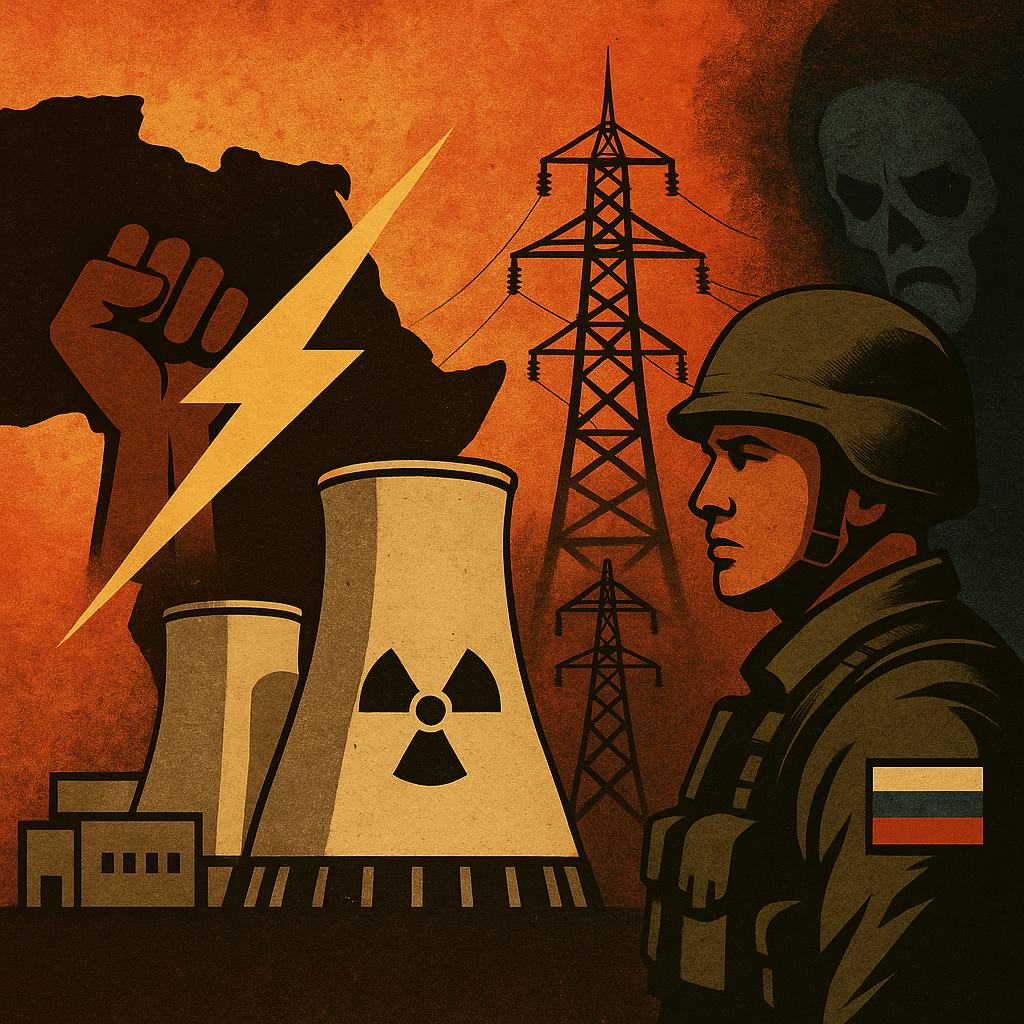
Western media warns of a Russian “nuclear takeover” in Africa—but the real fear isn’t Rosatom. It’s that African nations might finally escape Euro-American energy domination and reclaim power, infrastructure, and scientific sovereignty on their own terms.
By Weaponized Information | May 13, 2025
Part I: Radiation Warnings—But Only When the Empire Isn’t in Control
The article circulating on MSN—under the nondescript headline “How Russia Is Pushing to Take Control of Africa’s Nuclear Future”—is an unsigned dispatch. Like most Western propaganda today, it carries no authorial fingerprint because its voice doesn’t belong to a person. It belongs to an apparatus. MSN, a Microsoft-owned content funnel, is less a news outlet than a delivery system for empire-approved narratives. Its function is not to inform the public, but to curate ideological compliance across the algorithmic highways of the imperial core.
Microsoft, for its part, is no neutral bystander. It is one of the key nodes in the technofascist regime inside the United States—a monopoly-finance leviathan fused with state surveillance architecture, drone warfare systems, and predictive policing software. It bankrolls the very neural network of the imperialist media apparatus, laundering PR from NATO, the State Department, and arms contractors into digestible headlines. That’s the political economy of the outlet: colonization through aggregation.
The narrative being broadcast here aligns precisely with the class interests of Western energy monopolies, nuclear contractors, and foreign policy enforcers. Institutions like the International Atomic Energy Agency, the European Commission, and industry appendages such as the World Nuclear Association are all named in proximity to the story. No need to editorialize—just name them. They are the stewards of hyper-imperialism, the managers of the colonial leash.
The framing of the article is textbook Cold War reheat: “Russia is taking over,” “Africa is vulnerable,” and “the West must respond.” The language of panic—“push,” “influence,” “control”—suggests that Russia is somehow violating a sacred nuclear order that has, until now, kept Africa stable and safe. Left unsaid is that this “order” was built atop African uranium fields strip-mined by France, enforced by IMF austerity, and protected by coups and counterinsurgency. When the West poisons Africa, it’s called partnership. When another actor offers infrastructure and cooperation, it becomes infiltration.
The article infantilizes Africa at every turn. African states are not portrayed as sovereign decision-makers engaging in diplomacy and infrastructure development—but as dupes, lured by Russian manipulation. Their agency is erased. Their strategic rationality dismissed. In the eyes of the West, African nations are only legitimate when they know their place: as fuel suppliers, not reactor owners; as sources of extraction, not nodes of scientific development.
And then there’s the moral sleight-of-hand: the idea that only Western institutions are qualified to “safely” manage nuclear technology. The unspoken history here is brutal. Niger’s uranium powered French cities while its own people lit fires to boil water. South Africa’s post-apartheid nuclear development was deliberately sabotaged. Libya’s nuclear program was dismantled at gunpoint. This isn’t about proliferation—it’s about preservation. The West is trying to preserve its monopoly on the atom, on infrastructure, on power itself.
This article is not journalism. It’s cognitive warfare. Its purpose is not to debate facts but to manage perception—to frame multipolar cooperation as dangerous and to recast Africa’s right to technological advancement as a threat to global order. That’s the psychology of empire: it doesn’t fear instability. It fears sovereignty.
Part II: Beneath the Fallout—Extracting the Facts, Excavating the Silence
Let’s strip the propaganda to its bare bones. The article concedes that Russia’s state nuclear corporation, Rosatom, is expanding energy cooperation with several African nations. These agreements include infrastructure development, training programs, and long-term energy partnerships. It also notes, in an almost panicked tone, that African states remain rich in uranium but underdeveloped in nuclear energy infrastructure. What it does not say—what it cannot say—is that this is not by accident. It is by design.
Africa’s nuclear underdevelopment is a historical product of neocolonial extraction. For over half a century, countries like Niger, Namibia, and South Africa supplied the uranium that powered Western empires. France, in particular, built its entire nuclear energy program on Niger’s radioactive soil, even while Niger itself sat in the dark. Under the thumb of Areva (now Orano), Nigerien uranium was extracted for pennies, while local communities suffered radiation poisoning and structural poverty. That is the real “nuclear history” of Africa—a history erased by the article’s silence.
The West has never allowed African nations to develop full-cycle nuclear capacity. When Gaddafi proposed a pan-African energy grid and nuclear science institutions, he was met with sabotage, sanctions, and eventually military annihilation. When South Africa transitioned from apartheid, its nuclear research and development initiatives were frozen under international pressure. And when countries like Egypt or Algeria seek to develop peaceful nuclear programs today, they are hounded by Western watchdogs disguised as “nonproliferation experts.”
Meanwhile, the same countries ringing alarm bells over Rosatom have no issue selling fuel, reactors, and enrichment services to Saudi Arabia, the UAE, or Israel—none of which face the same scrutiny. This selective anxiety reveals the truth: the real concern is not technical capacity or geopolitical stability. It’s control. It’s about who owns the infrastructure, who builds the supply chains, and who dictates the flow of power—literally and figuratively.
In this context, Russia’s engagement is not an act of charity, nor is it free from contradiction. But it represents something the West cannot tolerate: the possibility of anti-imperialist sovereignty in the energy sector. Rosatom offers long-term agreements, localization options, and in some cases, partial technology transfer. Whether these partnerships fully serve African peoples remains to be seen—but they unquestionably disrupt the West’s monopoly over nuclear development in the Global South.
What the article erases is that this is not a story about Russia at all. It is a story about Africa—about a continent beginning to chart a course toward multipolarity, about sovereign governments attempting to build scientific and energy infrastructure on their own terms, and about the decaying hyper-imperialist order lashing out to preserve its dying grip.
Part III: From Radiation Panic to Energy Sovereignty—A New Story Must Be Told
Let us be clear: this isn’t about Russia “taking over” anything. This is about Africa refusing to stay where empire put it. For generations, the continent was reduced to a radioactive fuel depot for France and a dumping ground for colonial waste. The moment African nations begin to pursue sovereign development—on their terms, in partnership with non-Western actors—the alarms go off in Brussels, Washington, and Paris. The story writes itself: “interference,” “geopolitical risk,” “Russian influence.” But what the imperialist media cannot say—what they dare not say—is that Africa is moving.
It is moving away from the chokehold of hyper-imperialism—a world order in which infrastructure, finance, and technology are monopolized by the Global North and rationed back to the South only under conditions of debt, surveillance, and surrender. Nuclear energy, more than almost any sector, has been guarded like a priesthood. Only certain countries, we’re told, are mature enough to handle it. The rest are supposed to mine, export, and obey.
But African nations are not asking for permission. They are forging agreements—some with Russia, others with China, and increasingly with each other—to build reactors, train scientists, and lay the foundations for autonomous energy systems. These are not outposts of Russian imperialism. They are openings for anti-imperialist sovereignty, emerging within the very fissures of a decaying empire. The West calls it chaos. We call it rupture.
A multipolar world is not a utopia. It is a battlefield of contradictory forces. But it offers space for the Global South to maneuver, to experiment, to assert itself. Rosatom is not salvation—but its presence signals that the era of singular dependency is cracking. And it is not up to the U.S. or the EU to decide what direction Africa’s nuclear future takes. That right belongs to the people of Africa and no one else.
This is what frightens the imperialist class: not Russian involvement, but African initiative. Not technical risks, but political agency. The possibility that the continent might not only control its own uranium—but also generate its own electricity, run its own grids, and teach its own physicists. That is the real threat: not radiation, but revolution.
Part IV: From Mines to Megawatts—Building Power for the Powerless
We stand with the working classes, scientists, and sovereign peoples of Africa who are fighting to reclaim control over the atom—an element looted, weaponized, and monopolized by empire. The struggle for nuclear sovereignty is not a technical issue. It is a front in the global war between exploitation and emancipation, between hyper-imperialism and anti-imperialist sovereignty. And like all battlefronts, it demands not just analysis—but action.
Material solidarity begins with naming the enemy. France’s Orano (formerly Areva), Canada’s Cameco, and U.S.-based Westinghouse continue to plunder African uranium under exploitative contracts, while lobbying to block technology transfer to African states. These corporations profit from neocolonial extraction, laundering theft through “development partnerships.” They are the vanguard of imperial control—and they must be exposed, boycotted, and dismantled.
Across the Global South, resistance is already underway. Niger’s popular rupture with France over uranium theft marked a turning point. South Africa is reinvesting in nuclear science through BRICS+ cooperation. Zambia and Uganda are laying the groundwork for local research centers. These are not scattered anomalies. They are signals. The continent is rising—not as a client, but as a creator.
We call on all revolutionary media workers, organizers, students, and defectors from empire to take up this front:
- Expose the narrative manipulation: Deconstruct every article that paints Africa’s development as a threat. Weaponize WPE methods in your own communities and publications.
- Support the demand for nationalization: Stand in solidarity with calls for African control over their own uranium, reactors, and research institutions.
- Amplify African voices: Center African scientists, engineers, and energy workers who are building sovereign futures—don’t speak for them, speak with them.
- Build campaigns against the nuclear looters: Target EDF, Orano, and Western nuclear cartels that enforce dependency and block energy justice.
- Construct infrastructure for Proletarian Cyber Resistance: Use digital tools to map imperial energy flows, track extraction contracts, and disrupt cognitive warfare against the Global South.
Africa’s nuclear future belongs to its people—not to France, not to Washington, and not to any cartel hiding behind “nonproliferation” rhetoric. The era of atomic apartheid is ending. What replaces it is up to us. Will we allow the atom to remain a weapon of Western supremacy? Or will we transform it into a tool of liberation, lighting homes, hospitals, and revolutionary laboratories across the Global South?
We choose the latter. And we call on all comrades to join us in that fight.
 Weaponized Information
Leave a comment