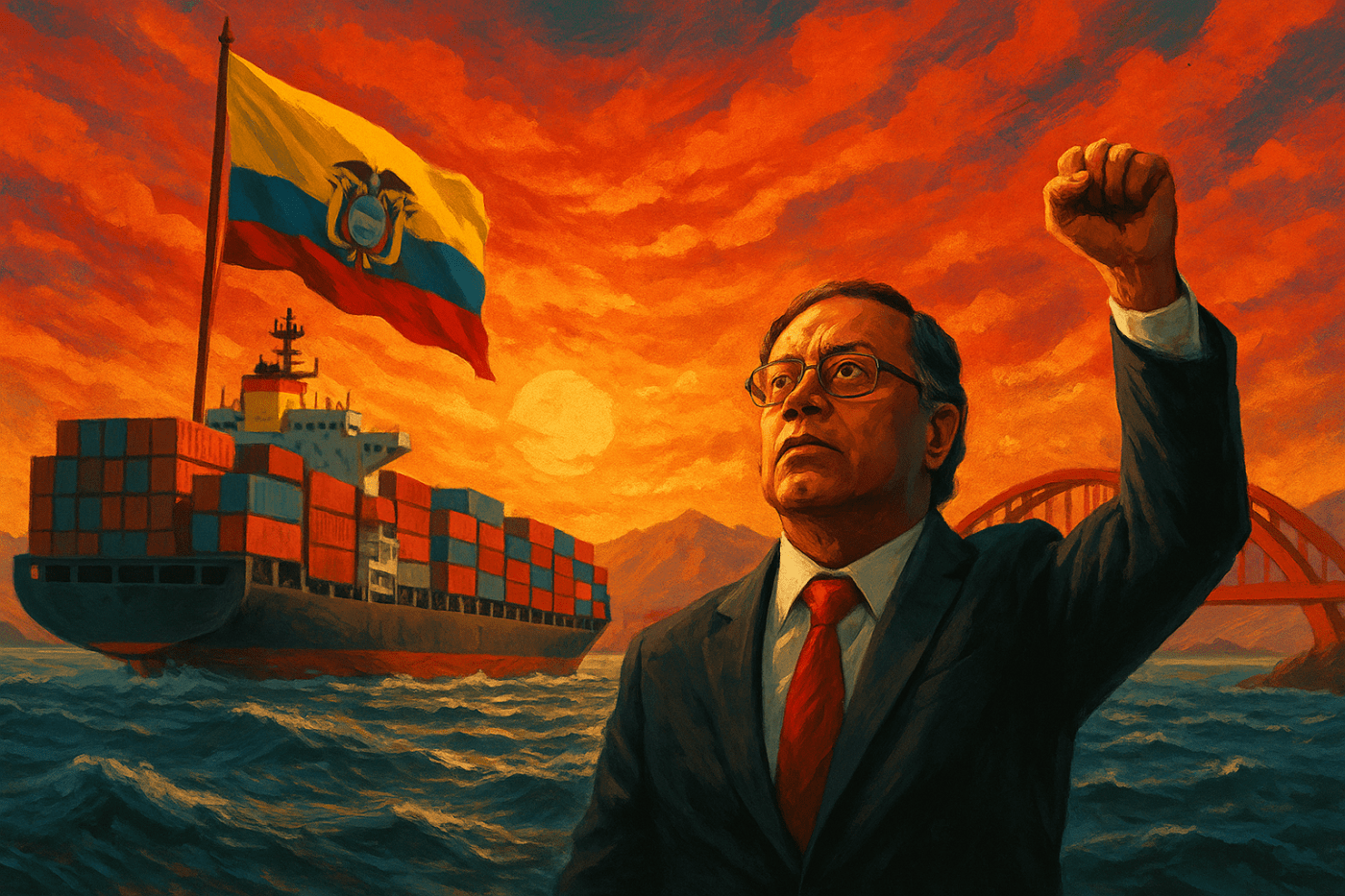
Petro’s BRI pivot signals more than diplomacy—it cracks the crust of hemispheric obedience and dares to chart another course
By Prince Kapone | Weaponized Information | May 12, 2025
I. Headlines from the Plantation: France 24, AFP, and the Colonial Anxiety Behind Colombia’s Turn
The article comes courtesy of France 24, republishing wire copy from Agence France-Presse (AFP)—a legacy colonial news agency operating as one of the core arteries of the Western imperialist media apparatus. AFP, funded by the French state and embedded within NATO-aligned information circuits, has consistently served as a mouthpiece for the Euro-American ruling class, especially in its portrayals of the Global South. No author is named—a convenient shield for institutional journalism that launders geopolitical panic into passive “reporting.” The class orientation is unmistakable: elite media bureaucrats transmitting the concerns of Western capital and empire, cloaked in the formal neutrality of the “international press.” Their subservience to Western power isn’t incidental—it’s structural.
Figures like Bruce Mac Master of the National Association of Colombian Businesspeople and Javier Diaz of the foreign trade lobby appear in the article to voice concern over Petro’s move—defending Colombia’s commercial dependency on U.S. markets and raising alarm over Chinese infrastructure investment as a threat to “international strategy.”
The article opens with a warning shot disguised as a headline: “Colombia moves to join China’s Belt and Road”, followed immediately by the anxiety-inducing clause: “a move sure to damage already frayed relations with Washington.” In other words, Colombia is not exercising sovereign trade policy—it’s committing a betrayal. This framing sets the stage: any shift toward China is not development, but defection. The headline doesn’t ask what the move means for Colombia’s poor or working class—it frames it entirely through the lens of U.S. displeasure. That is the true constituency of this article: the Western ruling class, not the Colombian people.
Petro is not referred to as Colombia’s president, but repeatedly as its “leftist” leader—an ideological tag loaded with suspicion. When the article notes that he intends to sign a “non-binding letter of intent” with China, it immediately tries to strip the act of political substance. “Future governments will decide if this intention becomes a reality,” it quotes Petro saying—positioning the BRI alignment as flimsy, symbolic, and reversible. At every turn, the article downplays the move while amplifying its supposed dangers. It’s a technique of double-edged minimization: if the BRI isn’t a threat, then why is it causing such panic? And if it is a threat, why insist that it’s “just a letter”? The answer is ideological: Western media cannot allow China to be seen as offering meaningful alternatives.
The framing of the BRI itself is revealing. It is described not in terms of infrastructure or cooperation, but as “a central pillar of Xi’s bid to expand his country’s economic and political clout overseas.” This is not reportage—it is projection. The article uses terms like “leverage,” “battle for influence,” and “clout” to evoke Cold War fears of foreign domination—while refusing to interrogate the far more extensive economic, military, and financial control the U.S. has wielded over Colombia for decades. Plan Colombia, U.S. military bases, IMF structural adjustment, and mass political killings—none of this makes the article. Instead, we are told the real danger is a highway project with Chinese cement.
And yet the article’s own facts betray its intentions. It admits, for instance, that “imports from China recently outpaced those from the United States.” It mentions that Petro had already denied U.S. military flights carrying deportees, and that Washington retaliated with 25% tariffs. But instead of framing this as coercion by the U.S., the article presents it as diplomatic tit-for-tat—flattening imperial retaliation into the language of policy friction. Colombia’s response is called a “backdown.” The U.S.’s move is framed as legitimate statecraft. The propaganda isn’t just in what is said—but in what is normalized.
In its closing paragraphs, the article quotes Colombian business elites asking: “Does Colombia want to do this right now? In exchange for what?” It’s a telling moment. The question isn’t whether BRI could benefit Colombia’s infrastructure, reduce dependence, or rebalance trade. It’s whether the country is allowed to make sovereign choices at all. Behind the thin language of economics lies the quiet terror of disobedience. What France 24 and AFP fear isn’t debt—it’s deviation. And what they seek to protect isn’t Colombia’s future—but the empire’s past.
II. From Plan Colombia to the Silk Road: Extraction, Dependency, and the Struggle for Sovereignty
Stripped of ideological framing, the article offers a few key empirical facts: Colombian President Gustavo Petro has announced plans to sign a non-binding letter of intent to join China’s Belt and Road Initiative (BRI) during an upcoming visit to Beijing. U.S.-Colombia relations are already strained—sparked by recent disputes over deportations and retaliatory tariffs under Trump 2.0. Petro’s move follows China’s persistent diplomatic pressure and comes months after Panama withdrew from the initiative under intense U.S. lobbying. The article also notes that while the United States remains Colombia’s largest buyer of exports, China has overtaken the U.S. as Colombia’s top source of imports. These data points, taken together, suggest a structural realignment in the making.
But the article says nothing of the historical scaffolding that defines Colombia’s position in the world system. For decades, Colombia has functioned as one of Washington’s most loyal satellites in Latin America. From the late 1990s through the Obama era, “Plan Colombia” funneled over $13 billion in U.S. aid into the Colombian military and paramilitary networks under the guise of drug war assistance. That aid came with strings: privatization mandates, counterinsurgency doctrine, and the systematic annihilation of peasant and unionist movements. The result was a scorched-earth neoliberalism that made Colombia “safe” for transnational capital but deadly for anyone who stood in its way. Massacres were not a policy failure—they were the price of compliance.
The article mentions none of this. It offers no context for why a sitting Colombian president might seek alternatives. No reference to the hollowing out of national industry. No mention of the murder of over 1,000 social leaders since the signing of the 2016 peace accords. No discussion of the agrarian question, the yawning infrastructure deficit, or the country’s reliance on extractive exports that serve foreign markets while leaving local communities poisoned and impoverished. All of that history is erased. And in its place, we are given a fantasy: that Colombia’s movement toward China is abrupt, irrational, and personal—driven by Petro’s “leftist” leanings, not by material constraints or systemic crises.
The article also fails to situate the BRI within the broader context of multipolar reconfiguration. The Belt and Road is not simply a Chinese investment program. It is a counterproposal to the Bretton Woods–NATO framework that has dominated the postwar era. Unlike IMF structural adjustment, BRI loans tend to avoid austerity conditionalities. Unlike U.S. aid packages, they don’t come with military bases or CIA advisers. Infrastructure, telecommunications, energy grids—these are the hard platforms of sovereignty, and China is offering them at scale. But this isn’t an uncritical endorsement. BRI projects have had contradictions: debt burdens in Sri Lanka (caused by pre-existing Western debt trap), elite capture in Kenya, ecological concerns in parts of Southeast Asia. Yet even these contradictions unfold within a different logic—one that doesn’t assume U.S. overlordship as the default setting of global development.
It is precisely this opening—this limited but real space for maneuver—that the Western ruling class fears. Not because it guarantees justice, but because it threatens monopoly. That’s why the article treats Colombia’s move not as a sovereign calculation, but as a geopolitical transgression. And that’s why Colombian business elites are wheeled out to ask rhetorical questions like, “In exchange for what?” The answer, unspoken but material, is this: in exchange for the possibility of infrastructure without occupation, development without IMF dictates, and trade that is not pegged to the survival of empire.
III. Not Betrayal—Breakaway: Colombia’s Move as Strategic Disobedience
This was never just about trade. When Colombia moved toward the Belt and Road Initiative, it didn’t just signal interest in infrastructure—it pulled the fire alarm on a century of imperial command. That’s why France 24’s article trembles with subtext: the imperial script has been breached. A junior partner has refused to stay in line. And in a world held together by debt traps, gunships, and bilateral “friendships” built at the barrel of a trade deal, such defiance is unforgivable.
Let’s reframe this moment properly. What Petro has done—whether from conviction, calculation, or pressure—is insert Colombia into the widening crack in the U.S.-led global order. It’s not yet a revolutionary rupture, but it is a crack. And cracks matter. Because in an international system built on unipolar obedience, the decision to even entertain another orbit—especially one led by China—is an act of geopolitical insubordination. That’s why the business class is howling. That’s why the media is panicking. That’s why Washington is retaliating. Not because Petro has “aligned with Beijing,” but because he dared to flirt with alternatives.
This is not about siding with one empire over another. It is about breaking the monopoly of one. The U.S. didn’t dominate Latin America by offering fair trade—it did so by disappearing presidents, arming death squads, and turning countries into laboratories for financialized extraction. China, for all its contradictions, is not bombing villages in Colombia. It isn’t backing paramilitary groups to crush unions. It hasn’t spent decades funding war under the cover of counter-narcotics. That doesn’t make China innocent—but it does make the terms different. And that difference matters.
France 24 wants us to see this shift as irrational, dangerous, even traitorous. But from the standpoint of Colombia’s working class, its peasantry, its students and displaced—this isn’t betrayal. It’s possibility. It’s the beginning of a conversation that has been violently suppressed for decades: What would it mean to develop infrastructure that serves the people and not foreign creditors? What would it mean to build trade relations that don’t hinge on the approval of a declining hegemon? What would it mean to exit the long night of Plan Colombia and step into something not dictated by Washington or Wall Street?
This is not utopia. BRI will not liberate Colombia. Multipolarity will not abolish capitalism. But these are openings—windows in the wall. And history teaches us that openings, once widened by people’s movements, can become ruptures. Petro’s move is not the revolution. But it has—however unintentionally—exposed the limits of the old arrangements. And now the ruling class is scrambling to patch the breach. That tells us everything we need to know about its potential.
IV. Make the Break Irreversible: From Diplomatic Gesture to Popular Struggle
Colombia’s move toward the Belt and Road Initiative is not the final destination—it is an opening. But openings are fragile. And without popular pressure from below, they are easily sealed shut by elite sabotage, imperial backlash, or quiet reversals cloaked in legal nuance. France 24 ends its article with a corporate lament and a passive shrug—“Future governments will decide if this intention becomes a reality.” That is not just a prediction. It’s a threat. A warning from empire: this move will be undone unless the people hold the line.
That’s why this moment demands more than commentary. It demands mobilization. Revolutionaries and anti-imperialist forces must not confuse Petro’s limited defection with liberation. But neither should we dismiss it. Instead, we must treat it as contested terrain—a space to organize, agitate, and insert the demands of the people into what has so far been a diplomatic process dominated by heads of state and capital. Colombia’s working class, Indigenous nations, Afro-Colombian communities, landless peasants, and displaced peoples must be centered in the next phase—not as spectators to BRI investment, but as builders of dual and contending power rooted in anti-colonial sovereignty.
That means exposing the U.S. counterattack: the tariffs, the sanctions, the lawfare. It means rejecting the neoliberal appropriation of BRI as just another supply chain conduit for elites. It means internationalist solidarity from below—linking Colombia’s break with campaigns across the South: base closures in Ecuador and Honduras, anti-austerity uprisings in Argentina, food sovereignty battles in Haiti. The breakaway must be materialized—through people’s assemblies, land recuperations, infrastructure monitoring collectives, and cross-border organizing against imperial retaliation.
Revolutionaries inside the empire also have a role to play. In the U.S., in France, in the E.U. metropoles: we must target the institutions that enforce Colombia’s dependency. Organize actions at IMF offices, disrupt World Bank summits, expose the NGOs laundering regime change narratives. Elevate Colombian grassroots voices over the whining of businessmen and ex-generals. Refuse the framing of “stability” and demand sovereignty—for all colonized nations, not just those who make headlines.
This is the task now: to make the break irreversible. To turn this symbolic departure into a structural one. To forge solidarity not around Petro’s presidency, but around the class forces that made this moment possible—and that will determine what comes next. A letter of intent is not a revolution. But if we do our work right, it can become the first paragraph in a much longer declaration.
 Weaponized Information
Leave a comment