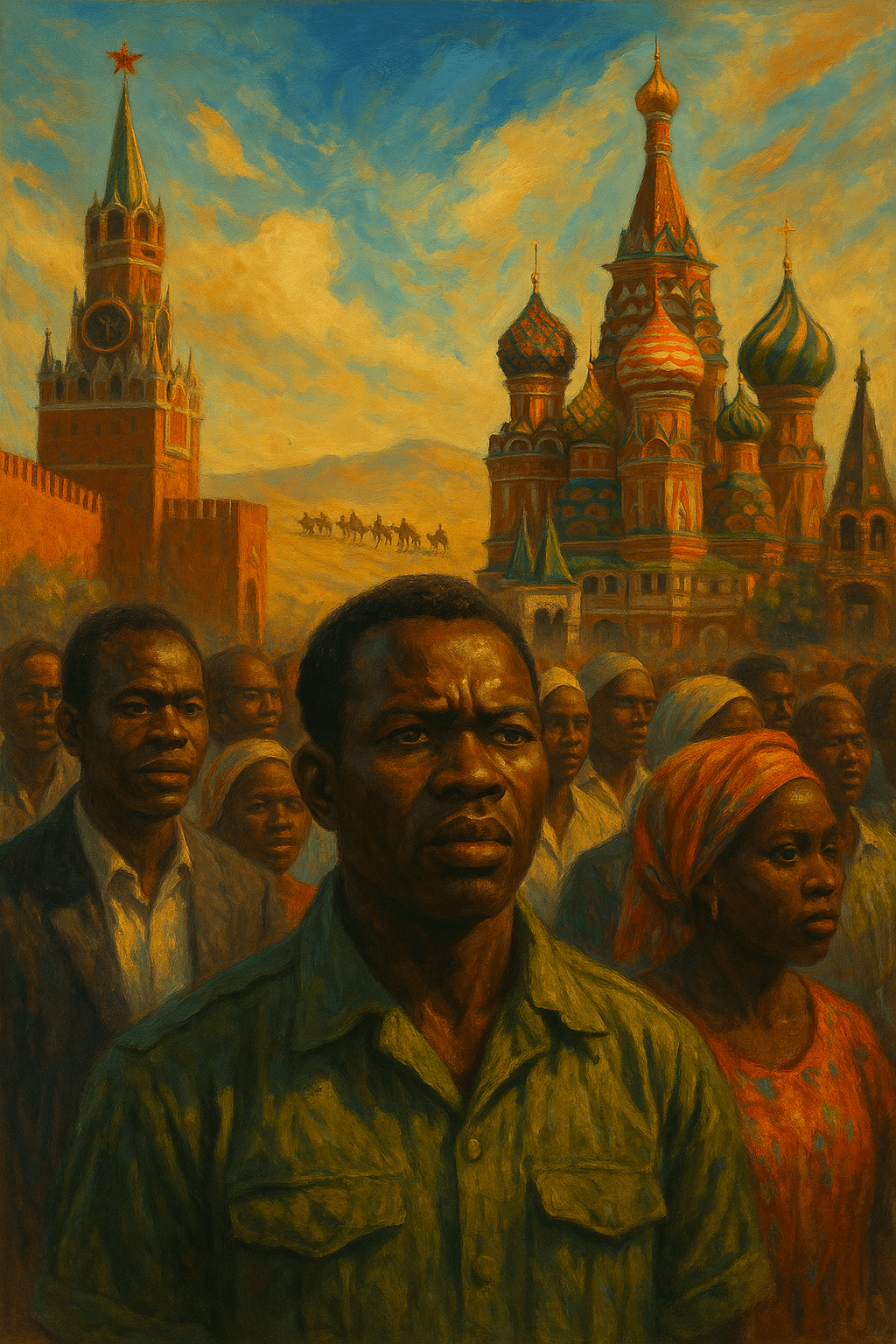
As Western empire crumbles, a multipolar alliance rises from Red Square to Ouagadougou
By Prince Kapone | Weaponized Information | May 9, 2025
A Stage of Sovereignty: Victory Day as a Platform for Russia-Africa Solidarity
In an era when most media coverage of Russia is shaped by the cold contempt of Western information war rooms, it’s rare to find a piece that even attempts to treat Russia-Africa relations with nuance, depth, and historical memory. Kestér Kenn Klomegâh’s recent article in Business Post Nigeria does just that. Though not radical in tone, the piece shows signs of political sobriety and journalistic dignity—qualities absent from the ghoulish spectacle of Atlanticist war propaganda.
Klomegâh is no revolutionary firebrand, but neither is he a mouthpiece for imperialism. A long-time chronicler of African diplomacy and Russia-Africa relations, his work reflects a Pan-Africanist curiosity, an interest in sovereignty, and a belief—however cautious—that the multipolar world is worth documenting. His tone leans toward state diplomacy, not mass struggle, but in a time when the bourgeois press can’t mention Russia without snarling, even level-headed observation becomes an act of defiance.
And Business Post Nigeria? It’s no vanguard paper, but it is not Reuters, not Bloomberg, not CNN. It speaks from the Global South, to the Global South. Owned and operated from Nigeria’s media landscape, it operates with relative editorial independence. It reflects the ideological openness of a region not yet fully captured by Atlanticist consensus. In our own framework, this makes it a fraternal voice—not beyond critique, but not to be smashed either.
Where most Western headlines vomit phrases like “Russia’s propaganda parade” or “Putin’s authoritarian spectacle,” this article dares to name what May 9th truly is for much of the world: a commemoration of anti-fascist victory, and increasingly, a platform for declaring a new order. And crucially, it documents the presence of African leaders—from Burkina Faso to Zimbabwe—who traveled not as beggars for aid, but as partners exploring new configurations of sovereignty, trade, and resistance.
The framing isn’t revolutionary, but it is respectful. Klomegâh neither scolds nor sneers at the Sahelian states forging ties with Moscow. He doesn’t scold them for rejecting ECOWAS, doesn’t wag the liberal finger over “military juntas,” and doesn’t sanitize France’s long trail of exploitation. Instead, he simply reports—with admiration—that these governments are reclaiming their minerals, restructuring their economies, and bartering resources for weapons not to wage war but to defend against it.
This is narrative insurgency by subtraction. By not calling anti-colonial governments “unstable,” Klomegâh allows their actions to breathe. By naming cooperation with Russia without invoking “influence,” he breaks the spell of Atlanticist hegemony. He refuses to treat the presence of African leaders in Moscow as scandalous—and in doing so, makes it feel normal, even dignified.
What’s more, he centers African agency. The article does not render Africa a passive recipient of Moscow’s geopolitical courtship. Instead, it highlights the deliberate recalibration of foreign policy by Sahelian states, the conscious pivot from French dependency to multipolar partnership, and the willingness to barter resources on their own terms. The African leaders are not props in Putin’s parade—they are protagonists in a shared vision of post-colonial alignment.
Even in its limitations, this article opens doors. It does not mention the counterinsurgency operations of AFRICOM, nor the resource plunder of Total and Areva, nor the war crimes of France in Mali and Burkina. But its silence on these issues is not a cover-up—it is an editorial choice consistent with a tone that seeks cooperation, not confrontation. It leaves space for us to speak more sharply, but it does not undermine the basic dignity of the moment.
In an information ecosystem drenched in cognitive warfare, even calm observation from the Global South can function as subversion. This article doesn’t radicalize—but it doesn’t lie. And in a world built on lies, that is no small thing.
The Geopolitical Ground Beneath Red Square
It’s tempting to treat Victory Day as pure pageantry—brass bands, tank parades, and nationalist speeches—but to do so would miss the tectonic shifts beneath the ceremony. What took place in Moscow wasn’t just a military celebration; it was a stage for recalibrating world power, and the presence of African heads of state was no accident. These leaders were not passive spectators. They were collaborators in a new historical moment, standing alongside Russia not as clients, but as co-architects of a multipolar future.
To understand this, we must situate the ceremony within the long arc of imperialist decline and resistance. The West’s centuries-long dominion over Africa—first through direct colonialism, then through structural adjustment, debt servitude, and endless counterinsurgency—is fracturing. Burkina Faso, Mali, and Niger have already torn the umbilical cord to France. Guinea-Bissau, Zimbabwe, Equatorial Guinea, Congo, and others are exploring deeper ties with Russia—not because of nostalgia or opportunism, but because the colonial options are bankrupt. These are not isolated moves. They are part of a broader regional realignment away from the hyper-imperialist yoke of the U.S.-EU axis and toward strategic partnerships grounded, at least aspirationally, in anti-imperialist sovereignty.
What’s more, the material basis for this pivot is not a matter of dreams or declarations—it is energy, minerals, infrastructure, arms, and hard geopolitical calculus. Russia’s outreach to Africa is not charity; it is mutually beneficial statecraft. Rosatom’s nuclear energy MOUs with Burkina Faso. Military training and equipment swaps in the Sahel. Infrastructure deals in Congo and Central African Republic. Platinum extraction in Zimbabwe. These are not just deals on paper—they’re living nodes in a parallel world economy that challenges the West’s monopoly on finance, extraction, and development models.
And all of this unfolds under the shadow of the collapsing dollar order. The United States responds to its declining power not with humility, but with tariffs, sanctions, and a propaganda barrage aimed at isolating Russia and undermining any state that dares break rank. That’s why the image of African presidents standing beside Putin in Red Square carries such historical weight. It is the inverse of the G7 summit, the counter-image to Bretton Woods, Davos, and Munich. It signals not only a geopolitical realignment, but the return of historical memory—one in which Africans remember who helped them fight colonialism, and who armed and funded their oppressors.
This is the deeper context for Victory Day 2025. Not merely a remembrance of Nazi defeat, but a subtle declaration that the defeat of fascism is still unfinished—that it now requires defeating the economic fascism of monopoly capital, the military fascism of NATO, and the technocratic fascism of algorithmic empire. And it is precisely because Russia once stood with anti-colonial movements, and because it now challenges the unipolar world order, that African leaders are responding. Not blindly. Not uncritically. But with eyes wide open to the opportunity for something different. Something multipolar. Something sovereign.
From Moscow With Multipolarity: Africa’s New Road to Sovereignty
What’s taking shape in Moscow is not some nostalgic rehash of Cold War theatrics. It is a tectonic shift—a recalibration of the global order where Africa and Russia, bound by memory and material interest, are learning to walk the new world stage together. The leaders who stood on Red Square weren’t there to nod solemnly at old battles; they were laying the groundwork for new ones—against neocolonial dependency, IMF structural sabotage, and Western-dictated terms of engagement.
The Russian-African partnership is not born from charity. It is grounded in mutually recognized necessity. Africa holds the world’s remaining strategic reserves—lithium, uranium, bauxite, oil—and Russia, encircled by sanctions and imperialist warfare, offers technology, grain, military protection, and a seat at a different table: one not carved from Bretton Woods timber. The West sees this as threat. We see it as alignment.
And let’s be precise. Russia isn’t handing out development loans tied to colonial contracts. It’s bartering weapons for mining rights, scholarships for diplomatic loyalty, wheat for political cover. These aren’t soft power exchanges—they’re strategic transactions aimed at untying Africa’s hands from the financial noose of the IMF and World Bank. This is anti-imperialist sovereignty in real time, however contradictory, however incomplete.
The BRICS framework—with Egypt, Ethiopia, and South Africa among its ranks—has now become a platform of strategic convergence. The entry of these African states into BRICS doesn’t just add numbers; it adds mass to the multipolar gravity that is pulling global trade, finance, and infrastructure away from Washington and toward a new axis of cooperation. In short: the unipolar empire is cracking, and Africa is no longer waiting for permission to act.
The agreements signed—from nuclear cooperation with Burkina Faso to platinum mining in Zimbabwe—are not without contradiction. Russia is not a socialist state. Rosatom and LUKOIL are not revolutionary organizations. But these deals are being made on different terms: terms shaped not by the West’s false benevolence, but by the assertive recalibration of sovereign states who are now speaking the language of multipolarity, not dependence.
And so, the sight of African presidents at the May 9 parade is not just symbolic. It is substantive. They are bearing witness not to a parade, but to a pivot—to a moment when the Global South steps forward not as charity case or client state, but as co-author of the post-American century.
From Spectacle to Struggle: Converting Commemoration into Commitment
If this year’s Victory Day in Moscow reminded the world that the fascists can be defeated, then it must also remind revolutionaries that fascism doesn’t die with surrender ceremonies—it mutates. Its latest mutation—hyper-imperialism—comes not in jackboots, but in sanctions, debt traps, and drone strikes. And if history is not merely to be remembered but made, then this commemoration must catalyze action.
The parade in Red Square was no ordinary state ritual. It marked a new front line in the struggle for multipolarity and anti-imperialist sovereignty. From Ouagadougou to Harare, from Bamako to Addis Ababa, African leaders stood shoulder to shoulder with Russia—not as pawns of geopolitical convenience, but as representatives of nations struggling to reclaim stolen futures. Their presence was a signal: the age of unipolar arrogance is cracking.
But solidarity is not a photograph. It is not a speech. It is not a military flyover. It is material, organized, and militant. If Africa and Russia are to walk forward in lockstep, it must be with clear eyes and clenched fists. African states must resist becoming subcontractors for new global blocs. Russia must not mirror the extractivist logic of its imperial predecessors. The old alliances—built on memory—must be reforged in struggle.
We call on revolutionaries in the imperial core to break the silence, break the sanctions, and break the myth of Western benevolence. Begin by:
- Organizing political education campaigns in your communities about the historical role of the USSR in supporting African liberation movements.
- Exposing AFRICOM, EUFOR, and NATO bases operating across Africa under the guise of security and stability.
- Supporting material solidarity campaigns that provide technology, medicine, or knowledge exchange between youth and revolutionary institutions in Africa and Russia.
- Amplifying the voices of African revolutionaries—like Ibrahim Traoré, Assimi Goïta, and the pan-Africanist grassroots movements reshaping political life in the Sahel.
- Calling for an end to the sanctions architecture and imperialist blockades targeting African nations aligned with Russia or BRICS+.
Our role is not to be cheerleaders or commentators but combatants in the ideological war. We must produce and circulate a new kind of media—anti-colonial, anti-capitalist, and fiercely loyal to the international proletariat. From the streets of Atlanta to the fields of Guinea-Bissau, from the servers of Toronto to the schools of Addis Ababa, a new world must be born. But it won’t arrive through commemoration—it will be built through confrontation.
We do not march for nostalgia. We march to make the future ours. Let the ghosts of the Red Army and the Mau Mau rise again—not as memory, but as motion.
 Weaponized Information
Leave a comment