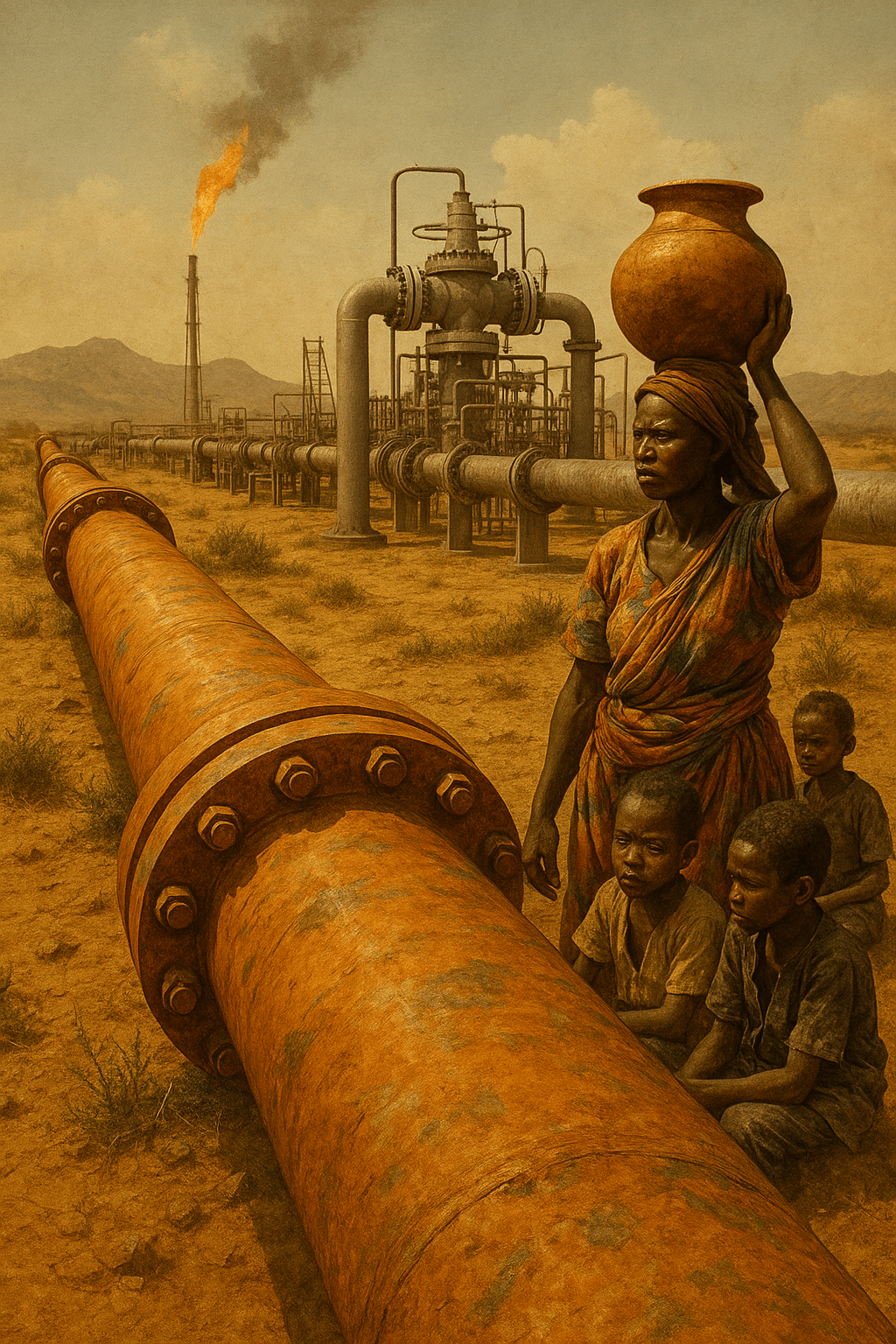
Touted as a development milestone, the Nigeria-Morocco pipeline is a corridor of imperial theft—funded by Gulf capital, wired to Europe, and enforced through technocratic deception and military coordination. What they call infrastructure, we call extraction.
By Prince Kapone | Weaponized Information | May 9, 2025
Follow the Pipe, Find the Parasites: Excavating the Neocolonial Narrative
The article in question comes from Business Insider Africa—a colonial outpost in the imperial media machine, dressed up in African branding. Don’t be fooled. It’s a corporate appendage of Insider Inc., which itself is owned by Germany’s Axel Springer SE, a publishing conglomerate whose loyalty isn’t to truth or the people, but to Wall Street, NATO, and the Atlanticist project. Their charter mandates support for “a united Europe,” the “free market,” and the “transatlantic alliance”—meaning every headline runs through a Western filter before it reaches African eyes. It’s not African media. It’s imperial messaging in local dialect.
The author isn’t named—typical of technocratic propaganda. No fingerprints. No accountability. Just institutional prose that floats above the continent like a development drone, dispensing buzzwords and investment metrics without ever touching the ground. This style isn’t neutral—it’s surgical. By omitting the author, the story becomes ideology without a face. It launders power through the illusion of expertise, as if facts can exist without politics.
The article never mentions who benefits—but you know damn well we will. The European Investment Bank. The Islamic Development Bank. ECOWAS. The UAE’s sovereign wealth funds. And behind them, the real pipeline: BlackRock, BP, Shell, and the European Commission’s Green Deal task forces. The role of these institutions isn’t explained—it’s assumed. They are presented as natural participants in Africa’s future, when in reality, they are architects of its continued dependency.
And what’s the story being sold? A heroic investment in “Africa’s largest pipeline,” linking Nigeria to Morocco and, eventually, to Europe. A project of “integration,” “development,” and “regional cooperation.” The UAE, we’re told, swooped in after U.S. interest faded, committing $25 billion to help carry African gas to European homes. It’s pitched like a win-win. But the math doesn’t add up—not for the people doing the digging.
There’s no mention that Nigeria—Africa’s largest oil and gas producer—still flares hundreds of millions of cubic feet of gas daily, while over 100 million Nigerians live in energy poverty. There’s no mention that more than 600 million people across sub-Saharan Africa have no electricity at all. Instead, we’re told about kilometers of pipe, not communities displaced. We hear about financing rounds, not forced relocations. We see maps, not lives.
The trick lies in the language. “Integration” means infrastructure geared toward export, not redistribution. “Development” means extraction made more efficient. “Energy security” means European lights stay on while African villages stay dark. The article reads like a press release from the IMF—technical, upbeat, and utterly detached from the material conditions of African people. That’s the point. It’s not written to inform. It’s written to normalize plunder.
This is what we call infrastructurewashing—when looting is disguised as logistics. When pipelines are treated as progress, even as they drain the continent’s wealth northward. It’s not that the facts are wrong—it’s that they’re weaponized. Deployed selectively. Arranged to flatter empire. Sanitized to obscure the violence of global capital.
And at the center of it all is the pipeline itself—described not as a corridor of extraction, but as a “development opportunity.” Who made this decision? Who demanded the gas flow north instead of inward? Who gets the profits? Who loses the land? Not a word. Not a whisper. Just the drumbeat of inevitability: Europe needs gas, Africa has gas, therefore Africa must deliver. As if empire didn’t already steal centuries of labor, minerals, and life.
The real narrative here is empire in crisis. Europe, cut off from Russian gas after NATO’s war games in Ukraine, is desperate. The UAE, for now a vacillating subcontractor of U.S. imperialism, steps in as financier—not out of solidarity, but because Gulf capital needs new outlets and new leverage. And ECOWAS, increasingly acting as an enforcer for external interests, signs on without a fight. That’s the pipeline. A route paved in broken promises, brokered by technocrats, and enforced by militarized states.
This article doesn’t analyze the pipeline—it markets it. It doesn’t question power—it reinforces it. What we’re looking at is propaganda, not reporting. A development fairytale for investors and imperial managers. And like all good propaganda, it tells us more by what it leaves out than by what it says.
Corridors of Extraction, Not Development: Mapping the Material Terrain
The article tells us that the Nigeria-Morocco Gas Pipeline will be the largest in Africa, stretching over 5,660 kilometers and running through 13 countries, from Nigeria to Morocco’s northern tip, where it will feed directly into Europe’s energy grid via Spain. We’re told that the UAE has committed $25 billion to finance it, and that various international institutions—like the European Investment Bank and the Islamic Development Bank—are involved in its development. But stripped of its corporate polish, this story reveals something far less inspiring: not a vision of African integration, but a blueprint for continental looting.
Let’s begin with the raw data: Nigeria is already one of the world’s largest exporters of liquefied natural gas (LNG), with pipelines that mostly bypass its own population. Over 100 million Nigerians—nearly half the country—live without consistent electricity. Despite sitting on one of the world’s largest gas reserves, Nigeria flares around 275 million cubic feet of gas per day, often just to maintain production levels for export. Across sub-Saharan Africa, nearly 600 million people lack access to electricity, and over 900 million lack clean cooking fuel. The basic energy needs of African people are not just unmet—they’re actively subordinated to the export demands of imperial capital.
And yet, the pipeline doesn’t move inward, toward domestic distribution or regional energy sovereignty. It moves north, toward Europe—a continent now scrambling to decouple from Russian gas after NATO’s war in Ukraine backfired economically. The EU, desperate for alternative suppliers, has turned its gaze southward. This pipeline isn’t about Africa—it’s about Europe’s survival. It’s a colonial solution to an imperial crisis, executed through a subcontracted Gulf intermediary.
The pipeline is projected to cost over $30 billion. The UAE’s $25 billion contribution is framed as generosity, but in reality it’s a high-yield geopolitical investment. Abu Dhabi doesn’t move without strategic returns. It seeks to solidify its role as an energy broker between Africa and Europe, earning both capital and political leverage. Meanwhile, African nations along the route—Benin, Togo, Ghana, Senegal, Mauritania—will shoulder the costs in expropriated land, environmental degradation, debt, and political instability.
None of this is new. In fact, it fits neatly into the pattern of neocolonial energy logistics established over decades. From Shell in the Niger Delta to TotalEnergies in Mozambique, Western powers have long relied on African hydrocarbons to subsidize imperial lifestyles. What has shifted is the choreography: today, Gulf states play intermediary, while Western finance repositions behind them. This is the essence of hyper-imperialism—a decentralized, multi-national arrangement in which empire outsources its violence, but not its control.
The role of ECOWAS in this arrangement also deserves scrutiny. Ostensibly a regional bloc aimed at African unity, ECOWAS has increasingly acted as a comprador enforcer of transnational capital. It has backed French and U.S. military bases in the Sahel, sided with the IMF during debt crises, and imposed sanctions on member states that challenge imperial authority. With this pipeline, ECOWAS acts again—not to coordinate sovereign energy access, but to smooth the logistics of extraction. It greases the gears of infrastructure that bypasses its own people.
Equally absent from the article is the question of militarization. Large-scale pipelines like this one do not move through 13 countries without armed protection. Already, gas projects in Mozambique have triggered mass displacement and militarized repression. In Nigeria, pipeline sabotage has been criminalized while multinational firms operate with immunity. The Nigeria-Morocco pipeline will likely be policed by a mix of private contractors, national armies, and possibly AFRICOM assets. In this context, “infrastructure” becomes a vector of counterinsurgency.
Historically, we’ve seen this model before. The Chad-Cameroon pipeline. The Baku-Tbilisi-Ceyhan pipeline. The Nabucco project. These corridors were never about national development. They were designed to lock in imperial flows of capital and energy while locking out the masses from the fruits of their own land. The Nigeria-Morocco corridor is no exception—it is simply updated with “green transition” rhetoric and Gulf petrodollars.
And while Europe attempts to present this project as part of its energy diversification strategy, the Global South sees the truth: these pipelines do not signify independence—they deepen dependency. Africa becomes the tube. Europe gets the oxygen. And the patient on the table isn’t Africa rising—it’s empire surviving by any means necessary.
From Pipeline to Lifeline: Reclaiming the Narrative of African Energy Sovereignty
Let’s strip away the development gloss and speak plainly: this pipeline is not for Africa. It is not a bridge to prosperity. It is a lifeline for empire—an umbilical cord from the decaying heart of Europe to the resource-rich soil of the African continent, sustained by Gulf intermediaries and enforced by comprador states. But there is nothing inevitable about this project. It is not progress. It is a theft in motion, and it can be stopped.
We must begin by reframing the terms. What they call “energy access,” we must name as imperial rerouting. What they frame as “investment,” we must understand as preemptive debt capture. And what they call “partnership,” we must unmask as colonial choreography—a tightly scripted performance in which African governments play grateful recipients while their people remain in the dark, literally and politically.
Africa is not a gas station. It is not a staging ground for Europe’s post-Ukraine energy panic. It is a continent of nations, peoples, and revolutionary histories. And in that history lies a different vision of energy—a vision where natural gas doesn’t flow north for European factories, but flows inward, powering African homes, hospitals, schools, and local industries. A vision where infrastructure is not built for extraction, but for redistribution. Where development is not measured in GDP growth, but in collective dignity and ecological repair.
We do not have to imagine this from scratch. We have models. The revolutionary government of Burkina Faso under Thomas Sankara invested in decentralized energy, village electrification, and self-sufficient agriculture—not pipelines for export. In the early 2000s, Bolivia under Evo Morales nationalized its gas fields, redirecting profits to social programs and lifting millions out of poverty. Venezuela, for all its contradictions, used its oil revenue to build universal healthcare and subsidized food systems. These efforts were attacked, sanctioned, and sabotaged—but they showed what energy sovereignty can look like when it’s rooted in the needs of the people.
What we face today is not a lack of resources, but a lack of power—political, not electrical. The African masses have been locked out of energy policy by a triangulated force of foreign investors, comprador elites, and multilateral institutions. This pipeline will only entrench that power structure. It will widen the distance between the gas field and the grassroots, between the grid and the ghetto.
But the masses are not passive. Across the continent, people have resisted this model. In the Niger Delta, youth have blown up pipelines, seized oil rigs, and declared autonomous zones. In Kenya, movements have stopped coal plants and forced environmental reviews on Chinese-backed infrastructure. In Mozambique, communities displaced by TotalEnergies’ gas megaproject have protested en masse, forcing international scrutiny. These struggles aren’t isolated—they are a continental front against logistical colonialism.
Our orientation must be rooted in these movements. The Nigeria-Morocco pipeline is not just an energy project—it is a territorial weapon, redrawing the map of Africa to serve Europe’s hunger. It is part of a broader imperial strategy to turn the continent into a corridor of extraction and surveillance, managed by Gulf intermediaries, militarized borders, and technocratic deception. The goal is not to empower Africa—it is to bypass it, drain it, and pacify it.
So we ask: what if the gas stayed in Africa? What if every dollar spent on transcontinental export was redirected toward off-grid solar for rural communities, methane capture for cooking fuel, and public ownership of natural resources? What if ECOWAS represented the working class instead of enforcing the contract class? What if the pipeline ran horizontally—between African nations, for African needs—rather than vertically into European markets?
This is not a utopian fantasy. It is a revolutionary necessity. And the first step toward it is ideological. We must refuse their narrative. Refuse their framing. Refuse their future. Because what’s at stake is not just gas—it’s the question of who Africa belongs to. And our answer must be clear: it belongs to the people, not the pipelines.
Sabotage the Corridor, Light the Way: Toward Revolutionary Energy Sovereignty
We do not analyze empire to admire its machinery. We study it to destroy it. And if this pipeline is the imperial artery, then it must be seen not just as infrastructure—but as a target. A target for political exposure, ideological rupture, and material resistance. Because every kilometer of this project is built on the backs of workers, peasants, and the displaced. It is not neutral. And we cannot be neutral in the face of it.
We declare full ideological unity with the revolutionary working class and peasantry of West Africa—especially the Niger Delta communities who have lived for decades in the shadow of pipelines and poverty. They have known what the Business Insider won’t say: that gas can burn through your land without ever lighting your home. They have risen before—and they will rise again. The Movement for the Emancipation of the Niger Delta (MEND) and newer formations like the Niger Delta Avengers showed the world that pipelines are not just lines—they are leashes. And leashes can be cut.
We also salute the rural and Indigenous resistance in Mozambique’s Cabo Delgado region, where communities have fought displacement by TotalEnergies. We recognize the militant environmental defense efforts in Kenya, where coal plant and land grab projects have been halted by grassroots organizing. These are not footnotes—they are blueprints.
Revolutionary forces in the North must do more than observe. We call on all comrades—especially in Europe and the U.S.—to take up the tasks of material solidarity:
- Expose the financiers: Map and publish detailed networks of the European Investment Bank, UAE sovereign wealth funds, and corporate partners profiting from the pipeline. Use open-source intelligence, whistleblowers, and local testimony to shine light on the empire’s veins.
- Disrupt the public relations machine: Protest outside UAE embassies, ECOWAS summits, and energy investment forums. Stage interventions in environmental conferences that greenwash imperial projects under the cover of “sustainable transition.”
- Support frontline organizing: Build direct relationships with African grassroots movements resisting extraction. Help fund local media, independent research, and legal defense for activists targeted by counterinsurgency.
- Organize teach-ins and cadre study groups: Use this WPE and others as tools for political education—connecting pipeline infrastructure to settler colonialism, logistics capitalism, and technofascism.
- Sabotage investor confidence: Pressure pension funds, ESG auditors, and climate philanthropists who lend legitimacy to projects like this. Discredit the pipeline as a reputational risk.
Most importantly: listen to the people on the ground. Let them lead. Revolutionary solidarity is not charity—it is joining the fight that has already begun. And that fight is not just about a pipeline. It is about the principle: that no people should live in the dark while their land lights another man’s empire.
So when they say this is Africa’s pipeline, we respond: no. This is Europe’s straw. And we are the ones who will snap it in half.
Revolutionary energy does not flow through gas lines. It flows through solidarity. Through sabotage. Through struggle. Let this be our response to the development lie: not silence, but insurgency.
Down with extraction. Up with liberation.
 Weaponized Information
Leave a comment