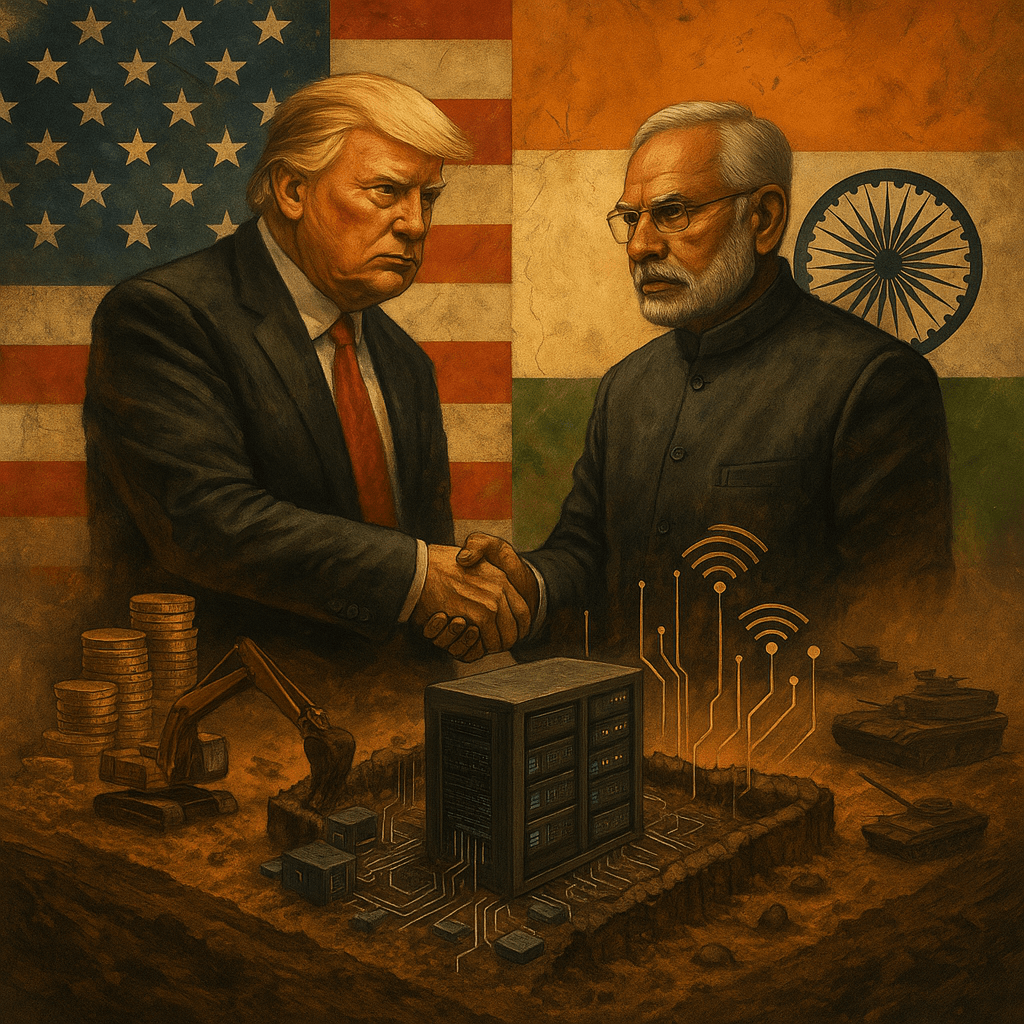
Behind the slogans of “mutual benefit” and “free trade,” the U.S.-India deal is a textbook case of imperialist recalibration—extracting India’s digital sovereignty, pharma independence, and strategic non-alignment in exchange for a seat at a rigged table.
By Prince Kapone | Weaponized Information | May 11, 2025
The Tariff King and the Media Courtiers: How CNBC Spins Surrender Strategy
This article was published by CNBC as part of its Inside India newsletter—a financial intelligence dripfeed for investors looking to stake claims in the so-called “emerging market” of India. But behind the branding is something more insidious. CNBC is not a neutral observer. It is an ideological arm of U.S. finance capital, owned by NBCUniversal and its parent company, Comcast—one of the most powerful corporate entities in the West. Its editorial slant reflects the interests of Wall Street, Big Tech, and the Washington consensus, delivering financial propaganda tailored to serve empire while cloaked in the language of economic reporting.
The author, Amala Balakrishner, writes from Singapore and serves as a regional amplifier of U.S.-aligned business interests in Asia. Her work routinely reproduces the talking points of portfolio managers, corporate executives, and neoliberal economists without critique. There is no engagement with labor unions, grassroots movements, or even critical economists from the Global South. In this article, she performs the role of a loyal courier—not for the Indian working class, but for the hedge funds and trade diplomats seeking to tighten their grip on India’s economic direction.
The cast of characters quoted reads like a Davos invitation list: Donald Trump, Malcolm Dorson (Global X ETFs), Shumita Deveshwar (TS Lombard), Peeyush Mittal (Matthews Asia), and the CEOs of India’s largest private banks and logistics firms. These are not impartial analysts. They are imperial stakeholders. Their function is to present U.S.-India economic convergence not as coerced alignment, but as natural evolution. Not as enclosure, but as opportunity.
And how does CNBC frame this story? As a strategic breakthrough. We’re told that India is moving toward a new trade deal with the U.S.—“coming along great,” as Trump puts it. The tone is celebratory. India, once the “tariff king,” is now being welcomed to the table. What’s left out is who set the table, who controls the menu, and who’s picking up the tab.
Balakrishner presents India’s proposed removal of tariffs on U.S. steel, pharmaceuticals, and auto parts as a signal of progress. But no mention is made of the power asymmetry at work—how the U.S., under Trump, slapped India with 26% punitive tariffs, only to suspend them once India crawled to the table. There’s no analysis of how this fits within the broader U.S. strategy of using trade as leverage to break India’s state-led development model, nor how this capitulation undermines India’s long-standing commitment to strategic autonomy.
The article treats India’s high average tariff (17%) as a problem to be solved—not a protective mechanism built through hard-fought struggles to defend domestic industry from foreign domination. It parrots the neoliberal line that growth requires deregulation, open markets, and foreign direct investment—without once questioning who that growth benefits, or what it costs in terms of sovereignty, self-sufficiency, and labor rights.
The piece is saturated with euphemisms: “free trade,” “mutual benefit,” “tariff relief,” “opening markets.” Not a single phrase is interrogated. “Zero tariffs” on U.S. goods is presented as if it’s a level playing field, ignoring the structural disparity between the two economies, and the fact that U.S. firms often enjoy state subsidies, tech monopolies, and backdoor access through digital platforms and IP regimes. India is framed as a reluctant but necessary reformer. The U.S., a benevolent market partner.
Even when skepticism emerges—such as the concern over pharma imports—the analysis is defensive, not critical. We are reassured that U.S. companies likely won’t flood India’s markets due to “transport costs” or “consumer preference.” But the real threat isn’t direct product competition—it’s structural domination. Patent law changes. Data localization rollbacks. Forced manufacturing relocation. None of this is discussed. The economic implications are reduced to portfolio movements and stock tips, not national development or class struggle.
This is the propaganda technique of modern imperialism: invisibilize the coercion, isolate the variables, and recast dependency as diplomacy. CNBC doesn’t just obscure the geopolitical stakes—it erases them. There is no mention of U.S. strategy to triangulate India against China. No context on BRICS+, de-dollarization, or India’s historic posture of non-alignment. No understanding of how trade policy is being used as a tool of imperialist recalibration.
What’s delivered instead is narrative discipline. India is growing, but to grow “correctly,” it must bend—open its gates, deregulate its markets, and hand over the keys to Wall Street and Silicon Valley. And if it doesn’t, we’re told, it risks “missing out.” The article becomes less an analysis and more a veiled threat: assimilate or be punished.
Free Trade in Chains: Mapping the Terrain of Economic Annexation
Let’s begin with the material facts the article does reveal. India and the U.S. are negotiating a new trade deal. India has proposed removing tariffs on key American exports—steel, pharmaceuticals, and auto parts—on a “reciprocal” basis. India currently has a trade surplus of $45.7 billion with the U.S., with total bilateral trade hitting $129 billion in 2024. The U.S. imposed 26% tariffs on Indian exports last month—now “suspended”—which appear to have nudged India toward the table. Modi’s regime, known for its protectionist posturing, is now offering tariff cuts and regulatory rollbacks under pressure.
The article presents this as a shift from “tariff king” to “free trader.” But what is really happening is that India is being strong-armed into dismantling the very policies that protected its industrial base. India’s average tariff rate of 17%, long a defense against foreign domination, is now under assault—not just from U.S. coercion, but from its own comprador elite, eager to prove themselves worthy managers of empire’s terms.
India’s promise of “zero tariffs” is not an act of sovereignty—it’s a surrender of policy space. What CNBC refuses to say is that trade liberalization of this kind has never benefited postcolonial states when executed under imperial supervision. The WTO, IMF, and the U.S. Trade Representative’s office have long used bilateral trade as a weapon to pry open Global South markets for Western capital. India is not negotiating from a position of strength. It is being pulled deeper into the gravitational orbit of U.S. economic domination, with Wall Street, Big Pharma, and Silicon Valley scripting the terms.
Let’s contextualize further. This trade deal is not happening in a vacuum—it is part of a broader U.S. strategy of imperialist recalibration. After failing to contain China through tariffs and proxy wars, Washington is now using trade and digital policy to re-align key middle powers. India is a keystone in this strategy: a massive consumer market, a rising tech hub, and a regional power that Washington wants to pull firmly into its anti-China axis. Trade deals, in this context, become geopolitical leverage points.
The “reciprocity” language masks deep asymmetry. U.S. pharma firms are demanding patent concessions, threatening India’s generics industry—the backbone of affordable medicine across the Global South. U.S. tech companies want India to abandon data localization laws, handing over digital sovereignty to Amazon, Google, and Meta. Meanwhile, Indian auto and steel manufacturers are promised “access” to U.S. markets they’ll never penetrate meaningfully, due to logistics, standards manipulation, and existing monopolies.
What’s omitted from the article is also telling. No mention of Modi’s Make in India policy being gutted. No mention of the role of the Digital Personal Data Protection Act, which has already weakened public data protections in preparation for corporate entry. No reference to how earlier trade openings under WTO pressure led to a flood of cheap imports that decimated Indian toy, textile, and electronics industries. And not a single word about labor—how deregulation, privatization, and FDI-led growth have failed to deliver secure employment or worker rights.
Also ignored are India’s domestic class contradictions. The urban corporate elite, heavily concentrated in finance, IT, and logistics, stands to gain from U.S. deals. But India’s rural poor, informal laborers, and small-scale producers face intensified exploitation, price shocks, and displacement. Pharma monopolies will drive up costs of generics. U.S. tech control over cloud infrastructure will commodify and extract Indian data. The Modi regime, in effect, is not bringing India to the world—it is selling it to the highest bidder.
Finally, we must place this within India’s long arc of postcolonial political economy. From Nehru’s model of import-substituting industrialization to the IMF-dictated neoliberal “reforms” of the 1990s, India has never been allowed to chart a fully sovereign economic course. Each wave of “opening” has been orchestrated under duress—sanctions, debt, or diplomatic pressure. What we are seeing today is simply the latest chapter in that cycle: a semi-peripheral state being repurposed as a node in the U.S.-led imperial architecture of capital.
So while CNBC gives us stock tips and investment buzz, the deeper truth is this: the U.S.-India trade deal is not about trade. It is about alignment, annexation, and absorption. Not India rising, but India being absorbed into the declining but still dangerous orbit of empire.
Annexation by Agreement: A Trade Pact Signed in Washington, Paid for in Mumbai
Let’s speak clearly: this is not a trade deal—it is a digital-age annexation. A slow-motion takeover of India’s economic sovereignty, packaged in the language of opportunity and reform. What is unfolding is not bilateralism—it is subordination. Not “mutual benefit,” but imperialist recalibration masked as market rationality. Behind the scenes, this agreement is being brokered by and for U.S. corporate interests—Big Tech, Big Pharma, and the financial oligarchy—who see in India not a partner, but a colony-in-waiting.
Narendra Modi, draped in nationalist garb, is playing the role once filled by colonial viceroys: facilitating the enclosure of India’s economic commons. What the East India Company once extracted by gunboat, today’s imperialists achieve through IP clauses, data treaties, and “reciprocal access” frameworks. This is the neoliberal mutation of old-school colonialism—more algorithm than armada, more NDA than naval blockade, but the results are the same: looting dressed as legalism.
The offer of zero tariffs is not a gesture of sovereignty, but an act of surrender. U.S. pharmaceuticals will flood Indian markets with overpriced, patent-protected drugs. Indian generics—lifelines for millions across the Global South—will be strangled by TRIPS-plus provisions. This is not trade liberalization—it is the destruction of an entire industrial model built on public health and domestic capacity.
In the tech sector, the stakes are just as high. Silicon Valley is not merely lobbying—it is colonizing. By forcing India to abandon data localization and open cloud infrastructure to U.S. surveillance firms, this deal transfers control of India’s digital nervous system to Washington. Indian data—its labor, consumption, health, and behavioral patterns—will be mined and monetized by Google, Meta, and Amazon. This is digital colonialism, and the price will be paid in lost autonomy, broken unions, and algorithmic domination.
What the CNBC article sells as “market access” for Indian firms is a mirage. Indian steel and auto parts manufacturers cannot compete in a deregulated U.S. market rigged with corporate subsidies, protectionist procurement policies, and invisible logistical barriers. India is not being invited to compete—it is being invited to comply. Its firms may survive as appendages of U.S. supply chains, but they will never flourish independently under such terms.
And what of the Indian masses? The informal worker, the small farmer, the Dalit wage laborer, the street vendor, the factory hand? Their names do not appear in the CNBC piece. Because this deal is not for them. It is for the Indian comprador class—CEOs, private bank directors, trade ministers, and investment fund managers—who have always preferred a slice of imperial loot over a stake in popular sovereignty. For them, Washington’s handshake is more valuable than workers’ rights, land reform, or economic democracy.
But this narrative can be broken. Just as the farmers’ revolt shattered the illusion of Modi’s neoliberal invincibility, this trade deal can become a flashpoint for renewed struggle. There is another India—the India of Narmada Bachao Andolan, of Shaheen Bagh, of the All India Trade Union Congress, of the thousands of village movements resisting displacement and privatisation. This India remembers that true development begins not with tariffs, but with control over land, labor, and life.
To reframe this moment, we must recognize that trade policy is not technical—it is political. It is a class war waged through spreadsheets. And every treaty signed without the people’s consent is a contract of dispossession. The real question is not whether India can cut a deal—it’s whether it can defend its future from being auctioned off by those who speak the language of patriotism but serve the empire’s bottom line.
So let us not call this a partnership. Let us call it what it is: a colonization cloaked in cooperation. A betrayal written in the language of growth. An annexation that must be confronted—not with policy tweaks, but with revolutionary clarity, mass education, and organized resistance.
From Free Trade to Fightback: Building Solidarity Against the New Economic Raj
We do not write to spectate. We write to intervene. And this so-called “deal” between the U.S. and India is not a policy adjustment—it is an attack on the sovereignty of over 1.4 billion people. It is the modern equivalent of the 1833 Permanent Settlement Act, of the drain of wealth under British rule, of the IMF structural adjustment packages that devastated the Global South. We are witnessing a new economic Raj, and it must be met with resistance in every arena—economic, ideological, digital, and material.
We declare our full ideological unity with the workers, students, peasant organizers, and digital rights activists in India who have long warned of these neoliberal incursions. The farmers who blocked highways in 2020 did not do so merely to defend agriculture—they did it to defend the soul of the nation from corporate takeover. The student movements at JNU, AMU, and other universities who resist surveillance and privatization are the frontlines of digital sovereignty. The public sector unions resisting privatization are defending more than wages—they are defending the last vestiges of collective control in an economy being devoured by empire.
Internationally, we must build a new anti-imperialist alliance against the logic of trade annexation. Here is how:
- Expose the Deal: Create media, study groups, and infographics breaking down how this trade agreement attacks public health, digital rights, and economic self-determination in India. Name the firms pushing it. Name the institutions underwriting it. Illuminate the blood trail of profit.
- Support Indian Resistance: Fund grassroots organizations fighting digital colonialism, data privacy violations, and Big Pharma exploitation. Translate their demands for international audiences. Share their victories and calls to action across borders.
- Disrupt Imperial Forums: Protest outside World Economic Forum events, Indo-Pacific business summits, and U.S. chambers of commerce. Expose how these meetings serve the interests of capital, not people. Insert the slogans of India’s masses into the halls of Western power.
- Build Labor Internationalism: Forge direct relationships between Indian trade unions and global worker organizations. Highlight how Amazon, Google, and Pfizer exploit workers both in India and abroad. Coordinate campaigns for joint bargaining power against global capital.
- Counter the Narrative: Dismantle the myth that U.S. economic integration equals development. Use historical materialist analysis to show how colonialism adapts through trade, not just tanks. Create public education campaigns that center the voices of the Indian working class.
The Indian people are not passive players in this history. They have fought and bled to reject foreign domination—from 1857 to 1947, and from 1991 to today. Their resistance is not past tense. It is present, alive, and calling for comradeship. We answer that call not with charity, but with militant solidarity.
Because this isn’t just about India. Every so-called “emerging economy” is facing similar pressures: to deregulate, to open, to submit. The enemy is not protectionism—it is the protection of capital at the expense of people. And every time we stand with those who resist, we chip away at the empire that makes such trade treachery possible.
Let us not allow this deal to be signed in silence. Let it be remembered as a line in the sand. Let this be the moment when the working classes of the Global South, joined by defectors from the North, said: enough. Not one more signature without sovereignty. Not one more concession without class war.
The U.S.-India trade pact is not a conclusion—it is a call to arms. Let it echo across borders, across languages, across trenches. Let it begin with us. Let it end with liberation.
No annexation through trade. No compromise on sovereignty. All power to the people.
 Weaponized Information
Leave a comment