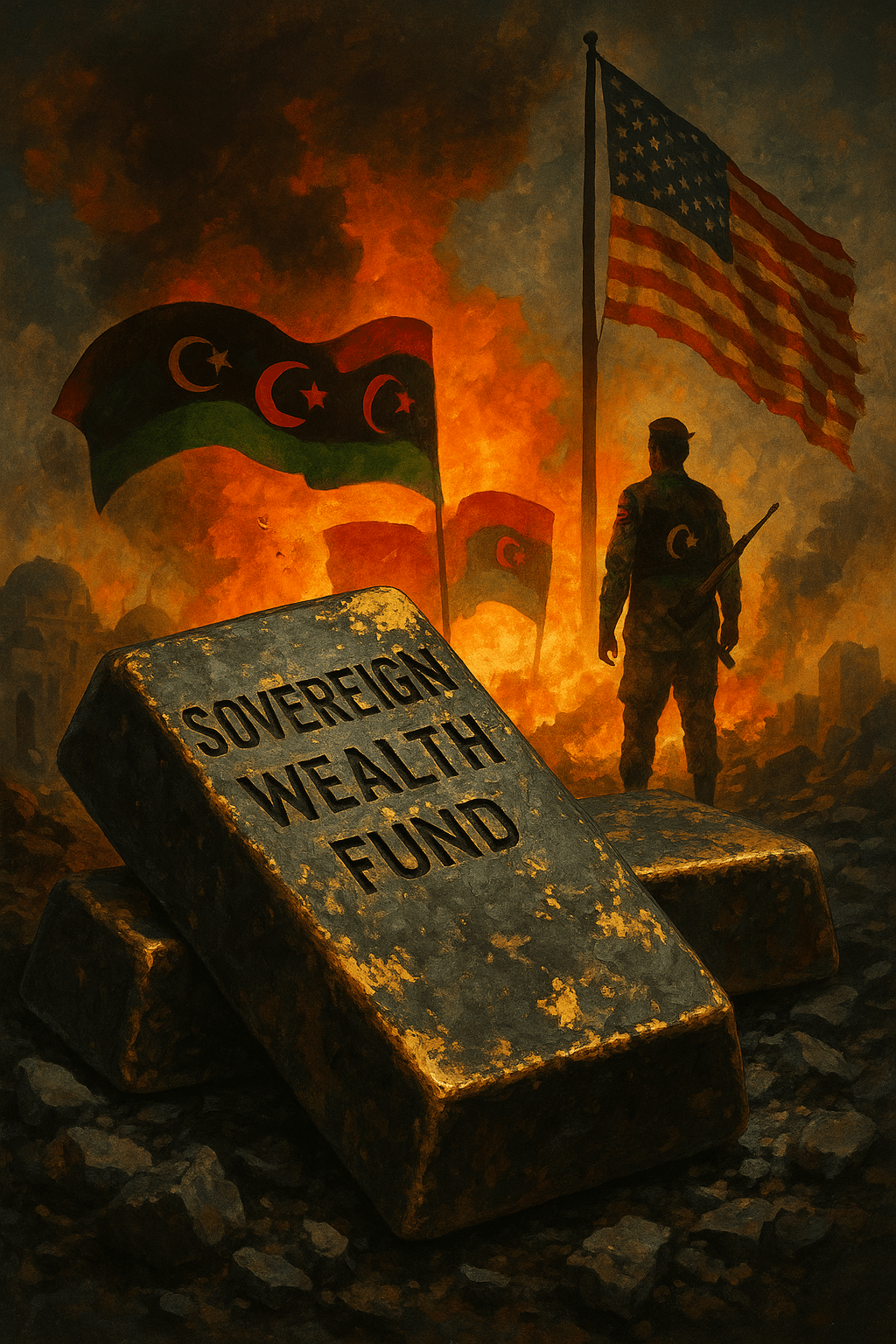
The empire doesn’t return what it steals—it reinvests it. Libya’s sovereign wealth fund, frozen since the NATO war, is being auctioned off under Trump 2.0’s technofascist diplomacy. This isn’t stabilization. It’s recolonization.
By Prince Kapone | Weaponized Information | May 9, 2025
Democracy at Gunpoint, Profits by Proxy
Sean Mathews, the author of this Middle East Eye report, plays his part in the imperial media apparatus with studied restraint. A Washington-based correspondent whose bylines orbit State Department narratives, Mathews rarely strays from the script. He does not sensationalize, nor does he lie outright—instead, he perfects the craft of omission, euphemism, and passive construction. It is the liberal imperialist’s signature: pretend to observe while quietly affirming the order of things.
Middle East Eye itself walks the line of geopolitical ambiguity. While it presents as a London-based outlet with editorial independence, its capital is entangled with Gulf money and ex-Al Jazeera personnel. It is not the Wall Street Journal or CNN—but nor is it Telesur or PressTV. It gives space to critiques of imperialism, yet it packages them in a palatable tone for Western consumption. Its silence is more lethal than its speech.
The piece at hand describes secret negotiations between the unelected, Western-backed government in Tripoli and Trump’s administration to release and “share” $30 billion in frozen Libyan state assets—frozen since NATO bombed Libya into ruin. Mathews presents this with the neutrality of a corporate ledger sheet. No mention of Gaddafi’s assassination. No mention of NATO’s war crimes. No mention of the fact that these assets are not “frozen”—they are stolen.
Instead, we are told of an agreement wherein the U.S. would unlock the funds in exchange for a $10 billion cut to invest in “infrastructure and energy projects” in Libya. That’s code for Halliburton, Honeywell, and whatever other vultures circle the corpse of Libyan sovereignty. Boulos, Trump’s personal envoy and fixer, is portrayed as a globe-trotting dealmaker rather than the transnational bagman of technofascist empire he truly is.
The framing is clinical. There is no looting, only “investment.” No plunder, only “returns.” Libya is not colonized—it is “transitioning.” The Tripoli regime is not an imperial client—it is a “partner.” This is not a story of recolonization. It is “peacebuilding,” “business,” “stability.” Mathews never calls it theft, because theft implies a victim. And victims must not be named—certainly not when they are African, oil-rich, and resisting.
In three sentences, the article mentions that the deal would be “in keeping with the Trump administration’s business-first, transactional approach.” That’s the tell. A euphemism for neocolonial asset-stripping. A polite nod to the logic of mafia capitalism where the Godfather demands tribute to reopen the vault he padlocked after burning your house down.
The piece names the players—Boulos, Trump, Dbeibeh—but never maps their functions within capital. Boulos is a conduit of state-corporate fusion; Dbeibeh is the placeholder premier propped up by militia guns and IMF briefcases; Trump’s administration is not a state in any democratic sense—it is an executive committee of imperial finance capital. But the article calls this a “deal.” The empire calls it diplomacy. We call it organized robbery.
Looted Vaults of Empire
The theft of Libya’s sovereign wealth fund is not an isolated act of opportunism—it is standard imperial operating procedure in the 21st century. Frozen assets are the new war reparations, extracted not through occupation armies but through central banks and legalese. The Libyan case is just the latest addition to a growing imperial archive of confiscated wealth.
Venezuela’s gold reserves, valued in the billions and held in the Bank of England, were seized to sabotage its sovereign economic policy and bankroll Juan Guaidó’s farcical coup attempt. Billions in Venezuelan state funds remain locked in U.S. and European accounts—held hostage by sanctions, asset freezes, and lawfare.
Afghanistan, after two decades of brutal occupation and the U.S.-engineered collapse of its economy, saw its foreign reserves outright stolen. Washington seized $7 billion from the Afghan central bank, redirecting half for 9/11 victims’ families and holding the rest in limbo, while tens of millions starve under economic siege.
Russia’s central bank assets—over $300 billion—were frozen in retaliation for the Ukraine war. The theft was openly framed not as a legal act but a geopolitical maneuver. Now Western states debate how best to “repurpose” these assets for Ukrainian reconstruction, bypassing any notion of legal sovereignty or financial ethics.
This is the blueprint of financial piracy under hyper-imperialism: destabilize a state, impose sanctions, recognize an illegitimate government, then raid the vaults. It is not just robbery—it is a form of warfare waged by banks and bureaucrats, backed by missiles and media. The dollar is the new gunboat; the SWIFT system, the new naval blockade.
Libya’s wealth, like Venezuela’s, Afghanistan’s, and Russia’s, sits at the nexus of imperialist recalibration—where capital’s inability to reproduce itself organically drives it to feed on the accumulated resources of sovereign states. The Tripoli regime isn’t negotiating a partnership—it’s signing over the key to a vault built by Gaddafi to finance pan-African sovereignty. And now, under the banner of “reinvestment,” imperialism demands a cut of the spoils it already stole.
Recolonization in Real Time
Let’s name this for what it is: recolonization. Libya is not being stabilized—it is being strip-mined by a dying empire that can no longer conquer by invasion and must now loot by memo. This isn’t humanitarianism. This is technofascism—the convergence of finance capital, militarized diplomacy, and algorithmic control masquerading as foreign policy.
The Trump regime is not reviving American influence through “deals.” It is weaponizing access to stolen wealth to entrench U.S. corporate power in zones devastated by previous U.S. wars. Libya’s sovereign wealth fund was not frozen for the sake of international security. It was immobilized to await recolonization through financial trusteeship. A digital-era trusteeship that allows the empire to claim stewardship while siphoning the spoils.
This is the logic of hyper-imperialism in the 2020s: when your empire can no longer produce value, you loot those who can. You criminalize sovereignty. You legalize theft. You repurpose colonial administration as “governance support.” You deploy think tanks, diplomats, and media syndicates instead of generals—but the mission is the same: extract, discipline, dominate.
And in that process, you blur the very meaning of war. Because Libya is still at war—it is at war with the financial, legal, and ideological architecture of empire. It is at war with the private contractors, NGOs, and UN envoys who speak of “stability” while enforcing a state of permanent dependency. It is at war with a system that destroyed its revolution and now demands tribute from the ruins.
The article calls Libya “divided.” But divided by whom? It was NATO that tore the country apart. It was Western proxies who armed both sides. It was technocrats in Washington, Brussels, and Doha who replaced popular sovereignty with mercenary diplomacy. And now they return, not with tanks, but with contracts—demanding ten billion to “help” rebuild what they obliterated.
There is no investment here. There is no peace. There is only the ongoing recolonization of Libya under new terms, with new tools. And there is only one word for this: war. Not the kind declared by congresses or debated on TV—but the kind waged silently by banks, brokers, and bureaucrats who steal with pens what bombs once could not destroy.
Revolutionary Memory, Proletarian Response
But if the empire has a blueprint, so do we. Libya is not a blank slate—it is a battlefield layered with revolutionary memory. From the Popular Guard to the Green Resistance, from the Jamahiriya to the youth insurgencies that emerged after Gaddafi’s death, Libya has never been passively plundered. It has resisted—and it resists still.
Across the Global South, nations have begun to demand the return of their stolen assets, not as a favor, but as an obligation of justice. Venezuela fights daily to reclaim its seized wealth. The African Union has begun debating reparations frameworks. Even in Afghanistan, resistance movements have linked foreign reserve theft to economic colonialism. This is not just policy—it is counterinsurgency by other means, and it must be fought as such.
Revolutionaries and workers everywhere must expose and oppose the theft of Libya’s sovereign funds. We can begin by organizing coordinated campaigns against the corporate looters like Halliburton and Honeywell, whose blood-drenched portfolios expand under every recolonization scheme. We must boycott their contracts, expose their ties to state violence, and disrupt their legitimacy in every domain.
We must also push international solidarity movements to raise Libya’s asset seizure as a core issue—at teach-ins, labor assemblies, student meetings, and media platforms. The same energy used to oppose IMF austerity or Israeli apartheid must be used to name this theft for what it is: imperialist war in financial form.
Proletarian cyber resistance should target and disrupt the digital infrastructure of financial piracy. Revolutionary media must amplify Libya’s call to reclaim its wealth without imperial strings. Wherever possible, we must build dual and contending institutions that bypass the imperial banking system altogether—alternative trade systems, people’s banks, and sovereign digital platforms.
Libya’s struggle is our struggle. Its vaults are filled with stolen futures, not just stolen funds. And to fight for their return is to fight for the return of the world—to its rightful owners: the working, plundered, colonized majority of this planet.
 Weaponized Information
Leave a comment