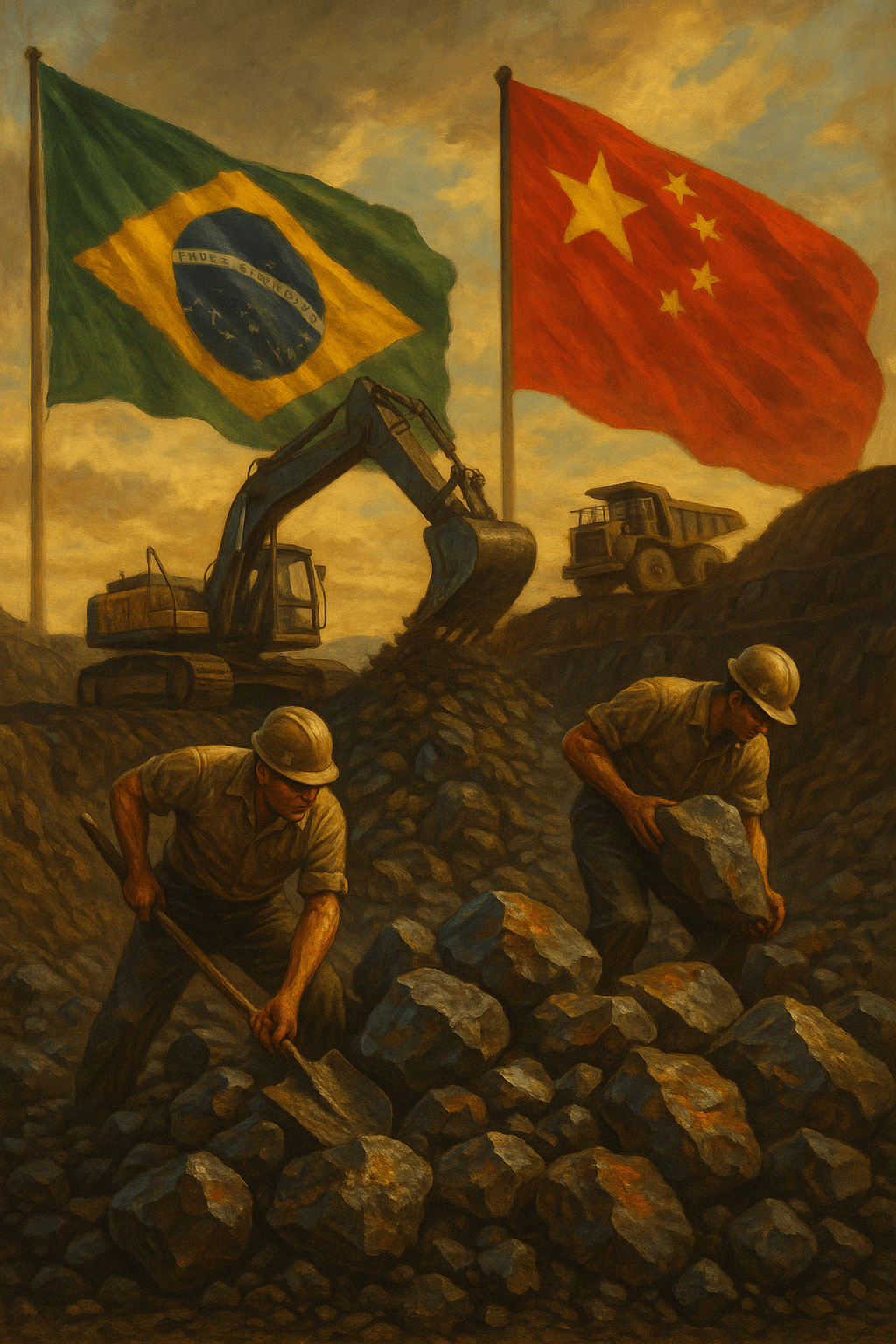
Brazil’s push to develop rare earth capacity is not a challenge to China—it’s a strategic step toward reshaping global industry through BRICS+, reclaiming sovereignty over the mineral backbone of the future, and building a world where supply chains don’t run through Washington.
I. Multipolar Moves in a Unipolar Script
Western media loves a fight—especially when it can fabricate one. Brazil’s decision to ramp up rare earth element (REE) extraction and processing is being framed as a challenge to China, a “competition” for mineral supremacy. But this isn’t a rivalry—it’s a realignment.
Brazil isn’t breaking with China. It’s building with China, inside a multipolar BRICS+ framework that values coordination over command. And what’s at stake here is nothing less than the material foundation of 21st century industry—from green energy to electronics to digital infrastructure.
II. Digging Beneath the Surface: Why Rare Earths Matter
Rare earth elements are misnamed—there’s nothing rare about them. What’s rare is the political power to extract, refine, and profit from them without foreign control. These minerals are essential to electric vehicles, solar panels, wind turbines, advanced sensors, batteries, and missiles.
The imperial core—led by the U.S. and EU—has long relied on Global South extraction zones, while hoarding the intellectual property, refining capacity, and industrial profits. Brazil, like much of the South, has been trapped at the raw material end of the chain.
Now, that’s starting to change.
III. China’s Role: Not the Enemy, But the Precedent
The Western narrative casts China as the villain because it dared to dominate REE supply chains outside the empire’s control. But China’s story is a model of developmental defiance: state-led planning, investment in refining and innovation, and refusal to be just a mine for Western tech.
Brazil’s decision to develop its own REE industry echoes that strategy. It’s not a threat to China—it’s a reinforcement of the BRICS+ vision: each pole developing capacity, exchanging knowledge, and building an alternative to the monopolies of the North.
A stronger Brazil doesn’t weaken China—it strengthens the Global South’s collective leverage.
IV. Hedging with Eyes Wide Open
Yes, Brazil is hedging. It’s talking to Europe, it’s entertaining proposals from the U.S. But this isn’t submission—it’s strategic realism. Brazil is positioning itself as a sovereign actor, not a junior partner.
And within the BRICS+ framework, this hedging isn’t betrayal—it’s part of the multipolar dialectic. Cooperation doesn’t mean uniformity. It means shared direction, flexible alignment, and a common enemy: dependency on the imperial core.
V. The South-South Supply Chain Is Being Born
Imagine it: rare earths mined in Brazil, refined in South Africa, integrated into electronics in China, traded through digital currency platforms developed by BRICS nations. No IMF. No World Bank. No strings.
Brazil’s rare earth move is a step toward this future. It’s about local capacity. It’s about building the infrastructure of sovereignty—from geology to geopolitics.
The risk isn’t that Brazil competes with China. The risk is that Western capital will try to co-opt, infiltrate, or sabotage this South-South shift.
VI. Digging for Liberation, Not Empire
The earth holds power. That’s why empires dig, drill, and destroy to get it. But for the first time in generations, Brazil is making a different move. It’s digging not for export, but for autonomy. Not to feed foreign monopolies, but to build something new—something cooperative, sovereign, and just.
This is not about one country outpacing another. It’s about many countries refusing to be ruled. If BRICS+ is serious about building a new world, it will be built from the ground up—mineral by mineral, port by port, worker by worker.
Brazil just put its shovel in the ground. Now it’s time to build.
 Weaponized Information
Leave a comment