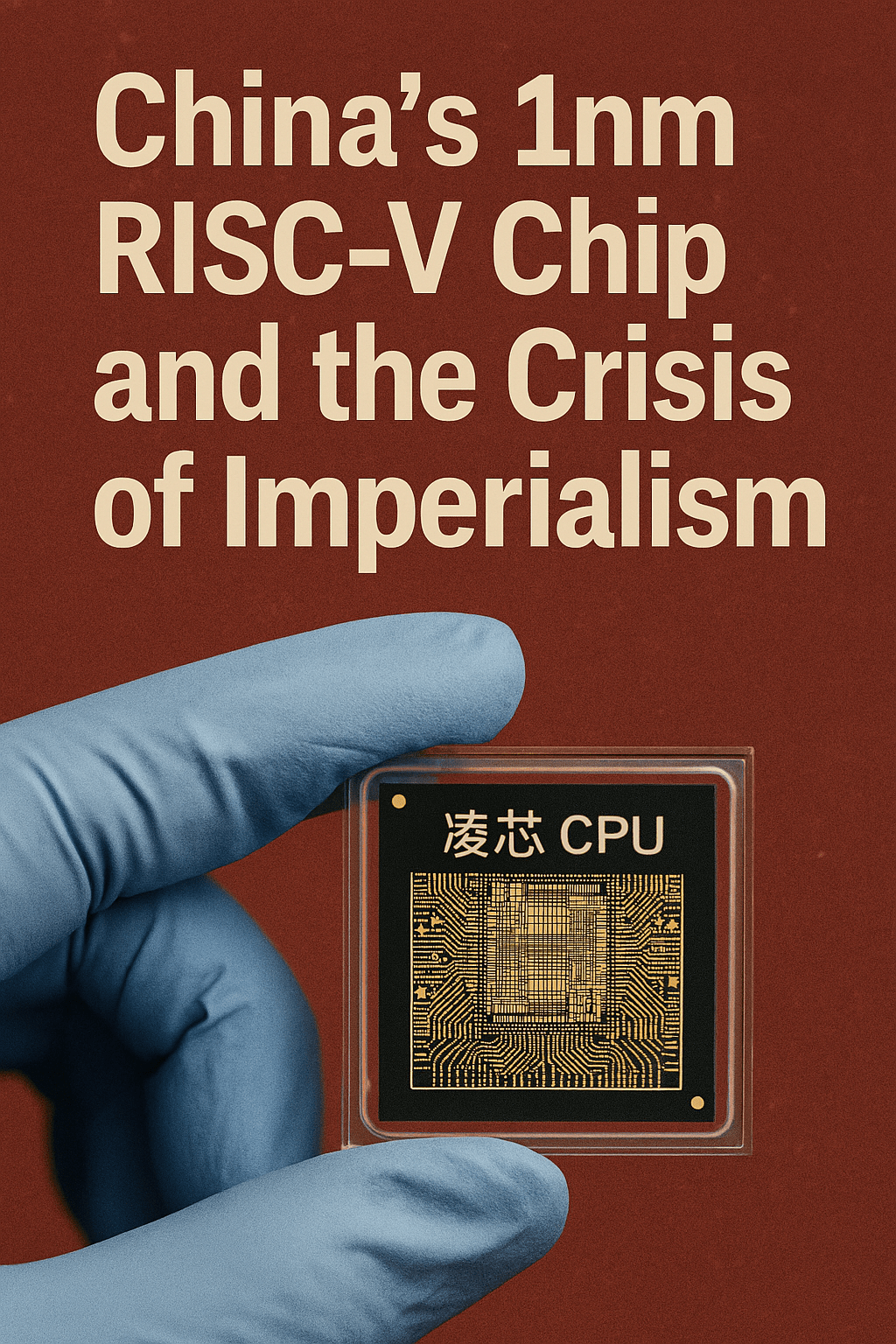
In the tangled circuits of our planetary disorder, where high finance and high-frequency warfare converge, a quiet shockwave has issued from the East. Chinese scientists have unveiled the world’s first 1-nanometer RISC-V CPU built with two-dimensional materials. Not made in Palo Alto. Not blessed by Silicon Valley venture capital. Not protected by the IP barons of Washington. This chip is born of the periphery, and that makes all the difference.
To understand the meaning of this development, we must locate it within the Crisis of Imperialism—the long-unfolding breakdown of U.S. hegemony in the global capitalist system. Faced with internal decay, declining profitability, and the revolt of the periphery, U.S. imperialism is recalibrating. Gone are the illusions of globalization and free markets. In their place: state-directed techno-nationalism, economic warfare, and a New Cold War aimed squarely at China.
It is in this context that the chip emerges—not just as a technical feat, but as a geopolitical rupture. The U.S. empire has wagered its future on maintaining monopoly control over advanced technologies, especially semiconductors. Its strategy is clear: deny China access to EUV lithography, to ARM’s designs, to the supply chains that feed the chipmaking apparatus. It is a project of digital containment, and it is being sold to the world as a “rules-based order.”
And yet here is China, unveiling a 1nm processor built on open-source RISC-V architecture and fabricated from atomically thin materials like molybdenum disulfide. It is not just an end-run around sanctions—it is a challenge to the very architecture of techno-imperial control. This chip is not born of Silicon Valley’s parasitic venture capital but from sovereign investment in scientific development. It is not a fluke. It is a material expression of imperialist contradiction.
Let’s not get carried away. This is not the arrival of socialism in a single die-shrink. China remains entangled in capitalist contradictions. But even within this terrain, it has exposed the vulnerability of a system that once claimed universality. It shows the limits of U.S. coercion. It confirms that empire cannot indefinitely suppress the emergence of rival powers.
The significance here is not that China has “won” anything. It is that the United States is losing control. Its recalibration toward cold war is reactive, not proactive. It is a strategy born not of strength, but of fear. The chip is proof that the imperial monopoly can be broken—not just economically, but technologically. And when technological monopoly breaks, the entire imperial system begins to crack.
Chips are not just hardware. They are imperial infrastructure. They enable war, surveillance, and profit extraction. But they can also become a battlefield of resistance. A site where the colonized and sanctioned strike back.
South China Morning Post reported that Chinese researchers, working through RiVAI Technologies and with materials such as tungsten diselenide, have created the world’s most complex 2D semiconductor microprocessor—breaking through both technical and geopolitical barriers.
Weaponized Information sees in this moment a fracture—a signal that U.S. imperialism is no longer able to command the heights of capitalist production with impunity. The Crisis of Imperialism deepens. The recalibration toward techno-containment falters. The Cold War against China begins to devour its architects. The Lingyu chip is not the revolution, but it is a crack in the imperial edifice. May the rupture widen.
— Weaponized Information Editorial Desk
 Weaponized Information
Leave a comment