
This article is part 2 of Technofascism Incorporated, an ongoing series exposing the corporate chieftains, Big Tech oligarchs, oil barons, and Wall Street fixers who have seized control of Trump’s second-term cabinet. Together, they are building a regime where monopoly capital and state power merge to secure U.S. imperial dominance in a world slipping from its grasp.
Marco Rubio didn’t just stumble into the corridors of American power. No, his story is far more polished, a tale scripted by the very institutions that churn out loyal functionaries of empire. A graduate of the University of Florida and the University of Miami School of Law, Rubio rose through the ranks not by challenging the status quo, but by embracing it with the fervor of an apprentice eager to impress his masters. While his educational credentials may lack the Ivy League gloss that many of his peers flaunt, Rubio’s real training came in the gilded halls of Miami’s political elite, where anti-Castro paranoia and corporate largesse shaped his worldview.
Rubio’s rapid ascent to national prominence wasn’t just a matter of ambition; it was a carefully managed operation by the Republican Party’s donor class, eager to market him as the youthful, “next-generation” face of their old, reactionary agenda. His Cuban exile background added just the right touch of identity politics to the mix, giving the GOP a convenient narrative of immigrant success to mask its deep-seated hostility to immigrants. But beneath the polished rhetoric, Rubio has always been what he remains today: a loyal servant of the oligarchy, a salesman for U.S. imperialism, and an apologist for war, exploitation, and corporate plunder.
A Career Sponsored by Corporate America
Rubio’s career, from state politics to the national stage, has been a textbook case of corporate sponsorship. His donors include some of the most powerful entities in the country: Big Oil, Big Finance, and more recently, Big Tech. He has consistently championed policies that advance the interests of the capitalist elite, often at the expense of workers, the environment, and basic human dignity.
Take his support for the Trans-Pacific Partnership (TPP), a trade deal that epitomized neoliberal orthodoxy. Billed as a tool to “contain China,” the TPP was, in reality, a corporate wish list: stronger intellectual property protections for Big Pharma, expanded powers for corporations to sue governments in secret tribunals, and, of course, the continued erosion of labor rights. Rubio’s enthusiasm for the TPP and similar agreements reveals a simple truth: he is less a policymaker than a lobbyist, someone who sees his role as ensuring that corporate profits remain untouchable, no matter the human or ecological cost.
Big Tech, Big Brother, and the Deep State
Rubio’s relationship with Big Tech is a natural extension of his role as a spokesman for U.S. empire. Silicon Valley’s techno-oligarchs have long understood that their profits depend on their integration into the machinery of state power. Rubio, as a ranking member of the Senate Intelligence Committee, has been one of their most reliable allies in Washington.
Under the guise of “national security,” Rubio has advocated for policies that expand the power of surveillance capitalism. He has defended the NSA’s mass data collection programs, voted to renew Section 702 of the FISA Act (allowing warrantless surveillance of communications), and supported efforts to pressure tech companies into more aggressive policing of “misinformation.” These moves, while marketed as necessary for the fight against terrorism or foreign interference, primarily serve to cement the dominance of U.S. tech giants at home and abroad.
Rubio’s fixation on China as the new Cold War adversary dovetails neatly with the interests of Big Tech, which sees Beijing as both a competitor and a convenient scapegoat. His rhetoric about “Chinese spies” infiltrating TikTok or Huawei isn’t about protecting ordinary Americans; it’s about protecting the profits of U.S.-based firms like Google, Amazon, and Meta. Rubio’s seamless alignment with Silicon Valley’s imperial ambitions underscores the extent to which U.S. foreign policy is now a joint venture between the Pentagon, the NSA, and the boardrooms of Big Tech.
A Record of Endless War
Rubio’s voting record is a master class in the bipartisan consensus on imperial violence. He supported the invasion of Iraq, an illegal war that killed hundreds of thousands and destabilized the region for generations. He cheered on the NATO bombing of Libya, reducing a once-prosperous nation to a failed state. He has been one of the most vocal defenders of U.S. complicity in the Saudi-led war in Yemen, a conflict that has created one of the worst humanitarian crises of the 21st century.
Rubio’s justifications for these interventions are always wrapped in the language of freedom and democracy, but the outcomes tell a different story: shattered societies, millions of refugees, and the enrichment of arms manufacturers and oil companies. If this is democracy, one wonders how much worse autocracy could be.
Miami’s Anti-Castro Mafia
Rubio’s political identity is inseparable from Miami’s Cuban exile community, a bloc that has long been a tool of U.S. imperial strategy in Latin America. The exile elite, many of whom are descendants of Batista-era oligarchs, have spent decades lobbying for a return to the days when Cuba was their personal plantation, a playground for American corporations and the mob. Rubio, as their anointed representative, has faithfully carried their torch.
He has consistently opposed any normalization of relations with Havana, framing Cuba as a “terrorist state” while ignoring the U.S.’s own history of supporting violent anti-Castro operatives. Rubio’s hostility toward the Cuban government isn’t about human rights—it’s about power. By maintaining the embargo and opposing diplomatic engagement, Rubio ensures that Cuba remains a scapegoat for U.S. failures in the region, a perpetual bogeyman to justify the continued militarization of the Caribbean.
The Monroe Doctrine’s Last Apostle
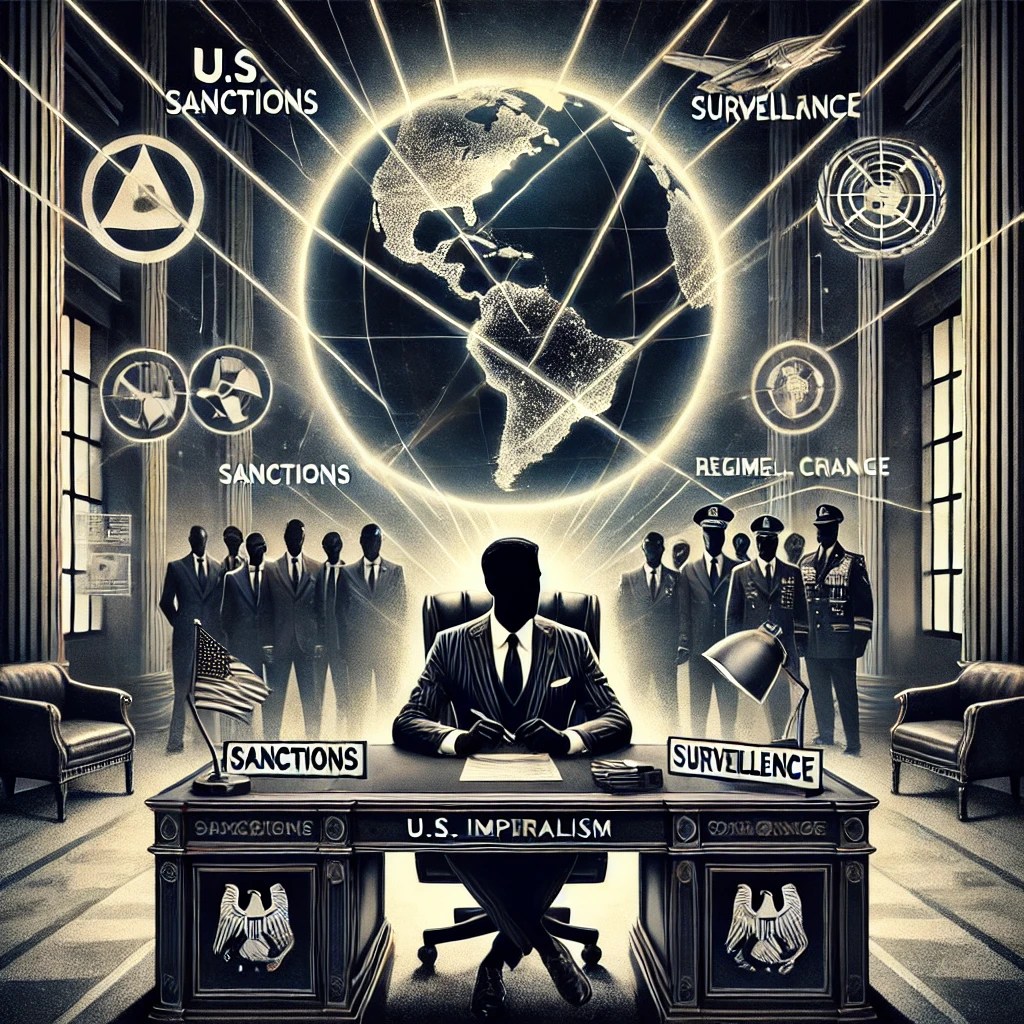
Rubio’s approach to Latin America is a grim echo of the Monroe Doctrine, updated for the 21st century. He has been a vocal advocate for regime change in Venezuela, openly calling for the overthrow of Nicolás Maduro and supporting the Trump administration’s recognition of Juan Guaidó as the country’s “interim president.” His support for economic sanctions, which have devastated Venezuela’s economy and caused untold suffering for its people, reveals the hollowness of his professed concern for democracy.
Rubio’s obsession with Venezuela is not an anomaly; it is part of a broader strategy to reassert U.S. dominance over Latin America. His support for coups, sanctions, and proxy wars is a continuation of the Cowboy tradition of American imperialism: brutal, shortsighted, and ultimately self-defeating.
The Empire’s Empty Suit
Marco Rubio is not a statesman. He is a salesman, a figure whose every word and action is calibrated to serve the interests of the powerful. Whether it’s Big Oil, Big Tech, or the Pentagon, Rubio’s loyalties are clear—and they do not lie with the people of the United States, let alone the people of the world.
Rubio’s career is a reminder that the decay of U.S. empire is not just a matter of policy but of personnel. The architects of imperial decline are not villains in the classical sense; they are mediocrities, functionaries whose ambition exceeds their intellect and whose loyalty to power blinds them to its contradictions. Marco Rubio is, in many ways, the perfect face for this phase of American decline: polished, hollow, and utterly beholden to the forces that are tearing the world apart. History, one suspects, will not remember him kindly.
 Weaponized Information
Leave a comment