
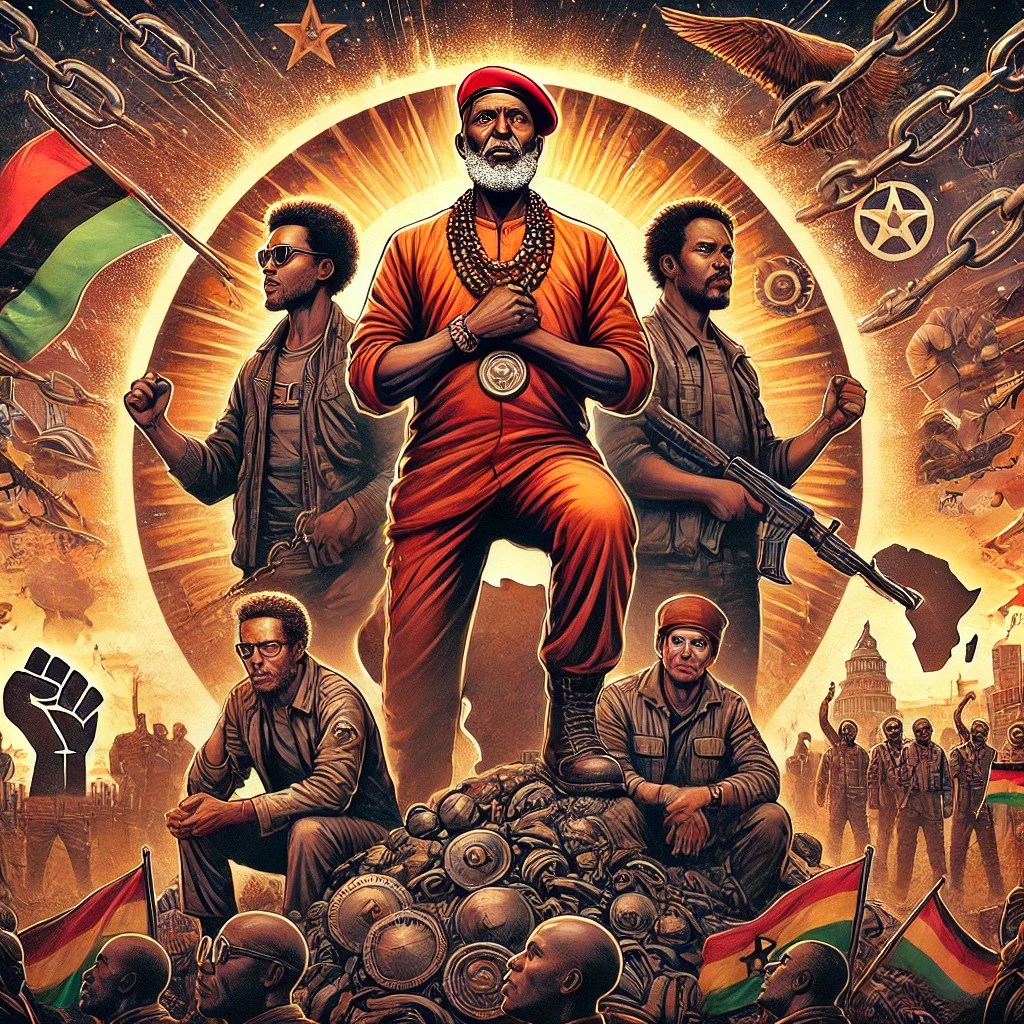
The case of the Uhuru 3—the African People’s Socialist Party members charged with conspiring to act as agents of a foreign government (Russia)—should not be dismissed as an isolated courtroom drama. It represents something much larger: a symptom of a declining U.S. empire clinging to its eroding supremacy. This case, when viewed through the lenses of history and power, encapsulates the deepening contradictions of imperialism, the systemic targeting of Black radical movements, and the lengths to which the state will go to suppress dissent.
To unpack the stakes, we need to situate this moment in a historical trajectory. As Dr. Charisse Burden-Stelley has demonstrated in her magisterial work Black Scare/Red Scare, the U.S. government has long conflated Black liberation movements with subversion and communism, using fear as a tool to suppress challenges to its parasitic empire . The persecution of the Uhuru 3 is yet another chapter in this well-worn playbook. But there’s a twist. This time, the U.S. is also grappling with its own waning global hegemony, and the legal machinery of repression has been recalibrated to meet the demands of an empire in crisis.
Dr. Burden-Stelley’s analysis teaches us that there is nothing new about this kind of persecution. In the early 20th century, figures like Paul Robeson and organizations like the Communist Party were subjected to relentless surveillance and legal harassment. Black activists who dared to organize against racial capitalism were labeled as dupes or agents of foreign powers. During the Cold War, the FBI’s COINTELPRO program targeted groups like the Black Panther Party under the pretense of national security. These tactics were never about protecting the nation as such—they were about protecting the racialized economic hierarchy that sustains the empire.
The Uhuru 3 fit squarely into this historical pattern. The African People’s Socialist Party’s critique of U.S. imperialism, its demands for reparations, and its international solidarity make it a direct challenge to the status quo. By accusing the group of acting on behalf of Russian interests, the U.S. government isn’t just reviving Cold War rhetoric—it’s doubling down on the criminalization of dissent.
Empire in Crisis and the Weaponization of Lawfare
This case cannot be divorced from the broader crisis of U.S. imperialism. As the world shifts toward multipolarity—driven by the rise of BRICS, growing resistance to neoliberal austerity, and calls for a new international economic order—the U.S. finds itself on the defensive. Unable to win the ideological argument on its merits, the empire has turned to lawfare and propaganda to silence opposition.
The prosecution’s argument rested on tenuous claims. Aleksandr Ionov, the Russian national with whom the Uhuru 3 had coordinated, was depicted as an agent of the Russian government. The evidence? Communications and alleged financial support. But this is a weak thread. If Ionov’s organization received funding from the Russian government, does that automatically make him a state agent? If so, would the same logic apply to U.S.-funded organizations like the National Endowment for Democracy (NED) or USAID? When NED-funded dissidents like Leopoldo López in Venezuela are arrested, the U.S. doesn’t consider them agents of the U.S. government. The hypocrisy is glaring, but it’s also revealing.
The reality is that the Uhuru 3 were targeted not because of some grand conspiracy but because their politics threatened the narrative hegemony of the U.S. state. They dared to question imperialism, to demand reperations for centuries of exploitation, and to imagine a world beyond the confines of capitalist parasitism. In an empire built on colonial domination, these are unforgivable acts.
The Danger of Precedent
While the Uhuru 3 emerged victorious, the precedent set by this case remains a sword hanging over the heads of all anti-imperialists. The government’s broad interpretation of “acting as an agent of a foreign government” creates a dangerous legal framework that could easily be weaponized against other movements, journalists, and organizers. If simply coordinating with a foreign national who may or may not have ties to their government is enough to warrant prosecution, then the space for dissent becomes perilously narrow.
This legal strategy is part of a broader effort to consolidate narrative control. Post-9/11 legislation like the Patriot Act, the National Defense Authorization Acts and amendments to the Foreign Agents Registration Act (FARA) have already expanded the state’s ability to monitor and suppress dissent. The Uhuru 3 case demonstrates how these tools can be deployed to criminalize opposition – particularly from among the colonized – under the guise of combating foreign interference. The implications for alternative media, grassroots organizing, and international solidarity are chilling.
Propaganda, Narrative Hegemony, and Desperation
The U.S. government’s reliance on propaganda in this case is telling. By framing the Uhuru 3 as puppets of Russian influence, the state sought to delegitimize their critique of U.S. imperialism and to isolate them from broader support. This tactic is not new. As history shows, imperialism has always relied on controlling the narrative to justify its violence. Whether through the demonization of communists, the “war on terror,” “Black Radicalism,” or the current fixation on Russia and China, the goal is the same: to suppress alternatives to the current order of white supremacist capitalist imperialism.
But the reliance on propaganda also reveals a deeper desperation. The U.S. state knows that its narratives are crumbling under the weight of their contradictions. The rhetoric of democracy and freedom rings hollow in the face of its actions, both at home and abroad. The criminalization of the Uhuru 3, like the broader assault on dissent, is a sign of an empire struggling to maintain its grip.
Victory and Vigilance
The acquittal of the Uhuru 3 is a victory—not just for them but for all who believe in free speech, international solidarity, and the right to dissent. It demonstrates that even in the face of state repression, resistance is possible. But the danger has not passed. The legal and political framework that enabled this case remains intact, and the state’s commitment to suppressing dissent is undiminished.
Although imperiqlism has been called a simple matter of bread and butter, the struggle against imperialism is also a struggle against the narratives that sustain it. The Uhuru 3 case is a stark reminder that the fight for liberation is not just about resisting overt violence but also about challenging the ideological and legal structures that uphold the empire.
The victory in this case should inspire us, but it must also steel us for the battles ahead. The U.S. government’s reliance on lawfare, propaganda, and repression is a sign of weakness, but it is no less dangerous for it. Our task is to continue building – and supporting – movements that expose these contradictions, resist these repressive measures, and imagine a world beyond imperialism—a world rooted in justice, solidarity, and freedom.
 Weaponized Information
Leave a comment