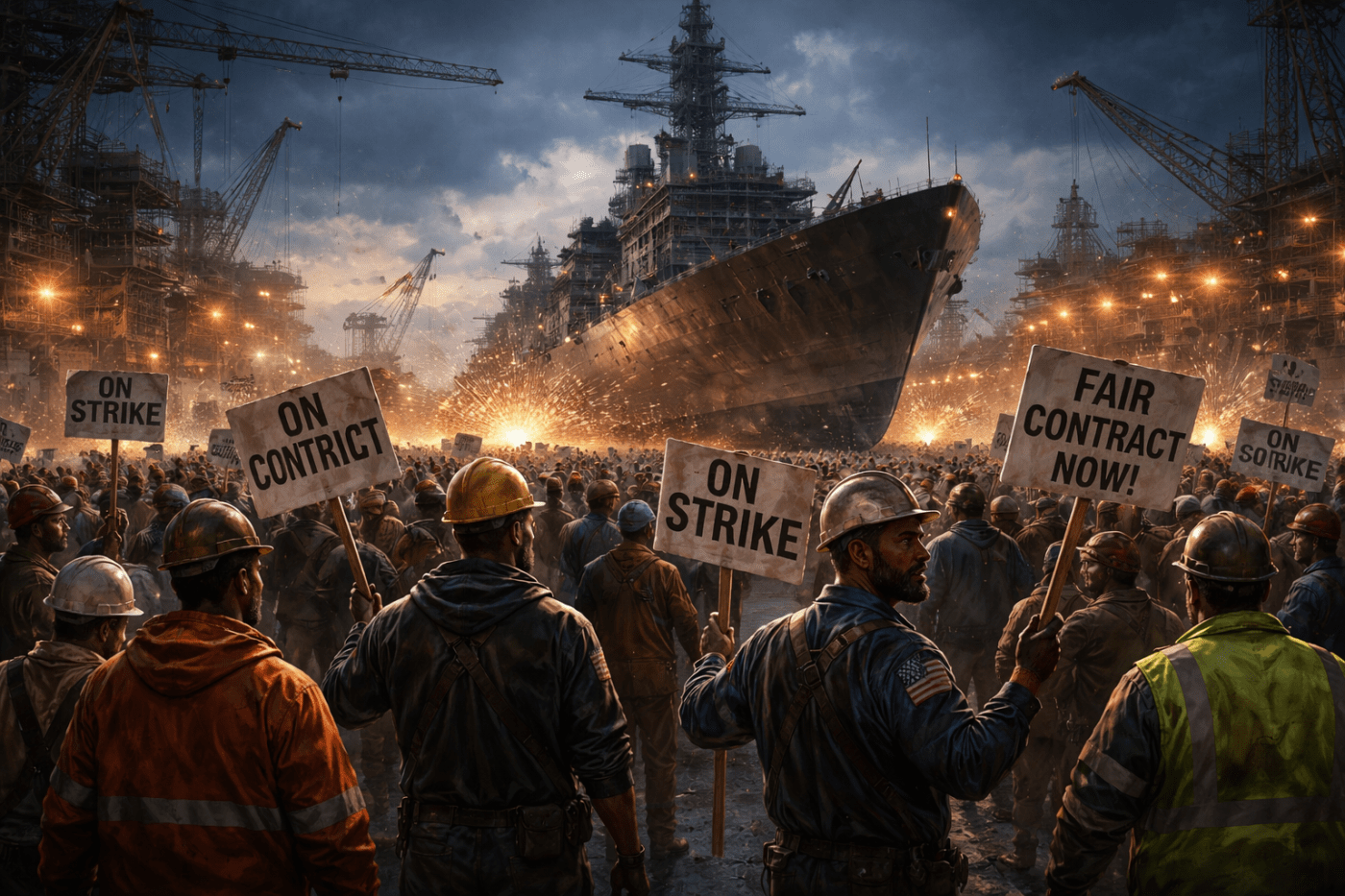
A shipyard walkout in Maine exposes a deeper contradiction: workers fighting for survival while producing the instruments of empire—and the political line required to break that alignment.
By Prince Kapone | Weaponized Information | March 23, 2026
When the War Yard Gets Reduced to a Payroll Dispute
There is a very particular kind of reporting that does not so much lie as narrow the field of vision until the truth has no room to breathe. That is what happens in Patrick Whittle’s March 23, 2026 Associated Press report on the strike at Bath Iron Works. The story gives us a walk-through of a labor dispute at a major Navy shipbuilder in Maine, presenting the conflict as a disagreement over wages, insurance, and retirement, with the union objecting, the company responding, and the whole affair enclosed in the familiar polite casing of institutional journalism. We are told enough to recognize that something serious is happening, but not enough to understand what kind of seriousness it is. The result is a report that appears calm, balanced, and factual while performing the ideological labor of making a highly charged social contradiction look like an orderly clerical disagreement.
That narrowing begins at the very first gate. The strike is defined immediately as a matter of “wages and benefits.” Now, on one level, that is true. But in journalism, what comes first does more than inform; it instructs. It tells the reader what kind of event this is and, just as importantly, what kind of event it is not. The opening frame does not invite us to ask what sort of workplace Bath Iron Works is, what sort of ships are built there, or why this strike might carry a significance beyond the contract table. It ushers us into a much smaller room. Once inside, the reader is expected to remain there: this is a labor-management disagreement, not a social contradiction, not a political contradiction, and certainly not a contradiction touching the larger machinery of power. The walls go up quickly, and the article never permits them to come down.
The style of the piece reinforces this containment through a rhythm of controlled alternation. The union speaks. Then the company speaks. Then the union speaks again. Then management returns to reassure the public that operations will continue and negotiations remain in motion. This is the house style of procedural equilibrium. It gives the impression of fairness because both sides are allotted space, but the deeper effect is to flatten both sides into exchangeable institutional voices. Nobody is allowed to become historical. Nobody is allowed to become political. Nobody is allowed to become dangerous. The workers do not appear as a social force with a point of view on the world; they appear as one party to a negotiation. The company does not appear as an employer defending a larger order; it appears as an administrator explaining its offer. Thus the antagonism is made present only to be neutralized.
The article also leans heavily on quantification without interpretation. We are given the number of workers involved, the size of the larger workforce, and the percentages in the company’s wage proposal. Numbers, of course, can clarify reality. But they can also perform a strange little trick in bourgeois reporting: they can make a conflict seem measured, manageable, already half-subdued by arithmetic. The figures arrive stripped of consequence. They tell us how many, but not what that quantity means. They tell us the percentage, but not what sort of language percentages are doing in the story. In this way, statistics become decorative instruments of sobriety. They do not deepen understanding; they certify the tone.
Then comes the insertion of corporate language, and here the article really does what establishment reporting does best: it handles the language of power like a fragile object that must not be scratched. The company’s claim that the offer contains “historic annual wage increases” is presented intact, with no pressure applied to the phrase itself. “Historic” is doing a lot of work there. It is a word chosen to make management sound generous, forward-looking, almost noble in its bookkeeping. But the article does not pause to examine the rhetorical function of the phrase. It just carries it across the page like a servant bringing silverware to the table. This is one of the small everyday courtesies through which ideology travels. The language of management arrives dressed for church, and the reporter, in the name of neutrality, opens the door.
Just as striking is the article’s treatment of the shipyard’s output. The ships are named. Their class is identified. Their place in the fleet is gestured toward. But all of this appears as industrial description without consequence. The product is acknowledged while its meaning is evacuated. The article gives the reader enough information to recognize that this is not a shoe factory or a cannery, but not enough to let that recognition change the character of the story. This is one of the central maneuvers of the piece: to mention the nature of the workplace while refusing to let that nature reorganize the narrative. In effect, the story says: yes, these are naval warships, but let us proceed as though that were merely background scenery.
The brief mention of the intensifying U.S. war effort in Iran works in the same way. It enters the article like a flash of lightning on a distant horizon and is then immediately shut back out. This is not accidental. Such a detail could have changed the temperature of the whole report. It could have forced the reader to confront the possibility that the strike is taking place inside a moment of military urgency, and that this fact might matter. But the article treats the reference as a passing atmospheric note, not as a thread to be followed. It is raised only to be abandoned. The effect is subtle but important: the story acknowledges a larger world only to preserve its own refusal to enter it.
This narrowing of meaning is not simply the result of one reporter’s personal failings. Whittle is an Associated Press reporter based in Portland, Maine, whose beat centers on the environment and oceans, and that location inside the labor process of news matters. He is writing within a form that rewards procedural description and punishes structural interpretation. Meanwhile, the Associated Press presents itself as an independent news cooperative serving member newspapers and broadcasters, which is precisely why it specializes in this kind of standardized voice: stripped-down, transferable, widely syndicateable, and safe for circulation across the broad terrain of respectable opinion. Its product must move smoothly. It cannot arrive carrying too much history, too much class, or too much smell of the battlefield.
And so the article closes the way such articles usually do: with continuity restored in advance. Operations will continue. Negotiations will continue. The strike continues, yes, but only inside a narrative structure already preparing its containment. The reader is left not with a sharpened sense of contradiction but with the impression that institutions remain in command, that the disruption is temporary, and that the matter belongs to the realm of bargaining procedure rather than the larger theater of social struggle. That is the quiet genius of this kind of propaganda. It does not demand that you cheer. It merely asks that you shrink your understanding to a size manageable by official language. It must preach more softly precisely where the truth, if allowed to stand up straight, would speak too loudly.
The War Budget Beneath the Wage Offer
The Associated Press article gives the skeleton of the dispute plainly enough. Some 627 workers represented by the Bath Marine Draftsmen’s Association went on strike at Bath Iron Works, a shipyard whose workforce includes designers, technical clerks, laboratory technicians, nondestructive test technicians, and associate engineers. The employer is General Dynamics Bath Iron Works, one of the major contractors in the U.S. naval shipbuilding base. The company says its proposal included a 10.1 percent wage increase in the first year and 4 percent increases in each of the following three years, while the union says the offer failed to address its concerns over wages, insurance coverage, and retirement income security. The same report notes that the total workforce at the yard is about 6,800, that the shipyard builds Arleigh Burke-class destroyers for the U.S. Navy, and that the company intends to continue operations during the strike through salaried personnel, subcontractors, and other employees who elect to come to work. That is the immediate factual baseline. But once one steps outside the narrow hallway of the AP frame, the dispute looks far larger, heavier, and more politically charged than the article allows.
To begin with, General Dynamics is not a struggling employer scraping to survive in a difficult market, but a gigantic military contractor that reported $47.7 billion in revenue and $3.8 billion in net earnings for 2024. This is not the profile of a firm confronting scarcity in any ordinary sense. It is the profile of a corporation deeply embedded in state military spending, cushioned by long-term contracts, and positioned to continue rewarding capital even while bargaining hard against labor. That matters because it changes the political meaning of management’s rhetoric. Once one sees the scale of corporate accumulation involved, the language of “historic annual wage increases” starts to sound less like generosity and more like what it really is: a carefully packaged public-relations line issued from the safe side of a war-funded balance sheet. The strike is therefore not taking place inside an endangered industrial relic. It is unfolding inside a highly profitable military enterprise whose resources have been fed, directly and indirectly, by the public treasury and the architecture of imperial procurement.
The strategic significance of the workplace comes into even sharper focus once we look at Bath Iron Works itself. The Navy announced in 2023 that General Dynamics Bath Iron Works received a multiyear procurement contract for three DDG-51 destroyers spanning fiscal years 2023 through 2026. That is not a minor detail buried in the machinery of budgeting. It means the yard is a designated production node in the continuing reproduction of U.S. naval striking power. These workers are not standing in a random factory that happens to have government business. They are positioned at one of the points where state policy, military planning, industrial labor, and imperial logistics meet in material form. The AP article mentions destroyers as though it were naming a product line. But the omitted fact is that this “product line” is a direct component of long-cycle war planning, funded years in advance, politically protected, and indispensable to the maritime force structure of the United States.
Once we widen the lens further, the size of the project surrounding the strike becomes even harder to ignore. The Congressional Budget Office estimated that carrying out the Navy’s 2025 shipbuilding plan would cost about $40.1 billion per year on average through 2054. Forty billion dollars a year is not a background condition. It is a declaration of state priority written in budgetary form. This means the Bath strike is situated inside a vast and ongoing public-finance stream directed toward maintaining and expanding U.S. maritime war-making capacity. The point is not merely that money exists in abundance somewhere in the system. The point is that the system itself has chosen, on a colossal scale, to allocate social wealth toward warship production over decades. The dispute over wages and benefits therefore unfolds inside a heavily financed state project of military expansion, not inside the ordinary give-and-take of a neutral marketplace. The contract table at Bath is sitting on top of a mountain of appropriated social labor, and the mountain was built for empire.
At the same time, the industry is not awash in interchangeable labor that management can swap in and out like batteries in a flashlight. The Government Accountability Office found that all seven shipbuilders it reviewed were facing workforce limitations involving recruitment, retention, or skill level, and cited a Defense Department briefing estimating that the shipbuilding industrial base will need 174,000 new workers over the next decade to meet Navy goals. This omitted fact is decisive. It reveals that the labor involved here is strategically necessary, technically specialized, and not easily replaceable, no matter how confidently management announces continuity plans. Such workers occupy a peculiar position. They are still workers, still subordinated to capital, still bargaining over wages, health care, and retirement. But they also sit in a sector whose labor power is scarce, protected, and critical to the state’s military objectives. That gives them leverage. Yet it is precisely the kind of leverage that can be used to renegotiate labor’s share within imperial production without contesting the imperial function of that production itself.
The union’s own public framing confirms this limit with unusual clarity. UAW Region 9A says BMDA members rejected the company’s “best and final offer” because it failed to address wages lower than the national average, affordable insurance, and retirement income security. Those are real concerns. They are not invented, and they should not be dismissed with cheap moral sermonizing from the comfort of abstraction. Workers have to live. Bodies age. Rent is due. Medical bills do not care about theory. But the political significance lies in the form of the demand. The strike, as presently constituted, is not organized around opposition to the ships themselves, the strategic use of those ships, or the war system they sustain. It is a struggle over compensation and social reproduction within the labor process of war production. That distinction matters. It means the conflict is real without yet being transformative, material without yet being anti-imperialist, and militant without necessarily breaking from the direction of the system that gives it its setting.
This limitation becomes even sharper when one considers what the state itself has been saying about Bath Iron Works. Pentagon reporting on Pete Hegseth’s February 9, 2026 visit to the yard framed Bath Iron Works as part of an “Arsenal of Freedom” tour and celebrated the shipyard’s role in strengthening U.S. military production. One does not need to borrow the Pentagon’s poetry to understand its intent. The state is openly identifying this workplace as a strategic military asset. In other words, while workers are on one side of the bargaining table pressing for better compensation, the state is on the other side of history marking the site as an important organ in the body of American war power. That is not incidental scenery. It is the political atmosphere in which the strike is occurring. The state is not a distant referee here. It is one of the authors of the material landscape itself.
The nature of the product becomes even harder to ignore once the undeveloped Iran reference in the AP story is given its proper context. Business Insider states that U.S. Navy destroyers in the eastern Mediterranean have been firing SM-3 interceptors against Iranian missiles. Even allowing for the fog, exaggeration, and theatrical self-display that always surround wartime reporting, the basic point stands: Arleigh Burke destroyers are not abstract industrial outputs floating in some antiseptic universe of procurement jargon. They are active instruments in a live regional war theater. They are part of the architecture through which the United States projects military force, manages escalation, and enforces its strategic posture across vital corridors of world politics. That means the AP article’s brief mention of Iran was not a harmless aside. It was a trace of reality left undeveloped because to develop it would have changed the whole meaning of the event being described.
The larger historical setting confirms that this kind of labor struggle cannot be understood as though it were unfolding in an ordinary branch of production. Defense shipbuilding in the United States has long operated through state contracts, procurement guarantees, and the ideological shelter of national-security discourse. These are not industries left to the weather of the market like corner diners or small machine shops. They are sectors chosen for preservation, subsidy, and expansion because they are considered indispensable to the projection of U.S. power. That is why the GAO’s 2025 work on naval and commercial shipbuilding describes a broad federal push to revitalize and rebuild domestic shipbuilding in the name of national security, including after an April 2025 executive order. Labor struggles inside such sectors are not “normal” labor disputes. They unfold inside industries receiving ideological, legislative, and financial protection from the state precisely because the state understands them as part of its strategic foundation.
Bath Iron Works, then, should be situated not simply as a Maine employer with a payroll problem but as a piece of a long-standing U.S. war-production system. That system is currently being expanded through multiyear destroyer procurement, while federal shipbuilding revitalization initiatives are explicitly being justified in the language of national security, all under conditions of heightened U.S. military activity connected to Iran. Workers in this sector therefore confront capital from within a position that is simultaneously exploited, protected, and integrated into the reproduction of imperial force. The contradiction is not simply that they are workers with grievances. It is that they are workers with grievances located in a strategic, state-prioritized layer of labor inside the imperial core.
Seen this way, the contradictions begin to line up with much greater clarity. The strike occurs amid an expanding U.S. war posture and heightened naval readiness. The employer is a highly profitable military contractor, not an endangered industrial firm. Workers still confront instability around wages, health care, and retirement despite operating in a richly funded sector. The industry depends on skilled labor that cannot be easily replaced, even as management attempts to preserve continuity through alternative staffing. All of this means that the contradiction is not simply that these workers are exploited, but that they occupy a protected and strategic layer of labor within the imperial core, tied to federal procurement, military planning, and long-cycle war production. And once the strike is placed alongside the Navy’s long-range shipbuilding plans, the current deployment of destroyers in the Iran war setting, and the state’s push to enlarge and protect the maritime-industrial base, the AP article’s balancing act begins to look narrower than neutrality. It keeps two realities apart that belong to the same world: the workers’ legitimate demands over wages and benefits, and the fact that their labor helps reproduce a coercive apparatus aimed at nations already living under sanctions, encirclement, missile defense, and naval pressure. That is the material condition behind the report. Everything else in the AP piece is the curtain.
When a Strike Renegotiates Labor’s Place in Empire
Once the facts are allowed to stand in their full weight, the scene at Bath Iron Works stops looking like a familiar dispute between labor and management and begins to reveal a harder and more politically dangerous structure. These workers are not standing outside the system they confront, demanding admission to its rewards. They are already inside it, positioned at one of the points where the imperial state reproduces its coercive power in steel, electronics, and labor time. The ships that leave this yard are not ordinary commodities moving into an ordinary market. They are warships. They carry radar, missile systems, and the organized violence of the American state. They move outward into the world as instruments through which pressure is applied, deterrence is staged, escalation is managed, and entire nations are reminded that the empire still claims the right to patrol the planet. To understand the strike, one has to begin there. Not at the contract table alone, but at the point where labor becomes organized force in the hands of the state.
This is where a deeply rooted liberal habit of thought has to be broken. Too much commentary, including commentary that likes to call itself left, treats “the worker” as though that figure arrives in politics pure, universal, and already aligned with emancipation by virtue of selling labor-power. But the world system does not produce one undifferentiated working class standing in the same relation to capital, empire, and historical violence. Imperialism has always stratified labor. It has produced layers, gradations, and political tendencies within the working class itself. As Lenin argued, monopoly capitalism does not merely intensify exploitation at the top and misery at the bottom. It also creates relatively protected and stabilized strata inside the imperial core, layers whose reproduction is bound up, unevenly but materially, with a global order sustained by extraction, unequal exchange, and organized force. This does not make such workers capitalists. It does mean that one cannot simply point at a wage relation and declare the politics settled. A worker can be exploited by capital and still occupy a position objectively aligned, in part, with the reproduction of imperial domination.
In the United States, that differentiation has never been merely economic in the narrow sense. It has been historically constituted through conquest, slavery, segregation, settler expansion, and the managed distribution of status and material advantage. Du Bois’s formulation of the public and psychological wage remains vital here not because it solves everything by itself, but because it identifies a crucial truth: labor in this society was never formed on neutral terrain. Sections of the working class were incorporated into the social order not only through wages, but through access, relative protection, civic standing, and a practical alignment with structures of racial and colonial domination. The labor question in the United States has therefore always been knotted together with the colonial question. That knot does not disappear when the workplace becomes more technical, the contract language more modern, or the union more respectable. It simply changes form.
Black revolutionary organizations working in and around advanced industry understood this far more clearly than most official labor institutions ever did. Formations such as the League of Revolutionary Black Workers did not look at the factory and see a naturally unified class subject waiting to be called into existence by better rhetoric. They saw a labor process already stratified from within: different jobs, different exposures, different securities, different relations to union power, and different political tendencies rooted in those material divisions. They insisted that one had to ask not just whether exploitation existed, but how it was organized, who was concentrated where, and what political line flowed from those positions. Those questions do not belong only to auto plants in Detroit a half century ago. They belong here too, in a shipyard producing destroyers for the most heavily militarized state on earth.
Seen from that vantage point, the Bath strike takes on a different political character. It is still a struggle by workers against their employer. That should not be denied. But that description is no longer sufficient. This is also a struggle over the terms on which labor participates in a protected, strategic sector of imperial war production. The workers are demanding higher wages, better healthcare, and more secure retirement. Those are real needs arising from the ordinary brutality of life under capitalism. Nobody pays rent with slogans. Nobody grows old on revolutionary posture alone. But the political content of the struggle cannot be read from the legitimacy of immediate needs. The workers are not striking to halt destroyer production, not striking to redirect productive capacity away from war, not striking in solidarity with the peoples living under the shadow of U.S. naval power. They are striking for a larger share of the value generated within that process. In its present form, this is not a struggle against the direction of imperial production. It is a struggle over labor’s compensation inside it.
That distinction is decisive. A strike is not automatically emancipatory because it is a strike. A worker is not automatically part of the revolutionary camp because he is paid a wage. There is a difference between an economic struggle by workers, a proletarian struggle in the political sense, and a revolutionary internationalist struggle directed against the structures of imperial domination. Those categories overlap at times, but they are not identical. The Bath strike belongs clearly to the first category. It does not yet belong to the second in any developed sense, and it certainly does not belong to the third. In fact, from the standpoint of the global proletariat and peasantry, the contradiction is sharper still: labor here is bargaining for better terms in producing instruments used to menace, discipline, and attack labor elsewhere.
That is why the labor-aristocracy question cannot be avoided or pushed aside as impolite. The point is not to hurl the phrase around as a ritual insult, nor to imagine that every worker in a strategic sector enjoys ease, security, or social power to the same degree. The workforce is internally differentiated, and a serious analysis has to respect that. But the larger structure remains. These workers occupy a relatively protected and strategically important location inside the imperial core. Their labor is socially valued, financially underwritten, and politically defended by a state that treats the yard itself as a strategic asset. Their demands arise from real insecurity, yet those demands are made from within a sector whose continued expansion depends on a world order of coercion. In that sense, the strike expresses a contradiction that is not just economic but geopolitical: exploited labor in the core pressing its claims from within a machinery aimed outward at the exploited and dispossessed of the world.
From the standpoint of Asia, Africa, Latin America, and the internally colonized, the matter looks different than it does from Maine. A destroyer is not an abstraction. It is part of the visible architecture of imperial force. It appears in sanctions regimes, missile shields, naval patrols, coercive diplomacy, and the larger choreography of encirclement. The worker negotiating a better contract at Bath and the worker or peasant living under the military pressure sustained by Bath’s output do not occupy symmetrical places in the world system. One is exploited within a strategic sector of the imperial core. The other confronts the consequences of that sector’s success. To flatten those positions into a single universal worker identity is not internationalism. It is imperial provincialism dressed up as class language.
None of this means that the political possibilities of such workers are fixed forever. Contradictions do not stay still. Workers tied to strategic sectors can radicalize. They can begin by fighting over wages and end by confronting the very purpose of their labor. History contains such turns, even if they are rare and difficult. But one has to begin from what is, not from what one wishes to see. In its current form, the strike at Bath Iron Works does not represent a rupture with empire. It represents an effort to improve labor’s share within imperial production. That makes it real as an economic struggle, but politically limited and objectively entangled with the continued reproduction of militarism.
And that is the contradiction that establishment reporting could not name and much of the labor left would prefer not to face. The problem is not simply that workers are exploited in a war industry. The problem is that their exploitation does not by itself place them on the side of those against whom that war industry is directed. Until the struggle begins to challenge not only the price of labor but the imperial function of labor, it remains confined within the boundaries of negotiation inside the war machine. It may disrupt the schedule. It may raise the cost. But it does not yet break the line of march. To say that plainly is not to moralize. It is to clear the ground for politics by refusing illusion.
From a Bigger Share of the War Economy to a Break With It
What the strike at Bath Iron Works ultimately places before revolutionaries is not a sentimental choice between cheering workers or denouncing them from a distance. It places before us a strategic problem. How should internationalists in the imperial core relate to labor struggles that are economically real, socially contradictory, and materially bound up with the machinery of war? The first answer has to be negative. We cannot take the lazy road of workerist romance. We cannot pretend that every strike carries a progressive content just because it interrupts production. Nor can we hide inside abstractions about “the working class” while ignoring the fact that some layers of labor in the imperial core occupy positions tied to militarism, global hierarchy, and the violent management of the world market. To do so would be to abandon the global proletariat in the name of domestic comfort.
But the second answer also has to be negative. Revolutionaries cannot substitute moral disgust for political analysis. The task is not to stand outside the contradiction and pronounce workers damned because they labor in industries created by imperialism. Most people do not choose the historical structure into which they are born. They enter the labor market as it exists, not as it ought to exist. They seek wages, insurance, and retirement because capitalism punishes anyone who does not. Condemnation, by itself, explains nothing and organizes less. If all one can say is that workers in war production are compromised, then one has not yet said anything useful. The question is not whether contradiction exists. The question is what line can intervene within it.
That line must begin by insisting on a distinction too often blurred. There is a difference between recognizing the legitimacy of workers’ immediate material needs and politically endorsing the social function of the labor through which those needs are presently met. Revolutionaries do not need to sneer at demands for healthcare or retirement in order to say that building destroyers for empire is not a socially liberating project. We can acknowledge the reality of the first while rejecting the politics of the second. Indeed, unless we learn to hold those two levels apart, we will either drift into liberal laborism or collapse into sterile denunciation. Neither path offers a strategy.
The practical task, then, is not to tail such struggles but to fight within and around them for a different political horizon. In a workplace like Bath, that means raising questions the official structure of the dispute is designed to exclude. What is being produced here? For whom? Against whom? Why should the horizon of struggle be limited to securing a better contract for building the very ships used to impose naval pressure, intercept missiles, enforce strategic control, and underwrite the empire’s assault on other peoples? Why should labor’s ambition stop at a larger cut of the war budget? These are not academic questions. They are the beginning of political struggle inside economic struggle.
No automatic mechanism will produce that shift. It will not arise simply because conditions are hard or because contradiction exists in theory. It has to be organized. That means revolutionary workers and organizers have to treat unions in strategic sectors not as sacred institutions to be flattered, but as contested terrain. Within them are currents that see the contract as the horizon of all serious activity. Within them too, potentially, are workers capable of recognizing that the problem is not only the price of labor, but the use to which labor is put. The revolutionary line has to strengthen the second tendency wherever it appears. Not by sermon, but by political education, agitation, patient debate, and the steady introduction of an internationalist standpoint into spaces where empire is normally treated as background noise.
This also means refusing the old separation between labor work and anti-war work. In the imperial core, that split has been one of the great practical victories of bourgeois politics. The labor movement is encouraged to speak about wages and contracts while leaving war to the foreign-policy specialists. Anti-war movements, meanwhile, often speak in moral and humanitarian language while leaving the labor process of militarism untouched. The result is a division of labor perfectly suited to empire. One side negotiates the terms of producing war. The other protests war without touching the industries that make it possible. Revolutionaries have to break that arrangement. The point is to build real links between workers in strategic industries, anti-war formations, international solidarity networks, and the oppressed peoples who bear the consequences of imperial production. Without that convergence, each struggle remains half-blind.
Concretely, this means building independent media and political education capable of naming what establishment journalism refuses to name. It means bringing the realities of Palestine, Iran, Yemen, Venezuela, Cuba, and the wider Global South into labor discussions that are usually sealed off from the world by contract language and patriotic atmosphere. It means fighting for debates inside unions over the political character of the industries in which members labor. It means encouraging rank-and-file formations willing to ask whether labor’s power can be used not only to bargain over compensation but to obstruct, contest, or delegitimize imperial production itself. It means insisting that solidarity is not complete until it extends beyond the national frame and begins to identify with those on the receiving end of the machinery being built.
None of this should be mistaken for a naive fantasy that shipyard workers will spontaneously transform themselves into anti-imperialist saboteurs because someone hands them a leaflet. The pressures moving in the opposite direction are enormous: patriotism, institutional inertia, wage dependence, technical pride, local identity, and the constant ideological work of the state. A revolutionary line worthy of the name has to account for that. It must understand that workers in such sectors often possess a real material stake in the continuation of the system, even while suffering inside it. That is precisely why the struggle is political and not merely moral. The goal is not to discover pure subjects untouched by contradiction. The goal is to create breaks where contradiction is thickest.
The Bath strike therefore does not give us a ready-made example of proletarian internationalism. It gives us something more difficult and more useful: a clear instance of labor in the imperial core confronting capital while remaining tied to the reproduction of empire. Revolutionaries should neither celebrate that contradiction as already emancipatory nor avert their eyes from it because it is uncomfortable. We should name it, study it, and intervene in it. We should say plainly that a struggle for better wages in war production is not enough. We should say just as plainly that the workers involved are not beyond politics, only deeply inside the problem that politics must solve.
The real question is whether labor in places like Bath will remain confined to negotiating the terms of its service to empire, or whether some part of it can be won toward a different allegiance: not to the destroyer fleet, not to the nation-state that commissions it, not to the imperial share of world wealth, but to the workers and oppressed peoples against whom that force is ultimately directed. That is the line internationalists in the belly of the beast have to take. Not applause. Not excommunication. Struggle. A struggle to split labor from empire, to break the identification of livelihood with domination, and to transform the very meaning of solidarity in the heart of the war machine.
 Weaponized Information
Leave a comment