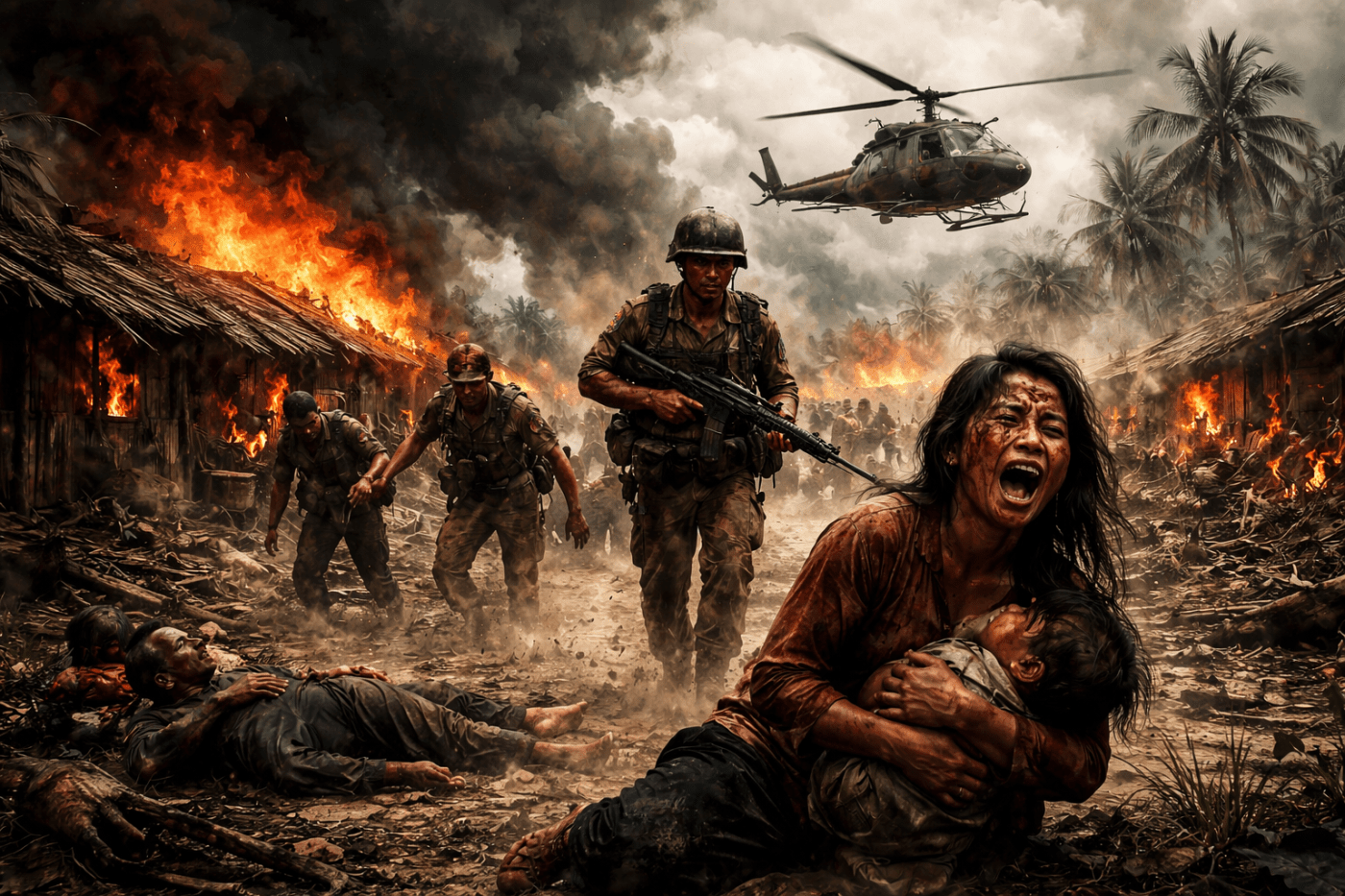
This Weaponized Intellects review enters Nick Turse’s investigation as both a historical excavation and a political indictment. It traces how a counterinsurgency war built on body counts transformed the Vietnamese countryside into a laboratory of industrialized violence. It examines the bureaucratic systems that normalized atrocity and the machinery of denial that later buried the evidence. And it argues that the truth uncovered in Turse’s archive forces us to confront the deeper imperial logic that made such a war not only possible, but predictable.
By Prince Kapone | Weaponized Information | Weaponized Intellects Book Review | March 18, 2026
The Massacre They Let Into Memory
Every empire has a trick it plays when the bodies begin to pile too high for comfort. It does not deny everything. That would be too crude, and too obviously dishonest. Instead it admits one crime, places it under a bright moral spotlight, and invites the public to stare at it until their conscience feels satisfied. The admission functions like a ritual cleansing. The system confesses just enough to survive the accusation. In the American memory of the Vietnam War, that ritual confession is My Lai.
My Lai sits in the national story like a stain carefully framed by the same people who spilled the blood. The massacre is remembered, taught, debated, dramatized in documentaries and classrooms, and invoked as proof that America is capable of self-criticism. But this carefully curated memory performs a political function. It isolates atrocity in one village, one day, and one lieutenant. The implication quietly follows: this was the moment when the war went wrong. The war itself remains intact. The machine remains innocent. The problem, we are told, was a breakdown in discipline, a tragic moral failure by a few men who somehow wandered away from the true American character.
Nick Turse opens his book, Kill Anything That Moves, by blowing that comforting fairy tale to pieces. He does not treat My Lai as a moral aberration. He treats it as a clue. Once you follow that clue outward into the war’s documentary trail — the letters, the testimony, the buried military files, the forgotten investigations — the story begins to change shape. My Lai stops looking like the exception and starts looking like the fragment of truth the system could no longer hide. America allowed itself to remember that massacre precisely because doing so helped bury the rest.
The first crack in that official memory comes through a voice that the government would have preferred to ignore. In 1971 a Vietnam veteran named Charles McDuff wrote to President Richard Nixon describing what he had witnessed. McDuff was not reporting a single episode of madness. He was describing a pattern. Civilians abused. Prisoners tortured. Villages destroyed. He warned the president “the atrocies that were committed in MyLai are eclipsed by similar American actions throughout the country.” The response he received was not outrage or investigation but bureaucratic indifference. The machinery of power had already decided how this story would be told: My Lai would be remembered as the rare exception that proved the system still worked.
What Turse uncovers is something very different. Once the paper trail is opened and the testimonies are allowed to breathe, the war begins to look less like a battlefield and more like a vast landscape of terror imposed on the countryside. Villages burned in reprisal. Civilians shot during sweeps. Women raped. Prisoners beaten or executed. Children killed and quietly folded into enemy body counts. None of this fits comfortably inside the mythology of a war fought to defend freedom. It fits much better inside the older, uglier tradition of colonial warfare — the kind of warfare that treats the people themselves as the battlefield.
This is where Turse shifts from the national myth to the ground itself, to a place called Trieu Ai. The move matters. Empire loves abstraction. It prefers maps, statistics, and tidy narratives of strategy. But the truth of a war is usually found in a village, not a briefing room. In Trieu Ai we encounter the daily rhythm of the American war machine: patrols moving through the countryside, fear on both sides, a booby trap exploding, a marine killed, others wounded. The shock and anger ripple through the unit. The men want someone to pay.
But here is the cruel logic of this kind of war. The guerrillas who planted the trap are gone. They melt into the terrain the way revolutionary fighters have done since the first peasant uprising against empire. What remains is the village. And in colonial war the village becomes the substitute enemy. Homes are burned. Civilians are forced from their land. Anyone who runs risks being shot. Anyone who stays risks being accused of hiding the guerrillas. The war moves downward, always downward, until it reaches those with the least power to defend themselves.
Turse shows that by the time American forces arrived in Trieu Ai the village had already been processed through this machinery of destruction. It had been bombed and shelled. Its homes burned. Its people driven into refugee camps in the name of what Washington called “pacification.” That word deserves a moment of attention, because it captures the genius of imperial language. Pacification does not mean peace. It means forcing a population to submit. And if submission cannot be achieved politically, it is pursued through displacement, hunger, and fear.
Seen from this vantage point, the massacre at Trieu Ai no longer appears as an inexplicable burst of violence. It appears as the logical result of a system that had already stripped the villagers of their civilian standing. Once a population is defined as a potential enemy — once the line between fighter and farmer is deliberately blurred — the door to atrocity swings open wide. A bunker becomes a target. A fleeing civilian becomes a suspect. A village becomes a military problem waiting to be solved with fire.
This is the deeper lesson Turse uncovers in the opening movement of his book. The violence of the Vietnam War was not simply the product of frightened young soldiers losing control. It grew out of a structure that taught those soldiers how to see the world around them. They were trained to regard the Vietnamese countryside as hostile territory and its inhabitants as possible enemies. Racism did not appear accidentally in that environment. It functioned as a battlefield technology, simplifying the moral equation so that killing could proceed without hesitation.
The tragedy, if one wishes to call it that, is that the fury of this war rarely traveled upward toward the men who designed it. The architects of intervention sat safely in Washington offices calculating strategy and issuing commands. The anger generated by a brutal guerrilla conflict instead fell on the nearest available targets: peasants in the hamlets, families hiding in bunkers, farmers tending fields. In that sense the American war in Vietnam followed the oldest pattern of imperial violence. When empire cannot defeat a revolution politically, it turns its weapons against the society that sustains the revolution.
By the end of these opening chapters Turse has already dismantled one of the central pillars of American historical mythology. The Vietnam War can no longer be understood as a noble mission stained by a few terrible mistakes. The evidence points somewhere else entirely. The killings were too widespread, the methods too consistent, the denials too rehearsed for that comforting story to survive. What emerges instead is a system in which massacre was not an accident interrupting the war. It was one of the ways the war functioned.
For those of us approaching this book from the standpoint of Weaponized Information, that revelation carries an uncomfortable clarity. The United States did not lose its moral compass in Vietnam. It revealed the direction that compass had always pointed when confronted with a people determined to control their own destiny. Under the pressure of anti-colonial struggle, the democratic mask slipped. Beneath it stood the familiar face of empire — armed to the teeth, convinced of its righteousness, and prepared to kill anything that moved.
The Village as Battlefield
If the first movement of Turse’s investigation breaks the spell of American memory, the second drags the reader directly into the place where that memory was manufactured — the Vietnamese countryside. The war did not unfold primarily in dramatic clashes between large armies across open terrain. It unfolded in villages, rice paddies, irrigation ditches, tree lines, and small clusters of homes that rarely appeared on American maps except as faint symbols marking what commanders called “population centers.” To the people who lived there these were not coordinates on a military chart. They were the world itself. But to the American war machine they increasingly appeared as a problem to be managed, searched, burned, or emptied.
Turse reconstructs this reality through the slow accumulation of testimony from soldiers and civilians alike. What emerges is not the clean geometry of conventional war but something closer to an occupation of rural life. Patrols moved through hamlets where farmers worked the same paddies their families had cultivated for generations. Helicopters circled overhead like mechanical vultures. Orders came down from command that villages suspected of aiding the insurgency could be destroyed. Houses were torched with cigarette lighters or flamethrowers. Livestock was shot. Rice stores were ruined. Families were driven from their homes and forced toward refugee camps that Washington preferred to call “strategic hamlets.”
The language used to describe these operations is revealing. In official briefings the process was called “search and destroy.” The phrase carried a simple meaning inside the military hierarchy: locate the enemy, eliminate him, and move on. But in the Vietnamese countryside the enemy did not line up neatly for battle. Revolutionary fighters lived among the population, drew support from the population, and vanished into the same villages that sustained them. Faced with this political reality, American strategy quietly shifted its focus. If the guerrillas could not be isolated from the people, then the people themselves would become the terrain of war.
That shift is the key to understanding why the destruction of villages appears again and again in Turse’s research. The burning of homes was rarely described as punishment or terror, even though the effect was both. Instead it was framed as necessity. Commanders insisted that denying shelter to the insurgency required denying shelter to the villagers who lived in those areas. The logic was circular but effective: any community located in contested territory could be interpreted as sympathetic to the resistance, and any action taken against that community could therefore be justified as military necessity.
Inside the patrol units carrying out these operations, the political nature of the war was rarely explained in such careful terms. What soldiers encountered instead was an atmosphere of suspicion that colored every interaction with the population. A farmer walking toward a field might be carrying fertilizer — or a grenade. A teenager running across a path might simply be frightened — or might be a courier for the Viet Cong. The countryside became a landscape of potential threats, and in such an environment fear easily slid into aggression. The line between caution and violence grew thinner with each patrol.
Turse captures this atmosphere with unsettling clarity. Soldiers describe entering villages where the inhabitants had already fled from previous bombardments, leaving behind empty huts and smoldering debris. Others recall encountering civilians who remained, often elderly people or families too poor to abandon their land. Under the rules governing many operations, anyone who ran could be treated as hostile. But in a war defined by helicopter gunships and sudden artillery strikes, running was often the most natural human response available. The tragedy was that instinct itself could become a death sentence.
At the center of these encounters stood a simple but devastating contradiction. American strategy claimed to defend the Vietnamese population from communist domination. Yet the tactics used to wage that defense repeatedly targeted the same population. Villages were evacuated in the name of protecting them. Crops were destroyed in the name of denying food to the insurgency. Entire districts were declared free-fire zones where any human movement could be treated as hostile. In practice this meant that ordinary life — farming, walking, gathering water — could appear indistinguishable from enemy activity.
What Turse’s evidence reveals is not merely cruelty but a form of political blindness. The architects of the war understood the conflict primarily as a military struggle against armed insurgents backed by foreign communism. But for millions of Vietnamese peasants the war was something different: a struggle over land, sovereignty, and the right to determine their own future. When American troops entered villages searching for enemies, they were stepping into communities whose political sympathies had been shaped by decades of colonial domination and revolutionary organizing. The villagers were not passive terrain. They were part of the historical force the United States was trying to suppress.
This is why the village became such a dangerous place for the occupying army. Every hut might conceal a fighter. Every family might be connected to the resistance. Every paddy might hide a trap. In that environment the temptation to treat the entire population as hostile grew stronger with each encounter. Racist language, already embedded in the training culture of the military, helped smooth the moral transition. When the people of a country are reduced to a slur, their deaths become easier to rationalize.
The cumulative effect of these practices was the slow transformation of the countryside into a battlefield without clear boundaries. Villages were searched repeatedly, sometimes burned more than once. Families fled and returned, rebuilt and fled again. Refugee camps swelled with displaced peasants whose lives had been uprooted in the name of saving them. The official narrative continued to describe these operations as necessary steps toward stabilizing the country, but the lived experience of the population told a different story — one of constant disruption, fear, and destruction.
In presenting this landscape Turse forces the reader to confront the central contradiction of the American war in Vietnam. The United States claimed to be fighting for the loyalty of the rural population while simultaneously treating that population as a potential enemy. The strategy required winning hearts and minds while destroying the villages where those hearts and minds lived. Such a contradiction could not be resolved through better tactics or improved discipline. It was rooted in the very premise of the intervention itself.
Seen from this vantage point, the violence that erupted in places like Trieu Ai begins to appear less mysterious. When an army operates inside a social world it neither understands nor respects, suspicion becomes the governing emotion. When that suspicion is combined with fear, racism, and overwhelming firepower, the path toward atrocity grows alarmingly short. Turse does not need to exaggerate this dynamic; the testimony of the participants speaks for itself.
The lesson emerging from this section of the book is therefore both historical and political. The destruction of villages was not simply the byproduct of a chaotic war. It was the logical consequence of a strategy that treated a revolutionary countryside as hostile terrain. Once that assumption took hold, the people living in that countryside could be pushed aside, displaced, or killed in the name of military progress. The village ceased to be a community of human beings and became instead a space to be searched, cleared, and, when necessary, destroyed.
For an empire accustomed to measuring success in territorial control and enemy casualties, this transformation might have appeared pragmatic. For the Vietnamese peasants living through it, it meant that daily life unfolded under the shadow of soldiers who saw their homes not as places of life but as possible hiding places for the enemy. That difference in perspective lies at the heart of Turse’s narrative. The war that Washington described in strategic terms was experienced in the countryside as a relentless assault on the fabric of rural existence.
And so the story moves forward. The burning villages, the displaced families, the suspicion that hangs over every encounter — these are not isolated scenes but the foundation upon which the rest of the war is built. By the time Turse begins to examine the military doctrines that governed American operations, the reader already understands something essential: the battlefield of Vietnam was not simply a place where armies met. It was a society under siege.
The Arithmetic of Death
Once the reader has walked through the villages, once the smoke from burned huts and shattered rice paddies has begun to settle into the imagination, Turse pulls the camera back and reveals something colder than battlefield chaos. Beneath the patrols, the burned homes, and the frightened villagers stood a managerial logic that governed the entire war. The American military did not measure success in Vietnam by territory held or political legitimacy won among the population. It measured success by numbers. Not the number of villages rebuilt, not the number of civilians protected, not the number of political grievances resolved. The metric that ruled the war was body count.
This fact alone should make any honest reader pause. A war supposedly fought to defend the Vietnamese people was being evaluated through a statistic that counted how many Vietnamese had died. The absurdity would almost be comic if it had not been soaked in blood. Yet inside the command structure it appeared perfectly rational. Robert McNamara and the technocrats of the Pentagon believed modern war could be managed the way corporations manage production. Data would guide strategy. Metrics would reveal progress. Victory could be calculated.
In the boardrooms of American power this approach carried the polished language of efficiency. On the ground in Vietnam it produced something closer to a grim competition in corpse production. Commanders were expected to demonstrate that their operations were weakening the enemy, and the easiest way to demonstrate that progress was to report rising numbers of dead Viet Cong. Promotions, praise, and reputation followed those figures upward through the chain of command. A battalion that produced impressive body counts appeared successful. A unit that returned with few enemy dead appeared ineffective.
The logic of the system was simple enough that soldiers learned it quickly. Dead bodies proved success. Dead bodies made the statistics look good. Dead bodies satisfied the expectations of officers whose careers depended on demonstrating progress in a war that refused to produce conventional victories. And so the battlefield quietly transformed into a kind of bureaucratic factory where the product being manufactured was the corpse.
Here the war reveals its most grotesque contradiction. The guerrillas rarely offered themselves up for large-scale engagements where American firepower could destroy them in bulk. They fought through ambushes, mines, sudden attacks, and swift withdrawals. Their strategy relied on mobility and patience. For the American military this created a persistent frustration. The enemy could strike without presenting a target large enough to justify the overwhelming destructive power the United States had brought to Southeast Asia.
But the body-count system did not allow frustration to remain an emotion. It converted frustration into pressure. Units were expected to produce results regardless of the tactical reality. If the guerrillas would not appear in sufficient numbers to satisfy the statistics, then the temptation to redefine the battlefield grew stronger. A Vietnamese corpse did not arrive with a label explaining whether the person had been a farmer or a fighter. Once a body lay on the ground, the paperwork could easily transform it into an enemy casualty.
This is where the war’s arithmetic becomes morally revealing. Turse shows that the distinction between civilian and combatant began to dissolve under the pressure of statistical expectations. Villagers killed during sweeps could be recorded as guerrillas. A farmer shot while running from soldiers could be listed as an enemy combatant who had attempted to escape. Children killed during firefights could be counted as youthful insurgents. Once the metric of success became numerical, the truth about who had died grew less important than the usefulness of the number itself.
The phrase that circulated among troops captured this brutal simplification with a kind of gallows humor: if it’s dead and Vietnamese, it’s VC. Beneath the crude cynicism lay a structural truth about the war. The command system had created conditions where the easiest way to demonstrate success was to treat the population itself as the enemy. The statistics rewarded death, not understanding. They rewarded destruction, not political insight.
For the technocrats managing the war from Washington, the body count appeared to offer clarity. Rising numbers suggested that the insurgency was being worn down. Charts and graphs displayed steady progress. Briefings reassured the public that victory was only a matter of time. But the numbers concealed a deeper reality that no spreadsheet could capture. Killing peasants did not weaken a revolution rooted in peasant grievances. In many cases it strengthened it. Every burned village, every displaced family, every civilian body counted as enemy dead widened the distance between the occupiers and the society they claimed to defend.
This is where the managerial arrogance of the American war machine collided with the political intelligence of a national liberation struggle. The United States believed it could reduce war to quantifiable outputs. The Vietnamese revolution understood that the decisive terrain of the conflict was not the number of bodies on a chart but the allegiance of the population. In that contest the body-count system proved worse than useless. It encouraged the very brutality that pushed rural communities toward the resistance.
Turse’s analysis makes this contradiction impossible to ignore. The war was being conducted through a metric that rewarded behavior almost guaranteed to alienate the people whose support Washington claimed to seek. Each operation designed to inflate the body count deepened the resentment of villagers who saw their homes searched, their relatives killed, and their communities disrupted in the name of freedom. The statistics that appeared to demonstrate progress were often measuring the spread of anger.
It is here that the cold language of administration begins to reveal its ideological character. McNamara’s systems analysis did not simply miscalculate the dynamics of insurgency. It reflected a worldview in which human beings could be reduced to units of data. The Vietnamese peasant disappeared behind a column of numbers. The reality of life in the villages — the social networks, the grievances against landlords, the memory of colonial rule, the hope for independence — vanished inside the abstraction of enemy casualties.
For the empire this abstraction was convenient. It allowed the war to be presented as a technical challenge rather than a political one. If victory depended only on killing enough insurgents, then the conflict could be managed through improved tactics, more aggressive operations, and better statistical monitoring. But if the war was fundamentally about the right of a people to determine their own future, then no quantity of corpses would resolve the problem.
That is the deeper significance of the arithmetic Turse exposes. The body-count system did not merely produce distorted statistics. It exposed the intellectual poverty of the entire intervention. By reducing the war to numbers, the architects of American policy revealed how little they understood the society they were trying to control. The revolution was treated as a military infection to be eliminated rather than as the expression of a political movement with deep roots in Vietnamese history.
Meanwhile the soldiers on the ground lived inside the brutal consequences of this logic. Patrols moved through villages searching for signs of enemy presence. Shots were fired at figures glimpsed in the distance. Bodies were counted, photographed, and reported upward through the chain of command. Each number traveled through the bureaucracy like a small token of success. Few within that system paused to ask whether the dead man lying in a rice paddy had ever held a weapon.
Seen from this perspective, the body count becomes more than a statistic. It becomes the moral signature of the war itself. A strategy that measures progress by the number of local people killed cannot claim to be protecting those people. The arithmetic reveals the political truth hidden behind official rhetoric. What was presented as a mission to defend South Vietnam increasingly resembled a campaign against the society that lived there.
Turse does not need rhetorical exaggeration to make this point. The documents and testimonies speak with quiet brutality. Reports celebrating successful operations often listed dozens of enemy dead alongside minimal American casualties. What those reports rarely acknowledged was the identity of the people counted as enemy fighters. Behind each number lay a human life whose story would never appear in the statistics that justified the operation.
For the reader following Turse’s investigation, the realization arrives slowly but unmistakably. The American war in Vietnam was being governed by a mathematical logic that rewarded killing while obscuring the meaning of the killing itself. Numbers rose, charts improved, and commanders congratulated one another on progress. Meanwhile the countryside filled with widows, orphans, and displaced families whose suffering could not be captured by the metrics of success.
In the end the arithmetic that promised clarity delivered only illusion. The war was not being won. The insurgency was not collapsing. The numbers were measuring something real — death — but they were measuring the wrong thing. They recorded the scale of destruction without revealing the political reality unfolding beneath it. And that reality was simple enough: the more the American war machine relied on body counts to demonstrate success, the more it revealed that it was fighting a people it did not understand and could not defeat.
Overkill: The Industrialization of Destruction
Up to this point the reader has walked through villages and patrols, through the tense encounters between soldiers and peasants that filled the countryside of Vietnam with suspicion and violence. But Turse does not allow the war to remain confined to that intimate scale. He widens the frame, and what comes into view is something even more chilling: a war conducted with the full industrial arsenal of the most technologically advanced military power on earth. If the village was the stage where American soldiers confronted the human reality of Vietnam, the sky above it became the domain where American technology rained destruction without ever needing to see the faces below.
The United States arrived in Vietnam carrying the tools of modern warfare in quantities that dwarfed anything the country had ever experienced. Jet aircraft screamed across the horizon dropping bombs powerful enough to flatten entire hamlets. Helicopter gunships circled above rice paddies like mechanical hawks, their machine guns cutting across fields and tree lines. Artillery batteries fired shells into villages miles away, guided by coordinates on a map rather than by the sight of a specific enemy. And then there were the chemicals — the herbicides that stripped forests bare and poisoned farmland in an attempt to expose guerrilla fighters who used the natural terrain as cover.
The official explanation for this overwhelming force was simple. American commanders believed that superior firepower could compensate for the elusive tactics of the insurgency. If guerrillas refused to fight on open ground, the thinking went, then the United States would bring the war to them through sheer destructive capacity. Villages suspected of harboring insurgents could be bombed. Forests that concealed guerrilla movement could be defoliated. Entire districts could be pounded by artillery until resistance became impossible.
In practice this strategy produced a landscape where violence arrived from directions that villagers could neither predict nor resist. Bombs fell from aircraft whose pilots could not distinguish a farmer from a fighter at the speeds they traveled. Artillery shells exploded in rice fields where families had worked for generations. Napalm spread burning fuel across homes built from wood and straw, turning simple huts into furnaces within seconds. For the people living below, the war often appeared not as a clash of armies but as a sudden eruption of fire descending from the sky.
Turse’s account reveals how thoroughly this technological advantage reshaped the character of the conflict. The American military possessed the capacity to destroy villages faster than they could be rebuilt. B-52 bombers could pulverize large areas of countryside with such intensity that the earth itself seemed to buckle under the pressure. Helicopter assaults allowed troops to strike remote locations with startling speed, turning quiet hamlets into battle zones within minutes. The war moved with a velocity and scale that rural communities had never experienced before.
Yet the paradox of this destructive power quickly became apparent. The United States could devastate enormous stretches of Vietnam’s landscape, but devastation did not translate into political control. A village destroyed by bombing did not automatically produce loyalty to the government in Saigon. In many cases the opposite occurred. Families who lost their homes, crops, and relatives under American firepower had little reason to view the occupying army as their protector. The technology that promised victory often generated the very resentment that sustained the insurgency.
This contradiction lay at the heart of what Turse describes as overkill. The American war machine possessed such immense destructive capacity that it frequently deployed it even when the tactical benefit was unclear. Firepower became a substitute for understanding. If a patrol encountered resistance, artillery could be called in. If a village appeared suspicious, aircraft could level it. If guerrillas vanished into the forest, chemicals could strip the leaves from the trees. The solution to political complexity was repeatedly sought through mechanical force.
In this sense Vietnam became a proving ground for what might be called the technological imagination of American power. The war offered an opportunity to test new weapons, new bombing strategies, and new methods of aerial mobility. Helicopters transformed the battlefield into a network of rapidly shifting landing zones. Advanced munitions promised greater destructive precision. The countryside of Southeast Asia was treated less as a society than as a laboratory where modern warfare could refine its tools.
For the villagers living within that laboratory the consequences were catastrophic. Fields that once produced rice were cratered by bombs. Water sources were contaminated by chemicals and debris. Families were forced to abandon ancestral land and seek refuge in overcrowded camps or unstable urban districts. What the American military described as tactical operations often meant the collapse of entire rural communities whose economic and social life had depended on the land.
Turse emphasizes that this devastation was not confined to isolated incidents. It formed part of a systematic approach to the war. Commanders believed that denying the insurgency access to rural resources would weaken its ability to operate. If villages could no longer supply food or shelter, the guerrillas would be forced into open confrontation where American firepower could destroy them. The strategy therefore targeted not only fighters but the ecological and economic foundations of village life.
The irony, as history would reveal, was that this strategy misunderstood the resilience of a population engaged in a struggle for national independence. Destroying forests did not erase the political grievances that fueled the revolution. Bombing villages did not dissolve the networks of solidarity that connected rural communities to the insurgency. The immense destructive power of the United States often succeeded only in deepening the determination of those who endured it.
What emerges from Turse’s account is a portrait of a war fought with tools designed for industrial conflict but applied to a society whose strength lay in its social cohesion rather than its military hardware. The United States brought machines capable of leveling cities to a countryside where the decisive factor was not the size of the bomb but the will of the people. In that mismatch between technological supremacy and political reality lies one of the central tragedies of the war.
For the empire, overwhelming firepower appeared to promise a shortcut to victory. If enough explosives could be dropped and enough land could be cleared, resistance might collapse under the weight of destruction. But the war in Vietnam repeatedly demonstrated the limits of that logic. A bomb can shatter a house. It cannot erase the idea that the land belongs to those who live on it.
Turse’s exploration of overkill therefore exposes another layer of the conflict’s deeper meaning. The American war machine was not merely brutal; it was structurally incapable of recognizing the political nature of the struggle it faced. Technology replaced understanding. Destruction replaced dialogue. Villages that should have been approached as communities with their own histories and aspirations were treated instead as coordinates on a targeting map.
By revealing how thoroughly this technological mentality shaped the war, Turse invites the reader to reconsider what modern military power actually accomplishes. The United States could deploy more bombs, helicopters, artillery, and chemicals than any adversary Vietnam could field. Yet the very scale of that power often magnified the gap between the occupiers and the people they sought to control. The war machine could crush buildings and forests with terrifying efficiency. It could not manufacture legitimacy.
In the end the sky over Vietnam became a symbol of both American strength and American blindness. From above, commanders saw targets and opportunities. From below, villagers saw the arrival of machines that destroyed their homes without ever asking why those homes stood where they did. The war that Washington imagined as a demonstration of technological superiority became instead a demonstration of how little technology can achieve when it is unleashed against a population determined to shape its own destiny.
This is the meaning of overkill in Turse’s narrative. It is not simply the use of excessive force. It is the belief that force alone can resolve a fundamentally political conflict. The United States possessed the capacity to devastate Vietnam’s landscape many times over. What it lacked was the ability to understand that the struggle unfolding beneath its bombs was not merely a military challenge but a revolution.
The Geography of Atrocity
By the time Turse reaches the middle movement of his investigation, the reader has already been forced to abandon several comfortable illusions. The war is no longer a series of tragic mishaps. The destruction of villages is no longer accidental collateral damage. The immense firepower unleashed across Vietnam is no longer the unfortunate excess of a frustrated superpower. Something more systematic is emerging from the evidence. And so Turse does something simple but devastating: he begins to assemble the record.
What unfolds is not a single story but a pattern. One atrocity follows another, then another, until the reader begins to recognize a grim familiarity in the details. Civilians rounded up and beaten. Prisoners tortured for information they may or may not possess. Women raped during sweeps through rural hamlets. Old men executed on suspicion of aiding the guerrillas. Children shot while running from troops who have been taught that anyone fleeing might be an enemy courier. Each episode appears at first like a fragment, a disturbing anecdote buried inside the chaos of war. But as Turse piles these fragments together, a map begins to appear.
This map stretches across the entire theater of conflict. From the Mekong Delta to the Central Highlands, from coastal provinces to the interior countryside, the stories repeat with unsettling consistency. Different units, different commanders, different months or years — yet the same basic sequence unfolds again and again. Patrols enter villages. Suspicion rises. Violence erupts. Civilians die. Reports are written. The machinery of command absorbs the incident and moves forward.
At this stage of the book the reader can no longer pretend that these events belong to the margins of the war. They are the texture of it. Turse’s research into military archives, investigative files, and testimony from veterans reveals hundreds of allegations of brutality, many of them supported by witnesses and internal documentation. Some cases were investigated. Many were ignored. Others vanished into bureaucratic silence. But together they form a record too widespread to dismiss as coincidence.
The significance of repetition cannot be overstated. In historical analysis, one atrocity can be explained away as a breakdown in discipline or judgment. Two or three can be attributed to unfortunate circumstances. But when similar acts appear across multiple regions and over extended periods of time, the explanation must shift. The problem ceases to be individual behavior and becomes institutional structure. Turse’s work forces that shift with relentless clarity.
Consider the recurring appearance of sexual violence in the testimonies he collects. Rape, often treated in official narratives as an unspeakable aberration, appears in case after case as troops move through villages during search operations. Women are assaulted during interrogations or while their homes are being searched. Sometimes the violence is hidden. Sometimes it is treated with casual indifference. The pattern exposes a dimension of domination that rarely appears in sanitized histories of the war: the body of the colonized woman becomes another terrain over which power is exercised.
Torture follows a similar pattern. Prisoners suspected of aiding the insurgency are beaten, shocked with electricity, or subjected to other forms of coercion designed to extract information. In many cases the information proves unreliable or useless. But the violence continues because it serves another function beyond intelligence gathering. It communicates fear. It teaches the surrounding population what happens to those accused of assisting the resistance.
Mutilation and execution appear as well, sometimes carried out in moments of rage, sometimes as acts of calculated intimidation. Soldiers recount ears cut from corpses as trophies. Bodies are displayed as warnings to villagers who might be tempted to aid the insurgency. These actions, horrifying as they are, reflect a deeper psychological shift within a war where the enemy is rarely visible and frustration accumulates with every ambush and hidden mine.
Yet even as Turse documents these acts, he refuses to present them merely as expressions of individual cruelty. The broader structure of the war continually presses upon the behavior of the men carrying it out. Units operating under body-count pressure know that dead Vietnamese can be transformed into evidence of progress. Soldiers patrolling hostile territory know that hesitation can cost lives. Racist language circulating within military culture reduces the population to caricatures that make violence easier to justify. Each of these forces pushes the boundary between soldier and civilian further toward collapse.
The result is a battlefield where the categories that normally govern war begin to dissolve. Civilians become suspects. Villages become targets. Entire regions are treated as hostile environments where ordinary life appears indistinguishable from insurgent activity. Once that transformation takes place, atrocities cease to be shocking interruptions. They become predictable outcomes of a system that has already defined the population as expendable.
Turse’s evidence accumulates with a quiet but relentless force. A massacre in one province echoes the details of another thousands of miles away. A soldier’s testimony about prisoners executed during a sweep matches reports found in a forgotten investigative file. Civilians recount scenes of violence that resemble the accounts of American veterans describing operations they were ordered to carry out. Piece by piece the fragments of the war assemble themselves into a grim cartography.
What that cartography reveals is not merely brutality but a method of warfare rooted in colonial logic. When an occupying force confronts a population whose loyalties lie with a revolutionary movement, the temptation to treat the entire society as hostile grows stronger with each encounter. The battlefield expands outward until it encompasses the homes, fields, and bodies of the people themselves. Violence directed at civilians becomes an extension of counterinsurgency rather than a deviation from it.
For the American military this transformation was often described in neutral strategic language. Operations were designed to deny the insurgency food, shelter, and mobility. Villages were relocated or destroyed in order to isolate guerrilla fighters from the population. Suspected collaborators were detained or interrogated. In official reports these measures appeared as rational steps within a counterinsurgency campaign.
But when the evidence is viewed from the perspective of those who lived through it, the language of strategy dissolves into something far more disturbing. Families driven from their homes do not experience relocation as a tactical maneuver. Farmers watching their crops burn do not interpret the flames as counterinsurgency policy. To them the war appears as a relentless assault on the fabric of daily life, carried out by soldiers who often cannot distinguish between those who resist and those who simply endure.
This is why Turse’s work matters so profoundly. By assembling the scattered evidence of brutality into a coherent narrative, he restores the human dimension that official histories so often obscure. Each testimony reminds the reader that behind every statistic lies a person whose life intersected with the machinery of war at the worst possible moment. The map of atrocities is therefore also a map of interrupted lives.
For readers approaching the war through the lens of empire and national liberation, the implications are difficult to ignore. The widespread nature of these atrocities suggests that the violence was not merely the product of individual failure but of a deeper contradiction within the American project in Vietnam. An army attempting to control a population that largely rejected its presence inevitably found itself treating that population as the enemy.
By the time this pattern becomes clear, the reader understands that the atrocities documented by Turse are not isolated shadows at the edge of the war. They are reflections of its central logic. The war demanded control over a society that refused to be controlled. And when political legitimacy proved impossible to manufacture, the machinery of force expanded until it engulfed the very people it claimed to defend.
Thus the geography of atrocity is not simply a record of suffering. It is a map of the war’s internal truth. Across Vietnam’s villages and provinces, the same grim equation repeated itself: suspicion bred violence, violence bred resentment, and resentment fed the revolutionary movement that the United States had come to destroy. The more the war spread through the countryside, the more it revealed the limits of military power in the face of a people fighting for their own liberation.
The Delta and the Mathematics of Slaughter
If the previous chapters of Turse’s investigation reveal the broad geography of atrocity, the story that unfolds in the Mekong Delta concentrates that pattern into something even more stark. Here the war begins to resemble a grotesque equation in which the only acceptable answer is a rising number of dead Vietnamese bodies. The Mekong Delta, one of the most densely populated and agriculturally rich regions of Vietnam, became the site of operations where the body-count logic of the war reached its most chilling clarity. What had already been visible as a pattern across the countryside now appeared as a deliberate method of command.
The region was strategically important for obvious reasons. Its waterways, rice fields, and villages formed a vast network through which revolutionary forces could move, organize, and sustain themselves. To American planners the Delta therefore represented both a threat and an opportunity. If control could be established there, it might demonstrate that the counterinsurgency strategy was finally working. The pressure placed on commanders operating in the region reflected that expectation. Success would be measured in numbers.
Enter the campaign known as Operation Speedy Express. On paper it appeared as another offensive designed to weaken the Viet Cong presence in the Delta. Units moved through the countryside supported by helicopters and artillery, searching for guerrilla fighters and destroying enemy infrastructure. Reports flowed upward through the chain of command announcing impressive results. Thousands of enemy combatants, the documents claimed, had been killed.
Yet the numbers themselves raised troubling questions. The ratio between American casualties and the reported enemy dead was so extreme that some observers began to doubt the accuracy of the statistics. The battlefield conditions did not resemble the kind of sustained combat that would produce such figures. There were few large engagements. Guerrilla units continued to operate despite the reported losses. Something about the arithmetic did not add up.
Turse carefully reconstructs what many participants already suspected. The pressure to produce high body counts had reached such intensity that the distinction between guerrillas and civilians became increasingly irrelevant to the reporting system. Helicopter crews firing from above the rice paddies could not reliably determine who they were shooting at. Anyone moving across the fields might be interpreted as an enemy courier. Anyone fleeing at the sound of approaching aircraft might be marked as hostile. Once the gunships opened fire, the bodies left behind could easily be classified as enemy fighters.
From the perspective of the command structure the system appeared to function perfectly. Patrols moved through villages. Helicopters swept across the countryside. Artillery pounded suspected positions. Reports recorded the number of enemy dead. Charts in briefing rooms displayed steady progress. Promotions followed those numbers upward through the ranks. The war seemed to be producing measurable success.
On the ground the reality was more disturbing. Villagers working in the fields suddenly found themselves caught in the sights of helicopter machine guns. Farmers traveling between hamlets risked being mistaken for guerrilla messengers. Entire communities learned to live with the knowledge that any movement across open ground might attract deadly attention from the sky. The Delta, once defined by the rhythm of rice cultivation and river trade, became a landscape where survival depended on avoiding the mechanical gaze of aircraft circling overhead.
Some within the American military recognized the moral and strategic disaster unfolding around them. Advisors and officers quietly questioned the accuracy of the body counts. A few attempted to raise concerns about the killing of civilians. But the institutional momentum of the war proved difficult to challenge. The reporting system rewarded numbers, and the numbers kept rising. As long as the statistics satisfied the expectations of command, the deeper truth about how those figures were produced remained obscured.
Here Turse exposes the final consequence of the arithmetic that had governed the war from the beginning. When the measure of success becomes the number of enemy bodies, the temptation to redefine who counts as the enemy becomes overwhelming. The system does not need explicit orders to kill civilians. It simply creates incentives that make civilian deaths useful. Once that incentive structure is in place, the machinery of violence begins to operate almost automatically.
The Mekong Delta therefore offers a grim illustration of how bureaucratic logic can transform warfare into something resembling a production process. Helicopters sweep the fields, soldiers patrol the villages, artillery strikes suspected locations, and the resulting deaths are converted into statistics that demonstrate progress. Each stage of the operation appears rational within the framework of military planning. Yet taken together they form a cycle of destruction that bears little relation to the political realities of the conflict.
The tragedy of this system lies not only in the lives lost but in the blindness it revealed at the heart of the American intervention. The Vietnamese revolution was sustained by the support of rural communities who saw the struggle as a fight for national independence and social change. No quantity of civilian deaths could extinguish that motivation. In fact, the destruction inflicted on the countryside often strengthened the resolve of those who survived it.
Turse’s account of the Delta therefore exposes the deeper failure of the American war machine. Its commanders believed that overwhelming force and precise statistics could produce victory. Yet the very tools they relied upon obscured the human realities that determined the course of the war. Each civilian death counted as an enemy casualty widened the gap between the occupiers and the population they claimed to defend.
Seen in this light, Operation Speedy Express becomes more than a controversial military campaign. It becomes the logical culmination of a strategy that had reduced war to arithmetic. The Delta turned into a proving ground for the idea that success could be measured by the number of bodies produced by an operation. But numbers, as Turse demonstrates, can conceal as much as they reveal. Behind each statistic stood a human life whose identity disappeared inside the machinery of reporting.
For the people of the Mekong Delta the consequences were immediate and terrifying. Rice fields that once sustained villages became killing zones where movement itself could invite death. Rivers that had served as transportation routes turned into avenues for military patrols. Communities that had survived decades of colonial conflict now found themselves caught inside a technological war whose destructive reach extended far beyond the limits of traditional combat.
By tracing the story of the Delta, Turse forces the reader to confront the ultimate irony of the body-count system. The numbers that appeared to demonstrate progress were often measuring the destruction of the very society the United States claimed to protect. The more successful the operations appeared on paper, the more devastating their impact on the civilian population became.
In the end the mathematics of slaughter could not deliver the victory it promised. The insurgency endured, sustained by a population whose determination could not be bombed, burned, or counted into submission. What remained were the records — the reports, the statistics, the testimonies of soldiers and villagers alike — revealing how a war fought in the name of freedom came to treat human life as a number on a chart.
When the Witnesses Began to Speak
By the time the American war in Vietnam began to unravel politically at home, the machinery that had produced so much devastation in the countryside was already starting to crack under a different kind of pressure. The violence itself had not suddenly become visible. Vietnamese villagers had known it for years. What changed was that some of the men who had participated in the war began to talk about what they had seen. And once the witnesses started speaking, the careful architecture of denial that had protected the war effort became much harder to maintain.
Turse’s narrative in this portion of the book shifts from the battlefield to the uneasy terrain of testimony. Soldiers who had once returned home quietly carrying the memories of burned villages and dead civilians began to describe the war in terms that sounded nothing like the official briefings delivered in Washington. Their accounts did not present isolated mistakes or unfortunate accidents. They described patterns. They spoke about routine practices, standing orders, and a climate of violence that made atrocities not exceptional but predictable.
One of the most significant turning points came through the investigations of journalists and antiwar activists who refused to accept the sanitized version of the war offered by government officials. Reports began to circulate describing operations where civilian deaths had been quietly recorded as enemy casualties. The press slowly uncovered documents and testimony that suggested the atrocities revealed in the My Lai massacre were not unique horrors but windows into a broader system of violence.
Within the military itself some investigators had already begun asking uncomfortable questions. Internal inquiries produced disturbing evidence that American units had repeatedly engaged in the killing of civilians, the destruction of villages, and the systematic mistreatment of prisoners. Yet these investigations rarely led to meaningful consequences. Files were closed, cases were downgraded, and reports were buried within bureaucratic channels where they could do the least damage to the reputation of the institution.
Here Turse exposes the quiet machinery of concealment that accompanied the violence on the ground. The same bureaucratic discipline that produced impressive body counts also ensured that reports of misconduct rarely traveled far enough up the chain of command to produce accountability. When allegations surfaced, they were often reframed as misunderstandings, exaggerated claims, or the misconduct of a few individuals who had failed to uphold the standards of the military.
But the witnesses were becoming harder to silence. Veterans returning from Vietnam began participating in public forums where they described their experiences openly. Organizations formed to collect and publish these testimonies, creating spaces where soldiers could speak about the war in language stripped of official euphemisms. Their stories carried a moral weight that statistics could not match. They described villages destroyed in search-and-destroy operations, prisoners beaten during interrogations, and civilians killed because the system demanded results.
These revelations did more than expose the brutality of the war. They also revealed how the institutional culture of the military had normalized that brutality. Young soldiers arriving in Vietnam entered a system already shaped by years of counterinsurgency doctrine that treated the rural population as a potential enemy base. Orders were delivered in language that encouraged aggression while leaving enough ambiguity to deny responsibility later. The result was a war fought within a moral fog where violence against civilians could be justified, ignored, or simply misreported.
The famous massacre at My Lai, once it finally reached public awareness, briefly forced the United States to confront the consequences of its own war. Images and testimony from the village shocked many Americans who had believed the official narrative of a disciplined army fighting to protect democracy. Yet even this moment of exposure revealed the limits of the system’s willingness to hold itself accountable. Only a handful of individuals faced prosecution, and the institutional forces that had made the massacre possible remained largely untouched.
From the vantage point developed throughout Turse’s work, My Lai appears less as an aberration than as a moment when the hidden structure of the war became briefly visible. The massacre shocked the American public precisely because it contradicted the myth of a morally restrained war. But for Vietnamese villagers living in contested areas, the destruction of communities and the killing of civilians had long been part of everyday reality.
What Turse ultimately demonstrates in this section is that the struggle over the truth of the war was itself a form of political conflict. On one side stood the institutions of the American state, armed not only with military power but with the ability to shape public narratives. On the other side were journalists, activists, and veterans who attempted to reconstruct the war from the fragments of testimony left behind by those who had lived through it.
The courage of these witnesses mattered because the war had been sustained in part by silence. As long as the violence remained hidden behind military reports and carefully managed press briefings, the machinery of destruction could continue operating without serious challenge. When soldiers began describing what they had seen, that silence broke. Their words created cracks in the official story that could no longer be easily sealed.
For readers approaching this history today, the importance of those testimonies extends beyond the Vietnam War itself. They remind us that imperial wars are fought not only with weapons but with narratives designed to justify those weapons. Governments construct stories about protecting freedom, restoring order, or defending civilization. The lived experiences of those on the ground often tell a different story.
Turse’s work stands in the tradition of historical investigations that recover those suppressed voices. By assembling the accounts of soldiers, villagers, and investigators, he reconstructs a picture of the war that the official archives tried to obscure. The result is not simply a chronicle of atrocities but a deeper understanding of how institutions manage violence while preserving the appearance of legitimacy.
When the witnesses began to speak, the war’s moral foundation began to crumble. The numbers in the reports no longer told the whole story. Behind them stood human beings whose lives had been erased by policies that treated the countryside as a battlefield and its inhabitants as expendable. Once those voices reached the public sphere, the myth of a clean and necessary war could no longer be sustained with the same confidence.
In that sense this chapter marks a turning point in Turse’s narrative. The violence that had unfolded in the shadows of the Vietnamese countryside now entered the arena of historical memory. What had once been buried in reports and dismissed as rumor became documented testimony. And from those testimonies emerged a record of the war that no amount of official rhetoric could fully erase.
The Architecture of Forgetting
Empires do not merely wage wars. They also wage campaigns against memory. Once the bombs stop falling and the troops begin returning home, another operation quietly begins: the reconstruction of the story. Nick Turse’s investigation arrives at this crucial terrain in the later chapters of Kill Anything That Moves, where the question is no longer only what happened in Vietnam, but why so much of what happened disappeared from the public consciousness of the United States. The answer, as Turse patiently reconstructs, lies not in the absence of evidence but in the remarkable efficiency with which institutions learned to bury it.
During the war itself, reports of atrocities circulated widely inside the American military bureaucracy. Investigators compiled files documenting civilian killings, village burnings, torture, and other crimes committed during operations across South Vietnam. These documents did not exist in isolation. They formed a sprawling archive that revealed a pattern of violence stretching far beyond the single event that would become famous under the name My Lai. Yet despite the sheer volume of these records, very little of this material reached the public in a way that could challenge the official narrative of the war.
The reason was not a grand conspiracy conducted in secret rooms by a handful of villains. It was something more ordinary and therefore more powerful: a bureaucratic system designed to protect the institution from scrutiny. Reports were categorized, transferred, or quietly shelved. Investigations were opened and then closed without serious consequences. Officers responsible for operations continued their careers with little interruption. The files remained within the labyrinth of military archives, technically preserved but practically invisible.
This machinery of forgetting served a political function that extended well beyond the immediate war. The American public had to believe that My Lai represented a terrible exception, a moment when discipline collapsed and moral standards failed. If the massacre could be framed as the isolated act of a rogue unit, then the broader legitimacy of the war effort might still be salvaged. The idea that similar atrocities had occurred across the countryside was far more difficult to reconcile with the image of the United States as a reluctant defender of freedom.
Turse demonstrates that this narrative of exception became the dominant framework through which Americans were encouraged to remember the war. Textbooks, documentaries, and public discussions often treated My Lai as the singular moral catastrophe of the conflict. The massacre was acknowledged, condemned, and then carefully contained within a story about a few individuals who had betrayed the values of the nation. The structural forces that had produced the violence remained largely untouched by this interpretation.
From the standpoint of historical materialism, the success of this narrative is hardly surprising. States possess enormous power to shape the boundaries of public memory. Archives can be sealed, investigations redirected, and attention focused on carefully chosen examples that obscure the larger pattern. The myth of the exceptional atrocity functions as a kind of ideological shield. By isolating one crime, the system protects itself from examination.
Yet the archive has a stubborn character of its own. Documents accumulate. Testimonies survive. And occasionally historians with enough patience and determination begin to assemble the fragments into a more coherent picture. Turse’s work represents precisely this kind of excavation. By tracking down veterans, interviewing Vietnamese survivors, and uncovering forgotten investigative files, he reconstructs the hidden record of the war that official narratives had long attempted to contain.
The picture that emerges from this reconstruction is both devastating and clarifying. The atrocities that shocked the world at My Lai were not anomalies. They were the visible edge of a system built upon the dehumanization of the Vietnamese population and the relentless pressure to produce enemy body counts. Once those structural conditions are understood, the violence appears less like a collapse of discipline and more like the logical outcome of the strategy itself.
This realization carries profound implications for how the war should be remembered. If the atrocities were systemic rather than accidental, then the moral responsibility cannot be confined to a few soldiers or commanders. It extends upward through the institutions that designed the strategy and downward through the culture that allowed such a war to be fought in the first place. The comforting narrative of national innocence becomes far more difficult to maintain.
But empires rarely surrender their myths easily. Even as historians uncover new evidence, the larger cultural memory often remains shaped by the earlier narrative of exception. Films, memorials, and public commemorations frequently emphasize the suffering of American soldiers while leaving Vietnamese civilians largely invisible. The war becomes a tragedy primarily for those who fought it rather than for the millions who lived beneath its violence.
Turse challenges this imbalance by restoring Vietnamese voices to the historical record. Survivors describe the destruction of their villages, the deaths of family members, and the years of terror experienced under aerial bombardment and ground operations. Their testimonies remind readers that the war was not an abstract geopolitical contest but a lived catastrophe for countless communities across Vietnam.
In doing so, Turse also invites a broader reflection on the relationship between power and historical memory. The ability to control how a war is remembered is itself a form of political authority. If atrocities can be reframed as rare deviations rather than systemic practices, then future wars can be launched under the same assumptions of moral legitimacy. Forgetting becomes a strategic resource.
The task of the historian, therefore, resembles that of the archaeologist working beneath layers of carefully arranged debris. Each document uncovered, each testimony recorded, disrupts the neat narrative constructed by those who held power. Over time these fragments accumulate into a counter-history that challenges the official version of events.
By the end of this section of the book, Turse has performed precisely this kind of intellectual excavation. The scattered evidence of countless investigations, testimonies, and field reports coalesces into a portrait of the war that cannot be easily reconciled with the myths that followed it. The violence was not hidden because it was rare. It was hidden because it was common.
And once that realization settles in, the familiar story of the Vietnam War begins to look very different. The massacre at My Lai no longer appears as the dark exception that briefly stained an otherwise honorable effort. It becomes a window into the deeper logic of the war itself — a logic that treated entire rural populations as obstacles to be removed in the pursuit of strategic victory.
The architecture of forgetting, Turse shows us, was carefully constructed. But like any structure built to conceal reality, it contains cracks. Through those cracks the truth of the war continues to emerge, carried by documents, witnesses, and the stubborn persistence of historical inquiry.
 Weaponized Information
Leave a comment