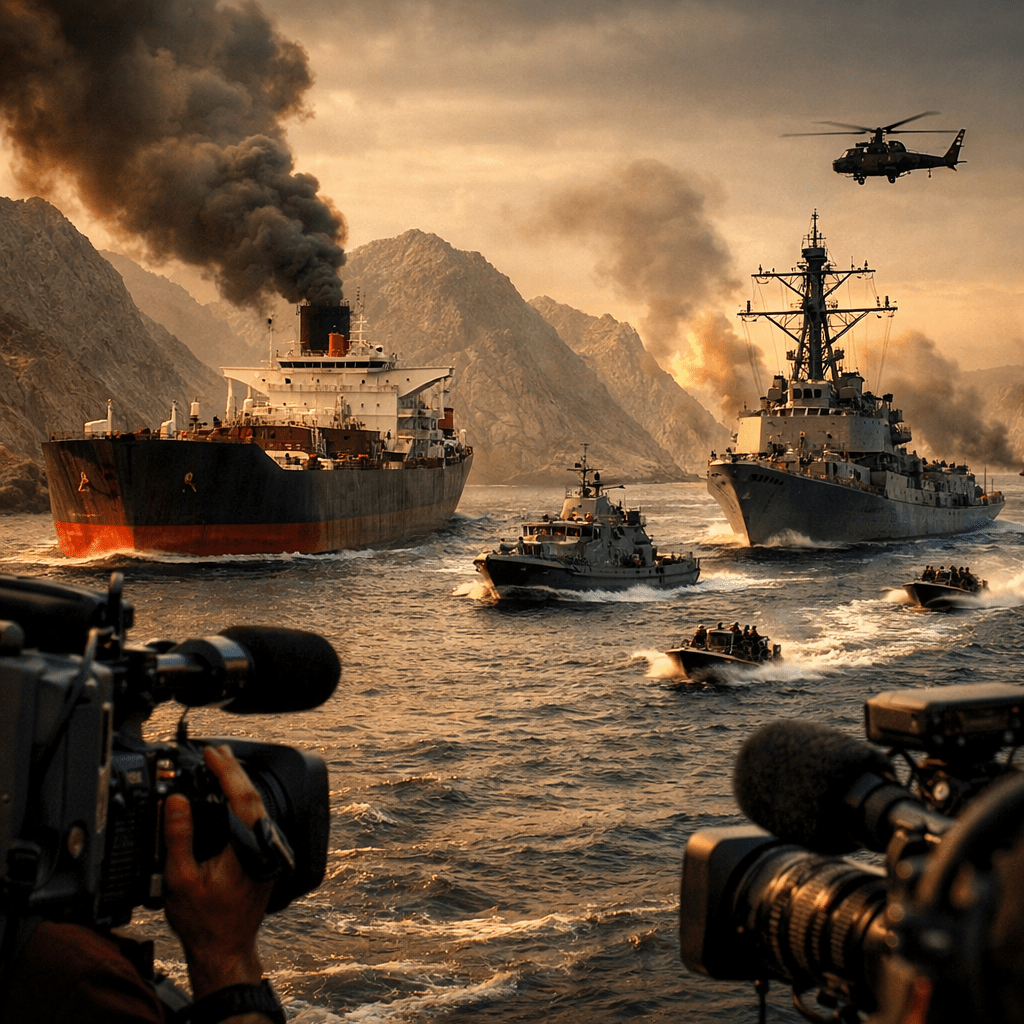
This WPE dissects how Axios turns a threatened expansion of war into the language of shipping, order, and responsible management. It reconstructs the material terrain beneath that narrative: the Strait of Hormuz as a world energy artery and Kharg Island as a critical node in Iran’s oil system. It then reframes the crisis as a struggle over who governs a global chokepoint in a world where energy flows east while coercive power still leans West. Finally, it argues that workers, antiwar forces, sovereignty movements, and independent media must organize against the use of the world’s lifelines as instruments of imperial pressure.
By Prince Kapone | Weaponized Information | March 16, 2026
The Language of Order, the Preparation of Force
Empire rarely introduces itself honestly, especially when it is preparing the public mind for a wider war. It does not walk into the room and declare that it is considering the seizure of another nation’s strategic territory. It does not begin by speaking the crude but accurate language of coercion, domination, or escalation. It begins, instead, with the market. It begins with tanker routes, fuel prices, anxious supply chains, and the smooth managerial vocabulary of responsibility. That is the opening maneuver performed by the Axios article under excavation here, “Trump eyes ‘Hormuz Coalition,’ seizure of Iran’s Kharg Island oil hub,” by Marc Caputo and Barak Ravid. The piece opens by telling the reader that “Oil and gas prices are rising as Iran’s blockade of the Gulf’s narrow strait drags on,” and soon folds that into the claim that the blockade is “choking off a significant share of the world’s crude supply.” This is not just information. It is narrative discipline. The reader is instructed, from the first sentence, to experience the event not as a political confrontation between states, not as a question of war and sovereignty, but as a disruption in circulation, an emergency in the metabolism of capital. In a class society, even war must often pass through the cash register before it can enter the public mind respectably.
Having established that mood of economic urgency, the article moves with polished confidence into the language of administration. The proposed response is described as an effort to “reopen commercial shipping,” with countries being asked to help “policing the straits,” while Trump calls for others to help “secure the strait.” Here the real ideological labor of the piece begins. The vocabulary is antiseptic, technical, managerial. One would almost think the Pentagon were being summoned not to expand a war but to fix congestion on a freeway. Force is translated into procedure. Military pressure is rendered as stewardship. The violence implied by warships, air power, and a possible territorial seizure is made to wear the clerical face of logistics. This is how elite propaganda works when it is well-tailored. It does not usually ask the public to love war in its naked form. It asks the public to accept coercion as maintenance, domination as order, escalation as the regrettable but necessary work of keeping the machinery running. There is an old bourgeois habit of treating the uninterrupted circulation of commodities as the highest moral achievement of civilization. In this article that habit is not incidental background noise. It is the very grammar through which force is made to sound reasonable.
The sequencing of the article is as instructive as its vocabulary. First comes the crisis. Then comes the sober-sounding technical remedy. Only after that architecture is in place does the piece introduce the more explosive possibility that “Trump is also weighing a seizure of Iran’s critical oil depot on Kharg Island.” That order matters. The article does not begin with the threatened seizure and then work backward. It escorts the reader toward that possibility through a carefully staged progression: disruption, response, escalation. By the time Kharg Island appears, the reader has already been guided into a frame where extraordinary measures begin to feel like extensions of common sense. This is one of the old tricks of ruling-class storytelling. Radical action is not sold all at once. It is normalized in increments. The rope is sold as a lifeline right up until it tightens. What might sound outrageous if stated plainly at the outset begins, through sequence alone, to appear practical, perhaps even inevitable, once the narrative has already taught the reader to identify order with imperial initiative.
The structure of authority inside the piece deepens this effect. Again and again, the narrative leans not on verifiable public argument from a wide field of actors, but on the recurring authority of unnamed officials and insider channels. “Four sources tell Axios.” “A source with knowledge of the situation said.” “A source familiar with the negotiations said.” “A senior administration official said.” The formulas repeat with nearly bureaucratic regularity, like stamps on shipping documents moving through an imperial customs house. This is access journalism in its most polished form: power speaks, the reporter transmits, and proximity to the state is quietly substituted for independent depth. Even when the article introduces a named voice such as Lindsey Graham, it does not broaden the field of interpretation. It simply sharpens one edge of the same imperial blade. The universe of the piece is therefore built almost entirely from above. The people who plan escalation interpret escalation. The officials considering wider war narrate the meaning of wider war. The empire and its clerks hold the floor. Everyone else is rendered atmospheric.
Axios’s house style magnifies that ideological effect. Its clipped structure, stacked bullet logic, and segmented headings—“Why it matters,” “Driving the news,” “Behind the scenes,” “Zoom in,” “What to watch,” “The intrigue,” “What they’re saying”—do more than organize information. They train perception. A profound geopolitical confrontation is broken into digestible executive fragments, as though the threatened seizure of strategic territory were merely another item in the workflow of policy management. The style encourages the reader to process escalation not as rupture, danger, and possible catastrophe, but as a sequence of updates to be consumed with brisk efficiency. The bullet style is ideological style. It accelerates judgment while shrinking reflection. It teaches the reader to move quickly from one item to the next without lingering too long on what is actually being proposed. It is a remarkable feat of bourgeois presentation: placing dynamite in a spreadsheet and calling it clarity.
Just as revealing as what the article says is what it refuses to say. The omissions are not decorative absences. They are structural silences that keep the narrative stable. There is no serious account of earlier U.S. militarization of Gulf waters, no historical memory of how “protecting commerce” has repeatedly served as the banner under which external force re-enters the region, and no meaningful effort to situate Iran as a sovereign state acting within its own doctrine of deterrence, survival, and strategic calculation. There is no sustained legal frame brought to bear on the discussion of seizing another state’s critical oil terminal. There is no real examination of what such a move could mean for regional retaliation, wider war, or the populations living beneath the shadow of escalation. There are no workers of the Gulf here, no seafarers, no civilians, no ordinary people at all except as implied consumers of fuel. Even the brief mention of an unnamed Iranian official functions less as perspective than as garnish. The article is sealed inside the present tense of imperial decision-making, where history disappears, sovereignty is flattened, and the threatened use of force against another nation’s strategic infrastructure is treated as one more option on the menu.
The article also organizes the world around the central will of the U.S. president. We are told whom Trump called, what he “demands,” what he expects from allies, what he may delay, what he is “drawn to,” and what he may do if others fail to cooperate. On one level this is ordinary White House reporting. On another, it performs quiet ideological work. The Gulf appears less as a field of competing states, histories, and material interests than as a stage on which American initiative is exercised and others are summoned to respond. The coalition itself is narrated in those terms. Other countries are invited not as political equals shaping a common order, but as supporting cast expected to answer the call of U.S. strategy. The assumption beneath the reporting is an old imperial one: that the essential questions of world order are first posed in Washington, and that the rest of the planet exists in varying degrees of compliance, hesitation, or refusal. That this conceit has become harder to sustain in reality only makes it more necessary to rehearse in language.
By the end of the piece, the ideological preparation is complete. A crisis has been declared in the language of markets. A military answer has been translated into the idiom of management. A grave escalation has been introduced as a practical option rather than a historical rupture. Anonymous officials have narrated the situation from within the state, while the peoples who would live with the consequences remain voiceless. History has been thinned out. Law has been pushed aside. Sovereignty has been blurred into procedure. This is why excavation matters. The most effective propaganda in elite media is not usually the loud, cartoonish kind. It is the polished arrangement of emphasis, sequence, authority, and silence through which empire is made to feel responsible while it prepares new forms of force. That is the real achievement of the Axios piece: not that it openly argues for war, but that it prepares the public language in which escalation can pass for competence, and coercion can travel under the respectable flag of order.
The Chokepoint Beneath the Headlines
Once the narrative architecture of the Axios article is stripped down and examined, the factual terrain surrounding the crisis must be reconstructed. The article speaks in the language of disruption and response, but the geography it gestures toward is not an abstract shipping inconvenience. It is one of the central arteries of the modern world economy. The Strait of Hormuz, a narrow maritime passage connecting the Persian Gulf to the Gulf of Oman and the Arabian Sea, has long functioned as the primary outlet through which the petroleum economies of the Gulf reach global markets. At its narrowest point the corridor is barely twenty-one miles wide, yet through this slim channel moves an immense share of the energy that powers contemporary industrial society. According to widely cited energy analyses, roughly twenty to twenty-one million barrels of oil pass through the strait each day, accounting for around one-fifth of global petroleum liquids consumption. In addition to crude oil, approximately twenty percent of global liquefied natural gas shipments also travel through this corridor. The strait is therefore not merely a regional shipping route. It is one of the pressure points through which the metabolism of the global energy system flows.
Recent developments have made the political status of the corridor far more complex than the image of a simple blockade often conveyed in media headlines. Following the joint military strikes by the United States and Israel on Iran in early 2026, the Strait of Hormuz entered what analysts now describe as an ongoing geopolitical and economic crisis that sharply reduced maritime traffic through the waterway. Shipping flows dropped dramatically after Iran’s Revolutionary Guard issued warnings that vessel passage through the strait was “not allowed,” leading many commercial tankers to halt transit and remain anchored outside the corridor. Yet Iranian officials have simultaneously emphasized that the strait is not closed to all international commerce. Tehran has indicated that ships belonging to countries not participating in the military campaign against Iran may still pass through the waterway under coordination with Iranian naval authorities. In statements to international media, Iranian officials explained that vessels from countries involved in what they call aggression against Iran should not expect safe passage, while other nations have been permitted to transit the strait after consultation with Tehran. Iranian military commanders have likewise warned that ships linked to states participating in attacks on Iran would be barred from the corridor. The result is not a universally sealed waterway but a selectively contested chokepoint in which geopolitical alignment increasingly determines who can safely move through one of the most critical energy passages on the planet.
The geography of demand surrounding this corridor is just as important as the geography of supply. Public discussion in the United States often frames Hormuz as a universal lifeline for “the global economy,” but the distribution of dependence is far more uneven. In reality, between eighty-four and ninety percent of crude oil shipments passing through the Strait of Hormuz ultimately flow toward Asian markets. China alone receives the largest share of these exports, followed by India, Japan, and South Korea, whose industrial economies depend heavily on imported energy. In contrast, the United States—now one of the world’s largest oil producers—imports only a small fraction of the crude moving through the corridor. As a result, China receives roughly thirty-seven percent of the oil passing through Hormuz, while India accounts for around fourteen percent and Japan and South Korea together form another major portion of the destination market. The corridor therefore connects Gulf extraction primarily to Asian industrial demand, even though the military architecture surrounding it has historically been dominated by Western naval power.
Within this broader geography sits Kharg Island, the location that appears in the Axios article as a potential target of seizure. Kharg is not simply another oil installation scattered across the Gulf. It is the central export terminal of Iran’s petroleum system. Situated off the Iranian coast in the northern Persian Gulf, the island contains the storage tanks, pipelines, and loading facilities through which most Iranian crude reaches international markets. Historical and energy-sector assessments consistently note that roughly ninety percent of Iran’s crude oil exports are loaded through the Kharg Island terminal. The infrastructure on the island is extensive enough that its facilities are capable of handling loading operations reaching several million barrels of oil per day, making it the backbone of the Iranian export system. Current estimates suggest that Iran exports on the order of 1.5 to 1.6 million barrels of crude per day through this terminal, a flow that represents a crucial source of revenue for the Iranian state. To speak casually about the seizure of Kharg Island, therefore, is not to discuss a symbolic target. It is to contemplate the direct disruption of the infrastructure through which Iran participates in the global oil market.
The strategic importance of Kharg Island is not a new discovery of contemporary policymakers. During the long and brutal Iran–Iraq War of the 1980s, the island became one of the central targets in what came to be known as the “Tanker War”. Iraq broadened that campaign in 1984 by attacking the oil terminal and tankers loading crude at Kharg Island, which functioned as Iran’s principal export port. Iraqi aircraft repeatedly struck vessels and facilities near the island, with missile-armed Iraqi jets carrying out attacks on shipping approaching Kharg and in the surrounding Gulf waters. These operations damaged tankers, struck loading infrastructure, and forced vessels navigating the northern Gulf to operate under constant threat of missile and air attack. Contemporary reporting noted that Iraqi air raids hit tankers and facilities at the Kharg Island oil terminal as Baghdad attempted to cripple Iran’s petroleum exports. Yet even under sustained bombardment the export system centered on Kharg proved resilient. Although the island’s oil terminal was repeatedly damaged during the Iran–Iraq War, Iran repaired facilities, redirected shipments when necessary, and continued moving crude through the terminal whenever possible. The experience demonstrated something that remains true today: whoever threatens Kharg Island is not merely targeting a piece of infrastructure but attempting to choke one of the principal economic arteries of the Iranian state.
Because of this concentration of energy flows, crises around the Strait of Hormuz have repeatedly triggered waves of anxiety in global markets. Shipping companies raise insurance premiums, tanker routes become riskier, and oil traders begin to factor disruption into price expectations. Even rumors of military confrontation in the Gulf can ripple outward through energy markets. Analysts regularly note that a serious disruption to Hormuz traffic could place at risk roughly one-fifth of the world’s oil supply, a scale large enough to push prices upward across the international economy. Those increases do not remain confined to oil companies or futures traders. They pass outward through shipping costs, electricity generation, industrial production, fertilizer manufacturing, and eventually into the price of food and transportation. In other words, what begins as a geopolitical confrontation in the Persian Gulf quickly migrates through the supply chains of the global economy until it lands in the budgets of ordinary households.
There is also a legal dimension to the discussion that is largely absent from the article under excavation. To openly contemplate the seizure of Kharg Island is not merely to discuss a military maneuver in the abstract. It is to consider the direct use of force against the strategic territory of a sovereign state. Under the framework of international law established after the Second World War, Article 2(4) of the United Nations Charter prohibits the threat or use of force against the territorial integrity or political independence of any state, a foundational rule intended to prevent exactly this kind of coercive seizure of territory. In addition, the postwar legal order recognizes the sovereign equality of states, meaning that the infrastructure and territory of a nation cannot lawfully be occupied or seized except under narrow circumstances such as self-defense recognized in Article 51 of the UN Charter. Under this framework, proposals to seize a country’s principal oil export terminal would carry profound legal and political implications within the international system. Yet in the Axios narrative this gravity disappears into the language of options and planning. The possibility of occupying another country’s central oil terminal is presented less as a rupture in the international order than as another item on a policy checklist. This quiet normalization of extreme measures is one of the clearest indicators of how elite media narratives can gradually acclimate audiences to the prospect of escalation.
Taken together, these facts reveal a much heavier reality than the one sketched in the article’s clipped prose. The Strait of Hormuz is not simply a shipping inconvenience to be solved through managerial coordination. It is one of the main arteries through which the global energy system circulates. Kharg Island is not an incidental facility but the central node of Iran’s oil export infrastructure. The majority of the oil passing through this corridor is destined for Asian economies whose growth depends on stable energy supplies. Any military confrontation in this space therefore carries implications that extend far beyond the immediate participants in the conflict. The Axios article compresses this immense geopolitical and economic terrain into a sequence of updates about coalition building and presidential deliberation. But once the material foundations of the corridor are restored to view, it becomes clear that the issue at stake is not simply the reopening of a shipping lane. It is control over one of the most critical chokepoints of the modern world economy—and over who is permitted to move through that corridor when war begins to reshape the rules of passage.
Who Claims the Right to Govern the World’s Energy Arteries
What the Axios article presents as a problem of restoring order to commercial shipping begins to look very different once the material terrain beneath it is restored. The narrative offered in the piece treats the crisis primarily as a logistical malfunction: tankers blocked, energy markets rattled, naval coordination required. Yet the facts assembled in the previous section reveal something far larger than a temporary disruption in maritime commerce. They reveal a struggle over authority in one of the central circulation routes of the modern world economy. The Strait of Hormuz is not merely a shipping lane. It is one of the principal arteries through which the energy that powers contemporary industrial civilization moves. Whoever claims the right to regulate that corridor is therefore claiming influence over a critical segment of the world’s economic bloodstream.
For centuries, great powers have competed over precisely such corridors. Control of strategic passages—canals, straits, rail junctions, pipelines—has always translated into political leverage over trade and production far beyond the immediate geography of the chokepoint itself. In earlier periods the imperial centers of Europe sought to dominate the Mediterranean sea lanes and the Suez Canal because those routes linked colonial extraction zones to European industry. In the twentieth century the Persian Gulf gradually assumed that role for the petroleum age. What makes the present moment historically unusual is not the existence of a chokepoint, but the shifting geography of the economic system that depends on it.
The oil flowing through Hormuz increasingly feeds an industrial landscape centered in Asia rather than the Atlantic world. The refineries, manufacturing zones, and energy-hungry cities most dependent on this corridor are now located thousands of miles east of the Gulf. China, India, Japan, and South Korea collectively absorb the overwhelming majority of the crude exports passing through the strait. In other words, the economic gravity of this corridor has drifted steadily toward the Asian end of the Eurasian landmass. Yet the military architecture claiming the authority to police that corridor remains rooted largely in an older configuration of power in which Western naval dominance defined the rules of maritime order.
This creates a quiet but powerful contradiction. The energy flows that sustain the modern world economy are increasingly tied to a multipolar industrial geography, yet the mechanisms through which security and authority are exercised around those flows still lean heavily on a legacy structure of Western military power. When an outlet like Axios describes proposals for naval patrols or coalition enforcement as the neutral restoration of order, it is describing only one side of that tension. What appears from Washington as routine guardianship of global commerce may appear from elsewhere as the preservation of political leverage over a corridor whose economic center of gravity has shifted.
The possibility raised in the article of seizing Kharg Island illustrates that tension in unusually stark form. The terminal represents the primary channel through which Iran converts its oil reserves into revenue and economic survival. For policymakers contemplating the seizure of the facility, it may appear as a tactical instrument—one more point of pressure in a confrontation between states. For the state facing that pressure, however, the same action represents something closer to economic strangulation: the threatened occupation of the infrastructure through which the nation participates in the global energy system. What one side narrates as securing the corridor, the other experiences as coercion exercised under conditions of overwhelming military asymmetry.
Once the question is framed in this way, the language of maritime management begins to look less innocent. Control over chokepoints has always been one of the principal tools through which dominant powers influence the behavior of weaker states. The ability to interrupt the flow of commodities—whether grain, oil, or manufactured goods—can shape diplomatic negotiations as effectively as armies in the field. In the modern petroleum economy the leverage created by such pressure can extend far beyond the immediate parties involved, because disturbances in the energy system cascade through the entire chain of production and exchange.
Those cascades are not absorbed evenly across the world economy. When energy corridors become sites of confrontation, the resulting shocks ripple outward through fuel markets, shipping costs, electricity generation, and industrial supply chains. Oil price spikes push transportation costs higher. Fertilizer production becomes more expensive. Food prices rise. Freight costs climb. Governments already carrying heavy debt burdens find their import bills swelling. In the end the economic consequences of geopolitical rivalry do not remain confined to cabinet rooms and military headquarters. They descend through the layers of the global economy until they reach the people who have the least influence over the decisions that triggered them: workers, farmers, and urban households struggling to maintain already fragile livelihoods.
This broader reality rarely appears in the polished surface of elite policy reporting. In the Axios narrative, the world is populated primarily by officials debating options, presidents making calls, and unnamed sources briefing journalists about strategic possibilities. The economic system itself appears only as a backdrop—a marketplace temporarily disturbed by instability. Yet once the larger structure becomes visible, the story changes. What the article describes as a technical effort to reopen shipping lanes is in fact embedded within a wider struggle over who governs the infrastructure of the world economy and how that authority is exercised in an era where the distribution of economic power is no longer as simple as it once appeared.
Seen from that vantage point, the debate over Hormuz and Kharg Island is not merely about tankers and patrol fleets. It reflects a deeper historical moment in which the geography of global production and the geography of geopolitical power are drifting apart. The oil continues to move through the narrow waters of the Gulf, but the political authority claiming the right to supervise that movement remains contested. The Axios article presents this tension as a problem of restoring order. What it actually reveals, perhaps unintentionally, is a struggle over who gets to define what “order” means in the first place.
From Imperial Chokepoints to the Politics of Solidarity
Once the geopolitical architecture behind the crisis becomes visible, the stakes begin to look very different from the tidy managerial problem described in the Axios narrative. What appears in elite reporting as a question of “securing shipping lanes” is, in reality, a confrontation over the infrastructure that sustains the world economy. When great powers contest control of those arteries—straits, pipelines, canals, and trade corridors—the consequences do not remain confined to diplomats and generals. They move outward through the material life of society. Oil price volatility raises freight costs, electricity bills, fertilizer prices, and the cost of food. Governments facing higher import bills shift the burden through austerity and inflation. Households already stretched by stagnant wages and rising living costs absorb the final shock. Empire fights over the world’s lifelines; working people receive the invoice.
That is why struggles against war and coercion rarely remain confined to the field of foreign policy alone. Across North America and Europe, antiwar coalitions, student organizations, and grassroots campaigns opposing sanctions and military escalation have repeatedly mobilized against the logic that treats distant regions as arenas for strategic pressure. These movements understand something that elite reporting often ignores: that the language of security used to justify intervention abroad frequently masks policies that deepen insecurity for ordinary people at home. When shipping corridors become militarized, it is not the architects of strategy who stand in line at grocery stores watching prices climb. It is workers and their families.
Labor movements occupy a particularly important position within this landscape. Dockworkers, maritime crews, transport workers, refinery employees, and logistics workers all sit close to the arteries through which the global economy circulates. Their livelihoods depend on the stability of trade routes and energy systems, yet they also experience firsthand how geopolitical conflict disrupts those same systems. Historically, labor organizations in port cities and transport sectors have often been among the first to recognize how war abroad translates into instability and hardship within the working class itself. Their ability to organize collectively around these contradictions gives them a potential role not merely as observers of geopolitical tension but as actors capable of influencing the direction of public debate.
Beyond the industrialized North, governments and social movements across the Global South confront these crises from a different but equally consequential position. Many states whose economies depend on imported energy or export revenues moving through maritime chokepoints face enormous vulnerability when geopolitical confrontation disrupts those corridors. Diplomatic initiatives advocating regional stability, nonalignment, and respect for sovereignty reflect not simply abstract legal principles but practical concerns about economic survival. When energy routes become instruments of coercion, it is often the developing world that experiences the most severe downstream consequences. The call for a more stable and cooperative international order therefore resonates strongly among nations that have long borne the economic costs of great-power rivalry.
Information itself has also become a field of struggle in these moments. Corporate media outlets frequently frame geopolitical conflicts through the perspective of state officials and strategic planners, leaving little room for the voices of those who bear the social consequences of war and economic disruption. Independent investigative journalism and alternative media platforms therefore play an increasingly important role in breaking the ideological preparation that often precedes escalation. By examining the narratives through which power explains its actions, they open space for public scrutiny and democratic debate that might otherwise be absent.
These different forces—antiwar activists, organized labor, sovereignty movements in the Global South, and independent media—do not operate from identical positions or pursue identical goals. Yet they encounter the same underlying structure: a world economy whose critical lifelines are repeatedly drawn into geopolitical confrontation. Each from its own vantage point confronts the consequences of a system in which the arteries of global commerce can be transformed into instruments of pressure and conflict.
The challenge, therefore, is not simply to call for peace in the abstract but to build connections among the social forces already confronting these contradictions in practice. Campaigns opposing sanctions regimes can link their work to movements challenging rising living costs driven by energy volatility. Labor organizations confronting disruptions in transport and logistics can connect their struggles to broader efforts aimed at preventing militarization of trade corridors. Independent media can expose the narratives that normalize escalation while amplifying the voices of those whose lives are most affected by it. Through such connections, the scattered experiences of crisis begin to reveal the structure that links them together.
The Strait of Hormuz will likely remain a strategic chokepoint for as long as the petroleum economy continues to shape the world system. But the political meaning of that chokepoint is not fixed. It can remain a flashpoint where imperial rivalry repeatedly threatens the stability of global society, or it can become a catalyst for broader recognition that the lifelines of the world economy cannot remain permanently subordinate to coercive state power. The task facing movements for peace, sovereignty, and economic justice is therefore clear: to organize across borders and sectors so that the arteries of global life cease to function as instruments of domination and begin instead to serve the needs of humanity as a whole.
 Weaponized Information
Leave a comment