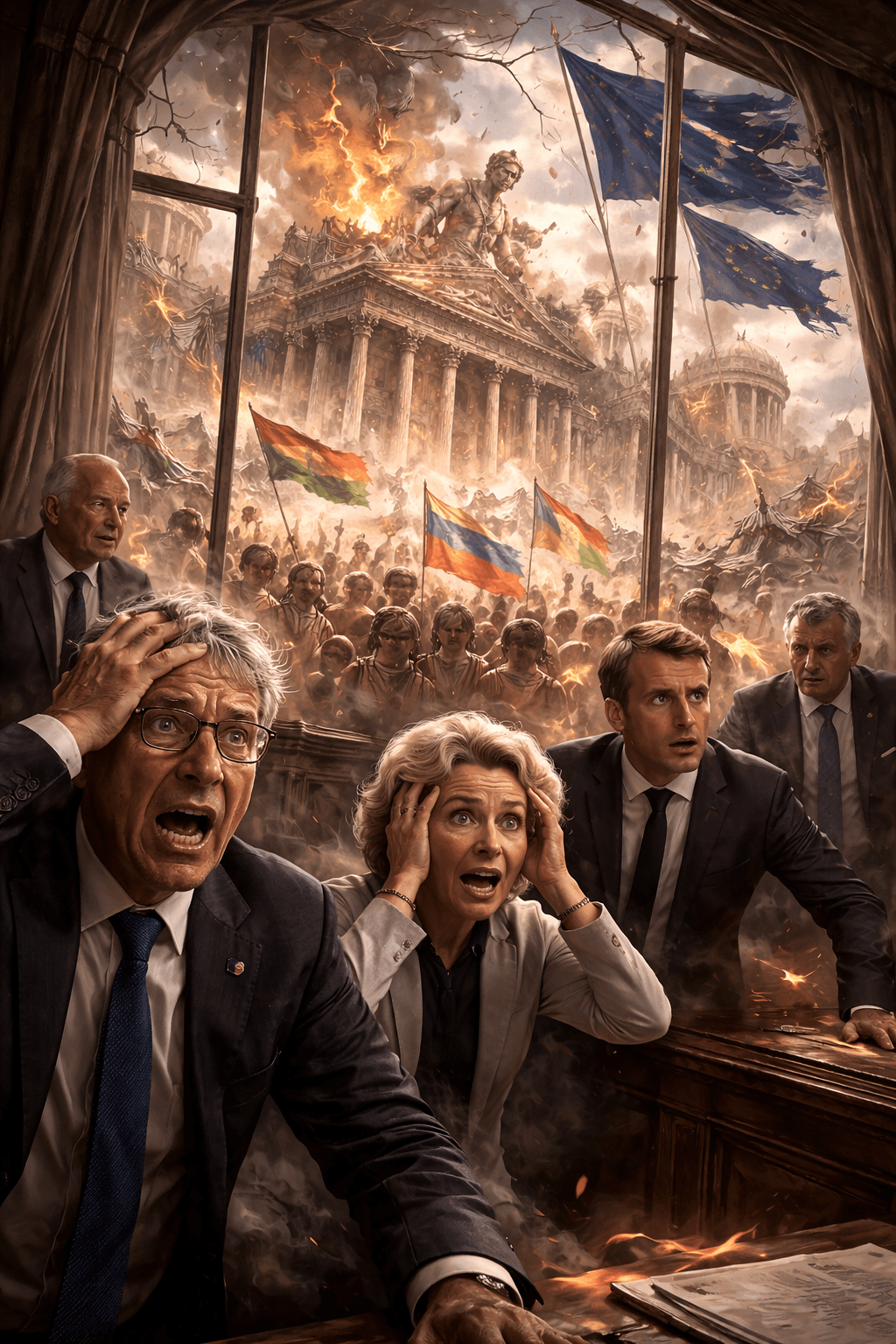
The language of “chaos” now coming from European leaders reveals something deeper than geopolitical instability. It reflects the growing panic of a ruling class confronting the limits of a world order built through colonial domination and sustained by imperial power.
By Prince Kapone | Weaponized Information | March 11, 2026
When Power Begins to Speak in the Language of Panic
The article under excavation is Jorge Liboreiro’s “Von der Leyen and Kallas call on Europe to adapt to chaotic, coercive world order”, published by Euronews on March 9, 2026. In the span of a few polished paragraphs, the reader is ushered into a familiar chamber of imperial anxiety. Ursula von der Leyen declares that “the old world order” has passed into history, Kaja Kallas warns that international law is eroding, and Europe is told that it must adapt to a harsher age of coercion, rivalry, and danger. The atmosphere is grave, the language solemn, the message clear: the adults in Brussels have looked out the window and discovered that the world has become unruly.
The central narrative is not hard to identify. First, the article tells us that a stable international order once existed and is now breaking apart. Second, it invites us to see Europe as the anxious but responsible custodian of that fading order, a force for balance suddenly surrounded by reckless actors and gathering storms. Third, it uses this mood of emergency to normalize a strategic turn: more defense, more deterrence, more geopolitical assertiveness, more flexibility in the name of “reality.” In other words, the piece does what so much establishment reporting does when empire begins to sweat through its expensive suit: it recasts strategic adjustment as reluctant necessity.
The journalist delivering this line, Jorge Liboreiro, is not some rogue pamphleteer screaming from the alleyway. He is a Brussels correspondent whose beat is the institutional machinery of the European Union. That matters. Reporters embedded in the daily bloodstream of EU politics do not simply observe power; they often inhale its atmosphere. Their work is shaped by official briefings, policy conferences, ambassadorial speeches, and the assumptions that circulate like oxygen in elite corridors. This does not require personal bad faith. The point is structural. When a man spends his days inside the house of power, he tends to describe the furniture from the owner’s point of view.
The outlet matters too. Euronews presents itself as a continental voice, a pan-European window onto world affairs, but it functions materially inside the ideological ecosystem of European capital and institutional Europe. Its role is not identical to that of a crude state bulletin, of course. Modern propaganda rarely comes wearing a helmet and barking orders. It arrives in a blazer, with neutral fonts and a concerned expression. It gives you quotes, balance, and atmosphere. It lets power narrate itself with just enough journalistic polish to make elite common sense sound like plain reality.
This article is amplified by a wider choir that does not need to sing in perfect unison to produce the same hymn. EU institutional communications, NATO-adjacent security discourse, Atlantic policy shops, and the broader Western media complex all circulate the same core assumptions: Europe is reacting, not initiating; Europe is stabilizing, not escalating; Europe is being forced by circumstance, not guided by class interest. When the same melody drifts from ambassadors, think tanks, cable panels, editorial pages, and summit speeches, we are no longer dealing with isolated commentary. We are inside an information environment designed to make one political interpretation feel inevitable.
The first propaganda mechanism at work here is crisis framing. The world is cast as entering a new age of “chaos” and “coercion,” as if history itself has suddenly slipped on a wet floor. This language is doing heavy labor. It creates urgency, compresses thought, and softens the public up for measures that might otherwise provoke scrutiny. If chaos is at the gate, then budgets for arms appear prudent, strategic realignment appears mature, and dissent begins to look like childish nostalgia. Empire loves a panic when it needs discipline.
The second mechanism is selective historical blame. Kallas points to Russia’s invasion of Ukraine as the event that sent the signal that “the rulebook has been thrown out of the window.” That phrase is not accidental. It performs a moral sorting operation. The reader is guided toward a timeline in which international law was meaningfully intact until rival powers began shredding it. Notice what this move accomplishes. It places Europe on the side of violated norms and its enemies on the side of nihilism. It is a neat trick. One can only admire the efficiency with which amnesia is repackaged as analysis.
The third mechanism is moral authority construction. Von der Leyen and Kallas are presented as worried custodians of a system of rules, order, and stability. The article positions them less as interested actors in a struggle among powers than as stern guardians of civilization itself, reluctantly forced to respond to a worsening world. This is one of imperial ideology’s oldest habits: to speak from within power while pretending to stand above it. Europe appears not as a bloc seeking advantage, but as a weary schoolmaster trying to calm the classroom after others have misbehaved.
The fourth mechanism is linguistic substitution. The article slides with great ease between “international law” and the “rules-based order,” as if the two were brothers born of the same mother. They are not. Yet in the article they are made to appear interchangeable, and that interchangeability is politically useful. “International law” carries the weight of universal obligation. “Rules-based order” sounds similar enough to borrow the halo, while remaining far more pliable as a phrase of power. The sleight of hand is elegant: the legal becomes ideological, and the ideological is dressed back up as law.
The fifth mechanism is the normalization of militarization. The article informs the reader that Europe must ramp up defense and deterrence capabilities, expand trade deals and security arrangements, and reduce dangerous dependencies. These are not presented as debatable political choices tied to class interests, strategic ambition, or bloc competition. They are presented as sober responses to an objective world. This is how militarization is laundered in respectable outlets. No drums, no goose-step, no froth at the mouth. Just a calm voice explaining that one more turn of the screw is regrettably necessary.
The sixth mechanism is strategic silence. The article notes that the United States and Israel continue their strikes on Iran, and that these strikes have upset the Middle East, shaken energy markets, and widened tensions among Western allies. Yet neither von der Leyen nor Kallas is pressed on whether these attacks constitute a breach of the international law they claim to be mourning. Instead, von der Leyen is allowed to say that Europe must deal with “the world as it actually is.” That phrase is doing a great deal of imperial work. It means: let us move quickly past questions that might embarrass our allies and ourselves. Reality, apparently, is what remains after principle has been escorted out the side door.
What makes this article useful for a Weaponized Propaganda Excavation is not that it lies crudely. Crude lies are easy to swat away. What it offers is something more refined and therefore more dangerous: a disciplined arrangement of emphasis, silence, and moral posture through which imperial anxiety is transformed into common sense. The world is cast as disorderly, Europe is cast as responsible, and strategic escalation is cast as realism. It is the old magic of ruling-class communication: first produce the fog, then sell yourself as the lantern.
And so the article leaves the reader with the impression that Europe has been dragged unwillingly into a harsher age. But what it really reveals, if one listens closely beneath the polished diplomatic sorrow, is something else entirely. The managers of empire are nervous. Their language has become heavier, their nostalgia more obvious, their realism more desperate. When power begins to speak this way, it is usually because the ground beneath it is no longer as firm as it once was.
When the Architects of Order Discover the Consequences of Their Own Architecture
Once the historical record is placed on the table, the language used by European leaders begins to look less like sober analysis and more like a man standing in a burning house complaining about the smoke. Ursula von der Leyen tells us that the world has entered an era of chaos. Kaja Kallas warns that international law is eroding. One might almost imagine that this disorder arrived like a thunderstorm from nowhere, rolling across the sky without human fingerprints. But history is not weather. It is construction. And the modern international system was constructed—carefully, deliberately—by the very powers now expressing such alarm at its instability.
To understand what is unfolding today, we must begin with a simple observation that is strangely absent from most official speeches. The international order that emerged after the Cold War was not a neutral system of global governance. It was a hierarchy. Western states occupied the commanding heights of military power, financial institutions, and international political influence. The rules of that order were written largely by those who possessed the power to enforce them. For a time, that arrangement appeared remarkably stable. But stability built on unequal power has a peculiar habit of looking permanent right up until the moment it begins to crack.
During the 1990s and early 2000s, Western policymakers often spoke as if history itself had confirmed their permanent leadership. The collapse of the Soviet Union was interpreted not simply as the end of a geopolitical rival but as the final proof that the Western model of political economy had triumphed. Liberal democracy, free markets, and a network of Western-led institutions were expected to govern the international system indefinitely. The phrase “rules-based order” entered diplomatic vocabulary during this period, presented as a neutral description of the global system rather than what it actually was: a political arrangement built during a moment of overwhelming Western dominance.
But as the old Marxist proverb reminds us, the ruling ideas of every age are the ideas of its ruling class. When power writes the rules, those rules tend to reflect its interests. The post–Cold War order was no exception. Western alliances expanded, military interventions multiplied, sanctions regimes grew increasingly sophisticated, and global financial institutions continued to regulate the flow of capital largely through Western-controlled channels. None of this appeared particularly controversial while the balance of power remained firmly tilted in one direction.
The difficulty begins when the balance of power starts to shift. As new economic centers emerge and former colonial regions seek greater autonomy, the old arrangements become harder to maintain. What once looked like global leadership begins to look suspiciously like domination. And domination, as the colonized world has patiently explained for centuries, rarely produces lasting gratitude.
This is where the language of “chaos” becomes revealing. From the vantage point of Western policymakers, the world does indeed appear more unpredictable today than it did during the height of the unipolar era. Governments that once accepted Western military partnerships now question them. Countries that once relied heavily on Western financial institutions explore alternative arrangements. Regional alliances emerge that do not revolve around European or American leadership. To those accustomed to commanding the orchestra, the sudden appearance of independent musicians can sound like disorder.
But from another vantage point—the vantage point of much of the Global South—the story looks rather different. For decades many societies experienced the international system less as a stable rules-based order and more as a landscape shaped by interventions, economic pressure, and strategic maneuvering among powerful states. The instability now lamented in European capitals is not entirely new to those who have long lived with the consequences of those policies.
Seen in that light, the current moment begins to resemble something far more historically familiar than the sudden collapse of civilization. It looks like the gradual erosion of a geopolitical arrangement that depended heavily on Western dominance. As economic power diffuses and political alliances diversify, the institutions that once structured global authority face increasing pressure to adapt. Some will survive. Others will transform. A few may disappear entirely.
The irony is that the very mechanisms used to maintain the old order may have accelerated its unraveling. Military interventions meant to preserve influence reshaped regional power dynamics in unpredictable ways. Sanctions designed to discipline adversaries encouraged the development of alternative financial channels. Security alliances forged during an earlier strategic environment now confront geopolitical realities that no longer resemble the world in which they were created.
This does not mean that the international system is collapsing into pure anarchy, as the most dramatic speeches might suggest. History rarely moves in such theatrical fashion. What is unfolding instead is a transition—a gradual redistribution of power across the global system. Periods of transition are always uncomfortable for those who benefited most from the previous arrangement. For them, every shift feels like disorder.
It is precisely at such moments that the language of crisis becomes politically useful. If the world can be portrayed as dangerously unstable, then calls for increased military spending, tighter alliances, and greater strategic assertiveness appear not as choices but as necessities. The rhetoric of chaos transforms geopolitical recalibration into common sense.
Yet beneath that rhetoric lies a quieter reality. The international system is not collapsing so much as it is changing. New actors are asserting themselves. Old hierarchies are being questioned. Economic power is spreading beyond the narrow circle that once monopolized it. For those accustomed to managing the world from the commanding heights of Western institutions, such developments may indeed feel unsettling.
But unsettling is not the same thing as inexplicable. The world European leaders now describe with such concern is not an accident. It is the historical outcome of the very system whose architects they represent.
From Imperial Panic to Proletarian Possibility
When the custodians of empire begin warning that the world is slipping into chaos, the global working classes should listen carefully—but not in the way those leaders intend. These warnings are not neutral descriptions of world affairs. They are signals. They tell us that the old architecture of power is beginning to tremble. The men and women who once managed the system with quiet confidence are suddenly discovering that the rest of the world has ideas of its own.
For the colonized nations and the global working class, this moment should not be interpreted as a tragedy. It is an opening. Every imperial order eventually reaches a point where the mechanisms that once guaranteed its stability begin to lose their effectiveness. When that happens, new political possibilities emerge—possibilities that were previously unimaginable while the old system appeared immovable.
Across the world we are already witnessing movements that express this shift. In West Africa, the governments of Mali, Burkina Faso, and Niger have begun rethinking their security relationships and asserting greater control over their own political direction. In Latin America, regional blocs continue experimenting with new forms of economic cooperation designed to reduce dependency on external financial institutions. Across Asia and the Middle East, states once firmly embedded in Western geopolitical structures are exploring new diplomatic and economic partnerships that reflect a more multipolar landscape.
These developments are not identical and they do not follow a single ideological line. Some are driven by national liberation movements, others by pragmatic state interests, and still others by popular pressure from below. But they share a common thread: the desire to loosen the structural dependencies that shaped the international system during the height of Western dominance.
For working people in the imperial core—the United States and Western Europe—this transition presents its own set of contradictions. The ruling classes in these societies will attempt to respond to the changing world with renewed militarization, expanded surveillance, and intensified economic competition. They will frame these policies as necessary defenses against instability. In reality, they will function as mechanisms for preserving elite power during a period of global adjustment.
This is why the task of political organization becomes so important. If the current transition is managed exclusively by competing state elites, the result may simply be a reconfiguration of power rather than its democratization. The global system could shift from one hierarchy to another without fundamentally altering the conditions faced by ordinary people.
Avoiding that outcome requires a different kind of politics—one grounded in international solidarity among workers, social movements, and anti-colonial struggles. The goal is not merely to replace one set of dominant powers with another but to expand the space in which societies can pursue economic justice, political sovereignty, and democratic participation free from external coercion.
In practical terms this means strengthening the networks that already link labor movements, grassroots organizations, and popular struggles across borders. It means supporting campaigns that challenge exploitative trade arrangements, resisting military escalation that turns working people into cannon fodder for geopolitical rivalry, and defending the right of nations to determine their own political and economic paths.
Moments of historical transition are rarely tidy. They produce uncertainty, conflict, and competing visions of the future. But they also create opportunities for transformation. The unraveling of the old imperial architecture does not automatically produce a more just world. It simply opens the possibility.
What happens next will depend not on the speeches of presidents and foreign ministers, but on the ability of ordinary people across the world to recognize their shared interests and act collectively upon them. If the current era truly marks the end of the old order, then the responsibility of shaping whatever comes next belongs not only to states and diplomats—but to the workers, movements, and communities who have long carried the burdens of the system now beginning to crack.
 Weaponized Information
Leave a comment