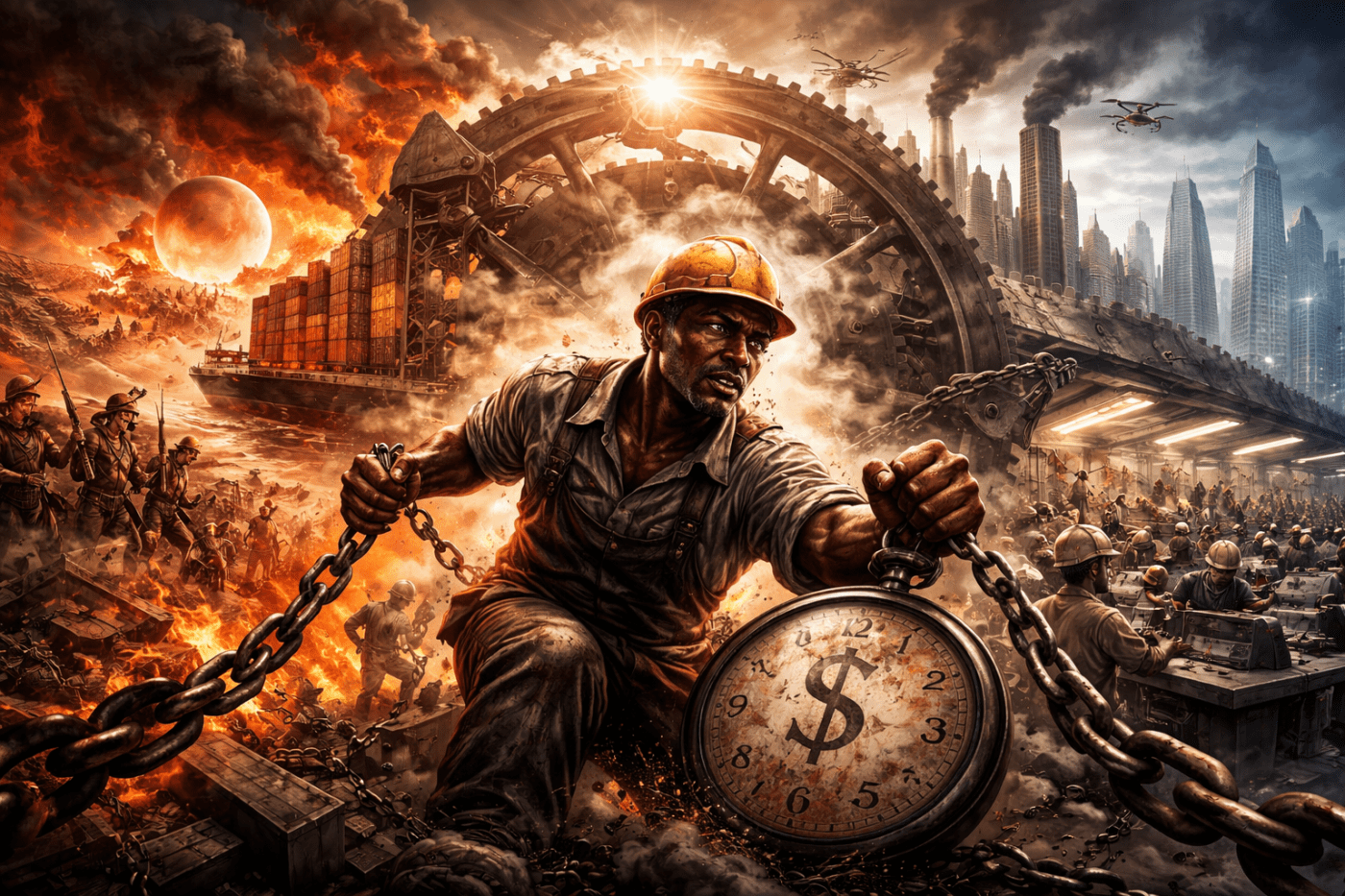
Marx dismantles liberal political economy and rebuilds the totality from production outward. Exchange and money reveal separation as the architecture of domination. Machinery and the general intellect expose capital’s war against its own measure of value. The world market universalizes crisis while pointing beyond labor time toward free development.
By Prince Kapone | Weaponized Information | February 20, 2026
Method as Weapon: Why Marx Refuses the Bourgeois Starting Point
Marx begins the Grundrisse the way a serious strategist begins a war plan: by refusing the enemy’s map. Bourgeois political economy wants to start with what looks “real and concrete”—the nation, the people, “population”—as if piling up a mass of facts automatically produces understanding. Marx calls that bluff. Population, he argues, is not a foundation but a fog. If you don’t know the classes that compose it, “population” explains nothing; and if you don’t know the relations of production that generate those classes, class itself becomes an empty label. What looks concrete at first glance dissolves the moment you demand determination.
This is not academic etiquette. It is a question of whether you will see the system or merely describe its surface. Marx insists that science cannot begin from the chaotic concrete and pretend that chaos is explanation. It must move from the immediate mess of reality into abstraction—not to escape reality, but to isolate the decisive relations—and then return to the concrete as a reconstructed totality. The movement is disciplined: concrete → abstract → concrete. Without it, the world remains a blur of appearances, and bourgeois ideology slips in through the cracks as “common sense.”
This is why Marx warns against “production in general.” Yes, humans must produce to live. But production is never just a technical interaction with nature. It is always production in definite social forms. Slave production, feudal production, capitalist production—each is a different architecture of property, command, obligation, and coercion. When economists treat production as timeless, they quietly universalize capitalism and present its categories as natural law. Marx’s method breaks that spell: categories are historical. They belong to specific modes of production. They are not eternal truths floating above struggle.
The same blow lands on the bourgeois myth of the isolated individual. Liberal thought begins with a self-sufficient person and builds society outward like a child stacking blocks. Marx reverses the story. The “individual” celebrated by bourgeois ideology is a historical product, formed through division of labor, exchange, and the widening web of social interdependence. In other words, the individual is not the origin of capitalist society; it is one of capitalism’s outcomes—its preferred mask, its moral alibi.
Read from the standpoint of the most advanced detachments of the global working class and peasantry, this opening is already a weapon. It teaches us how to reject the empire’s favorite abstractions—“development,” “modernization,” “free markets,” “national prosperity”—when they are used to bury the relations that actually govern life: who controls production, who is dispossessed, who labors, who commands, who accumulates. Marx does not yet name colonial conquest as the condition for the capitalist totality. That silence reflects his historical position—imperialism had not yet reached its monopoly stage. But his method already demands that we treat the violent creation of capitalist relations as internal to the system, not as an external footnote.
With the method established, Marx is ready to begin reconstructing the system from its determinate relations rather than its ideological appearances. The next step is not yet capital in its full form. It is the first surface in which separated producers meet one another and in which social relations begin to take on an alien, objective shape. Marx descends into that terrain next: production’s moments as they confront each other in practice, and then the sphere where mediation becomes necessary. Part II takes up that tightening—before we enter exchange proper and the rise of money as domination.
Production Is Historical: The Internal Structure of a Mode of Production
Having cleared away the illusion of beginning with “population,” Marx turns to the internal anatomy of production itself. If we are not permitted to start with aggregates, we must start with determinate relations. Production is not simply the act of making things. It is a structured process in which human beings enter into specific relations with one another and with the conditions of their labor. To speak of production, therefore, is already to speak of property, authority, obligation, and power.
Classical political economy often abstracts “production in general” as if it were a neutral and eternal activity. Marx dismantles that move. There is no production floating above history. There are only historically specific forms: communal production, slave production, feudal production, capitalist production. Each organizes access to land, tools, and labor differently. Each distributes command and dependency differently. When the social form is ignored, the present mode of production is quietly naturalized.
Marx then tightens the frame further by refusing to isolate production from its so-called “other spheres.” Production, distribution, exchange, and consumption are not autonomous departments of social life. They are internally related moments of a single process. Distribution is not a moral add-on that can be adjusted without touching production; it expresses the underlying structure of property. Exchange is not a neutral marketplace floating above class relations; it presupposes them. Consumption is not purely personal; it reproduces both labor power and the system that requires it.
This unity matters because bourgeois thought survives by fragmentation. It treats production as technical, distribution as ethical, exchange as voluntary, and consumption as private choice. Marx restores their articulation. If production is structured by determinate relations, then distribution reflects those relations, exchange mediates them, and consumption reproduces them. The totality holds.
From the standpoint of anti-colonial Marxism, this clarification prevents a recurring illusion: that injustice can be remedied at the level of trade or distribution alone. If the architecture of production remains intact—if land, machinery, and accumulated labor remain privately commanded—then redistributive reforms merely rearrange outcomes within the same structure. To transform outcomes requires transforming relations at the base.
At this stage Marx is still building the framework. He has not yet introduced capital in its developed form. He has shown instead that any mode of production rests upon historically constituted relations that bind its moments together. But if production under capitalism is organized through private property and the separation of producers, then its products will not circulate directly between associated members of a community. They will meet one another in another sphere—one in which their social character appears in disguised form.
The notebook now narrows its focus. Having clarified the internal articulation of production, Marx turns to the first visible arena where these relations surface in everyday life. That arena is exchange. And in exchange, social labor will begin to confront its own creators as an independent power.
Exchange and Separation: The Birth of Monetary Domination
If production under capitalism rests on private property and the separation of producers from the conditions of their labor, then the products of that labor cannot circulate as the transparent expression of a shared plan. They meet one another in exchange. This is where Marx now descends—not into morality, not into abstract theory, but into the everyday arena where separated producers confront one another as owners of commodities.
Exchange is often romanticized as freedom in motion: voluntary trade between equals, mutual advantage, the handshake across difference. Marx strips away the romance. Exchange presupposes separation. The weaver does not exchange cloth because exchange is pleasurable; he exchanges because he does not directly control the bread he needs. Each producer depends on others, yet that dependence is mediated through objects. Social cooperation appears not as conscious association, but as the exchange of things.
In simple commodity exchange, a commodity expresses its value in another commodity. But as exchange expands and becomes generalized, the system demands stability. It cannot rely on endless chains of barter. A universal equivalent must emerge—one commodity that stands in for all others. Money arises not as conspiracy or decree, but as structural necessity. It becomes the material expression of value itself.
Here the inversion becomes visible. Social labor—the collective effort of countless producers—congeals in money and confronts individuals as an independent force. Money appears to possess power: the power to command goods, to summon labor, to secure obedience. Yet this power is nothing mystical. It is social power objectified. Because producers are separated and uncoordinated, their unity can only assert itself after the fact, through price, through payment, through monetary discipline.
The more developed exchange becomes, the more universal this alien mediation grows. The individual who seemed “free” in the marketplace now finds that survival depends upon access to an abstract equivalent. Personal dependence gives way to impersonal domination. Instead of serving a lord, one serves the requirements of money. The form changes; the subordination persists.
From the standpoint of the colonized world, this abstraction must be read historically. Marx analyzes separation at the level of structure—the separation of producers from one another and from their conditions of life. But history filled that structure with violence: enclosure of communal lands, plantation slavery, forced migration, conquest, the destruction of subsistence economies. We do not graft this onto Marx from outside. We recognize that the abstract separation he describes was concretely imposed through dispossession on a world scale.
Yet discipline requires that we remain with the logic of circulation at this stage. Money condenses social labor into a universal equivalent. It stabilizes exchange. It makes generalized commodity production possible. But it is still, formally, a mediator. In simple circulation—C–M–C—a commodity is sold to purchase another commodity. Use remains the aim.
The decisive rupture comes when the sequence inverts. When money no longer mediates exchange for use, but instead initiates and concludes the process—M–C–M′—something fundamentally new appears. Value begins to move not for satisfaction, but for expansion. With that inversion, we leave exchange as mere mediation and enter capital proper.
From Money to Capital: Labor Power and the Logic of Endless Expansion
The inversion announced at the end of exchange—M–C–M′—is not a minor adjustment in sequence. It is a transformation in the purpose of social production. In simple circulation, commodities are sold in order to buy other commodities. The aim is use. In the new circuit, money is advanced in order to return as more money. The aim is not satisfaction, but expansion. Value no longer serves life; life is reorganized to serve the expansion of value.
But how can money return enlarged if commodities exchange at their value? Circulation alone cannot generate surplus. Buying cheap and selling dear may redistribute gains between individuals, but it cannot explain a systemic and continuous expansion of value. Marx therefore drives beneath the surface of exchange and back into production. The secret of capital does not lie in the marketplace; it lies in the labor process.
The decisive commodity appears: labor power. Unlike other commodities, labor power possesses the capacity to create value greater than its own cost. The worker sells the capacity to labor for a definite period. The value of that capacity is determined by the socially necessary labor required to reproduce the worker’s life. But once set to work, labor power can produce value beyond that equivalent. The excess—surplus value—becomes the foundation of accumulation.
Exploitation thus ceases to be a moral accusation and becomes a structural necessity. The wage relation may appear as an exchange of equivalents, but within production the worker produces more than is returned in wages. Surplus labor time is appropriated by the owner of the means of production. The apparent equality of the marketplace conceals a relation of domination embedded in the organization of labor itself.
Capital, then, is not money as such, nor machinery, nor factories taken individually. It is a social relation in which past labor—objectified in tools, land, and accumulated means of production—confronts living labor as an independent power. The worker stands separated from the conditions of production and must sell labor power to survive. That separation is not incidental; it is the precondition for capital.
From the standpoint of the colonized world, this structural separation cannot be understood as peaceful evolution. The commodification of labor presupposed land theft, plantation slavery, forced migration, and the destruction of communal forms. Marx isolates the inner logic of the wage relation. History supplied the violence that made it universal. We do not insert imperialism prematurely, but we recognize that the labor-capital relation was globalized through coercion.
Once labor power becomes the source of surplus value, accumulation becomes compulsion. Capital must expand or perish. Surplus value must be reinvested to generate more surplus value. Competition forces each capital to increase productivity, reduce costs, and intensify exploitation. The individual capitalist becomes functionary of a process larger than any personal will. Expansion is not greed; it is structural necessity.
And because accumulation has no internal limit, it presses outward. Capital must widen markets, deepen exploitation, and reorganize production to secure its expansion. The system that began in circulation now begins reshaping the world. If value must endlessly valorize itself, it cannot remain confined. It must universalize. The next movement of the notebook therefore widens its scope: capital not merely as relation between worker and employer, but as world-making force.
Capital as World-Making Force: Destruction, Universalization, and Uneven Development
If capital must expand or perish, it cannot remain a local arrangement between worker and employer. The logic uncovered in the wage relation presses outward. Surplus value must find new fields for realization; accumulation must breach inherited limits. What begins as a relation inside production becomes a force that reorganizes geography, dissolves old bonds, and integrates distant territories into a single circuit. Capital becomes world-making.
Marx recognizes this dialectically. Capital is revolutionary in one precise sense: it tears down the parochial barriers of feudalism, breaks local self-sufficiency, and draws humanity into a single web of exchange. It revolutionizes the instruments of production, accelerates communication, and creates the world market. This is not praise. It is recognition that capital develops the productive forces at a scale previous modes of production could not.
But this development is inseparable from destruction. To universalize exchange, capital must dissolve communal forms, subordinate subsistence economies, and transform land, labor, and life into commodities. The world market does not arise from mutual curiosity; it arises from systematic reorganization. The dissolution of older relations is the condition of integration into the new.
From the standpoint of the colonized world, the historical content of this dissolution becomes unmistakable. The expansion of the world market required the Atlantic slave trade, colonial extraction, genocidal land seizure, and the forced incorporation of vast populations into commodity production. Marx gestures toward global expansion; later revolutionaries would name imperialism as system. We do not force that theory backward. We observe that the universalization Marx describes logically necessitated colonial domination as its concrete mechanism.
Capital integrates the globe, but it does so unevenly. Centers of accumulation consolidate machinery, finance, and technical development. Peripheries are reorganized around extraction, plantation labor, and raw material supply. The world market is unified, but not harmonized. It is structured by hierarchy. Universalization does not abolish inequality; it systematizes it.
Yet even in this violent integration, the contradiction deepens. As capital expands, it socializes production on an unprecedented scale. Labor becomes cooperative and interdependent across continents. Scientific knowledge becomes increasingly central to productivity. The system grows more complex and more collective—while command remains private. The more the world is woven together, the sharper the tension between social production and private appropriation.
The outward expansion of capital thus circles back inward. In universalizing the market and revolutionizing production, capital creates new pressures within the labor process itself. Accumulation demands not only geographic expansion but technical transformation. If competition compels endless expansion, it also compels relentless innovation. The next movement of the notebook turns to that transformation: machinery, large-scale industry, and the emergence of what Marx calls the “general intellect.”
Machinery and the General Intellect: Capital’s Most Advanced Contradiction
Once capital becomes a world-making force, expansion alone is not enough. Competition does not merely push outward; it bores inward. Each capital must cheapen commodities, reduce necessary labor time, and increase productivity or be devoured by rivals. The result is not gradual adjustment but a transformation of the labor process itself. Manufacture gives way to large-scale industry. Tools cease to be extensions of the worker’s body and become components within a technical system that dominates the worker.
Under machinery, the relation between living labor and objectified labor shifts decisively. In earlier forms, the worker commands the tool. In large-scale industry, the worker becomes an attendant to the machine system. The rhythm of labor is no longer set by the craftsman’s skill but by the logic of mechanical and scientific coordination. Labor is subsumed under capital not only legally, but technically.
It is here that Marx introduces one of the most explosive insights of the Grundrisse: as machinery develops, science, knowledge, and social cooperation become direct productive forces. What he calls the “general intellect”—the accumulated intelligence of society—comes to reside in the productive apparatus itself. Production depends less on isolated manual exertion and more on collective knowledge sedimented into technology.
Yet capital continues to measure wealth by labor time. This is the contradiction sharpening beneath the surface. On the one hand, capital strives to reduce necessary labor through automation and scientific development. On the other hand, value remains grounded in the expenditure of labor time. The more productive the system becomes, the more it undermines its own metric. Capital must diminish labor and depend on it simultaneously.
The contradiction is structural. As machinery displaces labor, a smaller quantity of living labor activates vast systems of production. Social labor becomes increasingly collective and interdependent. But the products of this collective intelligence remain privately appropriated. The worker confronts not only machines but the accumulated knowledge of humanity as alien property.
From the standpoint of the colonized world, this contradiction manifests unevenly. Technological cores concentrate advanced machinery and scientific infrastructure. Peripheries are locked into supplying raw materials, cheap labor, and sites of extraction. The general intellect is globally produced, but its command is centralized. Uneven development intensifies. Marx does not yet theorize dependency or imperial hierarchy, but the internal logic he reveals makes their emergence intelligible.
Capital thus approaches its most advanced form of self-contradiction. It develops the productive forces to the point where labor time becomes an increasingly inadequate measure of wealth. Abundance becomes technically possible, yet scarcity remains socially enforced. The system’s success destabilizes its foundation.
The question now becomes unavoidable: if labor time ceases to be the adequate measure of wealth, what should measure it? If social knowledge and collective production dominate, what becomes of human development? The notebook moves toward its most distilled insight. The next section answers the question capital cannot.
Free Time as Wealth: The Measure Capital Cannot Admit
When machinery and the general intellect begin to erode the centrality of direct labor, Marx follows the contradiction to its logical conclusion. If the development of productive forces reduces necessary labor time—if science, cooperation, and technology increasingly determine output—then the old measure of wealth collapses. Capital insists that wealth is measured by labor time. But its own development steadily undermines that claim.
Here the Grundrisse reaches one of its most profound formulations: true wealth is not the accumulation of labor time, but the expansion of disposable time. Wealth, in its developed form, would be measured by the degree to which society frees human beings from necessary labor and allows the full unfolding of their capacities. Labor time would cease to be tyrant and become a shrinking component of life rather than its organizing principle.
This is not utopian fantasy. It is immanent possibility. Capital, in revolutionizing production, creates the material conditions for abundance. It reduces the labor required to sustain society. But because it remains bound to value as self-expanding labor time, it converts every gain in productivity into intensified accumulation. Necessary labor may shrink in proportion, but surplus labor expands. Machinery liberates time technically while capital recaptures it socially.
The contradiction is stark. On the one hand, the development of productive forces makes possible a society organized around free development. On the other, the value form demands that human activity remain subordinated to the expansion of capital. Abundance becomes threat. Free time becomes danger. The more capital succeeds in rationalizing production, the more irrational its own metric becomes.
From the standpoint of the colonized world, this contradiction acquires global dimension. Disposable time in the imperial core is often subsidized by extended necessary labor in the periphery. Leisure in one zone rests upon exhaustion in another. The promise embedded in technological development is unevenly realized because the world market distributes its benefits and burdens asymmetrically. If wealth is to be redefined as free time, that redefinition cannot remain national. The liberation of time must be global or it remains partial and parasitic.
Marx does not proclaim communism here as slogan. He derives its material basis from capital’s own movement. As labor time loses its adequacy as measure, a new principle of social organization becomes thinkable: the conscious regulation of production to expand human capacity rather than value. Capital creates the conditions of its transcendence even as it resists it.
But Marx does not end with this horizon. Having identified the immanent possibility beyond labor time, he turns backward to ground the argument historically. If capitalism is a stage in development, not the culmination of history, then we must examine the forms that preceded it. The next movement of the notebook widens historically, demonstrating that what was formed in time can pass in time.
Before Capital: Property, Community, and the Historical Limits of the Present
Having derived the possibility of a society beyond labor time from capital’s own contradictions, Marx refuses to leave the argument suspended in abstraction. He turns backward. If wealth can be redefined, if capital is historically specific, then it must be situated within a broader arc of social forms. The Grundrisse now widens historically, examining pre-capitalist modes of property and production—not to romanticize them, but to establish capitalism’s limits.
In ancient communal formations, in various Asiatic structures, in feudal orders, the direct producer did not yet stand in the same relation to land and tools as under capitalism. Property was embedded in communal ties, lineage, or hierarchy. The producer was bound—often oppressively—but not yet separated from the conditions of life in the modern sense. Labor and its objective conditions were not fully alienated into independent value.
What distinguishes capitalism is not simply private property in the abstract, but the systematic separation of the direct producer from the means of production. Under capital, land, tools, and accumulated labor confront the worker as autonomous powers owned by another. This separation creates the wage relation. It is the condition under which labor power becomes a commodity.
Marx insists that this arrangement is not natural. It emerged through historical rupture. The dissolution of communal landholding, the erosion of feudal obligations, the transformation of peasants into wage laborers—these processes prepared the ground for capital. The “free” worker is free in a double sense: free of feudal bonds, and free of access to the means of subsistence.
From the standpoint of anti-colonial Marxism, this historical transition cannot be confined to Europe. The same separation was violently imposed across the globe. Communal property was not abstractly dissolved; it was expropriated. Land was seized. Populations were displaced. Subsistence economies were shattered and forced into commodity production. Marx outlines the structural form; colonial expansion supplied its global mechanism.
By examining pre-capitalist forms, Marx accomplishes two decisive moves. First, he proves that capitalism is historically specific. Its categories are not eternal. Second, he demonstrates that social organization can and has taken radically different forms. Capitalism appears not as destiny, but as phase—one moment in a longer development of human association.
Yet this historical grounding does not weaken the analysis of capital; it sharpens it. Capital emerges as a system that dissolves older bonds, integrates disparate territories into a single market, and reorganizes production on a world scale. The very universality that makes it appear permanent is the product of historical rupture.
And once capital achieves global integration—once the world market becomes its terrain—the contradictions identified earlier no longer remain local disturbances. They become systemic shocks. The next movement of the Grundrisse turns to that inevitability: crisis, not as accident, but as structural expression of a totalized system.
The World Market and Crisis: Capital Confronts Its Own Totality
Once capitalism has dissolved older forms of property, separated producers from their conditions of life, and integrated territories into a single circuit of exchange, its contradictions can no longer remain contained. The world market is not an extension added onto capital; it is its full expression. Capital must expand or perish. Surplus value must be realized. Markets must widen. Labor and resources must be drawn into its orbit. The logic uncovered in the wage relation now operates at planetary scale.
Marx’s analysis of crisis in the Grundrisse emerges from this universalization. Capital produces not for need, but for profit. It expands production relentlessly, driven by competition and the compulsion to accumulate. Yet the very mechanism that generates surplus value—restricting wages to the value of labor power—limits the purchasing power of society. Production outruns realization. Commodities flood markets that cannot absorb them profitably. Overproduction is not abundance; it is contradiction made visible.
Crisis, therefore, is not accident, nor mere mismanagement. It is the violent adjustment through which capital confronts its own limits. Factories stand idle while needs remain unmet. Workers are dismissed not because society requires less labor, but because value cannot be realized. Credit contracts. Prices collapse. What appears as malfunction is the system enforcing its own law.
When this logic unfolds on the scale of the world market, instability becomes global. Integration transmits shocks across continents. A breakdown in one sector reverberates through others. Capital seeks to displace crisis geographically—exporting its contradictions through trade, finance, and restructuring—but in doing so it deepens interdependence. The world market unifies accumulation and synchronizes disruption.
From the standpoint of the colonized world, crisis is rarely symmetrical. Devaluation in the core is often offset by intensified extraction in the periphery. Debt regimes, commodity price collapses, austerity programs, and currency subordination become mechanisms through which instability is redistributed downward and outward. Marx does not yet theorize imperialism in its monopoly stage, but the logic of spatial displacement is already present. The world market makes crisis global; hierarchy determines who absorbs its cost.
Yet crisis is not only destructive. It is revelatory. It strips away the illusion that production under capital is rationally organized. It exposes the antagonism between social production and private appropriation in stark form. Abundance becomes glut. Need coexists with waste. The system reveals that it is governed not by human development, but by the imperatives of value.
The Grundrisse does not end with prophecy or timetable. It ends with structure exposed. Capital has developed the productive forces to unprecedented levels. It has created a world market that binds humanity into a single interdependent web. But it cannot reconcile the social character of production with the private command of wealth. Its crises are not temporary aberrations; they are expressions of this unresolved contradiction.
Read from the standpoint of the most advanced detachments of the global proletariat and peasantry, the conclusion is disciplined, not rhetorical. What has been historically constituted can be historically superseded. Capital is neither eternal nor self-correcting. It is a phase that has expanded to planetary scale while carrying within it the limits of its own organization. The task is not to manage its crises, but to move beyond the form of wealth that produces them.
Conclusion: Reading the Grundrisse in an Age of Global Breakdown
The Grundrisse was written in 1857–58, in the shadow of a global financial crisis that rippled across Europe and the Atlantic world. Marx was not drafting scripture. He was dissecting a system in motion. More than a century and a half later, the architecture he reconstructed has expanded beyond anything he directly witnessed. Capital has woven supply chains across continents, digitized circulation, financialized everyday life, and concentrated productive capacity into planetary infrastructures. Yet the core contradiction he identified remains intact.
Production is social. Appropriation is private. Wealth is materially abundant. Access is structurally restricted.
In our current conjuncture, machinery has evolved into algorithmic management, artificial intelligence, and real-time global logistics. The “general intellect” Marx described is no longer confined to factory systems; it lives in code, networks, and data centers. Science and cooperation are more central than ever to productivity. Yet wealth is still measured by labor time and enforced through wage dependence. Automation threatens livelihoods not because society lacks need, but because value cannot be realized without profitable exploitation.
The world market, now fully consolidated, transmits crisis with unprecedented speed. Financial shocks reverberate instantly. Supply disruptions cascade globally. Climate catastrophe—driven by the imperatives of accumulation—destabilizes regions unevenly, intensifying displacement and scarcity. Capital continues to respond as Marx’s logic predicts: through restructuring, displacement, intensified extraction, and renewed competition for markets and resources.
From the standpoint of the colonized world, the contradictions are magnified. Technological cores accumulate advanced industry and concentrated wealth, while peripheries remain sites of raw material extraction, debt discipline, and superexploited labor. Disposable time expands for some and contracts for others. The promise embedded in the development of productive forces remains unevenly realized because the value form governs their deployment.
The relevance of the Grundrisse in this conjuncture lies not in prophecy but in structure. Marx teaches us how to see beneath surface phenomena—beneath inflation headlines, trade disputes, development rhetoric, technological hype—and identify the relations that organize them. Exchange still presupposes separation. Money still condenses alienated social power. Capital still expands through surplus labor. Machinery still intensifies the contradiction between abundance and value. Crisis still expresses the limits of private command over social production.
To read the Grundrisse today from the standpoint of the most advanced detachments of the global proletariat and peasantry is to recognize both continuity and incompletion. Marx wrote before imperialism reached its monopoly stage. He did not fully theorize colonial hierarchy, dependency, or the financialization of accumulation. Those tasks were taken up by later revolutionaries confronting new configurations of capital. Our responsibility is not to freeze Marx in the nineteenth century, nor to graft contemporary realities onto him mechanically, but to extend his method dialectically into the terrain history has produced.
The notebook remains dangerous precisely because it refuses to naturalize capitalism. It reveals that the categories governing modern life—value, wage labor, profit, market—are historically specific. It shows that capital’s greatest achievements contain the seeds of its own obsolescence. As necessary labor time declines relative to productive capacity, the measure of wealth based on labor time becomes increasingly irrational. The material possibility of a society organized around free development stands in contradiction to the social form that administers it.
The present conjuncture does not invalidate the Grundrisse; it intensifies it. The more capital globalizes, the more visible its limits become. The more it digitizes and automates, the clearer the contradiction between abundance and exclusion appears. The more it integrates humanity into a single web, the more systemic its crises become. Marx’s reconstruction of capital’s inner movement remains a strategic map.
The task before the global working class and peasantry is therefore not to moralize about capitalism, nor to manage its periodic breakdowns. It is to grasp the structure that produces them and to organize consciously beyond it. The Grundrisse does not offer a finished blueprint. It offers a method and a diagnosis. In an age of planetary integration and planetary instability, that diagnosis is sharper than ever.
 Weaponized Information
Leave a comment