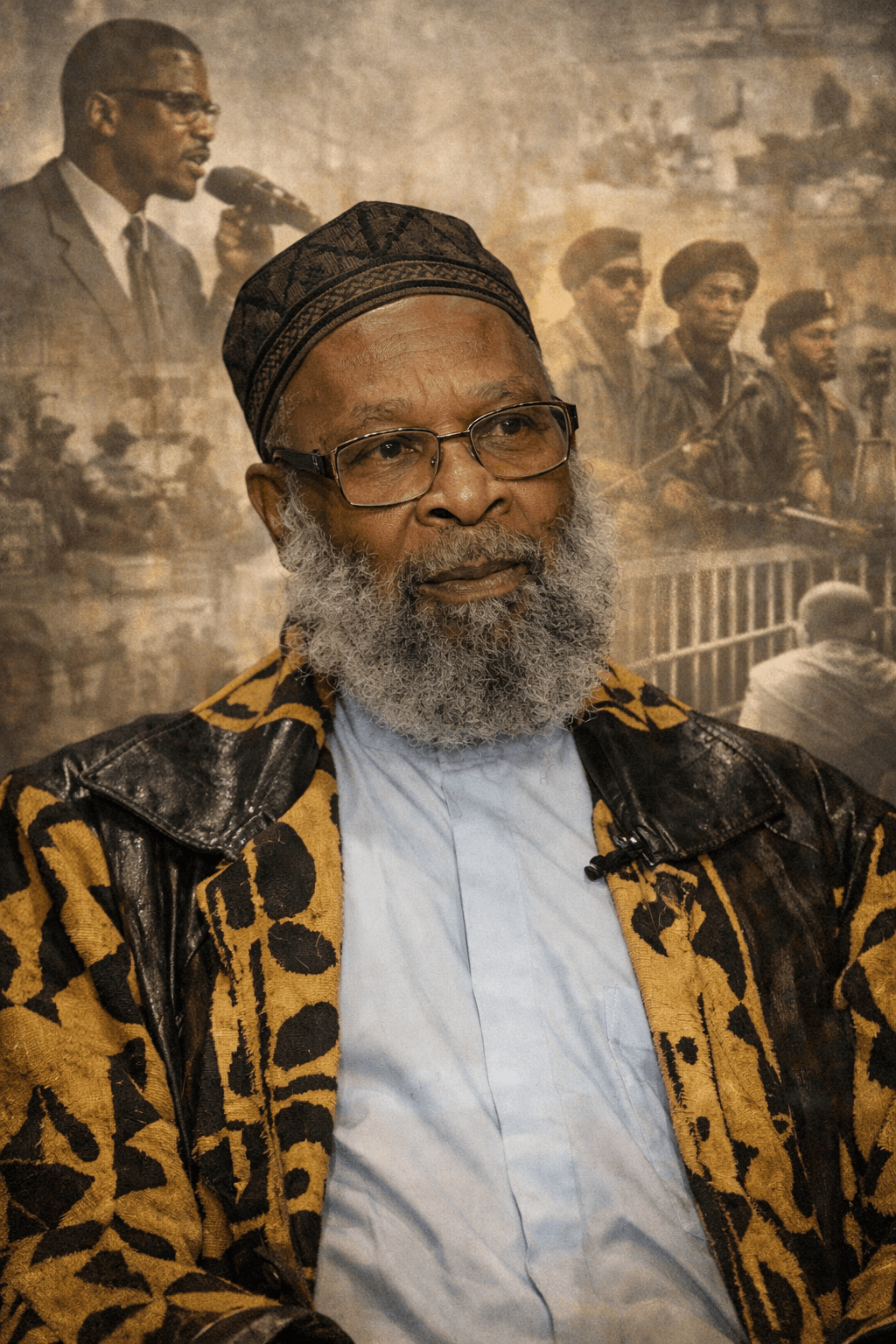
Jamaica, Queens forged a revolutionary in the shadow of Malcolm X. The Black Panther Party built dual power — and the state answered with disruption. Underground struggle met federal conspiracy and thirty-three years of captivity. Elderhood returned him to a new generation still facing the same empire.
By Prince Kapone | Weaponized Information | Black History Matters Series | February 16, 2026
Jamaica, Queens: Before the Party, Before the Legend
Sekou Odinga was born Nathaniel Burns on June 17, 1944, in Jamaica, Queens — not in the mythology of revolution, but in the concrete geography of postwar Black America. The war abroad had ended; the war at home had not. Queens was not Mississippi, but it was still the United States, which meant police occupation, racial containment, economic ceilings, and schools that prepared Black youth for discipline more than for destiny. The American Dream, like so many of its exports, was unevenly distributed.
Sekou did not enter politics through textbooks or polite debate societies. He entered through contradiction. As a young man, he spent time incarcerated as a “youthful offender.” That experience, which the state records as delinquency, he later understood as political education by other means. Prison has long functioned in the United States as a sorting mechanism for the surplus population of the internal colony. For some, it is a warehouse. For others, it becomes a classroom. For Sekou, it became the first site where he saw clearly that the law was not neutral terrain but an instrument, unevenly applied and historically aligned.
It was in this period that he encountered Lumumba Shakur and the political guidance of Abba Shakur. These were not casual acquaintances; they were organizers, teachers, and living examples of disciplined Black nationalist formation. The name change from Nathaniel Burns to Sekou Odinga was not cosmetic. It was a declaration that identity in a settler empire is not simply inherited; it is chosen, forged, aligned. In taking the name Odinga, he tethered himself to a broader African political horizon, signaling that his struggle would not be provincial. In a country that demanded assimilation, he chose alignment with anti-colonial memory.
The mid-1960s were years of ideological turbulence. Malcolm X had broken from the Nation of Islam and was expanding the terrain of Black struggle beyond the narrow confines of religious nationalism toward international anti-imperialism. For young militants in New York, Malcolm’s evolution was not abstract theory; it was a roadmap. Sekou absorbed not only Malcolm’s critique of white supremacy, but also his insistence that the condition of Black people in the United States could not be understood outside the global architecture of empire. The internal colony was linked to the colonial world.
Cultural nationalism, with its emphasis on pride and reclamation, provided an entry point. But pride alone does not dismantle structures. Sekou would later reflect that symbolism without organization becomes theater. What he and others sought was not merely a new aesthetic but a new apparatus — a vehicle capable of confronting police terror, economic abandonment, and the everyday humiliations of occupation. The question was not who we are, but how we fight.
Jamaica, Queens in the 1960s was not yet the epicenter of an armed underground. It was a neighborhood of working people navigating a tightening vise: deindustrialization beginning to hollow out opportunity, police repression intensifying under the banner of “law and order,” and political elites offering reforms calibrated carefully enough not to disturb the foundations of property and power. In this environment, young Black men were told to be patient. History, however, was not patient.
Sekou’s early formation reveals something essential about revolutionary development: it is not spontaneous combustion. It is accumulation. It is the slow sediment of lived contradiction, sharpened by study, disciplined by elders, clarified by global events. Ghana’s independence, Algeria’s war of liberation, Cuba’s defiance, Vietnam’s resistance — these were not distant headlines. They were proof that empire could be challenged. In a world where colonized people were winning, it became harder to accept permanent subordination at home.
By the time the Black Panther Party arrived in New York in 1968, Sekou was already politically ripened. He did not stumble into the movement; he moved toward it. The Panthers represented something that cultural nationalism alone could not: structure, program, discipline, and a direct confrontation with state power. But that belongs to the next chapter. Before the Party, there was formation. Before the underground, there was study. Before the legend, there was a young man in Queens deciding that the world as given was intolerable.
Sekou Odinga’s life would eventually span insurgency, clandestine struggle, three decades of imprisonment, release, and elderhood — and it would close in January 2024, when he joined the ancestors at age seventy-nine. But the foundation of that arc was laid here: in Jamaica, Queens, where the empire met a young man who refused to internalize its verdict. History would move, and he would move with it.
Harlem, 1968: When Community Defense Became Organization
By 1968, the question facing young Black militants in New York was no longer whether racism existed. That debate had already been settled in blood. The question was organizational: how do you confront a state that polices your neighborhoods like occupied territory while presenting itself to the world as the guardian of democracy? For Sekou Odinga, the answer emerged in Harlem, where the Black Panther Party established its New York chapter amid the aftershocks of Malcolm X’s assassination and the rebellions that followed the murder of Dr. King.
The Panthers did not enter Harlem as abstract theorists. They entered with a program — free breakfast for children, health clinics, political education classes, tenant organizing, armed patrols monitoring police conduct. The brilliance of the Party was not theatrical militancy, as the media preferred to portray it. It was structural intervention. It identified the points where the state had withdrawn — food, healthcare, legal protection — and moved in to build parallel institutions. This was not charity. It was embryonic dual power.
Sekou quickly emerged as a disciplined cadre within this apparatus. Harlem in 1968 was not a romantic revolutionary playground; it was saturated with surveillance. Police harassment was constant. Informants circulated. Federal agents were already embedding themselves inside organizations deemed threatening. The Panthers understood that their work unfolded under the eye of an empire recalibrating its domestic counterinsurgency strategy. COINTELPRO was not rumor. It was policy.
In this environment, Sekou’s organizing extended beyond public programs into security work — protecting offices, safeguarding leadership, ensuring that meetings were not casually penetrated. Security, in this context, was not paranoia. It was historical memory. Fred Hampton would be assassinated in 1969. Panther offices across the country were raided with militarized force. New York was no exception. The Party’s survival required vigilance.
But Harlem was not only a site of repression; it was also a site of ideological struggle. The Panthers in New York wrestled with internal contradictions — debates over nationalism versus Marxism, community control versus armed confrontation, local survival programs versus international alignment. Sekou absorbed these tensions not as distractions, but as necessary clarifications. Revolutionary politics is not a straight line. It is forged through debate sharpened by pressure.
The state, for its part, did not respond to the Panthers as it would to a civic association. It responded as if confronted by insurgency. Raids intensified. Arrests multiplied. Conspiracy charges ballooned into spectacles. The Panther 21 case in New York revealed how elastic the criminal code could become when applied to Black radicals. Charges of fantastical bombing plots collapsed under scrutiny, but not before defendants lost years of their lives in courtrooms and cages. The aim was exhaustion.
It is within this tightening vise that Sekou and others began confronting a strategic dilemma. Could open organizing survive a state that had already declared it subversive? Could community programs endure when offices were raided and leaders imprisoned? The Panthers’ brilliance lay in their public visibility. That same visibility made them targets. The contradiction was structural: dual power invites counterpower.
Sekou’s reflections in later years make clear that this period was formative. The Party revealed both possibility and limit. It demonstrated that Black communities could organize their own institutions and command mass respect. It also demonstrated that the U.S. state would deploy overwhelming force to prevent that consolidation. For some, the lesson was to moderate. For others, including Sekou, the lesson was to recalibrate.
Harlem in 1968 was therefore not merely a chapter in Panther history. It was a crucible. It forced militants to confront the material question of power: what happens when reform stalls, when surveillance becomes constant, when courts function as extensions of counterintelligence? Sekou Odinga did not romanticize the answer. He lived it. The next phase of his life would move from visible organization to clandestine formation — not out of fantasy, but out of assessment.
The empire had shown its hand. The Panthers had shown their capacity. The contradiction was escalating. History was pressing militants to choose how to respond when community defense becomes, in the eyes of the state, a declaration of war.
1969: Indictment as Strategy — When Organization Became a Target
If 1968 in Harlem clarified the power of disciplined organization, 1969 clarified the cost. Sekou Odinga’s recollections from this period are not nostalgic; they are precise. He situates the escalation not as surprise, but as pattern. January 17, 1969: Bunchy Carter assassinated in Los Angeles. April 2, 1969: the Panther 21 indicted in New York. The sequence, in his telling, was not coincidence. It was compression. Leadership targeted. Infrastructure disrupted. Momentum interrupted.
The Panther 21 case was not simply a legal proceeding; it was a strategic maneuver. Sekou describes it plainly: the purpose was disruption. Twenty-one members of the New York chapter were charged in a sweeping conspiracy alleging plans to bomb department stores, police stations, public landmarks. The spectacle mattered more than the evidence. Bail was set so high that most could not afford release. Organizers who had been running breakfast programs and tenant defense campaigns were suddenly locked in cells, isolated from community, drained of resources.
Sekou’s anecdote about the drainpipe escape attempt captures both the improvisation and the pressure of the moment. It is not told as bravado. It is told as illustration of how quickly normal political work can be forced into survival mode. When offices are raided and leaders indicted en masse, the terrain shifts. You are no longer debating policy. You are calculating endurance.
The legal defense itself became a battlefield. Trials dragged on. Attorneys required funding. Families scrambled to raise money. Community programs suffered as energy diverted to courtroom survival. Even when charges collapsed — and in the Panther 21 case, after the longest criminal trial in New York history at that time, all were acquitted — the damage had already been done. Months in jail. Years of strain. Organizational momentum slowed. Disruption achieved.
Sekou’s framing is instructive. He does not describe repression as random hostility. He describes it as structural logic. The Panthers had demonstrated capacity to build disciplined institutions embedded in community need. They had shown that Black neighborhoods could feed themselves, test for sickle-cell anemia, defend tenants, and monitor police without waiting for state permission. That example was intolerable. The indictment was therefore not a reaction to specific acts; it was preemptive containment of capacity.
COINTELPRO documentation later confirmed what militants already understood. The goal was to “neutralize” leadership, prevent the consolidation of a Black revolutionary apparatus, and sow distrust internally. But Sekou did not require declassified files to recognize the pattern. He was living it. When twenty-one key organizers are removed simultaneously, when bail is weaponized, when headlines precede verdicts, the message is clear: organization itself is being prosecuted.
1969 thus marks a turning point in Sekou’s political education. The Panthers had been, in his words, a “better vehicle” — disciplined, structured, capable. The state’s response demonstrated that open revolutionary organizing in a settler empire would be met with counterinsurgency. The contradiction sharpened: how do you sustain mass work when your entire leadership can be legally immobilized overnight?
The answer did not arrive immediately. It emerged from accumulation. Repeated raids. Repeated indictments. Repeated assassinations across the country. Sekou’s recollections from this period are devoid of melodrama. They are analytical. The Panther 21 case taught him that repression was not episodic; it was policy. It was not about guilt or innocence; it was about interruption.
If 1968 revealed the possibility of dual power, 1969 revealed the architecture deployed to crush it. Organization had become a target. Leadership had become a liability. The terrain was narrowing. And in narrowing, it was forcing a strategic question that would define the next phase of Sekou Odinga’s life.
Algiers: When Harlem Met the Third World
If 1969 revealed the architecture of repression inside the United States, the early 1970s revealed something else: that the struggle in Harlem was not isolated. It was entangled. Sekou Odinga’s movement into the international section of the Black Panther Party was not an escape from the fight — it was an expansion of its geography. In his own recounting, Algiers was not exile. It was convergence.
After repression intensified in the United States, Panthers established an international section in Algeria — a country freshly emerged from a brutal anti-colonial war against France. The Algerian government, itself forged in armed struggle, offered political recognition and material support. Sekou describes arriving in a space where liberation movements from across Africa, Asia, and Latin America intersected openly. The Panthers were not a curiosity there. They were understood as comrades.
In Algiers, Harlem’s local struggle was reframed as part of a global anti-imperialist current. Sekou details relationships with the PLO, MPLA, FRELIMO, the ANC, and delegations connected to North Korea and China. These were not symbolic gestures. They were strategic conversations. The lesson was clear: U.S. imperial power was not simply domestic police violence — it was planetary structure. To fight it locally required understanding its international reach.
Sekou recalls the sentiment expressed repeatedly by liberation movements abroad: “If you get them off your back, we get them off ours.” The United States functioned as a stabilizing force for colonial regimes worldwide. Its military aid, diplomatic shielding, and intelligence coordination sustained oppression beyond its borders. Therefore, Black liberation inside the U.S. was not merely civil rights agitation; it was a destabilizing pressure point in the global order.
Algeria, in this moment, functioned as a kind of revolutionary crossroads. Liberation movements maintained offices. Intelligence was exchanged. Delegations traveled. Strategies were compared. Sekou’s testimony underscores that the Panthers did not enter this space naïvely. They entered it already convinced that the Black condition in the United States bore the marks of internal colonialism. In Algiers, that thesis encountered confirmation.
What shifts here is not rhetoric but scale. The fight against police brutality in the Bronx is suddenly contextualized alongside anti-colonial insurgencies in Mozambique, Palestine, and Angola. The same empire that sent tactical units into Harlem was underwriting apartheid in South Africa and occupation in Palestine. The connections were not abstract; they were logistical.
Sekou does not romanticize this period. He does not describe it as a utopian revolutionary summit. He describes it as serious work. Building alliances. Establishing communication channels. Understanding that solidarity required more than slogans. It required material commitment and strategic clarity.
This phase of his life also reveals something often erased in simplified Panther narratives: the movement was never purely domestic. Its horizon was international from the beginning. Malcolm X had already pointed toward this direction — reframing the Black struggle as a human rights issue before the United Nations. In Algiers, that orientation was no longer theoretical. It was operational.
The international section did not dissolve repression at home. It did, however, alter perspective. Harlem was no longer a local site of grievance. It was a node within a larger insurgent map. Sekou’s political formation deepened accordingly. He was not merely fighting a police department. He was confronting an empire.
The question that would soon arise was how to translate that global clarity back into the tightening domestic terrain. The empire was studying the Panthers. Counterinsurgency was evolving. The open phase of revolutionary organizing was narrowing. Algiers illuminated the stakes — but the return to U.S. soil would demand a different posture.
From Open Programs to Clandestine Defense: When Repression Redefined the Terrain
By the early 1970s, the contradiction had hardened. Open organizing had been met not simply with surveillance, but with coordinated counterinsurgency. Assassinations, grand jury indictments, fabricated conspiracy cases, internal sabotage — the pattern was no longer episodic. It was systematic. Sekou Odinga’s own language is careful here. He does not speak of rupture; he speaks of consequence. “The BLA was a consequence.” That is the phrase that frames this transition.
The Black Panther Party had functioned above ground — breakfast programs, health clinics, eviction defense, political education classes, tenant organizing. But the state’s response was calibrated to disrupt precisely that infrastructure. Leadership was neutralized through incarceration. Offices were raided. Chapters fractured under pressure. The question that emerged was not abstract: how does a movement defend itself under sustained siege?
The answer, for Sekou and others, was not romantic insurrection. It was strategic adaptation. If above-ground organizing could be legally paralyzed overnight, then certain functions would have to move underground. The Black Liberation Army was not conceived as a substitute for mass organizing. It was conceived as a defensive arm — clandestine, cellular, insulated from immediate disruption.
Sekou’s framing rejects the simplified mythology of an East Coast versus West Coast split. He situates the conflict in ideological terms: reform versus abolition, electoral accommodation versus revolutionary transformation. As elements within the broader Panther structure began orienting toward municipal politics and institutional participation, others insisted that the structural conditions of Black life in America constituted a colonial occupation. One does not vote an occupation away.
The underground turn therefore reflected an abolitionist orientation. It was not about symbolic violence; it was about consequence. Sekou and his comrades argued that armed agents of the state operated in Black communities without accountability because there was no reciprocal pressure. The analogy often invoked was the Underground Railroad — a network developed under illegality because legality itself upheld enslavement. When law codifies domination, evasion becomes necessity.
The organizational structure shifted accordingly. Cell formations, compartmentalization, operational discretion — these were not stylistic choices. They were countermeasures against infiltration and surveillance. COINTELPRO had already demonstrated its capacity to penetrate open organizations. To survive, insulation became essential.
Sekou consistently underscores that this underground orientation remained embedded within community. The popular caricature of the BLA as detached militants ignores the infrastructure that sustained it. Housing, food, logistical support — these did not materialize from abstraction. They emerged from relationships built during years of above-ground organizing. “Urban guerrillas swim in the sea of the people,” as revolutionary doctrine phrases it. That sea, in Sekou’s account, was real.
It is important here not to romanticize or sanitize. The underground period was defined by high stakes. The cost of error was death or decades in prison. The state escalated as well. Tactical units expanded. Federal coordination intensified. The terrain became lethal. Sekou does not narrate this shift as triumphalism; he narrates it as tightening compression.
What remains consistent is the political logic. The turn underground was not a deviation from mass politics; it was, in their analysis, a necessary layer within it. Abolition of colonial policing required more than protest. It required structural disruption. The BLA, in Sekou’s words and actions, emerged as the clandestine articulation of that argument.
The empire, however, does not tolerate counter-power indefinitely. By the early 1980s, the machinery of prosecution was poised to respond. The underground could evade for a time. It could not remain invisible forever.
October 23, 1981: Capture, RICO, and the Theater of “Conspiracy”
Every insurgent life under empire eventually confronts a reckoning. For Sekou Odinga, that reckoning arrived on October 23, 1981. By then, the underground phase of struggle had already been compressed by escalating federal coordination. Tactical units had expanded. Surveillance networks had matured. Informants had been cultivated. The state had refined its prosecutorial tools. What COINTELPRO began in the 1960s would be formalized through federal conspiracy architecture in the 1980s.
The raid that led to Sekou’s capture was not a routine arrest. It was an armed operation. Zayd Malik Shakur — one of his comrades — was killed during the confrontation. Sekou himself was wounded and taken into custody. The symbolism was unmistakable: this was not treated as a criminal apprehension. It was treated as counterinsurgency theater.
The prosecution that followed reveals the state’s adaptive logic. Charges were assembled not merely around specific acts but through expansive conspiracy framing. RICO statutes — originally designed to combat organized crime — were deployed to aggregate activities into a single narrative of coordinated insurgency. Allegations tied Sekou to the 1979 liberation of Assata Shakur and to the 1981 Brink’s expropriation case. The architecture of prosecution allowed the state to narrate decades of militant activity as one seamless criminal enterprise.
Sekou’s own framing during sentencing was unambiguous. He did not accept the identity of “criminal.” He identified as a prisoner of war. That language was not rhetorical flourish; it reflected his analysis that the relationship between Black communities and the U.S. state constituted a colonial condition. Under that analysis, armed confrontation was not banditry. It was insurgency.
The court, of course, recognized no such framework. Federal sentencing in 1984 resulted in decades of incarceration. Conspiracy statutes allowed the state to impose punishment not merely for acts but for association. The spectacle of the trial — heavy security, press framing, prosecutorial rhetoric — reinforced the state’s narrative of internal enemy combatants.
Yet even here, the structural continuity is visible. The same logic that animated the Panther 21 indictment — disruption through legal overreach — was now codified through federal conspiracy doctrine. The underground period had narrowed tactical options; the state’s response was to criminalize the entire political horizon.
It is essential to note that Sekou’s capture occurred during a broader transition in U.S. governance. The Reagan era formalized mass incarceration as national policy. Mandatory minimums expanded. Federal sentencing hardened. Political prisoner recognition was categorically denied. The empire refined its domestic containment strategy while intensifying neoliberal restructuring abroad. The architecture of prosecution mirrored the architecture of economic consolidation.
Sekou’s self-identification as a political prisoner, echoed in his later interviews, challenged the state’s narrative directly. The United States, he insisted, denied the existence of political prisoners while holding individuals whose offenses were inseparable from political struggle. The Mandela comparison he invoked was not sentimental; it was structural. Colonial states criminalize insurgents. They do not label them political.
The capture in 1981 did not conclude the arc of struggle. It transformed its location. The battlefield shifted from streets to cells. The next three decades would unfold behind walls — not as retreat, but as continuation under confinement.
Thirty-Three Years: Prison as Continuation of the War
When Sekou Odinga entered federal custody in 1981, the state assumed that time itself would accomplish what bullets and indictments could not: erasure. Three decades behind concrete and steel were meant to dissolve networks, dissolve memory, dissolve insurgent will. But if we listen to Sekou’s own words — especially in his later interviews — prison was never narrated as the end of struggle. It was narrated as relocation.
The United States insists it has no political prisoners. Sekou rejected that fiction consistently. He named names: Sundiata Acoli. Mutulu Shakur. Mumia Abu-Jamal. The Omaha Two. Others less known, less quoted, less circulated in activist iconography. He refused the celebrity logic that isolates one or two figures while leaving dozens in obscurity. “These are our Nelson Mandelas,” he would say — not as analogy but as indictment. The state that praised Mandela abroad criminalized his equivalents at home.
Prison, in Sekou’s framing, was not accidental punishment. It was an extension of counterinsurgency. If the open phase of struggle had been met with COINTELPRO and RICO, the long phase would be managed through warehousing. The 1980s and 1990s saw the consolidation of mass incarceration — entire communities turned into extraction zones for prison labor and surveillance regimes. Political militants were absorbed into that architecture, classified as “security risks,” rotated through high-control units, monitored for association.
And yet, even inside, the logic of organization persisted. Political education continued. Correspondence networks functioned. Ideas moved through letters, through visits, through disciplined study. Sekou did not emerge from prison ideologically softened. He emerged sharpened — not nostalgic, not mythologizing the 1960s, but insistent that each generation must study both the victories and the errors of those before them.
His insistence on collective memory was central. In interviews, he repeatedly redirected attention away from himself and toward comrades still incarcerated. He resisted the reduction of struggle to personal biography. “Support them,” he would say. “Write them.” The continuity of political prisoner consciousness mattered more to him than individual rehabilitation narratives.
The material conditions of those years cannot be romanticized. Decades in confinement erode bodies. They strain families. They age movements. But Sekou’s testimony suggests something deeper than endurance — a long war consciousness. He understood his imprisonment not as an anomaly but as predictable cost within a colonial confrontation. The empire does not reconcile with insurgents; it cages them.
By the time he was released in November 2014, the political landscape outside had shifted dramatically. The hashtag era had begun. Police killings were once again national headlines. New generations were organizing, often disconnected from the earlier insurgent memory. Sekou returned not as relic but as bridge — a living archive of strategy, contradiction, and continuity.
Thirty-three years in prison did not extinguish him. It relocated him. And when he walked out, he carried not only his own story, but the accumulated memory of a generation the state had attempted to bury.
November 25, 2014: Elderhood in the Age of Hashtags
When Sekou Odinga walked out of prison on November 25, 2014, he stepped into a world that looked radically different from the one he had left in 1981. The Cold War had ended. The Soviet Union was gone. The prison population had exploded. Social media had replaced newspapers as the primary organ of political communication. But one thing had not changed: Black communities were still confronting armed agents of the state.
Within weeks of his release, the United States was convulsing over the police killing of Michael Brown in Ferguson. Protestors were chanting new slogans. Organizing was happening through Twitter feeds and livestreams. And here stood a man who had spent three decades inside a prison system built precisely to neutralize the insurgent generation of the 1960s and 1970s.
Sekou did not respond with nostalgia. He did not dismiss the younger generation. In interviews, he made something very clear: each generation must study its history and then act in accordance with its own conditions. “You can’t take what was done in ’68 and just transport it to 2016,” he said. That line matters. It is neither romantic repetition nor liberal amnesia. It is dialectical instruction.
He urged young activists to examine both the successes and the mistakes of the previous era. The Panthers had built disciplined structures rooted in community need. They had also been vulnerable to infiltration and internal fracture. The underground had emerged as consequence — but it had come with immense cost. These were lessons, not legends.
At the same time, Sekou did not soften his analysis of empire. He remained firmly anti-imperialist. He rejected reformist illusions. He insisted that police violence was not aberration but structure. He challenged the language of “defund” when it obscured the deeper question of power. The state does not voluntarily dismantle its own instruments of force. History does not support that fantasy.
In community spaces, on panels, in interviews, Sekou functioned as what he had always been: a disciplined cadre. He redirected attention toward political prisoners. He reminded audiences that liberation was not an aesthetic. It was organization. He resisted the celebrity logic that isolates one individual as icon while neglecting the broader movement.
He also embodied something rare in American political culture: durability without bitterness. Thirty-three years inside had not produced spectacle or self-mythologizing. It had produced clarity. The struggle, he would say, did not begin with him and would not end with him. He stood on the shoulders of Nat Turner, Harriet Tubman, Malcolm X. Others would stand on his.
Elderhood, in this sense, was not retirement. It was transmission. Sekou became a living bridge between insurgent generations — from the drainpipes of Queens to the livestreams of the 2010s. He did not ask to be commemorated. He asked for continuity.
The question he left hanging for the present generation was simple and unsentimental: What will you build that cannot be disrupted overnight?
January 12, 2024: Joining His Ancestors, Leaving the Question Open
On January 12, 2024, Sekou Odinga joined his ancestors at the age of seventy-nine. There was no state funeral. No official recognition. No commemorative stamp. Empires do not canonize insurgents. They bury them quietly and hope memory dissipates. But memory, like struggle, is stubborn.
His life stretched across the long counterinsurgency — from the post-Malcolm radicalization of 1960s Queens, through the formation of the Black Panther Party in New York, through the international corridors of Algiers, through clandestine years underground, through capture and thirty-three years of imprisonment, and finally into elderhood in the age of hashtags and livestreams. Few lives hold that continuity without fracture.
Sekou did not present himself as hero. He insisted he was part of a movement. That insistence is the final lesson. The state isolates; movements collectivize. The state criminalizes individuals; history remembers formations. His name is inseparable from Lumumba Shakur, from Assata Shakur, from Sundiata Acoli, from Mutulu Shakur, from Zayd Malik Shakur, from dozens of comrades whose names never trended.
To situate Sekou historically is to recognize the durability of colonial management in the United States. The armed occupation of Black neighborhoods did not begin in 1968, and it did not end in 2024. Mass incarceration did not emerge accidentally; it matured from counterinsurgency. Surveillance technologies have grown more sophisticated, not less. The terrain changes. The structure persists.
But so does resistance. From Nat Turner to Harriet Tubman, from Malcolm X to the Panthers, from the underground to the prison yard, there is a through-line of refusal. Sekou located himself in that lineage explicitly. He did not ask to be mythologized; he asked to be understood within continuity.
His passing does not close a chapter. It sharpens a responsibility. What does it mean to build organizations that cannot be dismantled by indictment? What does it mean to root movements in community so deeply that repression cannot sever them? What does it mean to study history not as nostalgia but as strategic archive?
Sekou Odinga’s life offers no sentimental comfort. It offers evidence. Evidence that empire responds to organized Black power with force. Evidence that repression can be survived. Evidence that political clarity can endure decades of confinement. Evidence that elderhood can function as transmission rather than retreat.
He is now ancestor. The counterinsurgency remains. The question he leaves behind is not whether struggle continues. It is whether we are disciplined enough to continue it with the seriousness it demands.
 Weaponized Information
Leave a comment